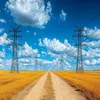
S7 Ep52: Is electricity a weak link in development?
In many cities in low-income countries, the grid fails often enough that businesses keep a diesel generator out the back. So an unreliable electricity grid looks like it is holding poor economies back. In many countries, lenders are putting money behind that idea.But Martin Shu and his co-authors, Jonathan Colmer and David Lagakos, set out to test it. They assembled data on power plants, fuel, workers and imported generators in 89 countries, and measured how productive each electricity sector was. In the poorest countries, electricity was about three-quarters as productive as in the US — in other words, much closer tot he frontier than their economies. And in the economic model they built using their data, bringing every country up to the world frontier adds only about 1% to long-run GDP.Shu presented the research at STEG's sixth Annual Conference in Nairobi in January 2026. He tells Tim Phillips where the productivity gap in electricity lies, why a shoe factory that is better at left shoes than right shoes explains the small gains, and which part of the economy is the real bottleneck.The research behind this episodeColmer, Jonathan, David Lagakos, and Martin Shu. 2026. "Is the Electricity Sector a Weak Link in Development?" Working paper, January 2026 version presented at the STEG Annual Conference, Nairobi. An earlier version appeared as NBER Working Paper 32041 (2024).To cite this episodePhillips, Tim, and Martin Shu. 2026. "Is electricity a weak link in development?" Conversations on Transformation (podcast).About the guestMartin Shu is Assistant Professor of Economics at the School of Management and Economics and the Shenzhen Finance Institute of the Chinese University of Hong Kong, Shenzhen. His research spans macroeconomics, development and labour economics, including what household and firm data reveal about structural transformation, and why children in poor countries are more likely to follow their parents into the same occupation. He holds a PhD in Economics from Boston University and bachelor's and master's degrees from the Hong Kong University of Science and Technology.Research cited in this episodeWeak links are sectors whose problems hold back the whole economy. When inputs are strong complements, output depends heavily on the least productive link in the chain, so a small sector can matter far more than its size suggests. The idea draws on Albert Hirschman's The Strategy of Economic Development (1958), and Charles Jones formalised it in "Intermediate Goods and Weak Links in the Theory of Economic Development" (American Economic Journal: Macroeconomics, 2011), which uses electricity as a motivating example. Shu and his co-authors ask whether electricity fits that description in poor countries today.Total factor productivity (TFP) measures how much output an economy or a sector gets from its inputs. If two countries have the same capital and the same number of workers, but one produces more, it has higher TFP. Shu measures each country against the United States. The figures for whole economies come from the Penn World Table, hosted by the Groningen Growth and Development Centre and described by Robert Feenstra, Robert Inklaar and Marcel Timmer in "The Next Generation of the Penn World Table" (American Economic Review, 2015). The paper uses version 9.1; the current release, PWT 11.0, is supported by STEG.Agriculture's productivity gap is the comparison Shu uses to show why measuring TFP is not enough. Farming in poor countries is far less productive than the rest of the economy, as Francesco Caselli ("Accounting for Cross-Country Income Differences," Handbook of Economic Growth, 2005) and Diego Restuccia, Dennis Tao Yang and Xiaodong Zhu ("Agriculture and Aggregate Productivity: A Quantitative Cross-Country Analysis," Journal of Monetary Economics, 2008) document. Farmers are also the majority of workers in many developing countries. Yet few economists call agriculture a weak link. Whether a sector is a bottleneck depends on how it connects to the rest of the economy, and answering that needs a model as well as data.The electricity data combine several sources. Generating capacity comes from S&P Global Platts' World Electric Power Plants database, which lists more than 200,000 plants; the authors use generating capacity alone because it tracks transmission and distribution capacity closely. Power output and fuel use come from the International Energy Agency, and employment from national statistics of
Podzilla Summary coming soon
Sign up to get notified when the full AI-powered summary is ready.
Free forever for up to 3 podcasts. No credit card required.
Listen to This Episode
More from VoxDev Development Economics

S7 Ep57: Skipping the factory

S7 Ep56: Why democracy alone does not build effective states

Ideas in Development: Ken Opalo on the research Africa needs

S7 Ep55: Armed groups as states: Taxation, security, and civilian support
Get summaries like this every morning.
Free AI-powered recaps of VoxDev Development Economics and your other favorite podcasts, delivered to your inbox.
Free forever for up to 3 podcasts. No credit card required.