Free Daily Podcast Summary
Voiceover Casting Corner: Daily Summaries Delivered
by The Voicecaster
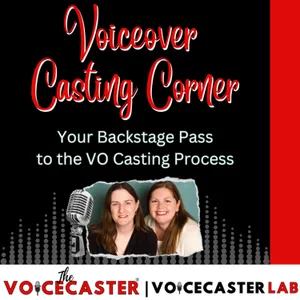
Join The Voicecaster's Head of Casting Kelly Moscinski and Senior Casting Director Kathryn Horan monthly for our LIVE podcast recording and Ask Us Anything!
Latest Episodes
The most recent episodes — sign up to get AI-powered summaries of each one.
- 1 weeks ago17 min
What Voiceover Conferences Really Give You - And What They Don't (Ep 50)
Kelly and Kathryn discuss voiceover conferences and some of the green and red flags associated with them.
- Aug 11, 202651 min
A chat with Aimee Gironimi (Ep 49)
Kelly Moscinski and Kathryn Horan sit down with voice actor Aimee Gironimi for a conversation about the road into VO, where the industry is headed, and what keeps her excited about the work. Aimee's path is anything but typical. Eight years as a stage actor and director for a regional children's theatre in the Midwest. Then grad school, followed by more than 20 years as a Leadership Development and Instructional Design practitioner. All of that experience shows up in the booth. She's SAG eligible, trained across TV promo, live announcing, in-show narration, film and TV trailers, commercials, eLearning, corporate narration, audiobooks, characters, video games, and animation. She's represented by agencies in Chicago, Milwaukee, and Boston, and she's a three-time Society of Voice Arts & Sciences nominee (Mobile App in 2022, TV Promo Demo in 2023, Audiobook Narration in 2024). Aimee also runs Wise Owl Productions LLC, a nationally certified LGBT Business Enterprise through NGLCC and a certified Disability-Owned Business Enterprise through Disability:IN. She brings a real passion for LGBTQ+ and social justice projects to the work she takes on. Connect with Aimee: 🌐 modvoiceover.com More from The Voicecaster: 🎬 Casting and workshops: voicecaster.com 🎓 On-demand courses: voicecasterlab.com
- Jul 28, 202619 min
Breaking Your Plateau Rut (Ep 48)
Every voice actor hits a plateau eventually. Kelly Moscinski and Kathryn Horan break down why it happens, how to tell the difference between being busy and making progress, and what to do when the thing that used to work stops working.
- Jul 7, 202617 min
Green Flags (Ep 47)
Kelly & Kathryn discuss green flags they look out for during their casting.
- Jun 9, 202615 min
There’s No “Right” Path: Understanding Union vs. Non-Union
Kelly Moscinski and Kathryn Horan of The Voice Caster discuss union versus non-union voiceover work and when to consider joining SAG-AFTRA, emphasizing it’s a personal decision based on career timing, goals, and sustainability rather than status. They compare union benefits—set rates, standardized protections, residuals, and potential health insurance and pension—against non-union’s flexibility, variable pay, and fewer built-in safeguards, noting industry shifts toward more non-union casting (now about 80% non-union). They explain the Taft-Hartley process and “must join” status, trade-offs of joining (no non-union work, fewer auditions, higher competition), and alternatives like Financial Core (Fi-Core) and right-to-work states. They also recommend NAVA membership as an insurance option, stressing long-term planning and doing what works for individual needs.
- May 26, 202620 min
Rates and Contracts (VCC Ep 45)
Episode Summary In this episode, Kelly and Kathryn tackle one of the most critical — and often overlooked — aspects of a voice acting career: understanding contracts and rates. They break down the difference between session fees and usage, explain how to determine fair rates for different media types, walk through what every contract should include, and flag the warning signs that could cost you dearly. They also address the growing importance of AI voice protections and how to safeguard your voice in the current landscape. Topics Covered Session Fee vs. Usage Fee — Why you should only count on the session fee until the spot actually airs What Determines Your Rate — Why per-word/per-minute pricing is misleading, and how media type (TV, cable, national, streaming, digital, radio) drives the real rate The GVAA Rate Guide — How to use it as a baseline and negotiation tool Contracts 101 — What should always be spelled out: session length, usage, term length, exclusivity, and renewals In Perpetuity Clauses — When to avoid them and when they may be acceptable "All Media" Language — Why vague bundling of rights hurts voice actors and how to push back Image & Likeness Clauses — Why these often don't belong in voiceover contracts AI & Voice Replication — How to spot dangerous contract language and how to protect yourself The NAVA AI Rider — A free, downloadable resource for all voice actors The No Fakes Act — Why this legislation matters for everyone, not just voice actors Red Flags to Watch For — Rushed signings, overly broad language, suspiciously high buyouts, and more Advocacy & Negotiation — Why asking questions is your right, and how to push for specificity in every contract Resources Mentioned GVAA Rate Guide — gvaa.us/rate-guide — Industry-standard rate ranges for all voiceover categories NAVA (National Association of Voice Actors) — navavoices.org — Includes a free AI Rider available in English and Spanish The No Fakes Act — Federal legislation advocating for voice and likeness protections; contact your representatives to show support Key Takeaways Never expect to be paid the full session + usage amount until the project airs and is confirmed. The type and breadth of media use — not word count or minute length — determines your rate. Use the GVAA Rate Guide as a baseline, not a rule book. Negotiate from there. Every contract should clearly define: session length, usage, term, exclusivity, and renewal terms. Avoid "in perpetuity" clauses on commercial work unless AI protections are signed off on. Push back on "all media" language — make clients specify exactly what they need. Add the NAVA AI Rider to any project involving voice recordings. Asking questions is not confrontation — it's good business. Booking the job is step one. Protecting your voice is step two. Connect with The Voicecaster Follow @TheVoicecaster on social media | New episodes every 2nd and 4th Tuesday of the month
- May 12, 202612 min
Casting Wants You to Win (VCC Ep 44)
Voice Over Casting Corner – Episode 44: Casting Wants You to Win In this episode, Kelly Moscinski and Kathryn Horan from The Voicecaster tackle one of the biggest misconceptions in the voiceover world: that casting directors are working against you. Spoiler — they're not. They're rooting for you every time they open your audition. What we cover: The "us vs. them" myth – Why actors feel like casting is against them, and why that couldn't be further from the truth Silence isn't rejection – With 500–1,000 submissions per project, why casting can't respond to every audition — and what that silence actually means When you win, we win – How booking actors makes casting directors look good to their clients, creating a true win-win relationship The long game – Why casting and agents keep submitting actors who haven't booked in a year or more, and why consistency matters more than individual bookings Submit and release – The mindset shift that can transform how you approach every audition Auditions as opportunities – Reframing the competitive mindset into one of possibility Key takeaways: Not booking doesn't mean anyone disliked your audition — it just means you weren't the right fit for that specific project Clients do remember voices they've loved over years, and that persistence pays off Consistency is what casting directors notice and remember most Focus on your connection to the script, trust your instincts, and let go of expectations for feedback About The Voicecaster: The country's first and oldest voiceover casting house, established in 1975. Casting thousands of voices every year across all genres. Stay connected: Subscribe so you never miss an episode (new episodes every 2nd and 4th Tuesday) Follow @TheVoicecaster on social media Check out past episodes, workshops, seminars, and the Insiders Membership
- Apr 28, 202651 min
Booked Together: The Power of Actor & Agent Collaboration (VCC Ep 43)
About Voiceover Casting Corner
Join The Voicecaster's Head of Casting Kelly Moscinski and Senior Casting Director Kathryn Horan monthly for our LIVE podcast recording and Ask Us Anything!
Customized Recaps
AI-powered recaps with compact key takeaways, quotes, and insights.
Straight to Your Inbox
Get key takeaways from Voiceover Casting Corner in a 5-minute read.
Save Hours Every Week
Stay current on your favorite podcasts without falling behind.
Frequently Asked Questions
What is Podzilla's Voiceover Casting Corner daily summary?
It's a free AI-powered email that summarizes new episodes of Voiceover Casting Corner as soon as they're published. You get the key takeaways, notable quotes, and links & mentions — all in a quick read.
How does the Voiceover Casting Corner podcast summary work?
When a new episode drops, our AI transcribes and analyzes it, then generates a personalized summary tailored to your interests and profession. It's delivered to your inbox every morning.
Is this an official Voiceover Casting Corner product?
No. Podzilla is an independent service that summarizes publicly available podcast content. We're not affiliated with or endorsed by The Voicecaster.
Can I get summaries of other podcasts too?
Absolutely! The free plan covers up to 3 podcasts. Upgrade to Pro for 15, or Premium for 50. Browse our full catalog at /podcasts.
How often does Voiceover Casting Corner release new episodes?
Voiceover Casting Corner publishes biweekly. Our AI generates a summary within hours of each new episode.
What topics does Voiceover Casting Corner cover?
Voiceover Casting Corner covers topics including Leisure, Education, Arts, Performing Arts. Our AI identifies the specific themes in each episode and highlights what matters most to you.
Start getting Voiceover Casting Corner summaries tomorrow morning.
Free forever for up to 3 podcasts. No credit card required.
Free forever for up to 3 podcasts. No credit card required.