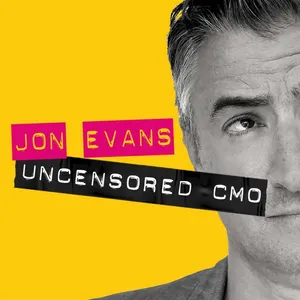
Free Daily Podcast Summary
Uncensored CMO: Daily Summaries Delivered
by Jon Evans
The Uncensored CMO was created to explore the good, the bad and quite frankly downright ugly truth about marketing theory & practice.
Latest Episodes
The most recent episodes — sign up to get AI-powered summaries of each one.
- 5 days ago49 min
How to build a disruptive brand and win over the CFO - Vineet Mehra, Chime
What happens when a CMO brings the discipline of P&G, private equity and fintech together?Vineet Mehra, CMO of Chime, joins Jon to explain how the challenger bank has disrupted one of the most established industries in the world - and why modern marketing leaders need to become more fluent in the language of commercial value.Vineet shares what marketers can learn from private equity, how to position investment with a CFO, and the financial metrics he watches most closely. He also unpacks the constant balancing act between long-term brand building and short-term performance: not treating them as opposing forces, but connecting both to sustainable growth. They also discuss where AI is genuinely creating return, how marketers can avoid becoming commoditised, and the skills CMOs will need as AI reshapes the profession.Timestamps00:00 - Start01:21 - Vineet’s background at P&G04:51 - What marketers can learn from working in Private Equity07:50 - What is Chime Bank?09:02 - The strategies that Chime used to disrupt the banking industry13:46 - Advice on how to position marketing to the CFO17:00 - What financial metrics is Vineet most focused on?19:40 - How Vineet combines long term and short term marketing23:59 - Are we in a golden age for marketing?26:59 - How Vineet is getting the biggest return on his AI investment31:13 - How to stop AI commoditising marketers36:09 - What skills will a CMO need in an AI-first future38:58 - How to see AI as an opportunity not a threat40:13 - Why Vineet is on the Effie’s board42:15 - Why Vineet spends time building his personal brand on LinkedIn46:00 - What’s the bst advice Vineet has ever received? ---Thank you to our sponsors System1 and HubSpotDownload System1's creator effectiveness report here:https://system1group.com/the-creator-effectiveness-playbookFind about more about HubSpot's AEO product here:https://www.hubspot.com/products/aeo
- 1 weeks ago47 min
What every Marketer needs to know about the future of search - Google’s Sophie Neary
AI is rapidly changing how people search, shop and discover new brands. So what does that mean for marketers?Sophie Neary has spent the past few years inside Google, giving her a front-row seat to some of the biggest shifts in consumer behaviour and advertising. In this episode, she joins Jon to explore what she's learned, the assumptions marketers still get wrong about Google, and the surprising ways consumers are already using AI.They discuss how brands can show up in AI-powered search, the evolving relationship between advertisers and creators, how to make the most of the crucial golden quarter, and what AI commerce could mean for the future of shopping.Plus, as AI becomes capable of doing more of the work, Sophie and Jon ask a bigger question: which uniquely human skills will become even more valuable to marketers?This episode is an advertisement feature brought to you by Google.Timestamps00:00 - Start01:12 - What has Sophie learned in the past few years at Google?03:07 - CMO lessons from being inside Google05:11 - What assumption marketers have about Google would Sophie challenge08:07 - A surprising consumer pattern with AI11:17 - How brands can show up in AI searches18:56 - How advertisers can collaborate with creators?22:09 - How Sophie uses her Google Fitbit Air24:18 - How to optimise the golden quarter28:08 - How important will AI commerce be in the future?30:36 - get them to check this section34:01 - The most uncensored question for Sophie Neary37:44 - Where will human skills count in the age of AI?45:26 - The best advice Sophie has ever been given ---Thank you to our sponsors System1 and HubSpotDownload System1's creator effectiveness report here:https://system1group.com/the-creator-effectiveness-playbookFind about more about HubSpot's AEO product here:https://www.hubspot.com/products/aeo
- 2 weeks ago1h 2m
Why uncertainty creates better marketing & what AI will never replace - Dr Margaret Heffernan
Dr Margaret Heffernan is one of the world's leading thinkers on uncertainty, leadership and creativity. A bestselling author, entrepreneur and former CEO, her latest book, Embracing Uncertainty, challenges one of the biggest assumptions in business that the future can, and should, be predicted.In this episode, Margaret explains why forecasting often fails, where great ideas really come from, and why spending more time with uncertainty can actually make us better leaders and marketers. We discuss the dangers of relying too heavily on data, the surprising habits of highly creative people, and why walking might be one of the best things you can do for your thinking.Timestamps00:00 - Trailer01:09 - Why pick uncertainty as a topic05:31 - Why some companies shouldn’t forecast09:04 - Why smart people are wasting time on forecasting14:41 - The problem with having too much data19:07 - Predictability only happens at scale24:41 - Where do ideas come from?27:19 - Why the Chief Economist of the Bank of England goes on walks30:29 - Are we becoming too left brain dominant?32:32 - The problem with AI36:10 - Is AI killing our ability to think?41:17 - How to make good ideas happen44:11 - The power of surprise46:15 - The improvisers paradox49:31 - The correlation between the artists mind and the entrepreneur’s mind51:57 - What human skills do we need to survive?58:43 - The best advice Margaret has ever been given ---Thank you to our sponsors System1 and HubSpotDownload System1's creator effectiveness report here:https://system1group.com/the-creator-effectiveness-playbookFind about more about HubSpot's AEO product here:https://www.hubspot.com/products/aeo
- 3 weeks ago45 min
How Heineken became creative brand of the year - Ali Payne
Ali Payne, CMO of Heineken, joins us to discuss how one of the world's most iconic beer brands became Creative Brand of the Year at Cannes Lions - and what it takes to keep a 150-year-old brand feeling fresh.From being the "Official Beer of Soccer" as a non-sponsor of the FIFA World Cup to reviving the legendary "Most Interesting Man in the World" campaign, Ali shares how Heineken balances long-term brand building with cultural relevance. We explore what it takes to get an entire organisation behind bold creative ideas, the role of sport in Heineken's marketing strategy, and how brands like Birra Moretti continue to grow through innovation.Timestamps00:00 - Trailer00:56 - World Cup fever for the USA and Heineken02:51 - Jumping on cultural moments04:25 - Becoming the official beer of soccer (unofficially)06:50 - How non sponsors got more coverage than sponsors for the World Cup10:18 - How to manage a 150 year old brand12:31 - Winning Cannes creative brand of the year14:46 - Getting the wider business on board with creative work17:06 - Ali’s favourite Cannes Lions winner18:38 - Bringing back Dos Equis most interesting man22:58 - The success of Birra Moretti24:49 - Heineken’s sports sponsorship strategy28:32 - How are Heineken bringing new people into the category29:56 - The ingredients for a successful innovation33:12 - Heineken’s partnership with Heinz37:08 - How great CMOs keep creativity alive40:11 - What makes a great CMO?41:58 - What’s the best advice you’ve ever recieved? ---Thank you to our sponsors System1 and HubSpotDownload System1's creator effectiveness report here:https://system1group.com/the-creator-effectiveness-playbookFind about more about HubSpot's AEO product here:https://www.hubspot.com/products/aeo
- Aug 19, 202655 min
Why AI should drive growth, not just efficiency – Najoh Tita-Reid
Najoh Tita-Reid, former Chief Growth Officer at Mars Petcare, joins us to discuss why she made the unusual decision to step away from one of the biggest roles in marketing to embark on a self-described "learning safari", immersing herself in the world of AI and exploring what it means for the future of business.In this conversation, Najoh shares why she believes too many organisations are using AI purely to drive efficiency, when its greatest opportunity lies in unlocking growth. We explore how AI is changing creativity, leadership and the role of the CMO, why marketers risk becoming tacticians instead of strategic business leaders, and what today's CEOs really expect from marketing.Timestamps00:00 - Start00:57 - Why Najoh left Mars02:18 - Why F1 is the perfect metaphor for AI in 202605:18 - Using AI for growth vs efficiency08:01 - The impact AI is having on creativity09:17 - Why AI is the colonisation of inefficiency16:21 - Are we at risk of becoming tacticians and not strategy leaders?18:52 - Does the CEO understand your role?22:40 - Can AI actually delivery higher efficiency?25:00 - What’s the secret to delivering growth28:24 - What having a different job title gives you permission to do33:11 - They key leadership skills for a great CMO34:02 - Why great CMOs are accountable for making change36:06 - Lessons from Najoh’s biggest failure40:01 - The difference between culture in the UK and USA44:09 - What Najoh has learnt on her learning safari49:47 - The best advice Najoh has ever been given ---Thank you to our sponsors System1 and HubSpotDownload System1's creator effectiveness report here:https://system1group.com/the-creator-effectiveness-playbookFind about more about HubSpot's AEO product here:https://www.hubspot.com/products/aeo
- Aug 12, 202654 min
How creativity transformed Australia’s No.1 Telecom’s brand - Brent Smart
Brent Smart is one of the most respected marketers in the world. After spending more than 20 years in advertising, he made the rare move from agency life to become CMO of NRMA Insurance. Brent's most recent role as CMO of Telstra, Australia's largest telecommunications company, he helped transform the brand through bold, distinctive and highly effective marketing.In this episode, Brent shares the principles behind his approach to creativity, from selling big ideas inside large organisations and drawing on academic marketing frameworks to building a culture where great work can thrive. We discuss the campaigns that defined his career, including Telstra's viral "Better on a Better Network" campaign, why humour and surprise remain powerful competitive advantages, and the unique agency model that helped Telstra consistently produce standout work.Timestamps00:00 - Start01:03 - Why Brent left Telstra02:31 - Why Brent moved in house after 20 years agency side05:41 - How to sell a creative idea into a big organisation11:01 - The academic frameworks to create great marketing12:16 - Why you should look at your brands heritage14:02 - The most successful campaign Brent did for NRMA17:33 - How Brent won a Grand Effie21:13 - How Brent transformed Telstra’s brand marketing26:08 - The Telstra Walk - the viral campaign32:39 - Using humour to cut through35:00 - The power of surprise and consistency37:41 - The unique agency model that helped Telstra create cuthrough work40:02 - Why craft is so important in 202642:44 - How to build a creative culture47:11 - How to be a great CMO ---Thank you to our sponsors System1 and HubSpotDownload System1's creator effectiveness report here:https://system1group.com/the-creator-effectiveness-playbookFind about more about HubSpot's AEO product here:https://www.hubspot.com/products/aeo
- Aug 5, 202648 min
Why this brand can't afford to be boring - Rebecca Darley, Vodafone Australia
Bec Darley, CMO of Vodafone Australia, joins us to discuss what it really takes to grow a challenger brand in one of the world's toughest telecoms markets.From competing against an entrenched duopoly to building distinctive campaigns with Ali Wong, Bec shares how Vodafone has embraced its challenger mindset rather than trying to imitate the market leaders. We explore why marketers need to understand far more than advertising, from unit economics and legal to customer experience and organisational change, and why the best marketing leaders are, ultimately, business leaders.Timestamps00:00 - Start00:54 - Who is Bec Darley?03:31 - Taking on roles beyond marketing to make you a better marketer05:38 - Why the history of duopolies in Australia makes being a challenger tough08:53 - How does Vodafone take on the giants as a challenger12:55 - Leaning into your disadvantage16:01 - Vodafone’s commercials with Ali Wong18:37 - The importance of legal for marketing21:08 - When taking risks backfires - getting banned24:19 - Focusing on mental availability26:40 - Are we losing the ability to be creative while hunting efficiency29:28 - Understanding the unit economics of the business34:28 - How to manage a portfolio of brands36:18 - Why you need to be customer first38:51 - The best marketers move beyond marketing40:24 - How to make change in a company43:46 - Embracing discomfort and failing fast46:23 - Bec’s advice to all young marketers ---Thank you to our sponsors System1 and HubSpotDownload System1's creator effectiveness report here:https://system1group.com/the-creator-effectiveness-playbookFind about more about HubSpot's AEO product here:https://www.hubspot.com/products/aeo
- Jul 29, 20261h 3m
20 years of challenger brand lessons with Auto & General CMO, Jonathan Kerr
Jonathan Kerr, CMO of Auto & General, joins us to explore how one of Australia's most successful challenger brands has built sustained growth by combining strong marketing fundamentals with relentless execution.From creating a role for himself at Auto & General to helping Budget Direct become one of the country's fastest-growing insurance brands, Jonathan shares why product should always come before growth, how marketers can take greater ownership of the 4 Ps, and what insurance consistently gets right about creativity. We also discuss the power of distinctive brand characters, audio branding, in-house creative teams and a media strategy designed to maximise long-term effectiveness.Useful linksThis episode is brought to you by System1. Download their creator effectiveness report here: https://system1group.com/the-creator-effectiveness-playbookFind about more about HubSpot's AEO product here:https://www.hubspot.com/products/aeoTimestamps00:00:00 - Start00:01:41 - How Jonathan found out about Auto and General00:03:31 - How Jonathan created a new role for himself00:06:58 - How to balance low price with great product00:10:36 - Market share growth for Budget Direct00:12:06 - Focusing on product over growth00:13:59 - How to control more of the P’s00:16:51 - Why does insurance produce such creative work?00:20:52 - The power of compounding work in insurance00:24:21 - Developing brand characters, and when to kill them off00:30:08 - The power of audio and jingles00:34:16 - What’s too silly to be said can be sung00:36:13 - Why they do so much work in house00:40:34 - Budget Direct’s unique approach to media buying00:42:43 - How Jonathan uses AI00:48:04 - The key challenger brand principles Jonathan has followed00:50:59 - What makes a successful CMO?00:52:55 - Do we need to re-educate ourselves on marketing theory?01:00:27 - The best advice you’ve ever recieved
About Uncensored CMO
The Uncensored CMO was created to explore the good, the bad and quite frankly downright ugly truth about marketing theory & practice.
Customized Recaps
AI-powered recaps with compact key takeaways, quotes, and insights.
Straight to Your Inbox
Get key takeaways from Uncensored CMO in a 5-minute read.
Save Hours Every Week
Stay current on your favorite podcasts without falling behind.
Frequently Asked Questions
What is Podzilla's Uncensored CMO daily summary?
It's a free AI-powered email that summarizes new episodes of Uncensored CMO as soon as they're published. You get the key takeaways, notable quotes, and links & mentions — all in a quick read.
How does the Uncensored CMO podcast summary work?
When a new episode drops, our AI transcribes and analyzes it, then generates a personalized summary tailored to your interests and profession. It's delivered to your inbox every morning.
Is this an official Uncensored CMO product?
No. Podzilla is an independent service that summarizes publicly available podcast content. We're not affiliated with or endorsed by Jon Evans.
Can I get summaries of other podcasts too?
Absolutely! The free plan covers up to 3 podcasts. Upgrade to Pro for 15, or Premium for 50. Browse our full catalog at /podcasts.
How often does Uncensored CMO release new episodes?
Uncensored CMO publishes weekly. Our AI generates a summary within hours of each new episode.
What topics does Uncensored CMO cover?
Uncensored CMO covers topics including Business, Marketing, Entrepreneurship. Our AI identifies the specific themes in each episode and highlights what matters most to you.
Start getting Uncensored CMO summaries tomorrow morning.
Free forever for up to 3 podcasts. No credit card required.
Free forever for up to 3 podcasts. No credit card required.