Free Daily Podcast Summary
Truce - History of the Christian Church: Daily Summaries Delivered
by Chris Staron
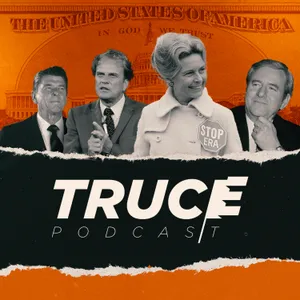
Truce explores the history of the evangelical church in America, from fundamentalism to pyramid schemes to political campaigns. Host Chris Staron uses journalistic tools to investigate how the church got here and how it can do better. The current season follows the rise of the Religious Right, examining the link between evangelicals and the Republican Party. Featuring special guests like Rick Perlstein, Frances Fitzgerald, Jesse Eisinger, Daniel K. Williams, and more.
Latest Episodes
The most recent episodes — sign up to get AI-powered summaries of each one.
- 6 days ago48 min
Kristin Kobes Du Mez: "Live, Laugh, Love"
Give to help Chris make Truce Kristin Kobes Du Mez is best known for her book Jesus and John Wayne, which looked at masculinity in American evangelicalism. Her new book, out now, does the same for femininity and positivity. Women today are often told to "live, laugh, love" and focus on the positive. They are to put mind over matter, even though that concept is not explicitly stated in the Bible. This attitude can make women susceptible to abusive relationships, scams, and multi-level marketing schemes. The book covers a wide swath of history, from Love Comes Softly to The Total Woman and the Little House books. Kristin and I had a lot of fun geeking out over history. I'm excited for you to hear it! Discussion Questions: What are some of the messages that women get in your type of Christianity? How do they differ from what men hear? What is Keswick Holiness? How did it inform the Pentecostal movement? What is New Thought? How do these ideas push people toward free-market capitalism? What about multi-level marketing? Learn more about your ad choices. Visit podcastchoices.com/adchoices
- 2 weeks ago45 min
200th Episode Celebration!
Give to help Chris make Truce Can you believe it? The Truce podcast has crossed the 200-episode mark! Actually, this is something like the 203rd episode... but we still need to celebrate! In this special bonus episode, Nick Staron joins Chris to answer listener questions like: What was the most difficult interview you've ever done? How do you decide how long a season should be? Which books have shaped your worldview? Have you ever considered doing a season on liberal Protestantism? and more! Thank you SO MUCH for your help in making this show. I really appreciate your prayers and that you're sharing this project with your friends. God willing, there will be a new episode in two weeks. Learn more about your ad choices. Visit podcastchoices.com/adchoices
- Aug 18, 202631 min
Rupublicans and Evangelicals | The Far Right's Plan to Takeover the GOP
Give to help Chris make Truce Richard Vigueries. What can be written about him? His nickname was "the founding father of the Religious Right". He founded RAVCO, which was a fundraising organization that raised money for... well, who didn't it raise money for? In his book, Takeover, Viguerie laid out a detailed plan of how the far right could take over the Republican Party. It is a fascinating book, one that may not have had an overwhelming impact, but the idea within the book has. In this special epsiode, Chris walks listeners through the book and the impact of the ideas inside. Sources: Takeover by Richard Viguerie Reaganland and Before the Storm by Rick Perlstein The Evangelicals by Frances Fitzgerald God's Own Party by Daniel K Williams Revive Us Again by Joel Carpenter These Truths by Jill LePore A Choice Not An Echo by Phyllis Schlafly The Lord's Prayer Discussion Questions: Who was Richard Viguerie? What are some of his grievances? Why do you think he skipped the Republican presidents of the 1920s in his history? What did he think of FDR? Of Robert Taft? How do you see the conservative wound in this book? What were some of Viguerie's prescribed tactics for taking over the GOP? Learn more about your ad choices. Visit podcastchoices.com/adchoices
- Aug 4, 202634 min
Republicans and Evangelicals | The War on Mark Hatfield
Give to help Chris make Truce Our season has spent a lot of time looking at how some evangelicals tied themselves to the GOP as the party became more conservative. But not every evangelical Republican was taken in by the conservative swing. In this episode, we're taking a look at Senator Mark Hatfield, an evangelical Republican who didn't follow the pack. Senator Mark Hatfield had a long and influential career in public service spanning nearly five decades. After serving in the U.S. Navy during World War II and earning degrees from Willamette University and Stanford University, Hatfield began his political journey in the Oregon Legislature, winning election to the Oregon House of Representatives in 1950 and then to the Oregon State Senate in 1954. He went on to become Oregon’s youngest Secretary of State at age 34 and was elected Governor of Oregon in 1958, where he served two terms and oversaw the expansion of the state’s infrastructure and environmental programs. In 1966, Hatfield was elected to the U.S. Senate, beginning a 30-year tenure that made him the longest-serving senator in Oregon’s history at the time. In the Senate, Hatfield was known as a moderate Republican who often put conscience ahead of party, particularly on issues of war and defense spending. Deeply shaped by his wartime experiences and Christian faith, he consistently opposed military authorization bills, including votes against the Vietnam War and the Persian Gulf War, and co-sponsored efforts like a nuclear freeze resolution. Hatfield twice chaired the powerful Senate Appropriations Committee, using that position to direct federal funds to Oregon for health, transportation, and research projects, and to support biomedical research at institutions like the National Institutes of Health. His independent approach earned him respect across party lines, and although the GOP shifted rightward over time, he remained a distinctive figure in national politics until his retirement in 1997. Sources: IMDB and Amazon reviews of the movie Bringing up Bobby Stand Alone or Go Home by Lon Fendall Transcript of the Keynote Address by Gov. Hatfield at G.O.P. Convention, NY Times, July 14, 1964 “CONVENTION ENDS; Extremism in Defense of Liberty ‘No Vice,’ Arizonan Asserts” New York Times, July 17, 1964 Before the Storm by Rick Perlstein With God on Our Side by William C Martin FBI files on Mark Hatfield from archive.org Conflict and Conscience by Mark O. Hatfield. Between A Rock and A Hard Place by Mark O Hatfield Nixonland by Rick Perlstein “When a Candidate Conspired With a Foreign Power to Win An Election” by John A Farrell. Politico website, August 6, 2017. H. R. 17123 “The Amendment to End the War” Bill Bright and Campus Crusade for Christ by John G Turner One Nation Under God by Rus Walton “Born Again Politics” New York Times by Gary Wills. August 1, 1976. Congressional record, February 28, 1978. Discussion Questions: How would you describe Hatfield's faith? How did Hatfield defy conservative Republican evangelicals? Why did Hatfield oppose the Vietnam War? Would you have the courage to do what Hatfield did? Learn more about your ad choices. Visit podcastchoices.com/adchoices
- Jul 21, 202631 min
Republicans and Evangelicals | Where the Gang Ended Up part 2
Give to help Chris make Truce Jimmy Swaggart was caught in a major controversy in the late 1980s. It involved the famous American televangelist, who was a leading figure in Pentecostal Christianity. In 1988, Swaggart publicly admitted to “moral failure” after reports surfaced that he had been involved with a prostitute, behavior that directly contradicted the strict moral standards he preached. The revelation led to his suspension by the Assemblies of God, his church denomination, and caused significant damage to his reputation and ministry. Swaggart delivered a widely televised, tearful confession, which became one of the most memorable moments in religious broadcasting, symbolizing broader concerns at the time about hypocrisy, accountability, and power among high-profile televangelists. This proved to be a problem for Pat Robertson, who was running for president. Just as he needed his conservative brothers and sisters on his side... they disappeared or chose another politician. When he lost the race, he continued his streak of being shelved by politicians. He and other evangelicals with large followings placed their hope in politicians to save them. Only to find disappointment. Sources: The Evangelicals by Frances Fitzgerald Reaganland by Rick Perlstein Pat Robertson: A Life and Legacy by David Edwin Harrell Jr. Andrews, T. M. (2017). The Rev. Marvin Gorman, who prompted Jimmy Swaggart's downfall in the '80s, dies at 83 Art Harris, W. P. (1988, Feb 26). Jimmy Swaggart's secret life in the world of no-tell motels 'shouting, weeping' Preacher was just another man on prowl. Toronto Star RNC National Convention speeches 1988, around 2:35:00 God's Own Party by Daniel K Williams PETER STEINFELS (1989, Jun 12). Moral majority to dissolve; says mission accomplished. New York Times Rolling Stone Magazine article on Jay Sekulow. By Andrew Perez, January 3, 2024 Washington Post article about Robertson's death Discussion Questions How did success become a problem for the Moral Majority and Christian Coalition? Why is it a problem that we keep being marketed to with fear? How could conservative evangelicals argue both that they were the majority AND a persecuted minority? Why does it matter? Learn more about your ad choices. Visit podcastchoices.com/adchoices
- Jul 7, 202630 min
Republicans and Evangelicals | Jim and Tammy Faye Bakker/ What Happened to the Gang (part 1)
Give to help Chris make Truce. Pat Robertson’s bid for the 1988 Republican presidential nomination (often discussed in 1989 contexts because of its aftermath) marked a notable moment in American politics, as a prominent televangelist moved out of religious broadcasting and directly into the national political arena. After building a large following through his Christian Broadcasting Network and The 700 Club, Robertson formally entered the Republican primary race in late 1987, having first set an unusual condition for his candidacy: he would run only if three million Americans pledged support through petitions to pray, work and contribute to his campaign—an effort that succeeded and gave him a built-in grassroots base. His platform blended standard conservative Republican positions—such as lower taxes and strong defense—with a strong emphasis on social and moral issues informed by his evangelical Christian worldview. During the 1988 primary season, Robertson surprised many political observers by finishing second in the Iowa caucuses, ahead of Vice President George H.W. Bush and indicating the mobilizing power of evangelical voters in early nominating contests. However, he struggled to maintain momentum as voting moved to later states: his support weakened in more diverse primary electorates, and he did not win a competitive share of delegates nationwide. Ultimately, Robertson suspended his campaign in 1988, later endorsing Bush, who went on to win the nomination and presidency. In the aftermath of his presidential run, Robertson organized the Christian Coalition in 1989, which became a significant force in mobilizing conservative Christian voters and shaping Republican politics in the 1990s and beyond. His campaign was plagued by the public falls of other televangelists like Jim and Tammy Faye Bakker. Our special guest for this episode is John Wigger. Sources PTL: The Rise and Fall of Jim and Tammy Faye Bakker’s Evangelical Empire by John Wigger Pat Robertson: A Life and Legacy by David Edwin Harrell Jr. God's Own Party by Daniel K Williams "Clean Up Radio Everywhere" (Season 3, Episode 22) WKRP in Cincinnati Prime Time Preachers by Jeffrey K. Hadden and Charles E. Swann. Fager, C. (1982, May 05). Falwell and co.--on the skids... or speeding up? In these Times Interview with Frances Fitzgerald on the Gospel Coalition The Evangelicals by Frances Fitzgerald Reaganland by Rick Perlstein “CBN'S Pat Robertson: White House Next?” Saturday Evening Post, March 1985. by Cory SerVaas M D. and Maynard Good Stoddard. ABC News story on the Bakkers Interview with Falwell on the Bakker scandal Discussion Questions A lot of evangelicals with large followings are super into entrepreneurship. Why is that? How does it change evangelicalism? Why would it be risky for Robertson to have extraction interests in poor countries? How did the public falls of televangelists impact Robertson? What is there to be learned from the Tim and Tammy Faye Bakker scandals? Learn more about your ad choices. Visit podcastchoices.com/adchoices
- Jun 23, 20263 min
Should I Move to Europe?
Give to help Chris Several months ago, Chris informed the audience that he was thinking about moving to Europe. Now, he's back to update everyone! Chris went to Seville, Spain, for several weeks to take Spanish-language classes and see if he'd like to live there. It is an exciting, vibrant, clean city with a lot of fun attractions. He got to see Ferria and Semana Santa, as well as Cordoba, Granada, Cadiz, and more. The result is that he does not think he's quite ready to move to Europe. But he came back to the US with a lot of inspiration for future episodes! Learn more about your ad choices. Visit podcastchoices.com/adchoices
- Jun 9, 202633 min
Republicans and Evangelicals | The Iran Contra Affair
Give to help Chris make Truce. The Iran-Contra Affair was a major political scandal in the United States during the second term of President Ronald Reagan in the mid-1980s. At its core, the affair involved the secret sale of arms to Iran—despite an arms embargo—in the hopes of securing the release of American hostages held by Hezbollah in Lebanon. These sales were initiated covertly by members of the U.S. government, who believed they could foster better relations with moderate elements in Iran while also achieving humanitarian aims. The operation violated official U.S. policy and Congressional restrictions, particularly the Boland Amendment, which explicitly prohibited aid to the Contra rebels in Nicaragua. The second part of the scandal involved diverting profits from the Iranian arms sales to fund the Contras, a right-wing rebel group fighting the leftist Sandinista government in Nicaragua. The Reagan administration had viewed the Contras as essential to stopping the spread of communism in Central America. However, Congress had explicitly forbidden further military aid to the Contras, making the diversion of funds both illegal and secretive. Key figures in the affair included Lieutenant Colonel Oliver North of the National Security Council, who helped coordinate the operation, as well as senior officials like National Security Advisor John Poindexter. When the operation was exposed in 1986, it triggered a political firestorm and led to multiple investigations by Congress and an independent counsel. While President Reagan claimed he had no knowledge of the diversion of funds, the scandal significantly damaged his administration’s credibility. Several officials were convicted of crimes related to the affair, though many were later pardoned by President George H. W. Bush. The Iran-Contra Affair remains a powerful example of executive overreach and the risks of conducting foreign policy outside the bounds of democratic oversight. Sources: Nixonland by Rick Perlstein Vietnam Ken Burns documentary, especially episodes 2 and 7 Time article about the credibility gap Reagan's 1981 inaugural address on C-SPAN Reagan: An American Journey by Bob Spitz fun video about the video game Contra Brief article about the Boland Amendment PBS article about Iran-Contra Way Out There In the Blue by Frances Fitzgerald article about North's time as NRA head article about Oliver North Fox News website about Oliver North Los Angeles Times article “Religious Right Drums Up Support for North” September 3, 1988 The Evangelicals by Frances Fitzgerald Shadow Network by Anne Nelson Battiata, M. (1987, Sep 26). "Beverly LaHaye and the hymn of the right; leading her women in support of Reagan, bork, and SDI: The Washington Post (Pre-1997 Fulltext)" article about Robert Bork Discussion Questions: What was the Iran-Contra scandal about? Why did the US support the overthrow of Nicaragua? Should politicians be held accountable for their lies? How? What crimes/ actions are enough to make you stop supporting a politician? What happens when we tie our Christian faith to politicians? Political movements? Learn more about your ad choices. Visit podcastchoices.com/adchoices
Get Truce - History of the Christian Church summaries in your inbox
Free AI-powered daily recaps. Key takeaways, quotes, and mentions — in a 5-minute read.
Get Free Summaries →Free forever for up to 3 podcasts. No credit card required.
You Might Also Like
Listeners also like.

The Alisa Childers Podcast
Addressing progressive Christianity and skeptical challenges to the gospel from a biblical perspective.
The Holy Post
Phil Vischer and Skye Jethani discuss pop culture, media, and theology from a Christian perspective in a post-Christian world.
Relatable with Allie Beth Stuckey
A Christian, conservative perspective on current events, culture, and theology with thoughtful, engaging commentary.

Wretched Radio with Todd Friel
A Christian talk show addressing theology, cultural issues, and evangelism with humor.
Steve Deace Show
Daily commentary on principled conservatism with a snarky tone.
The Counsel of Trent
Teaches practical ways to defend and share the Catholic faith in response to common objections.

The Remnant Radio's Podcast
Explores Christian theology, church history, and spiritual gifts through respectful dialogue with believers across denominations.

Issues, Etc.
Discusses a wide range of topics with experts, centered on Christian faith and teachings.

I Don't Have Enough FAITH to Be an ATHEIST
Examines ideas and Christianity in relation to truth.

Ruthless Podcast
Four conservative hosts deliver irreverent, no-holds-barred commentary on current events and media narratives.

Newt's World
Newt Gingrich discusses history, science, and society with experts to explore the past, present, and future.

The Eric Metaxas Show
A podcast featuring discussions on truth, humor, and hope from a Christian worldview.
About Truce - History of the Christian Church
Truce explores the history of the evangelical church in America, from fundamentalism to pyramid schemes to political campaigns. Host Chris Staron uses journalistic tools to investigate how the church got here and how it can do better. The current season follows the rise of the Religious Right, examining the link between evangelicals and the Republican Party. Featuring special guests like Rick Perlstein, Frances Fitzgerald, Jesse Eisinger, Daniel K. Williams, and more.
Customized Recaps
AI-powered recaps with compact key takeaways, quotes, and insights.
Straight to Your Inbox
Get key takeaways from Truce - History of the Christian Church in a 5-minute read.
Save Hours Every Week
Stay current on your favorite podcasts without falling behind.
Frequently Asked Questions
What is Podzilla's Truce - History of the Christian Church daily summary?
It's a free AI-powered email that summarizes new episodes of Truce - History of the Christian Church as soon as they're published. You get the key takeaways, notable quotes, and links & mentions — all in a quick read.
How does the Truce - History of the Christian Church podcast summary work?
When a new episode drops, our AI transcribes and analyzes it, then generates a personalized summary tailored to your interests and profession. It's delivered to your inbox every morning.
Is this an official Truce - History of the Christian Church product?
No. Podzilla is an independent service that summarizes publicly available podcast content. We're not affiliated with or endorsed by Chris Staron.
Can I get summaries of other podcasts too?
Absolutely! The free plan covers up to 3 podcasts. Upgrade to Pro for 15, or Premium for 50. Browse our full catalog at /podcasts.
What topics does Truce - History of the Christian Church cover?
Truce - History of the Christian Church covers topics including History, Religion & Spirituality, Spirituality. Our AI identifies the specific themes in each episode and highlights what matters most to you.
Start getting Truce - History of the Christian Church summaries tomorrow morning.
Free forever for up to 3 podcasts. No credit card required.
Free forever for up to 3 podcasts. No credit card required.