Free Daily Podcast Summary
TRM Talks: Daily Summaries Delivered
by TRM Labs
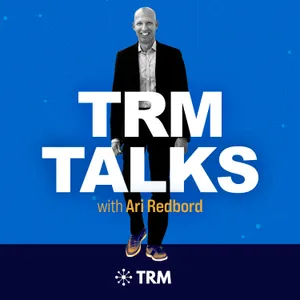
Every other week, TRM’s Global Head of Policy, Ari Redbord, sits down with business leaders, policy makers, and investigators from across the globe to talk about the key crypto policy, regulatory and enforcement issues of the day. About TRM Labs TRM provides blockchain intelligence to help financial institutions, cryptocurrency businesses and public sector agencies detect and investigate crypto-related fraud and financial crime.
Latest Episodes
The most recent episodes — sign up to get AI-powered summaries of each one.
- 1 weeks ago40 min
EP. 119 | How Institutions Can Use Permissionless Rails with Rebecca Rettig and Michael Mosier
In this episode, Ari is joined by close friends and two of the most important voices in our space: Rebecca Rettig, Chief Operating Officer and Chief Legal Officer at Jito Labs, and Michael Mosier, founding partner of Arktouros and former acting director of FinCEN.Rebecca developed deep subject matter expertise as a financial-services litigator working with the earliest DeFi protocols, including an early pitch to Uniswap when the team numbered four people in a Williamsburg loft. Michael came through DOJ, OFAC, and FinCEN, and traces a through-line from protective orders for domestic-violence survivors to cryptography as a tool for people living under authoritarian control.The focus is on the future of DeFi. In a brand new paper, the dynamic duo lay out a framework institutions can implement under current law, and explains why OFAC and BSA enforcement has never targeted SWIFT, telecoms, or RPC nodes the way critics fear it will target crypto infrastructure. They cover the GENIUS Act's focus on issuers rather than networks, US DOJ’s prosecution of a Tornado Cash developer and the Blockchain Regulatory Certainty Act. Mosier also addresses the panic around AI, arguing these systems function as motion sensors rather than a person standing in front of the car with a red flag.
- 3 weeks ago30 min
EP. 118 | Inside Australia’s Historic AML Reform with AUSTRAC’s Brad Brown
Australia just rolled out its biggest anti-money laundering reform in two decades — and it didn't just tighten existing rules, it more than doubled the number of businesses AUSTRAC regulates almost overnight, from roughly 19,000 to over 50,000, sweeping in lawyers, accountants, real estate agents, and dealers in precious metals and stones for the first time.Brad Brown, AUSTRAC's National Manager for Regulatory Operations, joins Ari to walk through what changed, why AUSTRAC redefined digital currency exchanges as "virtual asset service providers" to align with FATF standards, and what that reclassification means in practice for crypto businesses now covering custody, wallets, and transfers, not just cash-to-crypto conversions. Brad has spent more than two decades at AUSTRAC across intelligence, policy, international engagement, and now supervision, following a career in Australian law enforcement.The conversation digs into AUSTRAC's focus on outcomes-focused, risk-based supervision, the scale of the fraud threat Australia is confronting — part of an estimated USD 500 billion in global fraud losses in 2024 and 2025 — and how the Beacon Network, the largest public-private information-sharing and seizure network in the crypto ecosystem, is helping regulators and exchanges move faster against bad actors.
- Aug 12, 202630 min
EP. 117 | A 1934 Footnote Predicted Governance Tokens: Rethinking Crypto Law with Teresa Goody Guillén
In 1934, legal scholar Adolf Berle wrote a footnote speculating that someone might one day hold a passive property right in active property — what we'd now call a governance token. He called it a problem for another day. For Teresa Goody Guillén, founding partner of Bellamentis and founder of the legal AI platform Sophie Lex, that day is now, and it's reshaping how she advises clients building in digital markets.Teresa joins Ari to trace a career that runs from a plaintiff's law firm and a federal clerkship for Judge Urbina of the US District Court for the District of Columbia, through the SEC's Office of General Counsel and a stint working alongside former SEC Chairman Harvey Pitt, to launching her own law firm built around the convergence of traditional and digital financial markets. Her name has even come up as a potential contender for SEC Chair.The conversation moves from the day-to-day of her practice — clients navigating exemptive relief, subpoenas, and the "security or commodity" question she thinks misses the point — to what she's building next. Through Sophie Lex, she's developing proprietary AI trained on her own legal reasoning to help lawyers work faster without losing judgment, arguing AI should scale lawyers rather than replace them. She also shares her take on SEC Chair Paul Atkins' modernization push and why she thinks exemptive relief, more than new legislation, could unlock effective crypto regulation today.
- Jul 29, 202636 min
EP. 116 | Treasury’s War: Then and Now — Economic Statecraft in the Age of Technology with Juan Zarate
Juan Zarate joined the US Treasury just three weeks before September 11, 2001, and helped build the Office of Terrorism and Financial Intelligence (TFI), transforming Treasury into a cornerstone of American national security. He later chronicled that evolution in Treasury’s War, the definitive account of how financial intelligence, sanctions, and economic power became central tools of US statecraft.In this episode, Juan joins Ari to discuss how the post-9/11 financial architecture still underpins U.S. national security—and how it must evolve for an era of cryptocurrency, AI, and emerging technologies.
- Jul 15, 202633 min
EP. 115 | Criminals Don't Have Compliance Officers: The AI Arms Race in AML with ComplyAdvantage’s Vatsa Narasimha
Criminals have no compliance officers and no regulators looking over their shoulder. That means their barrier to adopting new technology — including AI — is effectively zero. They don't need a tool to work for five years. They need it to work for the next five hours. Vatsa Narasimha, CEO of ComplyAdvantage, has been watching this asymmetry define the fraud landscape for years, and his answer is a platform built to match it.Vatsa joins Ari to talk through what building ComplyAdvantage have taught him about fighting financial crime as a network problem rather than a point-in-time compliance exercise.The conversation covers the industrialization of fraud (synthetic IDs, money mule recruitment at scale, AI-enabled targeting of retirees and immigrant workers), the architecture behind ComplyAdvantage's new Mesh platform, and the case for information sharing as a structural defense against crime networks whose strength lies in their interconnection. TRM focuses on the on-chain world; ComplyAdvantage focuses on the off-chain. Together, Vatsa argues, they cover the full picture.
- Jul 1, 202644 min
EP. 114 | The Women Rewriting Crypto's Rulebook with DEX in the City
On this TRM Talks, Ari sits down with the team behind Unchained DEX in the City — three of the sharpest legal minds in crypto and three of his closest friends — for a wide-ranging conversation about the regulatory questions reshaping the industry in real time.TuongVy Le, Jessi Brooks, and Katherine Kirkpatrick Bos bring their distinct backgrounds as prosecutors, general counsels, and enforcement attorneys to bear on what investor protection, custody, and market integrity actually look like in a market structure with no historical precedent.The SEC has provided guidance and clarity, the CFTC is emerging as a consequential voice on digital assets, perps and prediction markets , and the work ahead is proving that a new market structure can deliver on those fundamentals.The conversation covers the legal architecture being built right now, the national security stakes of DeFi exploits, the case for privacy as a precondition for institutional capital, and the founding mission of the show: amplifying the women writing crypto's rulebook. No Mr. Big’s on this one, just the Carrie Bradshaws of crypto providing cutting edge legal insights.Origin stories, journeys, and genuine friendship make this one of the most fun episodes of the year.
- Jun 17, 202641 min
EP. 113 | Quantum, Hacks, and Privacy: Inside Blockchain Security with Penn's Brett Falk
If a sufficiently powerful quantum computer came online tomorrow, every token on every blockchain would be a target — Bitcoin, Ethereum, Solana all share signature schemes that pre-date the post-quantum era. The math has been clear since the 1990s. What's been missing is the machine. That uncomfortable truth anchors this week's TRM Talks.Brett Falk, research faculty at the University of Pennsylvania and director of the Crypto and Society Lab, joins Ari to work through what that actually means — why Shor's algorithm threatens every chain, what NIST's 2024 post-quantum standards mean in practice, and why Ethereum is better positioned than Bitcoin to respond. They also dig into the back-to-back Drift and Kelp DAO exploits and what made the DPRK playbook behind them unlike anything we've seen before, and into the cryptographic tools — zero-knowledge proofs, secure multi-party computation, credential-based KYC — that let users prove compliance without turning every business into a ransomware target. The math to thread that needle already exists.
- Jun 3, 202633 min
EP. 112 | The Golden State of Crypto: Regulating Digital Assets with Brynly Llyr, California DFPI
Brynly Llyr has deep roots in fintech and blockchain — in-house at eBay, PayPal, and Ripple, where she served as one of the first general counsels in crypto, then founding team at Celo, then Head of Blockchain and Digital Assets at the World Economic Forum. Now she’s Deputy Commissioner for Digital Financial Assets at the California DFPI, leading the rollout of the Digital Financial Assets Law, which goes live July 1, 2026, covering exchanges, custodians, stablecoin issuers, and crypto kiosks across the world’s fourth-largest economy.Ari Redbord, TRM’s Global Head of Policy, sits down with Brynly to talk through what California is actually trying to solve. IC3 data puts the state at the top of the country for crypto-related fraud losses, with serious harm to elderly residents and teenagers under 17. Her thesis: licensed intermediaries that recognize fraud patterns are the most powerful lever a regulator has.They also dig into how blockchain’s public visibility changes what supervisors can see in real time — and what that means for every licensed business managing its own risk. The conversation covers AI’s role in regulation, what success looks like a year from now, and the universal experience of feeding teenage boys.
About TRM Talks
Every other week, TRM’s Global Head of Policy, Ari Redbord, sits down with business leaders, policy makers, and investigators from across the globe to talk about the key crypto policy, regulatory and enforcement issues of the day. About TRM Labs TRM provides blockchain intelligence to help financial institutions, cryptocurrency businesses and public sector agencies detect and investigate crypto-related fraud and financial crime.
Customized Recaps
AI-powered recaps with compact key takeaways, quotes, and insights.
Straight to Your Inbox
Get key takeaways from TRM Talks in a 5-minute read.
Save Hours Every Week
Stay current on your favorite podcasts without falling behind.
Frequently Asked Questions
What is Podzilla's TRM Talks daily summary?
It's a free AI-powered email that summarizes new episodes of TRM Talks as soon as they're published. You get the key takeaways, notable quotes, and links & mentions — all in a quick read.
How does the TRM Talks podcast summary work?
When a new episode drops, our AI transcribes and analyzes it, then generates a personalized summary tailored to your interests and profession. It's delivered to your inbox every morning.
Is this an official TRM Talks product?
No. Podzilla is an independent service that summarizes publicly available podcast content. We're not affiliated with or endorsed by TRM Labs.
Can I get summaries of other podcasts too?
Absolutely! The free plan covers up to 3 podcasts. Upgrade to Pro for 15, or Premium for 50. Browse our full catalog at /podcasts.
How often does TRM Talks release new episodes?
TRM Talks publishes biweekly. Our AI generates a summary within hours of each new episode.
What topics does TRM Talks cover?
TRM Talks covers topics including News. Our AI identifies the specific themes in each episode and highlights what matters most to you.
Start getting TRM Talks summaries tomorrow morning.
Free forever for up to 3 podcasts. No credit card required.
Free forever for up to 3 podcasts. No credit card required.