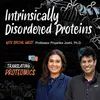
Intrinsically Disordered Proteins with Professor Priyanka Joshi, Ph.D.
Unlike “globular” proteins that adopt stable structures that are relatively easy to analyze, intrinsically disordered proteins adopt many context-dependent shapes. These shapes may drive diverse functions, but they are also difficult to capture and study. This represents a large gap in our understanding of biology, given that most proteins may have intrinsically disordered regions. Thankfully, researchers like Professor Priyanka Joshi, Ph.D., from Georgetown University have devoted themselves to studying intrinsically disordered proteins and are developing new approaches and leveraging new technologies like the Nautilus Voyager™ Platform to discover how their dynamic structures influence biological function. Because intrinsically disordered proteins often aggregate in disease, this work is not only essential to our understanding of biology but may also enable the development of effective biomarkers and treatments for diseases like Alzheimer’s.Parag interviews Professor Joshi on this episode of Translating Proteomics to discover:What intrinsically disordered proteins areHow intrinsically disordered proteins influence biology and why they’re hard to studyHow the recently announced SEEDS Consortium is studying intrinsically disordered proteinsChapters:00:00 – Introduction to Prof. Priyanka Joshi, Ph.D.04:35 – What are intrinsically disordered proteins (IDPs)?11:41 – When do intrinsically disordered proteins go bad in disease?23:02 – Archetypal Intrinsically disordered proteins – c-Myc/Max, p53, and Tau38:26 – Barriers to solving the problems associated with intrinsically disordered proteins43:30 – The future of intrinsically disordered protein research and introducing the SEEDS ConsortiumAdditional resources featured in the episode:https://pubmed.ncbi.nlm.nih.gov/26923286/Joshi, Priyanka et al. “A Fragment-Based Method of Creating Small-Molecule Libraries to Target the Aggregation of Intrinsically Disordered Proteins.” ACS combinatorial science vol. 18,3 (2016): 144-53. doi:10.1021/acscombsci.5b00129Priyanka’s 2016 work developing small-molecule libraries to target IDPs https://www.georgetown.edu/news/georgetown-and-buck-institute-awarded-up-to-51-7m-to-predict-protein-changes-linked-to-alzheimers-and-some-cancers/Georgetown University press release covering the SEEDS Consortiumhttps://investors.nautilus.bio/news-releases/news-release-details/nautilus-measure-proteoforms-driving-alzheimers-disease-andNautilus Biotechnology press release covering its involvement in the SEEDS Consortium
Podzilla Summary coming soon
Sign up to get notified when the full AI-powered summary is ready.
Free forever for up to 3 podcasts. No credit card required.
Listen to This Episode
More from Translating Proteomics
Multiomics and Transplant Medicine
Tau proteoform analysis – Key takeaways from our recent Nature Methods publication

Proteomics Hot Takes with Sheri Wilcox, Andreas Huhmer, and Parag Mallick

AI and Statistics in Proteomics and Systems Biology
Get summaries like this every morning.
Free AI-powered recaps of Translating Proteomics and your other favorite podcasts, delivered to your inbox.
Free forever for up to 3 podcasts. No credit card required.