Free Daily Podcast Summary
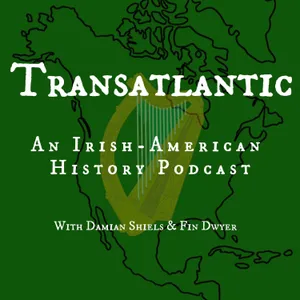
Transatlantic: An Irish American History Podcast: Daily Summaries Delivered
by Fin Dwyer & Damian Shiels
3,000 miles of ocean separate Ireland from the USA, but both countries share a deep and intertwined history. Links between North America and Ireland predate Columbus, stretching back over 1,000 years. Since then, Irish people have shaped the history of the United States. From Ann 'Goody' Glover, who was hanged as a witch in Boston in the 17th century, to JFK, the story of the Irish in the US is fascinating. Join historians Damian Sheils and Fin Dwyer as they join forces to explore the good, the bad, and the ugly of Irish American history. In Season 1 Fin and Damian explore fascinating topics including Who was the first Irish person to cross the Atlantic? The Story of Goody Glover who was hanged as a witch in Boston. What was it like to emigrate during the Great Famine of the 1840s? How Irish people shaped the US Civil War? And much more...
Latest Episodes
The most recent episodes — sign up to get AI-powered summaries of each one.
- 1 weeks ago52 min
55. Andrew Jackson: The First Irish American President
In 1829 Andrew Jackson was sworn in as the Seventh President of the United States--becoming the first Irish American to hold that office. Jackson's parents had emigrated from Boneybefore near Carrickfergus, Co. Antrim to the Carolina frontier, where Jackson had been born in 1767. In this episode we explore the life, legacy and identity of this remarkable and controversial figure, in company with Professor Bryan McGovern of Kennesaw State University.In the show you will hear about Jackson's origins and uprbringing, and the familal experiences during the American Revolution which did much to shape his life. We discuss how his defeat of a British army (led by the Westmeath-born Edward Pakenham) at New Orleans propelled him into the spotlight, along with his rise to the Presidency and his policies when leader of the country. In addition to examining Jackson's sense of his Irish origins, we also chat about how he built his fortune as a plantation owner and traded in enslaved people, and his actions in signing the notorious Indian Removal Act. Finally we discuss Andrew Jackson's legacy, particularly how he became an important figure for large numbers of Irish American Catholics in the 19th Century United States. Bryan is a noted scholar of Irish America and has published numerous books and articles, with the latter including 'Andrew Jackson and the Protestant Irish of Philadelphia: Early Nineteenth Century Sectarianism' which appears in Pennsylvania History. Among his books are a biography of John Mitchel, John Mitchel: Irish Nationalist, Southern Secessionist and The Fenians: Irish Rebellion in the North Atlantic World: 1858-1876 which he co-authored with Patrick Steward. Hosted on Acast. See acast.com/privacy for more information.
- 2 weeks ago49 min
54. New York, The Dynamite Campaign...and Sherlock Holmes
During the 1880s U.S. based Irish nationalists orchestrated a bombing campaign in England, known to history as the Dynamite Campaign. But what if the world’s most famous fictional detective had been sent across the Atlantic by the British Government to investigate? In this episode, Fin and Damian are joined by Dr Terry Golway, the author of numerous factual history books on this period, to dicuss just such a scenario, from his new historical novel Terror from America: A Sherlock Holmes Adventure. As well as discussing the history that underpins the novel, we explore some of the American and Irish ties of Sherlock Holmes and his creator, Arthur Conan Doyle.The show begins with outlining the real story of the Dynamite Campaign and just why New York mattered so much to it.In addition to exploring the lives and relationship of John Devoy and Jeremiah O’Donovan Rossa, two of 19th century Irish America's most famed figures, we chat about the fascinating Dubliner Thomas Byrnes, who ran the detective deparment in the late 19th century NYPD. Listeners will also hear about some of Terry’s earlier historical work, particularly on Devoy and Tammany Hall, and how that helped to shapeTerror from America.Dr. Terry Golway is a historian of American and Irish American history as well as a distinguished journalist. He is Adjunct Professor of Political Science and U.S. History at the College of Staten Island.You can check out Terry's novel Terror from America: A Sherlock Holmes Adeventure here. For Terry's biography of John Devoy, Irish Rebel: John Devoy and America's Fight for Irish Freedom see here. For our discussion with Terry on the history of Tammany Hall, see Episode 34. Tammany Hall: The Irish Political Machine in New York. Hosted on Acast. See acast.com/privacy for more information.
- Oct 19, 202655 min
53. Leaving Poverty Behind: The Irish in New York in the 1950 - 1980s
The story of Irish emigration to New York did not end with the great migrations of the nineteenth century. In this episode of Transatlantic Damian and Fin explore two later waves: the Irish who left for New York in the 1950s and those who followed in the 1980s.What drove them to leave and how did they make new lives in a dramatically different society? We also explored the reason why they left Ireland in the tens of thousands; poverty at home and opportunity in New York, the impact of the Catholic Church on life in Ireland and the Troubles from the late 1960s.Our guest is Linda Dowling Almeida. Linda has BA and MA Boston College and a PhD NYU and taught Irish American history and literature at Glucksman Ireland House NYU for more than 20 years. Her area of interest is 20th century immigration and culture. She is the author of Irish Immigration in New York City, 1945-1995 as well as several articles on migration and culture. She is currently President of the New York Irish History Roundtable and book review editor of its journal. Her upcoming publication (edited with Sally B. Ebest) is These Traits Endure: Irish American Research in the 21st Century Hosted on Acast. See acast.com/privacy for more information.
- Oct 13, 20261h 7m
52. Stories in Stone: Transatlantic Graves from Munster to Ontario
During the 1820s the Peter Robinson Emigration Scheme saw large numbers of families leave Munster the begin new lives in Upper Canada. Two hundred years later, the headstones these families left behind in Peterborough County, Ontario and in Cork, Limerick and Tipperary are helping to tell their stories in a unique, innovative and intrguing way. Fin and Damian are joined by Dr John Tierney, Director of the Historic Graves Project and Patrick Leahy of the Douro Heritage Group in Ontario to discuss their incredible transatlantic Carved in Stone community heritage project, which is using archaeology and history to explore the graveyards that linked these people across the Atlantic. The episode begins with John explaining how Historic Graves works, and his long experience of collaborating with local communities in Ireland to record their graveyards. Patrick then takes us through the story of Irish settlement in Douro, Ontario and some of the stories of those who crossed to Canada. The remainder of the show is given over to discissing how their transatlantic collaboration came about, their ongoing work on both sides of the water, and the incredible insights that is bringing for our knowledge of these communities, their origins, and their maintained connections with home.Historic Graves WebsiteHistoric Graves Youtube ChannelDuoro Heritage Group Facebook PageBallyhoura Development Peter Robinson Emigration PageCarved in Stone Ballyhoura Development Project Page Hosted on Acast. See acast.com/privacy for more information.
- Oct 4, 202657 min
51. Irish America & Slavery
Irish America's relationship with African Americans in the mid-19th century has long been a focus for historians, particularly those trying to understand racism and Irish opposition to emancipation. But what if part of the answer lies not in New York or Boston, but in Ireland itself? In this episode, Fin and Damian are joined by Dr Ian Delahanty, Associate Professor of History at Springfield College, Massachusetts. Ian's award-winning work has shed new light on some of the origins of Irish attitudes towards slavery, abolition and emancipation, and how they changed over time. As he explains, if we want to better understand them, we have to begin not in the United States, but in Ireland.In this episode, Ian takes us back to the years around the Great Famine to explore Ireland's abolitionists, the influence of abolition on Irish politics, and how the tensions that resulted began to shape the views some Irish nationalists developed on abolition and emancipation during the 1840s. These political attitudes were carried across the Atlantic with Famine emigrants and nationalist leaders into a United States on the brink of war over the issue of slavery. We cross the Atlantic to follow that story, discussing how the political scenario in America shaped these pre-existing attitudes during the 1850s, and finally explore the major impact and influence the Civil War had on how Irish America came to view the question of emancipatiing enslaved African Americans.Our discussion is based on Ian's book, Embracing Emancipation: A Transatlantic History of Irish Americans, Slavery and the American Union, 1840-1865 published by Forduham University Press. It was awarded the Lawrence J. McCaffrey Prize for the best book on Irish America in 2024. Hosted on Acast. See acast.com/privacy for more information.
- Sep 27, 202650 min
50. Forest City Irish: The Story of Portland, Maine
Maine may not be the first place we think of when it comes to large Irish communities, but in the years after the Great Famine, the port city of Portland became home to a significant Irish population. The communities they developed began a strong connection between the city and Ireland that endures to this day, especially with the place most connected with its immigrants— Galway. In this episode, Fin and Damian are joined by historian, genealogist and author Matthew Jude Barker, the expert on the Portland Irish, to explore their story.As well as discussing what brought the Irish to Portland, in this episode Matt tells us about the neighbourhoods they made their own during the 19th and early 20th centuries. We explore events like the impact events like the "Great Fire" of 1866 and "Rum Riot" of 1855 had on their lives, and how they navigated local politics and nativism. Along the way we meet people like the McGlinchy brewing family, some of the women who made their living as domestic servants, and the remarkable story of Bishop James Augustine Healy, who became the first African American Catholic bishop in the United States. Matthew's latest books are a two volume set on the story of the Portland Irish, Becoming American: Portland, Maine's Irish and the Making of Immigrant America 1840-1861 andThe Blue and the Green: The Irish of Portland Maine During the Civil War Era 1861-1870. You can purchase them here.Maine Irish Heritage CenterMatthew's WebsiteIn the intro to this week's show Damian mentioned a three-week online course he will be running this October for the Celtic Junction Arts Center. If you would like to find out more about the course, or sign up, you can do so via this link. Hosted on Acast. See acast.com/privacy for more information.
- Sep 20, 202651 min
49. Irish Domestic Servants in America
Throughout the 19th and early 20th centuries, tens of thousands Irish women worked as domestics. The "Irish Bridget" is one of the most recognisable stereotypes of Irish America, but what was life really like for these women, who were the subject of such extensive cariacture and discrimination? In this episode, Fin and Damian are joined by Dr Catherine Healy, Historian-in-Residence at EPIC The Irish Emigration Museum and an expert on Irish domestic service. In the show we explore the reality of their hard working lives, and try and recover something of their lived experiences, both positive and negative. As well as discussing what these women did and the types of places they worked, we chat through things like vulnerabilities that came with live-in service, the prejudices they endured, and the pride they took in earning their own money and supporting families back in Ireland.You can find Catherine's Website here: https://catherinehealy.org/The link to Catherine's Book: Irish Domestic Servants in Transatlantic CUlture, c. 1870-1945Epic: The Irish Emigration Museum Hosted on Acast. See acast.com/privacy for more information.
- Sep 14, 202613 min
48. The Return of Transatlantic
Damian and Fin return after the summer break to talk over their summer and whats coming in Transatlantic in the coming months. Hosted on Acast. See acast.com/privacy for more information.
Get Transatlantic: An Irish American History Podcast summaries in your inbox
Free AI-powered daily recaps. Key takeaways, quotes, and mentions — in a 5-minute read.
Get Free Summaries →Free forever for up to 3 podcasts. No credit card required.
You Might Also Like
Listeners also like.

American History Tellers
Pivotal moments in American history are explored through narrative storytelling, revealing their impact on the nation and modern life.

American History Hit
Examines key events in American history, from colonial conflicts to civil rights, through expert interviews and detailed storytelling.

Our American Stories
Ordinary Americans share personal stories of courage, resilience, faith, and generosity that highlight the best of the human spirit.

Noiser Presents
Immersive dramatizations of historical events like the Titanic and the founding of the United States through narrative storytelling.

American English Podcast
Learn American English through everyday expressions, pronunciation practice, and cultural insights from the United States.

American Scandal
Examines major American scandals in politics, business, and society, exploring the lies, corruption, and downfalls of powerful figures.

American Homicide
A journalist examines unsolved and notorious murders across America, exploring how each case is shaped by its local environment and community.
American Revolution Podcast
Explores the events of the American Revolution from beginning to end, with supplemental maps, images, and resources available on its blog.

Tides of History
Explores how historical events and forces have shaped modern societies, cultures, and global systems.

The History of English Podcast
A podcast about the spoken history of the English language as it became a global language.

Americast
Political analysis and social media insights on the stories shaping the United States, featuring BBC journalists and special guests.

The Atlantic Interview
A weekly exploration of democracy, society, and the American ideal through in-depth interviews and analysis.
About Transatlantic: An Irish American History Podcast
3,000 miles of ocean separate Ireland from the USA, but both countries share a deep and intertwined history. Links between North America and Ireland predate Columbus, stretching back over 1,000 years. Since then, Irish people have shaped the history of the United States. From Ann 'Goody' Glover, who was hanged as a witch in Boston in the 17th century, to JFK, the story of the Irish in the US is fascinating. Join historians Damian Sheils and Fin Dwyer as they join forces to explore the good, the bad, and the ugly of Irish American history. In Season 1 Fin and Damian explore fascinating topics including Who was the first Irish person to cross the Atlantic? The Story of Goody Glover who was hanged as a witch in Boston. What was it like to emigrate during the Great Famine of the 1840s? How Irish people shaped the US Civil War? And much more...
Customized Recaps
AI-powered recaps with compact key takeaways, quotes, and insights.
Straight to Your Inbox
Get key takeaways from Transatlantic: An Irish American History Podcast in a 5-minute read.
Save Hours Every Week
Stay current on your favorite podcasts without falling behind.
Frequently Asked Questions
What is Podzilla's Transatlantic: An Irish American History Podcast daily summary?
It's a free AI-powered email that summarizes new episodes of Transatlantic: An Irish American History Podcast as soon as they're published. You get the key takeaways, notable quotes, and links & mentions — all in a quick read.
How does the Transatlantic: An Irish American History Podcast podcast summary work?
When a new episode drops, our AI transcribes and analyzes it, then generates a personalized summary tailored to your interests and profession. It's delivered to your inbox every morning.
Is this an official Transatlantic: An Irish American History Podcast product?
No. Podzilla is an independent service that summarizes publicly available podcast content. We're not affiliated with or endorsed by Fin Dwyer & Damian Shiels.
Can I get summaries of other podcasts too?
Absolutely! The free plan covers up to 3 podcasts, any in the catalog. Basic raises that to 15, Pro to 40 and Max to 100. Browse our full catalog at /podcasts.
How often does Transatlantic: An Irish American History Podcast release new episodes?
Transatlantic: An Irish American History Podcast publishes weekly. Our AI generates a summary within hours of each new episode.
What topics does Transatlantic: An Irish American History Podcast cover?
Transatlantic: An Irish American History Podcast covers topics including History, Education, Culture, Society & Culture. Our AI identifies the specific themes in each episode and highlights what matters most to you.
Start getting Transatlantic: An Irish American History Podcast summaries tomorrow morning.
Free forever for up to 3 podcasts. No credit card required.
Free forever for up to 3 podcasts. No credit card required.