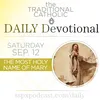
It's the Feast of The Most Holy Name of Mary, 3rd Class, with the color of White. In this episode: the meditation: "The Resurrection of the Body", today's news from the Church: "Freemasonry in France: Thirty days of influence in the open", and today's thought from the Archbishop Marcel Lefebvre. Have feedback or questions about the DD or our other shows? podcast@sspx.org Sources Used Today: "The Resurrection of the Body" — From the Assumption to Adventhttps://angeluspress.org/products/from-trinity-sunday-to-the-assumption "Freemasonry in France: Thirty days of influence in the open" (FSSPX.news) https://fsspx.news/en/news/freemasonry-france-thirty-days-influence-open-61041 The Spiritual Life — Archbishop Marcel Lefebvre (Angelus Press) https://angeluspress.org/products/spiritual-life-archbishop Please support our new project, the Archbishop Lefebvre Biography Audiobook: Learn more:https://www.youtube.com/watch?v=Y-Wp4MQdK2oDonate:https://sspx.gifts/audiobook The Feast of the Most Holy Name of Mary celebrates something wonderfully simple: the name by which Christians have called upon the Mother of God for nearly two thousand years. The name Mary comes to us through the Hebrew Miriam, and scholars have proposed several meanings over the centuries. Christian writers have especially loved titles such as "Star of the Sea." Saint Bernard famously developed that image, telling Christians caught in the storms of temptation and suffering to look toward the star and call upon Mary. But the feast itself has a surprisingly dramatic history. Devotion to Mary's name existed long before there was a universal feast. By the Middle Ages, Catholics regularly invoked her name in hymns, prayers, and preaching. A formal feast developed in Spain during the sixteenth century and gradually spread elsewhere. Then came Vienna in 1683. The Ottoman Empire had advanced deep into Europe, and a massive army surrounded Vienna. If the city fell, the road into central Europe would be dangerously exposed. For weeks the defenders held out while relief forces gathered under the Polish king John III Sobieski. Before the battle, Sobieski and his soldiers attended Mass and entrusted themselves to the Blessed Virgin. On September 12, the Christian relief army attacked. Sobieski's famous Polish Winged Hussars joined what is often described as one of the largest cavalry charges in history, sweeping down upon the Ottoman positions. By evening, the siege had been broken. Sobieski reportedly adapted Julius Caesar's famous words afterward: "We came, we saw, God conquered." Pope Innocent XI attributed the deliverance of Vienna to divine assistance obtained through Our Lady's intercession. In thanksgiving, he extended the Feast of the Most Holy Name of Mary to the universal Church, connecting it permanently with September 12. So behind this gentle-sounding feast stands one of the most dramatic moments in European history. <
Podzilla Summary coming soon
Sign up to get notified when the full AI-powered summary is ready.
Free forever for up to 3 podcasts. No credit card required.
Listen to This Episode
More from Traditional Catholic Daily Devotional
Sep 18 – S Joseph of Cupertino
Sep 17 – Feria / Stigmata of St. Francis
Sep 16 – Ss Cornelius & Cyprian / S Euphemia
Sep 15 – Seven Sorrows of Our Lady
Get summaries like this every morning.
Free AI-powered recaps of Traditional Catholic Daily Devotional and your other favorite podcasts, delivered to your inbox.
Free forever for up to 3 podcasts. No credit card required.