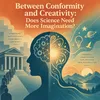
Between Conformity and Creativity: Does Science Need More Imagination?
Tracking WisdomEpisode 44Between Conformity and Creativity: Does Science Need More Imagination?Recorded - 03/16/26 DESCRIPTIONWhat role does creativity play in how we understand reality—and what happens when the institutions responsible for expanding human knowledge become increasingly structured around collaboration, specialization, and consensus?In this episode, we reflect on a conversation about art, innovation, and the nature of creativity before turning to a broader question: does modern science leave enough room for genuinely original thinking?We explore the distinction between art and innovation, and consider whether creativity might be more than a uniquely human act. From there, the conversation moves into the structure of modern science itself. Large institutions, collaborative research, peer review, and increasingly resource-intensive projects have made extraordinary scientific achievements possible—but those same structures can also create incentives toward conformity, specialization, and lower-risk research.Drawing on ideas raised by Iain McGilchrist and others, we consider the tension between individual insight and collective knowledge. Committees may be effective at evaluating, refining, and combining ideas, but where do genuinely new ideas originate? And how do we preserve space for unconventional thinking without abandoning the empirical rigor that makes science valuable?The question isn't whether science needs less structure or less collaboration. It is whether a mature scientific culture can preserve both: the discipline required to test ideas and the imagination required to generate new ones in the first place.Takeaways:Creativity may be worth considering as more than artistic expression, particularly when examining innovation, discovery, and consciousness.Modern scientific collaboration enables work that individuals could rarely accomplish alone, while institutional incentives may also discourage unconventional or high-risk ideas.Original insight and collective evaluation serve different functions; scientific progress may depend on creating room for both.Philosophy, intuition, and imagination can contribute to generating hypotheses without replacing empirical testing.Preprints, broader critique, and more open exchange of developing ideas may provide ways to expose unconventional thinking to scrutiny without requiring immediate institutional consensus.Scientific institutions are tools for producing knowledge—not knowledge itself—and can be examined and improved like any other human system.Episode ResourcesThe Institute of Art and IdeasEsther FreudRoger PenroseIain McGilchrist Is creativity essential to understanding the universe? | Roger Penrose and Iain McGilchrist - The Institute of Art and IdeasImagining the universe Is creativity an illusion? - Institute of Art and IdeasConsider showing your support to help make this content possible. Review us on PodchaserLeave a ReviewWe are grateful for your giftsSupport with a TipShow MerchandiseTracking Wisdom Coffee MugWeb & Social Media:ETH Studio WebsiteTracking Wisdom Reflections (Substack)Facebook<a href="https://instagram.com/ethstudiomedia/" rel="noop
Podzilla Summary coming soon
Sign up to get notified when the full AI-powered summary is ready.
Free forever for up to 3 podcasts. No credit card required.
Listen to This Episode
More from Tracking Wisdom

Beyond the Heartbeat: Exploring HeartMath's Social and Global Coherence

The Heart–Brain Connection: Exploring Rollin McCraty and HeartMath
Can Technology Shortcut Awakening? The Helmet and the Search for Enlightenment
Examining the Skeptics Dictionary Critique of Dean Radin
Get summaries like this every morning.
Free AI-powered recaps of Tracking Wisdom and your other favorite podcasts, delivered to your inbox.
Free forever for up to 3 podcasts. No credit card required.