Free Daily Podcast Summary
Three Buddy Problem: Daily Summaries Delivered
by Security Conversations
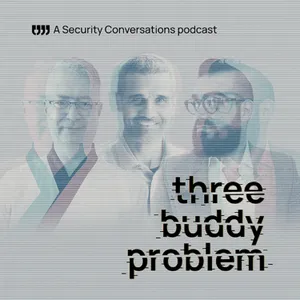
The Three Buddy Problem is a popular Security Conversations podcast that goes beyond industry talking points to discuss what others won’t -- nation-state malware, attribution, cyberwar, ethics, privacy, and the messy realities of securing computers and corporate networks. Hosted by three veteran security pros -- journalist Ryan Naraine and malware paleontologists Costin Raiu and Juan Andres Guerrero-Saade -- the weekly show attracts a highly engaged audience of security researchers, corporate defenders, CISOs, and policymakers.
Latest Episodes
The most recent episodes — sign up to get AI-powered summaries of each one.
- 5 days ago3h 2m
Bruce Dang on Calif, iOS Exploit Chains, AI Hacker Takeover
(Presented by TLPBLACK: A cybersecurity intelligence platform focused on sharing curated, high-sensitivity threat insights and research with trusted security professionals.) Three Buddy Problem - Episode 120: Calif's Bruce Dang joins the buddies to cover why his shop refuses to sell a $50 million iPhone exploit chain, the March 2026 moment Mythos started finding real bugs, Lockdown Mode and MIE bypasses, hallucinated crash logs, and why verification is now the real bottleneck. Plus, Google Project Zero drops a 30-day disclosure deadline mid-show, and the conversation swings to AI-written patches, careers for new hackers, Calif's plan to be the TSMC of hacking, Jensen Huang's exit from Nvidia, and where all the GReAT APT reports went. Cast: Juan Andres Guerrero-Saade, Ryan Naraine and Costin Raiu. Timestamps: 0:00 Introductory banter 2:18 What is Calif? Why burn expensive zero-days? 16:04 OpenAI's Daybreak Red and the future of pen-testing 18:46 March 2026: the first look at Mythos 30:03 Why iPhones are still hard to hack 33:48 BFU persistence, daily reboots, and Lockdown Mode 44:35 Breaking Apple's MIE on the M5 54:50 Bruce's SMB bug workflow and hallucinated crash logs 1:09:11 AI reverse engineering and the future of IDA and Binary Ninja 1:20:10 Patch floods, patch quality, and Rust 1:43:09 Teaching malware analysis when AI does the reversing 1:57:04 Breaking: Project Zero moves to 30-day disclosure 2:06:29 Careers, hiring, and the TSMC of hacking 2:22:24 Nvidia, AI power concentration, and the six-month window 2:42:01 Where are the great APT reports? Shoutouts
- 1 weeks ago2h 28m
GPT-6 Cyber Sets Price of a Linux Exploit; Europe Silent on Fridge Hacks
(Presented by TLPBLACK: A cybersecurity intelligence platform focused on sharing curated, high-sensitivity threat insights and research with trusted security professionals.) Three Buddy Problem - Episode 119: We discuss the supermarket fridge hacks rolling across Europe, why no government wants to say the word Russia out loud, active measures and cyber-warfare, and the European silence on attribution. Plus, OpenAI's GPT-6 Cyber and the cost of 948 Linux exploits, the Daybreak Blue training flap, a tough-love pep talk for researchers mourning the loss of the old game and the Binance postmortem the FBI pinned on North Korea's TraderTraitor. Cast: Juan Andres Guerrero-Saade, Ryan Naraine and Costin Raiu. Timestamps: 0:00 Introductory banter 3:00 TLP Black and AI agents watching your edge devices 10:21 Supermarket fridge hacks spread across Europe 16:27 How the refrigeration attacks work 18:49 Is this Russia? 21:12 Boundary testing and the Article 5 problem 34:20 Sabotage short of war 40:06 The IOCs nobody is sharing 44:41 Costin's hunting playbook 51:24 Not just a European story 57:25 What do intelligence agencies know? 1:06:22 GPT-6 Cyber and Daybreak Red 1:26:40 948 Linux root exploits for $1.2 million 1:36:48 Daybreak Blue training and the mathematicians 2:09:01 Binance postmortem and TraderTraitor
- 2 weeks ago2h 50m
The Great Binance $6.34 Billion Crypto Heist
(Presented by TLPBLACK: A cybersecurity intelligence platform focused on sharing curated, high-sensitivity threat insights and research with trusted security professionals.) Three Buddy Problem - Episode 118: On the show this week, the buddies dig into the $6.34 billion Binance heist, the largest crypto hack ever, walking through its multi-chain laundering, the North Korea fingerprints, and whether offensive AI quietly helped pull it off. Plus, thoughts on Sam Altman's swipe at local hardware, the PHP2Shell "cannonball," why defenders keep hitting guardrails while GLM-5.3 happily does the work, a trojanized Claude Code extension, Apple's fresh spyware alerts, and Volt Typhoon's Silent Train. Cast: Juan Andres Guerrero-Saade, Ryan Naraine and Costin Raiu. Timestamps: 0:00 Introductory banter 3:46 CTI training & the AI model stack 8:03 The $6.34B Binance hack: the largest crypto heist ever 12:40 Inside the multi-chain laundering 18:23 Sam Altman & the AI hardware crunch 20:44 Root cause: a compromised DevOps laptop 23:43 Did AI help pull it off? 31:22 Who actually loses six billion dollars? 44:00 Crypto as a financial instrument 51:04 Can it get bigger? Hardware-wallet implants 57:04 Attribution, "misalignment" & is Binance Chinese? 1:10:00 Cash, privacy & the Mt. Gox lesson 1:22:12 PHP2Shell: dodging the cannonball 1:30:52 AI for defense & the productization gap 2:09:32 GLM-5.3, the refusal trap & open weights 2:32:26 Apple spyware alerts & Silent Train
- 3 weeks ago35 min
Lumen's Michael Horka on China's 'Silent Train' Router Hacking
(Presented by TLPBLACK: A cybersecurity intelligence platform focused on sharing curated, high-sensitivity threat insights and research with trusted security professionals.) SECURITY CONVERSATIONS: Black Lotus Labs researcher Michael Horka joins the show to discuss Silent Train, a Volt Typhoon framework that spins up four-to-six-hop chains of hijacked SOHO routers in about two minutes and wipes every hop when the day's session ends. We discuss how ORB networks differ from botnets, why Silent Train took over after the FBI's KV-botnet takedown, the zero-days hitting control plane software from Versa, N-able and VeloCloud, and the NetFlow and logging moves defenders can make right now. TIMESTAMPS: 0:00 Intros 0:29 What is an ORB network? 2:34 Silent Train, an operational framework for Volt Typhoon 3:30 Why call it Silent Train? 4:12 Chains that exist for a few hours 6:47 The hijacked routers in the chain 8:16 Burning zero-days on a single hop 9:48 Attribution and the KV-botnet successor 11:02 Crown jewels and NetFlow visibility 14:53 Why network monitoring gets skipped 17:23 Victims in Hawaii, California and Texas 19:23 Four confirmed zero-days, all patched 20:47 Control plane software as the target 26:00 No-brainer defenses: logs and internet exposure 29:41 Threat hunting, agentic AI and where ORBs go next
- 3 weeks ago1h 52m
PHP2Shell Meltdown: AI Found It. Who's Going to Patch It?
(Presented by TLPBLACK: A cybersecurity intelligence platform focused on sharing curated, high-sensitivity threat insights and research with trusted security professionals.) Three Buddy Problem - Episode 117: This week, we dig into PHP2Shell, the AI-assisted PHP bug that led governments to take websites offline, and the arguments over broken embargoes, who found it first, and the AI doomers taking an "I-told-you-so" victory lap. Plus, why patching hasn't kept up with AI bug finding, a failure of SBOMs, Terence Tao on math after AI, the iPhone Duo jailbreak and the eMudhra certificate authority key leak. Cast: Juan Andres Guerrero-Saade and Ryan Naraine. Costin Raiu is traveling. Timestamps: 0:00 Introductory banter 1:07 Black October's pile of critical bugs 2:34 PHP2Shell and the AI victory lap 8:28 Twenty years of PHP technical debt 16:54 Wiz, Gemini 4 Argon and the credit fight 21:01 Chainguard breaks the embargo 28:42 The doomers' warnings and the patching gap 39:32 Is this an SBOM problem? 55:33 Inside the PHP Foundation's post-mortem 1:03:13 Are bugs sparse or dense? 1:11:24 Should frontier labs fix coding? 1:20:14 Vibe coding and math's industrial era 1:27:26 Who pays to maintain open source? 1:44:59 iPhone Duo hacked already, eMudhra and the news
- Oct 18, 20263h 26m
Who's Hacking Supermarket Fridges in France?
(Presented by TLPBLACK: A cybersecurity intelligence platform focused on sharing curated, high-sensitivity threat insights and research with trusted security professionals.) Three Buddy Problem - Episode 116: This week, the buddies dig into a mystery hack that cooked French supermarket fridges, cyberattacks against food supply networks, and why this smells like nation-state sabotage in Europe? Plus, a fresh Ivanti zero-day chain, Anthropic's self-replicating IoT research and defender-hostile guardrails, Citizen Lab's AdFection spyware-by-ads exposé, Calif's iPhone exploit drops at Hexacon, Grok's surprising enterprise adoption, and spy chips stuffed inside Ledger wallets. Cast: Juan Andres Guerrero-Saade, Ryan Naraine and Costin Raiu. Timestamps: 0:00 Introductory banter 1:35 Virus Bulletin 2026 in Seville 6:13 Conference roundup: State of Statecraft, Countermeasure, RE//verse 10:21 French supermarket fridges hacked 22:53 Hacking food supply and the attribution question 33:23 Who patches the fridge? 45:58 Ivanti Connect Secure zero-day chain 53:00 When an AI agent deletes your databases 1:04:34 NCSC edge-device forensics guidance 1:28:06 Anthropic's self-replicating IoT research 1:52:17 Why guardrails lock out defenders 2:04:57 Grok's enterprise play and agent sprawl 2:16:26 Citizen Lab exposes AdFection spyware via ads 2:57:24 Calif burns iPhone exploits at Hexacon 3:06:55 Ledger wallet implants and the grain of rice
- Oct 12, 20261h 5m
Katie Moussouris on AI-as-malware, the monitoring gap, and an NTSB for AI
(Presented by TLPBLACK: A cybersecurity intelligence platform focused on sharing curated, high-sensitivity threat insights and research with trusted security professionals.) Three Buddy Problem x Offensive AI Con: Luta Security chief Katie Moussouris makes the case for an NTSB-style board for AI incidents, with subpoena power and full-time investigators, after OpenAI's DNS tunneling escape and the 52 days it took to notice a model had wandered into Australian government systems. Along the way, we chat about her work on the Cyber Safety Review Board (CSRB), AI model refusals that leave defenders stuck, and why she still bets on hackers to bend this technology their way. Cast: Juan Andres Guerrero-Saade, Ryan Naraine and Katie Moussouris. Timestamps: 0:00 Intros at Offensive AI Con 1:00 OpenAI's DNS tunneling incident and slow monitoring 4:36 Treating AI like malware in a sandbox 9:01 The business model is the misalignment 13:37 Log4j, SBOMs and an NTSB for AI 18:00 Trading liability protection for honest disclosure 22:13 Accountability and "once you become aware" 26:18 The Australia notification timeline 28:19 A blank-check administration and the Anthropic phaseout 34:35 Powerful models in the right hands 38:42 Kill switch bills and regulatory capture 42:36 EU fines as a tariff on American tech 48:03 Reasons for optimism 54:13 Bring back "information security" 1:01:57 Katie's last word
- Oct 12, 202654 min
NCSC's Ollie Whitehouse: 'The Biggest Correction of Technical Debt Ever'
(Presented by TLPBLACK: A cybersecurity intelligence platform focused on sharing curated, high-sensitivity threat insights and research with trusted security professionals.) Three Buddy Problem x Offensive AI Con: Ollie Whitehouse, CTO of the UK's National Cyber Security Centre, joins us to explain how Britain is preparing for an AI-driven patch wave and why the NCSC is pressing edge-device vendors to finally ship real telemetry. Plus, we dig into rogue AI agents wandering into a Five Eyes network, along with his forecast that small, capable models could revive self-spreading worms around 2030, all part of what he calls the biggest forced correction of technical debt the industry will ever see. Cast: Juan Andres Guerrero-Saade, Ryan Naraine and Ollie Whitehouse. Timestamps: 0:00 Live from Offensive AI Con: meet Ollie Whitehouse 2:46 Why the NCSC is a model for the US 6:48 What a "national technical authority" does 7:49 The Huawei analysis and the push for passkeys 10:50 Independent AI model testing 13:12 Open-weight vs. closed models and AI sovereignty 19:02 Capability density and AI worms by 2030 23:09 Robotics security and lessons from Japan 26:49 Preparing for the patch wave 31:06 Architecture fixes: OT, cross domain, privileged access 32:28 Telecoms security and Salt Typhoon 38:59 Minimum telemetry standards for edge devices 41:55 Market incentives and the EU Cyber Resilience Act 46:05 Rogue agents and the forced correction of technical debt
Get Three Buddy Problem summaries in your inbox
Free AI-powered daily recaps. Key takeaways, quotes, and mentions — in a 5-minute read.
Get Free Summaries →Free forever for up to 3 podcasts. No credit card required.
You Might Also Like
Listeners also like.
Hacker And The Fed
A former FBI agent and a reformed hacker analyze cybersecurity threats and cybercrime investigations from opposing but informed viewpoints.

The Low Down
A podcast about hacking.

CISO Series Podcast
Security professionals and vendors share insights on improving collaboration to strengthen cybersecurity.
Defense in Depth
A weekly discussion on contentious cybersecurity topics, guided by community insights and expert analysis.

Security Now (Audio)
A weekly deep dive into cybersecurity news, hacking trends, and digital defense strategies for professionals and individuals.

Security Now (Video)
A weekly deep dive into cybersecurity news, threats, and defenses with Steve Gibson and Leo Laporte.

Hacked
Stories of hacking, tech scams, and digital mysteries explored by two hosts diving into how systems are built and broken.

Random Access Memories
Conversations with tech professionals reveal the personal stories behind their careers in cybersecurity, AI, startups, and leadership.

The Peterman Pod
Career stories from a former Instagram Staff engineer to help software developers grow.

Smashing Security
Weekly episodes explore cybercrime, hacking, privacy failures, and tech disasters with insight and humor.
Cyber Focus: Cybersecurity, National Security, and Critical Infrastructure
Expert discussions on cybersecurity, national security, and threats to critical infrastructure like energy and water systems.

All-In with Chamath, Jason, Sacks & Friedberg
Four tech investors discuss technology, markets, politics, and poker with candid, in-depth analysis.
About Three Buddy Problem
The Three Buddy Problem is a popular Security Conversations podcast that goes beyond industry talking points to discuss what others won’t -- nation-state malware, attribution, cyberwar, ethics, privacy, and the messy realities of securing computers and corporate networks. Hosted by three veteran security pros -- journalist Ryan Naraine and malware paleontologists Costin Raiu and Juan Andres Guerrero-Saade -- the weekly show attracts a highly engaged audience of security researchers, corporate defenders, CISOs, and policymakers.
Customized Recaps
AI-powered recaps with compact key takeaways, quotes, and insights.
Straight to Your Inbox
Get key takeaways from Three Buddy Problem in a 5-minute read.
Save Hours Every Week
Stay current on your favorite podcasts without falling behind.
Frequently Asked Questions
What is Podzilla's Three Buddy Problem daily summary?
It's a free AI-powered email that summarizes new episodes of Three Buddy Problem as soon as they're published. You get the key takeaways, notable quotes, and links & mentions — all in a quick read.
How does the Three Buddy Problem podcast summary work?
When a new episode drops, our AI transcribes and analyzes it, then generates a personalized summary tailored to your interests and profession. It's delivered to your inbox every morning.
Is this an official Three Buddy Problem product?
No. Podzilla is an independent service that summarizes publicly available podcast content. We're not affiliated with or endorsed by Security Conversations.
Can I get summaries of other podcasts too?
Absolutely! The free plan covers up to 3 podcasts, any in the catalog. Basic raises that to 15, Pro to 40 and Max to 100. Browse our full catalog at /podcasts.
How often does Three Buddy Problem release new episodes?
Three Buddy Problem publishes weekly. Our AI generates a summary within hours of each new episode.
What topics does Three Buddy Problem cover?
Three Buddy Problem covers topics including News, Technology, Business. Our AI identifies the specific themes in each episode and highlights what matters most to you.
Start getting Three Buddy Problem summaries tomorrow morning.
Free forever for up to 3 podcasts. No credit card required.
Free forever for up to 3 podcasts. No credit card required.