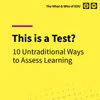
This Is a Test? 10 Untraditional Ways to Assess Learning
What if the best way to know whether a student understands something isn't a traditional test at all? What if it was a bathroom stall poster or a campus full of long lines and slow WiFi? In this Top 10 episode, instructors share 10 alternative assessments they've used to measure student learning beyond standardized tests. These authentic and unconventional assessments ask students to apply what they know, explain their thinking, communicate with real audiences, recognize course concepts in new situations, and reflect on their own learning. Some of the ideas are delightfully strange. Underneath all of them is a much more serious question: What are we actually trying to measure? From an escape-room final that tests students' understanding of processes to an oral math assessment, a HyFlex take-home exam, and a review game designed so nobody gets to hide, these are practical assessment ideas instructors can borrow, adapt, or steal outright. Brought to you by Macmillan Learning. Episode Breakdown [1:09] Put Assessment in the Wild. Make students design for a real audience, not just the grader. [4:00] Escape the Exam. Turn problem-solving into the assessment itself. [5:46] Make Chemistry Perform. Ask students to demonstrate the concept, then explain it. [8:18] Make the campus itself the case study. Use real-world problems as an economics assessment. [11:23] Talk It Out. Use oral assessment to reveal student understanding. [13:48] Solve a Problem From Every Angle. Assess whether students can connect knowledge across fields. [16:56] Take Assessment Off the Screen. Disconnect assessment from the automatic click-submit cycle. [19:26] Stretch the Exam Window. Change the pressure without changing the standard. [22:22] Make the News the Test. Ask students to connect this week to your course. [25:06] Make Them Answer for Themselves. Turn review into individual accountability. [28:03] Bonus Round: Not Everything Needs a Grade. [29:29] What We Learned: Build Backward From What You Want to See. Featured Educators Dr. Jennifer Ripley Stueckle has spent the past 17 years as a Teaching Professor and Non-Majors Biology Program Director at West Virginia University. She has taught introductory biology, immunology, and human physiology, and also created biology courses offered through dual enrollment at West Virginia high schools. Dr. Sara Lahman teaches upper-level genetics and has built assessments, including a cumulative final structured as an escape room, that ask students to work through problems in sequence and rely on each other's strengths. Dr. Edward Lee is an Instructional Associate Professor and Director of Service Laboratories at Texas A&M University in the Department of Chemistry. His research is related to synthetic organic chemistry and its application toward biological systems. Dr. Ryan Herzog is an Associate Professor of Economics, Program Coordinator, and Faculty Fellow at Gonzaga University, where he has been teaching for 16 years. His work focuses on macroeconomics, financial markets, and public policy. Dr. Daniel M. Look is the Charles A. Dana Professor of Mathematics at St. Lawrence University. He's spent over 25 years trying to convince students that math is not only useful, but occasionally fun. He authored Math Cats: Scratching the Surface of Mathematics, an illustrated exploration of mathematical ideas through the lens of cats. Marissa Dahari, M.Sc., is the Undergraduate Course Coordinator in the Department of Molecular and Cellular Biology at the University of Guelph. Her research focuses on genetically altered proteins of the human heart, leading to disease states such as cardiomyopathy. Jennifer Duncan is Associate Professor of English at Georgia State University's Perimeter College. Jennifer has been teaching English literature and composition for twenty-five years and specializing in online teaching for fifteen. Dr. Christin Monroe is an Educational Research Associate at the Center for Innovation in Teaching and Learning at the University of Illinois at Urbana-Champaign. She previously taught chemistry at Landmark College with a focus on supporting neurodivergent learners through inclusive and innovative teaching practices. Dr. Kendra Thomas is an Associate Professor of Psychology at Hope Co
Podzilla Summary coming soon
Sign up to get notified when the full AI-powered summary is ready.
Free forever for up to 3 podcasts. No credit card required.
Listen to This Episode
More from The What And Who Of EDU
Phones, FOMO and Focus: 10 Ways to Reclaim Student Attention
10 Ways to Build Student Trust Early On. No Trust Falls Required.
AI in the Classroom: What's Working, What's Not, and What Instructors Are Still Figuring Out
Why Students Go Quiet and 10 Instructor-Approved Class Discussion Strategies That Actually Work
Get summaries like this every morning.
Free AI-powered recaps of The What And Who Of EDU and your other favorite podcasts, delivered to your inbox.
Free forever for up to 3 podcasts. No credit card required.