Free Daily Podcast Summary
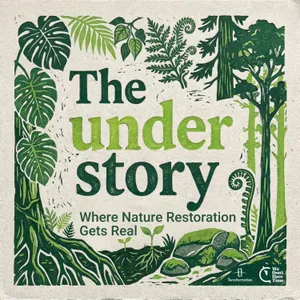
The Understory - a podcast where nature restoration gets real: Daily Summaries Delivered
by We Don't Have Time and Terraformation
The case for restoring the world's forests and ecosystems has been made — repeatedly. The Understory is for everyone ready to ask what comes next: the practitioners, scientists, and builders working on the harder questions the main stages don't have room for.Every episode starts from a shared premise: the science, the economics, and the moral case for restoration have been made — repeatedly. The Understory is not interested in making that case again. It starts from where that conversation ends, and asks why restoration hasn't scaled, who's been blocking it, and what's actually working.
Latest Episodes
The most recent episodes — sign up to get AI-powered summaries of each one.
- Oct 9, 202624 min
Nature, the other climate story
Recorded live at The Nest during Climate Week NYC 2026, this episode brings together Adam Met, co-founder of Planet Reimagined and a member of AJR, and Monica Medina, former U.S. Special Envoy for Biodiversity and Water Resources, to ask the question the climate conversation keeps stepping around: if nature is a third of the answer, why does it get treated like a footnote?In this episode:Why America's forests already work as a climate solution, and why their impact will rise or fall depending on what we do nextWhat a survey of 350,000 concertgoers taught Planet Reimagined about getting people to act, and why local wins come firstHow a fan petition for tree cover at an AJR show in Phoenix fits a bigger plan for scaling local policies to the state and federal levelWhy Adam says the U.S. grassroots climate movement "doesn't exist in the way we think it exists," and why concerts, comedy shows and sports games could be the way inHow the split between mitigation and adaptation pushed nature to the back burner, and why Monica calls nature a unifierSubscribe for upcoming episodes, including our live recording at COP31.🌱 Real talk. Real practitioners. Real solutions.
- Aug 28, 20261h 21m
How Does Good Forestry Spread?
A forest is built by millions of separate decisions, made over timescales longer than any career, election, or fund life — while the climate moves underneath them the whole time.That movement has done two things at once. It has made forests more valuable, because they are among the largest carbon solutions available to us. And it has made them more fragile, at a speed and reach nobody in forestry has seen before. We are leaning on forests harder than ever, at exactly the moment they are least able to take the weight.Chris Swanston and Joseph Appiah-Gyapong have the same job on different continents: changing what other people do to trees, at scale. At the U.S. Forest Service, Chris built the translation layer — turning climate science into a decision a working forester can actually make on a particular stand. In Ghana, Joseph connected that science to the payment layer, changing what hundreds of thousands of cocoa farmers do by making the better practice the one that pays. Two halves of the same machine.Hosts Dr. Sweta Chakraborty and Jad Daley put three questions to them: what good forest practice looks like under a changing climate, how that knowledge reaches the people who do the work, and what kind of financial support makes adoption possible.It gets specific. Twenty percent of the southern Sierra is no longer forest — it is shrubland, and it is not coming back. Prescribed fire made giant sequoias four times likelier to survive a megafire. A forty percent stake in the harvest changes whether a farmer sets a fire. Sixty-nine percent of Ghana's carbon revenue reached communities, deliberately not as cash. And fourteen billion dollars of U.S. federal money arrived before anyone had the seedlings, the supply chain, or the workforce to spend it well.Learn more at terraformation.com/the-understory
- Jul 1, 202643 min
The Frontline Generation (Live from London Climate Action Week)
Everyone agrees the climate movement needs young people, and everyone agrees the next generation will live with the consequences. So why do the rooms where the decisions get made still look the way they do?In this episode, recorded live at London Climate Action Week, hosts Dr. Sweta Chakraborty and Jad Daley dig into an uncomfortable irony — a gathering of tens of thousands convened to solve the climate crisis, where most of the people in the room are neither young nor from the communities most immediately at risk — and ask what the established movement keeps getting wrong.They're joined by two people who responded to that gap by building institutions to close it: Samrah Khan, who helps lead a nonprofit founded on the fact that roughly 90% of climate science is published in English while about 80% of the world doesn't speak it, and Zainab Bie, who advances unconditional cash transfers as a tool for climate justice — from a pilot paying young climate defenders in Tuvalu to a proposed South Pacific Climate Justice Fund. Guests:Samrah Khan — Chief of Staff, Climate Cardinals; a former conservation specialist (AmeriCorps / Climate Impact Corps) who helped grow the language-justice nonprofit from a $500 Google Doc into an organization that has translated more than four million words across 100+ languages.Zainab Bie — Asia Pacific Director, Equal Right, and co-founder of Impactship, a community of ~2,000 young changemakers across the Global South. An economist by training, she works on unconditional cash transfers and direct-access climate finance, with active projects in Tuvalu and Kenya.
- Jun 5, 202653 min
Why Hasn't Reforestation Scaled? Bridging Community Stewardship and Corporate Capital
Everyone agrees reforestation needs to scale, and everyone agrees private capital has to be part of the answer. So why is it still so hard? In this episode, hosts Dr. Sweta Chakraborty and Jad Daley dig into the gap between what corporate buyers and investors require and what the communities actually stewarding the land can offer — and what it takes to build a bridge that works for both sides.They're joined by two people who've spent careers closing that gap from opposite ends: Hindou Oumarou Ibrahim, who represents pastoralist and Indigenous communities in Africa's Sahel, and Christine Cadigan, who built a program making U.S. carbon markets accessible to small family forest owners. The conversation gets specific — aggregation, contract length, property rights, permanence risk, and where the money actually goes (Hindou notes that less than 7% of the $1.7B pledged to Indigenous peoples at COP26 reached communities). It ends with a live agreement to pilot something together.HostsDr. Sweta Chakraborty — CEO, North America, We Don't Have TimeJad Daley — President, TerraformationGuestsHindou Oumarou Ibrahim — Co-chair, International Indigenous Peoples' Forum on Climate Change; founder of the Association for Indigenous Women and Peoples of Chad. A Mbororo pastoralist, she works on participatory 3D mapping, Indigenous knowledge, and direct-access climate finance.Christine Cadigan — EVP of Carbon Origination, American Forest Foundation; architect of the Family Forest Carbon Program and herself a family forest owner.
- May 8, 202656 min
Climate, Biodiversity, Communities — Do We Have to Choose? (Live from EarthX)
Earth Day started in 1970 with twenty million Americans, a bipartisan coalition, and no carbon agenda. It gave us the EPA, the Clean Water Act, the Endangered Species Act. So why does it feel like the environmental movement has spent the last two decades narrowing — not expanding?Recorded live at EarthX in Dallas on Earth Day 2026, this episode brings together some of the most credible voices in American conservation to ask the question most people in this space won't say out loud: has the obsession with carbon as the single metric for nature been holding us back?In this episode:Why the shift from "nature" to "climate" wasn't inevitable — and who benefited from itHow siloed funding structures are actively limiting what gets built on the groundThe Trinity River Audubon Center: what 120 acres on a former illegal landfill tells us about what restoration can look likeWhy the bipartisan conservation coalition fractured — and whether it can be rebuiltWhat investors and business leaders actually need to change about how they spend money on thisSubscribe for upcoming episodes, including live ones at COP, Climate Week, and beyond.🌱 Real talk. Real practitioners. Real solutions.
- Apr 23, 20261 min
TRAILER: The Understory
The Understory is a podcast about restoration where practitioners can real talk — no polished conference-stage performances, no organizational spin, just honest conversation about what's working, what isn't, and what it will actually take to reforest the world the right way.
- Apr 23, 202630 min
Meet the Understory
What if everything we're doing to restore the world's forests is missing the point?At every COP, every Climate Week, every major nature summit — the panels are the same, the talking points are the same, and the hard questions never get asked. In this first episode, Jad Daly and Sweta Chakraborty introduces The Understory: a podcast built for the people who are ready to talk about what's actually happening on the ground.Why are we talking about forests without talking about forestry? Why do the voices closest to the work — indigenous communities, local practitioners, field scientists — keep getting left out of the conversation? And what would it take to go from 15% tree survivorship to 85%... just by being willing to geek out on the details?This is the space for that conversation.In this episode:Why the big climate forums have become a "performance" — and what we're missing because of itThe forest understory as a metaphor for everything our movement is getting wrongWhy braiding indigenous knowledge with climate science is the unlock no one's talking aboutThe "pre-mortem" question every restoration project needs to askSubscribe so you don't miss upcoming episodes, including live recordings at EarthX, COP, and Climate Week.🌱 Real talk. Real practitioners. Real solutions.
Get The Understory - a podcast where nature restoration gets real summaries in your inbox
Free AI-powered daily recaps. Key takeaways, quotes, and mentions — in a 5-minute read.
Get Free Summaries →Free forever for up to 3 podcasts. No credit card required.
You Might Also Like
Listeners also like.
The Forest Garden
Discusses forest gardening, permaculture, and regenerative design through interviews with practitioners and experts.
The Nature Of with Willow Defebaugh
Explores lessons from nature through conversations with artists, scientists, and thinkers about creativity, connection, and transformation.

Terrestrials
Nature stories that reveal surprising animal and plant behaviors through immersive, family-friendly audio adventures.
Sustainable World Radio- Ecology and Permaculture Podcast
Experts discuss ecology, permaculture, organic gardening, and sustainable living through interviews and commentary.
Natural Causes
Explores the intersection of outdoor access, conservation, and environmental justice in an era of climate crisis and political threat.
Unf*cking the Future
A scientist explores environmental crises and practical solutions to secure a sustainable future.
In Defense of Plants Podcast
Explores the fascinating world of plants, from tiny duckweeds to towering redwoods, celebrating the science and wonder of botany.
For What It’s Earth
Emma Brisdion & Sophie Pavelle
Forest 404
A woman discovers a recording of a vanished forest, confronting ecological loss and memory in a future without nature.
How Wild
Explores the evolving idea of wilderness through voices of rangers, scientists, hikers, and Tribal leaders across American trails.
The Origins Foundation Podcast
Discusses wildlife conservation, hunting ethics, and controversial issues in sustainable use through candid interviews.
Care More Be Better: A Podcast For Sustainable Social Impact and Regeneration
Features interviews with environmentalists, activists, and scientists focused on sustainable social impact and regenerative solutions.
About The Understory - a podcast where nature restoration gets real
The case for restoring the world's forests and ecosystems has been made — repeatedly. The Understory is for everyone ready to ask what comes next: the practitioners, scientists, and builders working on the harder questions the main stages don't have room for.Every episode starts from a shared premise: the science, the economics, and the moral case for restoration have been made — repeatedly. The Understory is not interested in making that case again. It starts from where that conversation ends, and asks why restoration hasn't scaled, who's been blocking it, and what's actually working.
Customized Recaps
AI-powered recaps with compact key takeaways, quotes, and insights.
Straight to Your Inbox
Get key takeaways from The Understory - a podcast where nature restoration gets real in a 5-minute read.
Save Hours Every Week
Stay current on your favorite podcasts without falling behind.
Frequently Asked Questions
What is Podzilla's The Understory - a podcast where nature restoration gets real daily summary?
It's a free AI-powered email that summarizes new episodes of The Understory - a podcast where nature restoration gets real as soon as they're published. You get the key takeaways, notable quotes, and links & mentions — all in a quick read.
How does the The Understory - a podcast where nature restoration gets real podcast summary work?
When a new episode drops, our AI transcribes and analyzes it, then generates a personalized summary tailored to your interests and profession. It's delivered to your inbox every morning.
Is this an official The Understory - a podcast where nature restoration gets real product?
No. Podzilla is an independent service that summarizes publicly available podcast content. We're not affiliated with or endorsed by We Don't Have Time and Terraformation.
Can I get summaries of other podcasts too?
Absolutely! The free plan covers up to 3 podcasts, any in the catalog. Basic raises that to 15, Pro to 40 and Max to 100. Browse our full catalog at /podcasts.
What topics does The Understory - a podcast where nature restoration gets real cover?
The Understory - a podcast where nature restoration gets real covers topics including Science, Nature. Our AI identifies the specific themes in each episode and highlights what matters most to you.
Start getting The Understory - a podcast where nature restoration gets real summaries tomorrow morning.
Free forever for up to 3 podcasts. No credit card required.
Free forever for up to 3 podcasts. No credit card required.