Free Daily Podcast Summary
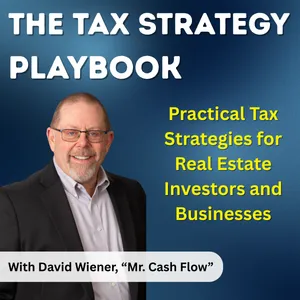
The Tax Strategy Playbook: Daily Summaries Delivered
by David Wiener, "Mr. Cash Flow"
The Tax Strategy Playbook is where real estate investors and business owners learn how to stop overpaying the IRS and turn taxes into an opportunity center instead of an annual pain point. Each episode, host David Wiener (“Mr. Cash Flow”) sits down with CPAs, tax attorneys, cost segregation experts, and top investors to break down complex tax rules into clear, step‑by‑step strategies you can actually use.You’ll hear real case studies, before‑and‑after numbers, and practical checklists on things like cost segregation, bonus depreciation, real estate professional status, short‑term rental strategies, entity structure, and more—without legalese or fluff. Expect straight talk, tactical advice you can hand to your CPA, and simple action items at the end of every show so you always know what to do next.
Latest Episodes
The most recent episodes — sign up to get AI-powered summaries of each one.
- Today41 min
Democrats Won Congress. Is Your Bonus Depreciation Gone?
Democrats won Congress. Your 100% bonus depreciation didn't change. Three depreciation deadlines did not care who won, and one of them lands in 2026. In this solo news episode, David Wiener, Mr. Cash Flow, sorts every post-election tax headline into three buckets (law, proposal, or needs a signature) and walks through what the midterms mean for bonus depreciation, cost segregation, Section 179D, the R&D tax credit and the new qualified production property deduction for factory buildings under Section 168(n). The answer to "is my bonus depreciation gone" is no: 100% bonus depreciation for property acquired and placed in service after January 19, 2025 has no end date in the statute, and your 2026 return gets filed under the law as it stands today. The deadlines that matter were written before a single vote was counted. If you signed a binding contract before January 19, 2025 on a building that still isn't placed in service, bonus depreciation is 20% in 2026 and 0% in 2027, so the placed-in-service date is worth a call to your tax professional this month. If you manufacture, produce or refine a product, construction on a new plant has to begin before January 1, 2029 for the 100% factory building deduction, and the election to take it goes on the original return. And if your exit plan leans on the step-up in basis, the proposal to end it is bucket two: not law, but worth one conversation with your estate planning attorney. Built for real estate investors who own rentals or commercial property, business owners who are building or expanding, and tax professionals whose clients are calling this week asking whether they should be worried. Three worked examples put numbers on it: a $500,000 cost segregation study placed in service one month apart, a $10 million plant split by production use, and a $200,000 first-year deduction taken now at 37% or later at 39.6%. CHAPTERS00:00 Democrats won Congress: is my bonus depreciation gone?03:34 Three buckets for every tax headline: law, proposal, or needs a signature04:47 Seven tax proposals on the table after the election: corporate rate, surtax, step-up, data centers09:13 100% bonus depreciation in 2026: what the One Big Beautiful Bill Act made permanent12:34 Pre-2025 contract? Bonus depreciation is 20% in 2026 and 0% in 202715:02 Qualified production property: deduct 100% of a new factory building (Section 168(n))20:29 Is 179D coming back? The R&D tax credit after the election23:39 Should you wait on depreciation if tax rates go up? The $200,000 example28:42 Step-up in basis proposal: swap till you drop, 1031 exchanges and your heirs37:35 Bonus depreciation playbook: 5 steps before December 31 Nothing in this episode is tax advice for your situation. Your numbers are your numbers, and they need a professional who knows them. Tax evasion is a crime, but tax avoidance is mandatory. Your host: David Wiener, "Mr. Cash Flow"Website: https://davidhwiener.comNo-cost analysis for cost segregation, 179D and R&D tax credits. No obligation, no pitch, and I'll tell you if a study won't pay for itself: https://calendly.com/david-wiener/cs or 770-224-8504 x2Email: david@davidhwiener.comFree newsletter and 2026 tax planning guide: https://www.taxstrategyplaybook.com/newsletter/YouTube: https://www.youtube.com/@TaxStrategyPlaybookPodcast/?sub_confirmation=1 #BonusDepreciation #CostSegregation #TaxPlanning #TaxStrategyPlaybook
- 1 weeks ago43 min
Charitable Remainder Trust: Sell Your building, Owe Nothing at Closing, Get Paid for Life
A charitable remainder trust lets you sell an appreciated building with no tax due at closing, reinvest every dollar, and collect income for life. The trade: what is left goes to a charity you pick, not your kids, and the tax does not disappear. It reaches you a slice at a time, in an order the tax code sets.In this solo episode of The Tax Strategy Playbook, David Wiener, Mr. Cash Flow, explains how a charitable remainder trust works in plain English: the charitable remainder annuity trust (CRAT) versus the charitable remainder unitrust (CRUT), and why the flip unitrust is built for real estate. You'll see the tier system that decides how your payments are taxed, what happens to years of depreciation inside the trust, and the rule that shrinks your charitable deduction on a building that has had a cost segregation study. Then one fourplex runs two ways, sold outright or put in a trust first, as a labeled illustration.You'll also get the 2026 charitable deduction changes (a floor of 0.5% of AGI for itemizers, a 35% benefit cap for the top bracket, and a new $1,000 or $2,000 deduction for people who don't itemize), year-end moves with a donor advised fund and appreciated stock, the Hoensheid Tax Court case on giving too late, why a mortgage causes trouble, and the annuity scheme the IRS treats as abusive. A properly drafted charitable remainder trust is settled law. That annuity version is not.Built for the real estate investor who would sell tomorrow if not for the tax bill, the business owner planning year-end giving, and the tax professional who will field 2026 charitable deduction questions this filing season.CHAPTERS00:00 Charitable remainder trust explained: sell a $1.3M building with no tax at closing03:11 What is a charitable remainder trust? CRAT vs CRUT vs flip unitrust07:15 Charitable remainder trust taxation: the tier system and your depreciation10:35 Charitable deduction changes for 2026: the 0.5% floor, 35% cap, donor advised funds15:04 Donating a cost segregated building: how depreciation recapture cuts the deduction19:32 Sell a rental outright vs charitable remainder trust: a fourplex example25:33 Charitable remainder trust mistakes: timing, debt, appraisal, self-dealing29:12 Charitable remainder trust myths and the abusive CRAT annuity scheme32:11 Who should use a charitable remainder trust? CRT vs 1031 exchange vs DST, plus FAQ40:00 Charitable remainder trust playbook: 5 steps before you sell Nothing in this episode is tax or legal advice for your situation. This is education, and your facts need your own tax professional and an estate attorney working together. Tax evasion is a crime, but tax avoidance is mandatory.Your host: David Wiener, "Mr. Cash Flow"https://davidhwiener.comDavid.wiener@cashflowstrategies.us770-224-8504x2Schedule a conversation or free consultation athttps://calendly.com/david-wiener/initial-consultationSubscribe to The Tax Strategy Playbook Podcast Channel:https://www.youtube.com/@TaxStrategyPlaybookPodcast/?sub_confirmation=1Get updates, special episodes and live streams, and free resources on the latest tax strategies:https://www.taxstrategyplaybook.com/newsletter/ #CharitableRemainderTrust #CapitalGainsTax #RealEstateInvesting #CostSegregation #TaxStrategyPlaybook
- 2 weeks ago38 min
R&D Tax Credit: Getting Paid Isn't the Problem, Your Contract Is
Getting paid by a client won't cost you the R&D tax credit. Your contract can. Two tests decide whose credit it is when a client pays for the work. In part two of a four-part solo series on the research and development tax credit, David Wiener, Mr. Cash Flow, walks through the funded research rule in plain English. The risk test asks whether you were going to be paid whether the research worked or not. The rights test asks whether you can use what you figured out in your own business without paying the client for it. You have to pass both. Fail the first and you can lose some or all of the credit on a project. Fail the second and you lose all of it. Along the way: how hourly, capped, fixed fee, and milestone contracts hold up under the risk test, why a work for hire or IP assignment clause buried in a master service agreement can zero out a project, a software shop that loses the credit on one project and keeps it on another for the same client in the same year, and what two federal appeals courts held in Geosyntec and Meyer, Borgman and Johnson. Whether a fixed fee contract where you eat the overruns satisfies the risk test is still debated by courts and practitioners, and the episode treats it that way.Built for engineering firms, architecture practices, software developers, product design studios, and custom manufacturers whose research runs through somebody else's paperwork. If you pay outside engineers or developers to do research for you, the same two questions run in reverse. Tax professionals get notes on why funded research comes up early when a service firm's claim is examined, and why the master agreement belongs in the file.CHAPTERS00:00 R&D tax credit on client work: when a client pays, whose credit is it?04:00 What is funded research? The R&D credit rule in plain English06:05 R&D credit risk test: who pays when the research fails?09:51 Hourly, capped, fixed fee, milestone billing: which contracts fund the research12:12 Failed the risk test? How a cost overrun can still count toward the credit14:35 Substantial rights test: the contract clause that can zero out the R&D credit16:56 Work for hire and IP clauses for architects, engineers and software firms22:34 R&D credit project by project: Form 6765 Section G and two court cases29:46 Paying a contractor for R&D: the 65% rule and who claims the credit33:10 R&D tax credit playbook: 6 steps to check your client contracts this week Nothing in this episode is tax advice for your firm. Your facts need a tax professional who knows them and, on this topic, an attorney who knows your contracts too. Tax evasion is a crime, but tax avoidance is mandatory.Your host: David Wiener, "Mr. Cash Flow"https://davidhwiener.comDavid.wiener@cashflowstrategies.us770-224-8504x2Schedule a conversation or free consultation athttps://calendly.com/david-wiener/initial-consultationSubscribe to The Tax Strategy Playbook Podcast Channel:https://www.youtube.com/@TaxStrategyPlaybookPodcast/?sub_confirmation=1Get updates, special episodes and live streams, and free resources on the latest tax strategies:https://www.taxstrategyplaybook.com/newsletter/ #RDTaxCredit #TaxCredits #ResearchAndDevelopment #TaxStrategyPlaybook
- 3 weeks ago41 min
Rental Property Depreciation Explained: How It's Calculated
Rental property depreciation is the one deduction the IRS counts against you whether you take it or not. Here's how yours is calculated, line by line. In this solo episode of The Tax Strategy Playbook, David Wiener, Mr. Cash Flow, walks through real estate depreciation from the beginning. You'll see what goes into your cost basis and what stays out, how to split land from building using your county assessor's ratio instead of a flat 20 percent guess, why the clock starts on the placed in service date (the day the property is ready and available for rent) instead of the closing date, and how the mid-month convention shapes your first year. If you've ever searched how to calculate depreciation on rental property, the duplex example in this episode is the whole answer. Then David takes apart the advice to skip depreciation so you won't owe tax when you sell. The IRS lowers your basis by the depreciation allowed or allowable, whichever is greater, so the deduction you skipped still counts against you at the sale. Of all your rental property tax deductions, depreciation is the one that never costs you a check, and it still matters on a rental that shows a loss. Built for the investor with one to five rentals who has never looked at the depreciation line on their own return, the business owner who owns or is buying a rental or the building their company runs out of, and the tax professional who wants a plain English version to hand a client. It also covers converted homes, inherited rentals, short-term rentals (where 27.5 versus 39 years is a judgment call your tax professional makes), and when an engineering-based cost segregation study, with an in-person site visit, moves parts of the building onto 5, 7, and 15 year schedules. Every dollar figure in the episode is an illustration, not a client. CHAPTERS00:00 What is rental property depreciation? 27.5 vs 39 years explained05:12 How to find your cost basis and split land from building10:11 When does depreciation start on a rental? Placed in service and the mid-month convention13:12 How to calculate depreciation on rental property: a duplex example17:39 Repairs vs improvements: de minimis safe harbor and the old roof problem21:33 Do you have to depreciate rental property? Allowed or allowable and passive losses25:12 Depreciation on a converted home, inherited rental, short-term rental, or business building28:37 Cost segregation and 100% bonus depreciation on a rental property33:34 Rental property depreciation FAQ37:06 Your rental property depreciation playbook: five steps this week Nothing in this episode is tax advice for your situation. Your numbers are your numbers and they need a professional who knows them. Tax evasion is a crime, but tax avoidance is mandatory. Your host: David Wiener, "Mr. Cash Flow"https://davidhwiener.comDavid.wiener@cashflowstrategies.us770-224-8504x2Schedule a conversation or free consultation athttps://calendly.com/david-wiener/initial-consultationSubscribe to The Tax Strategy Playbook Podcast Channel:https://www.youtube.com/@TaxStrategyPlaybookPodcast/?sub_confirmation=1Get updates, special episodes and live streams, and free resources on the latest tax strategies:https://www.taxstrategyplaybook.com/newsletter/ #RentalPropertyDepreciation #RealEstateDepreciation #RentalPropertyTaxDeductions #CostSegregation #TaxStrategyPlaybook
- 4 weeks ago38 min
R&D Tax Credit for Startups: Get Paid Even If You're Losing Money
The R&D tax credit can pay a startup that is losing money, through payroll taxes it already owes. Miss one box or one date and the cash waits, or never comes.Most small business tax credits aren't hidden. They're missed, because every one of them runs on a clock. In this solo episode of The Tax Strategy Playbook, David Wiener, Mr. Cash Flow, opens a four-part series on the research and development tax credit with the question founders ask most: we don't make money yet, does any of this help us? It does. A qualified small business, one under $5 million in gross receipts and within its first five years of receipts, can elect to use up to $500,000 a year of R&D credit against the employer share of Social Security and Medicare. David walks through the three clocks that decide whether that money shows up and when, including how a filing date moved one startup's $90,000 by nine months.Then the lens widens to the tax credits for businesses with employees: the SECURE 2.0 retirement plan credits, worth about $65,000 over five years for one 18-person company, the small employer health care credit, the paid family and medical leave credit that changed for 2026, and the credits that are gone for 2026 hires.Built for the founder or CFO of a young company paying engineers, developers or designers and not yet profitable, the owner of an established business with 10, 20 or 50 employees who has never been walked through the credits that come with having them, and the tax professional who wants to know where the traps sit in the middle of extension season.CHAPTERS:00:00 Small business tax credits: why they're missed, not hidden03:50 Tax credit vs tax deduction: which one saves you more05:53 What qualifies for the R&D tax credit (no lab required)09:20 R&D tax credit for startups: using it against payroll taxes10:37 Who qualifies for the R&D payroll tax offset: the $5 million and five-year tests14:24 When does the R&D payroll credit start? The filing date that costs nine months18:06 R&D tax credit example: a 12-person startup's $90,000, quarter by quarter22:28 Retirement plan tax credits for small business: SECURE 2.0 and Form 888125:45 Small business health care tax credit and the paid family leave credit for 202629:33 Is the Work Opportunity Tax Credit gone? FAQ and the PlaybookNothing in this episode is tax advice for your situation. Your facts are your facts, and they need a professional who knows them, so work with your own tax professional. Tax evasion is a crime, but tax avoidance is mandatory.Your host: David Wiener, "Mr. Cash Flow"https://davidhwiener.comDavid.wiener@cashflowstrategies.us770-224-8504, option twoBook a no-cost analysis. No obligation, no pitch, and David will tell you if a study won't pay for itself:https://calendly.com/david-wiener/csSubscribe to The Tax Strategy Playbook Podcast Channel:https://www.youtube.com/@TaxStrategyPlaybookPodcast/?sub_confirmation=1Get updates, special episodes and live streams, and free resources on the latest tax strategies:https://www.taxstrategyplaybook.com/newsletter/ #RDTaxCredit #SmallBusinessTaxCredits #StartupTaxes #PayrollTaxCredit #TaxStrategyPlaybook
- Oct 6, 202636 min
Why Nobody on Your Team Has Mentioned Cost Segregation
Cost segregation is a real estate tax deduction many of the largest property owners never use. The reason has nothing to do with money. David Wiener, Mr. Cash Flow, sits down with DJ Van Keuren, founder of the Family Office Real Estate Institute and co-founder of Evergreen Property Partners, who has spent 25 years inside family office real estate. They cover why a cost segregation study so often never reaches the people who make the decisions, who actually brings a new tax strategy to a wealthy family, why DJ's annual family office study finds about 80 percent of families do not do 1031 exchanges, how 100% bonus depreciation changes the math when a deal is underwritten, how depreciation recapture works when you sell, and when not to do a cost segregation study at all. Built for the real estate investor who assumes a bigger portfolio means better tax planning, the business owner who owns the building the company runs out of and has never had anyone look at it closely, and the tax professional who knows how cost segregation works and wants a 25-year view of how these conversations start inside a family office, and who starts them. WHAT YOU WILL LEARNWhy a missed cost segregation study is usually an oversight, not a decision, and who is most likely to raise itHow wealthy families pick advisors by trust, and why a bigger team can mean fewer tax strategies reach youThe five types of family office real estate investors and which ones have someone watching for cost segWhen not to do a cost segregation study: a short hold, a sale without a 1031 exchange, losses you cannot use yetWhy tax benefits belong in the real estate underwriting model, and how depreciation recapture works on the way out CHAPTERS00:00 Same tax code, different outcome: why big real estate owners miss cost segregation03:03 What is cost segregation? 27.5 and 39 years vs 5, 7, and 15 year property explained04:39 Why family offices underuse cost segregation, and what the callers asked05:56 Missed tax strategy: a decision or an oversight? Who wealthy families trust09:20 The five types of family office real estate investors and who handles cost seg13:18 How many families skip 1031 exchanges and opportunity zones18:24 When not to do a cost segregation study: short holds, small properties, passive losses20:30 Bonus depreciation in the underwriting model: how tax benefits change real estate returns24:26 Depreciation recapture, 1031 exchanges, and why cost seg cannot fix a bad deal29:24 Your cost segregation playbook: the question to ask your tax professional this week Nothing in this episode is tax advice for your situation. Your numbers are your numbers and they need a professional who knows them. Tax evasion is a crime, but tax avoidance is mandatory. Your host: David Wiener, "Mr. Cash Flow"https://davidhwiener.comDavid.wiener@cashflowstrategies.us770-224-8504x2Schedule a conversation or free consultation athttps://calendly.com/david-wiener/initial-consultationSubscribe to The Tax Strategy Playbook Podcast Channel:https://www.youtube.com/@TaxStrategyPlaybookPodcast/?sub_confirmation=1Get updates, special episodes and live streams, and free resources on the latest tax strategies:https://www.taxstrategyplaybook.com/newsletter/#CostSegregation #FamilyOffice #RealEstateTaxStrategies #RealEstateInvesting #TaxStrategyPlaybook
- Sep 29, 202645 min
179D Is Not Dead: Claim It on a Building You Have Owned for Years
The 179D deduction did not die on June 30, 2026. The energy efficient commercial building deduction closed to new projects that begin construction after that date, and that is the entire loss. Every commercial building already placed in service still qualifies, and so does every project that broke ground before July 1. If you own a warehouse, office, hotel, self storage facility, medical building, or an apartment building four stories or taller placed in service since 2006 and never claimed section 179D on it, you can catch the whole deduction up on your current return through Form 3115, change number 152, without amending a single old year. David Wiener, Mr. Cash Flow, walks both doors: the 179D tax deduction rates by year, from a flat $1.80 a square foot before 2023 to the 2026 scale of $0.59 to $1.19 base and $2.97 to $5.94 with prevailing wage, Form 7205 and the engineering certification behind it, the 179D allocation letter that hands the deduction to architects and engineers, and why 179D and cost segregation pull from two different piles on the same building. Built for three people. The owner or investor who never claimed 179D on a building or a renovation. The developer whose project was underway this spring and finishes years from now. And the architects and engineers who design for schools, cities, hospitals and universities, because your version runs on a three year clock, not a twenty year one.
- Sep 22, 202625 min
Why Mobile Home Parks Are One of the Best Cost Segregation Assets in Real Estate
Mobile home park investing has a cost segregation edge most real estate investors never see. On most manufactured housing communities the operator owns the land and the residents own their homes, so nearly the whole purchase price sits in roads, utility lines, pads, and site work instead of a 27.5 year building. Run an engineering-based cost segregation study on that and 40 to 80 percent of the purchase price can land in 15-year land improvements that qualify for 100% bonus depreciation in year one. David Wiener, Mr. Cash Flow, sits down with Leo Young, founder and managing partner of Cornell Communities, an operator of more than 500 pads across eight states, to walk through what a cost seg study finds on a park, what changed when the One Big Beautiful Bill Act made 100 percent bonus depreciation permanent, when to order the study, what the engineer needs on site, and a real acquisition where a $1.05 million park produced close to $800,000 in accelerated depreciation. Built for the real estate investor who has passed on manufactured housing because it looked small next to an apartment complex, the passive investor weighing an operator's deal and the K-1 that comes with it, and the business owner or tax professional who wants to see exactly where the depreciation comes from on a land-heavy asset. WHAT YOU WILL LEARNWhy mobile home parks beat apartment buildings on cost segregation: land improvements, not a 27.5 year structureWhat a cost segregation study finds on a manufactured housing community: roads, utilities, pads, fencing, signage, and how park-owned homes push the number toward 80 percent100% bonus depreciation under the One Big Beautiful Bill Act, and why the placed-in-service date controls, not the date of the studyWhen to commission the study, what to hand the engineer, and why septic tanks and buried water lines need an on-site walkthrough with your contactHow to vet an operator before you invest: why the jockey matters more than the horse, and the recourse and exit questions to askCHAPTERS Nothing in this episode is tax advice for your situation. Your numbers are your numbers and they need a professional who knows them. Tax evasion is a crime, but tax avoidance is mandatory. Your host: David Wiener, "Mr. Cash Flow"https://davidhwiener.comDavid.wiener@cashflowstrategies.us770-224-8504x2Schedule a conversation or free consultation athttps://calendly.com/david-wiener/initial-consultationSubscribe to The Tax Strategy Playbook Podcast Channel:https://www.youtube.com/@TaxStrategyPlaybookPodcast/?sub_confirmation=1Get updates, special episodes and live streams, and free resources on the latest tax strategies:https://www.taxstrategyplaybook.com/newsletter/ #CostSegregation #MobileHomeParkInvesting #BonusDepreciation #RealEstateInvesting #TaxStrategyPlaybook
Get The Tax Strategy Playbook summaries in your inbox
Free AI-powered daily recaps. Key takeaways, quotes, and mentions — in a 5-minute read.
Get Free Summaries →Free forever for up to 3 podcasts. No credit card required.
You Might Also Like
Listeners also like.

The Owner Meeting
Real estate investors share proven strategies and costly mistakes to help others build wealth and achieve financial freedom.

Cornerstone Private Office
Covers tax planning, asset protection, and estate design for business owners and investors building long-term wealth.

One Rental At A Time
A guide to achieving financial freedom by building wealth through buying and holding rental properties.

Real Estate Insider Podcast
Real Estate Insider

Jet Setting Wealth Advisory
A financial advisor and airline pilot explores wealth management through aviation-themed stories and expert interviews.

The Deduction
Experts explain tax policy, trade, and economic impacts in plain terms.

The Deduction
Experts explain tax policy, tariffs, and economic debates in clear, accessible episodes.

What's Your Deal? | Business Buying, Business Acquisitions, Investing & Exit Strategies
Analyzes business acquisitions, financing, and exit strategies for entrepreneurs and investors.

BiggerPockets Business Podcast
Real entrepreneurs share practical advice on starting, growing, and selling businesses, covering hiring, marketing, and raising capital.
The Abundant Accountant Podcast: Sales & Business Growth for Accounting, Tax, and Bookkeeping Firm Owners
Teaches accounting, tax, and bookkeeping firm owners how to raise fees, improve sales, and build profitable firms without burnout.

The Investor's Podcast (We Study Billionaires) - The Investor’s Podcast Network
Analyzes the investment strategies of billionaire investors and explores lessons from legendary financiers on wealth, wisdom, and life.

Money Rehab with Nicole Lapin
A financial guide to overcoming money taboos and improving personal finance with practical advice from Nicole Lapin.
About The Tax Strategy Playbook
The Tax Strategy Playbook is where real estate investors and business owners learn how to stop overpaying the IRS and turn taxes into an opportunity center instead of an annual pain point. Each episode, host David Wiener (“Mr. Cash Flow”) sits down with CPAs, tax attorneys, cost segregation experts, and top investors to break down complex tax rules into clear, step‑by‑step strategies you can actually use.You’ll hear real case studies, before‑and‑after numbers, and practical checklists on things like cost segregation, bonus depreciation, real estate professional status, short‑term rental strategies, entity structure, and more—without legalese or fluff. Expect straight talk, tactical advice you can hand to your CPA, and simple action items at the end of every show so you always know what to do next.
Customized Recaps
AI-powered recaps with compact key takeaways, quotes, and insights.
Straight to Your Inbox
Get key takeaways from The Tax Strategy Playbook in a 5-minute read.
Save Hours Every Week
Stay current on your favorite podcasts without falling behind.
Frequently Asked Questions
What is Podzilla's The Tax Strategy Playbook daily summary?
It's a free AI-powered email that summarizes new episodes of The Tax Strategy Playbook as soon as they're published. You get the key takeaways, notable quotes, and links & mentions — all in a quick read.
How does the The Tax Strategy Playbook podcast summary work?
When a new episode drops, our AI transcribes and analyzes it, then generates a personalized summary tailored to your interests and profession. It's delivered to your inbox every morning.
Is this an official The Tax Strategy Playbook product?
No. Podzilla is an independent service that summarizes publicly available podcast content. We're not affiliated with or endorsed by David Wiener, "Mr. Cash Flow".
Can I get summaries of other podcasts too?
Absolutely! The free plan covers up to 3 podcasts, any in the catalog. Basic raises that to 15, Pro to 40 and Max to 100. Browse our full catalog at /podcasts.
What topics does The Tax Strategy Playbook cover?
The Tax Strategy Playbook covers topics including Business, Investing. Our AI identifies the specific themes in each episode and highlights what matters most to you.
Start getting The Tax Strategy Playbook summaries tomorrow morning.
Free forever for up to 3 podcasts. No credit card required.
Free forever for up to 3 podcasts. No credit card required.