Free Daily Podcast Summary
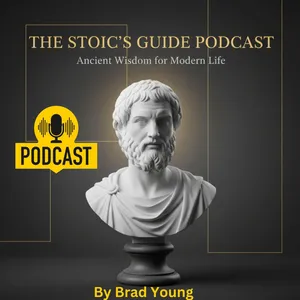
The Stoic’s Guide Podcast by Brad Young: Daily Summaries Delivered
by Brad Young
Hosted by Brad Young — multi‑time bestselling author. Discover how ancient wisdom can transform modern life. In a world overloaded with noise, stress, and distraction, The Stoic’s Guide Podcast helps you find clarity, strength, and purpose through the timeless teachings of Marcus Aurelius, Seneca, Epictetus, and other great Stoic thinkers. Brad Young breaks down their most powerful ideas into simple, practical strategies you can apply immediately—whether you’re navigating challenges in your career, relationships, or personal growth. Each episode delivers actionable insights to help you build resilience, master your emotions, and cultivate inner peace in a chaotic world. If you’re ready to live with more intention, stability, and meaning, this podcast gives you the tools to thrive. Ancient wisdom for modern life.
Latest Episodes
The most recent episodes — sign up to get AI-powered summaries of each one.
- 5 days ago16 min
Stoicism in the Age of Overload
I want to start with something I've been sitting with for a while. There is more information hitting my brain in a single morning than a Roman senator would have encountered in a month. I'm not exaggerating that. I'm not being dramatic for the sake of a podcast hook. That's just the actual reality of what we're navigating right now. And the thing is, nobody really warned us that this would happen. Nobody handed us a user manual for the information environment we currently live inside of. When I started seriously reading the Stoics — and I mean really reading them, not just pulling Marcus Aurelius quotes for Instagram — I noticed something that surprised me. These people were not living in a quiet world. Rome at its height was chaotic, politically violent, economically unstable, and full of gossip and noise. Seneca wrote letters from within a culture that was drowning in spectacle. Marcus Aurelius wrote his private journal while running military campaigns. Epictetus was a former enslaved person navigating one of the most brutal institutions in human history. These were not people writing from mountaintop retreats. They were writing from inside the storm. That's why I think Stoicism hits differently in 2026 than it might have twenty years ago. We're not looking for a philosophy that helps us optimize a comfortable life. We're looking for something that helps us function when everything is loud, when the notifications never stop, when every platform is architecturally designed to keep your nervous system in a low-grade state of alarm. The Stoics were solving for that exact problem. Just in a different century. Learn more about your ad choices. Visit megaphone.fm/adchoices
- 1 weeks ago16 min
The Stoic Blueprint for a Chaotic World
Today, we’re breaking down The Stoic Blueprint for a Chaotic World , not as ancient philosophy, but as a tactical framework for modern life. A blueprint for thinking clearly when everything around you is engineered to pull you off center. A blueprint for staying grounded when the world is shaking. A blueprint for choosing your response instead of being dragged by your reactions. The Stoics didn’t promise calm lives. They promised strong minds. And in a time where chaos is the default setting, strength isn’t optional — it’s survival. Learn more about your ad choices. Visit megaphone.fm/adchoices
- 2 weeks ago20 min
Living With Virtue: The One Thing That Was Always the Point
Let me start with a question, and I want you to be honest with yourself, because nobody hears your answer but you. If everything you were chasing suddenly vanished, the money, the status, the approval of the people whose opinions you care about most, what would be left of you? Strip all of it away, and what remains? Sit with that for a second. Because whatever remains when everything external is gone, that is the real you. That is your character. And the Stoics believed, with their whole hearts, that this one thing, your character, was the only thing that ever truly mattered. Learn more about your ad choices. Visit megaphone.fm/adchoices
- 2 weeks ago13 min
The Shortness of Life: Why You Have More Time Than You Think and Less Than You Waste
Life feels short, but much of that feeling comes from how easily time slips through our fingers when we live without intention. This episode, The Shortness of Life, explores one of the Stoics’ most powerful teachings: time is both abundant and scarce, depending entirely on how you choose to use it. Drawing from the insights of Seneca and other Stoic thinkers, we examine why people often feel rushed, overwhelmed, or behind — not because life is too brief, but because so much of it is spent on distraction, obligation, and unconscious habits. Modern research on attention, productivity, and psychological well‑being echoes the Stoic warning: the greatest threat to a meaningful life is not a lack of time, but the careless spending of it. Listeners will learn how to reclaim hours, days, and even years by practicing deliberate focus, eliminating trivial commitments, and aligning daily actions with long‑term values. This episode offers a clear, practical framework for living with urgency and spaciousness — the Stoic way of treating time as your most precious asset.
- 3 weeks ago11 min
The Stoic Morning: How to Win the Day Before It Begins
Let me start with a question, and I want you to be honest with yourself, because nobody hears your answer but you. Think about how you actually begin your day. Not the day you wish you had, the one you really have. When you first open your eyes, what happens? Do you reach for your phone before your feet even touch the floor, letting a flood of messages, news, and other people's demands pour into your mind before you have had a single thought of your own? Or do you take a quiet moment, before the world gets to you, to decide the kind of person you want to be today? Sit with that for a second. Because how you begin your morning quietly shapes everything that follows, and most of us hand those first precious minutes away without even noticing. Today, we talk about taking them back.
- Aug 20, 202613 min
Mastering Anger: How to Cool the Fire Before It Burns Down Your Life
Let me start with a question, and I want you to be honest with yourself, because nobody hears your answer but you. Think about the last time you truly lost your temper. Not a small flash of irritation. Real anger. The kind that made your heart pound, your voice rise, your hands shake. Now think about what came out of it. Did that anger fix the thing that made you angry? Did it make your life better in any way? Or did it leave a mess behind, a broken conversation, a wound in someone you love, a knot in your own stomach that lingered for hours or even days after the person who triggered it had moved on with their life?
- Aug 15, 202613 min
Negative Visualization: Why Imagining Loss Is the Secret to Gratitude
Let me start with a question, and I want you to be honest with yourself, because nobody hears your answer but you. Think about the people and the things in your life that you love the most. The person sleeping beside you. The child in the next room. The health of your body. The roof over your head. Now be honest about something. When was the last time you actually felt grateful for any of them? Not said the words. Felt it. Really felt the weight of how much you would miss them if they were suddenly gone. Sit with that for a second. Because most of us walk right past our greatest treasures every single day without a second glance, and we only wake up to their value the moment we lose them. Today, we talk about a practice that fixes that, and it is one of the strangest and most powerful ideas the Stoics ever gave us.
- Aug 10, 202611 min
The Dichotomy of Control: Finding Peace in What You Can and Cannot Change
Let me start with a question, and I want you to be honest with yourself, because nobody hears your answer but you. Think about the last time you lay awake at night, your mind spinning, your chest tight, worry running in circles that would not stop. Now be honest about what you were worrying about. Were you worrying about what someone else might think of you? Were you replaying something that already happened and could not be changed? Were you dreading something in the future that you had no power over anyway? Sit with that for a second. Because I would bet almost everything I own that most of what steals your peace lives entirely outside your control. And learning to see that, clearly and honestly, is the entire subject of today.
About The Stoic’s Guide Podcast by Brad Young
Hosted by Brad Young — multi‑time bestselling author. Discover how ancient wisdom can transform modern life. In a world overloaded with noise, stress, and distraction, The Stoic’s Guide Podcast helps you find clarity, strength, and purpose through the timeless teachings of Marcus Aurelius, Seneca, Epictetus, and other great Stoic thinkers. Brad Young breaks down their most powerful ideas into simple, practical strategies you can apply immediately—whether you’re navigating challenges in your career, relationships, or personal growth. Each episode delivers actionable insights to help you build resilience, master your emotions, and cultivate inner peace in a chaotic world. If you’re ready to live with more intention, stability, and meaning, this podcast gives you the tools to thrive. Ancient wisdom for modern life.
Customized Recaps
AI-powered recaps with compact key takeaways, quotes, and insights.
Straight to Your Inbox
Get key takeaways from The Stoic’s Guide Podcast by Brad Young in a 5-minute read.
Save Hours Every Week
Stay current on your favorite podcasts without falling behind.
Frequently Asked Questions
What is Podzilla's The Stoic’s Guide Podcast by Brad Young daily summary?
It's a free AI-powered email that summarizes new episodes of The Stoic’s Guide Podcast by Brad Young as soon as they're published. You get the key takeaways, notable quotes, and links & mentions — all in a quick read.
How does the The Stoic’s Guide Podcast by Brad Young podcast summary work?
When a new episode drops, our AI transcribes and analyzes it, then generates a personalized summary tailored to your interests and profession. It's delivered to your inbox every morning.
Is this an official The Stoic’s Guide Podcast by Brad Young product?
No. Podzilla is an independent service that summarizes publicly available podcast content. We're not affiliated with or endorsed by Brad Young.
Can I get summaries of other podcasts too?
Absolutely! The free plan covers up to 3 podcasts. Upgrade to Pro for 15, or Premium for 50. Browse our full catalog at /podcasts.
How often does The Stoic’s Guide Podcast by Brad Young release new episodes?
The Stoic’s Guide Podcast by Brad Young publishes weekly. Our AI generates a summary within hours of each new episode.
What topics does The Stoic’s Guide Podcast by Brad Young cover?
The Stoic’s Guide Podcast by Brad Young covers topics including Education, Culture, Society & Culture, Self-Improvement. Our AI identifies the specific themes in each episode and highlights what matters most to you.
Start getting The Stoic’s Guide Podcast by Brad Young summaries tomorrow morning.
Free forever for up to 3 podcasts. No credit card required.
Free forever for up to 3 podcasts. No credit card required.