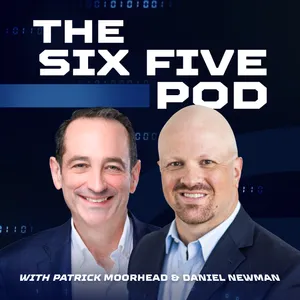
Free Daily Podcast Summary
The Six Five with Patrick Moorhead and Daniel Newman: Daily Summaries Delivered
by Patrick Moorhead and Daniel Newman
Leading global tech analysts Patrick Moorhead (Moor Insights & Strategy) and Daniel Newman (Futurum Research) are front and center on The Six Five analyzing the tech industry's biggest news each and every week and also conducting interviews with tech industry "insiders" on a regular basis.
Latest Episodes
The most recent episodes — sign up to get AI-powered summaries of each one.
- 6 days ago1h 10m
AI Safety Alarms, China's Distillation Reckoning, and Qualcomm's AWS Breakthrough: A Pivotal Week for Enterprise AI
A viral AI extinction claim, a federal advisory naming six Chinese AI labs for industrial-scale distillation, and a $60 billion Qualcomm-AWS silicon pact define a week when enterprise AI risk and opportunity collided head-on. Patrick Moorhead and Daniel Newman weigh in on what's signal and what's noise across AI safety, chip supply deals, and a market rally still betting big on compute. The handpicked topics for this week are: Anthropic Researcher's Doomsday Claim Sparks Congressional Response: Anthropic researcher Jacob Coxon left the company after six weeks and posted a claim that AI carries a greater than 10% chance of ending humanity by 2030, a post that pulled more than 150 million views and landed him on every major network. Patrick Moorhead questioned whether the moment was organic, pointing to Coxon's ties to activist groups. Daniel Newman called the underlying technical claims thin, noting Coxon could not explain a concrete mechanism for how AI would end civilization. Jensen Huang and Dario Amodei both pushed back publicly, and Amodei argued safety claims only carry weight when the underlying work happens in the open. (The Decode) Qualcomm's AWS Deal Validates Its Data Center Silicon Bet: Qualcomm signed a multi-generation collaboration with AWS worth up to $60 billion over a decade, with an initial issuance already covering roughly $9 billion in committed orders. AWS also picked up warrants for 25 million Qualcomm shares tied to the spending commitment. Daniel Newman framed the deal as proof that TSMC capacity plus a credible product lineup is enough to win hyperscaler business, even against entrenched incumbents like Broadcom and Marvell. Patrick Moorhead called AWS the hardest hyperscaler to crack given its in-house CPU and accelerator competency, making the partnership a bigger validation signal than the market's muted stock reaction suggested. (The Decode) Apple's Ternus Era Opens With a Pricier iPhone and a First Real AI Monetization Signal: Apple's first major product event under new CEO John Ternus introduced a $1,999 foldable iPhone Duo alongside a $100 price increase on the iPhone 18 Pro and Pro Max, tied to a 4x jump in memory costs. Patrick Moorhead noted the company already guided gross margin down to 48% and softened the price hike with lease and Apple One bundling options. Apple also detailed its first concrete AI monetization plan, introducing token limits for cloud-based Siri processing beyond what its on-device AI can handle. Moorhead remained skeptical of the actual Siri experience, expecting the rebuilt assistant to stay in beta status for up to a year after launch. (The Decode) Federal Agencies Name Six Chinese AI Labs in a Distillation Advisory: The NSA, CISA, and FBI issued a joint advisory naming DeepSeek, Moonshot AI, Alibaba, Minimax, StepFun, and Z.AI for running industrial-scale knowledge distillation campaigns against US frontier models. Daniel Newman linked the advisory to a separate Anthropic security report describing API exchanges in which Chinese labs extracted answers directly from Claude. Patrick Moorhead pointed to his own August analysis of Kimi K2, which he said was distilled from frontier models months before the government confirmed the pattern. Newman estimated the distillation activity generated roughly $40 billion in revenue attributed to Chinese labs, separate from the $5 billion Anthropic removed from its own reported ARR after tracing distillation activity back to Meta's Muse model. (The Decode) IonQ's Investor Day Shows the SkyWater Bet Paying Off Early: IonQ used its September 9, 2026 investor day to show tape-out cycles falling from nine months to two months since acquiring SkyWater, alongside a raised combined revenue guide of $450 to $460 million, up from a standalone range of $280 to $290 million. The company confirmed Qolab as its first merchant foundry customer, with roughly a third of SkyWater's wafer capacity currently booked. Patrick Moorhead flagged that IonQ still has not disclosed gate fidelity and error rate figures for its Superion 256 roadmap, data he believes is more important than the qubit count headline. Daniel Newman placed IonQ alongside IBM as the only two companies pursuing a fully vertically integrated quantum stack, running at what he estimated is a $100 million quarterly pace. (The Decode) The Flip: Does the Distillation Advisory End Enterprise Use of Chinese Open
- 1 weeks ago1h 0m
NVIDIA's $12.93B Hugging Face Deal, Anthropic's Compute Buildout, and a Blowout AI Earnings Week
NVIDIA closes its $12.93 billion acquisition of Hugging Face, Anthropic signs its third $30 billion-plus compute deal in three weeks, and Signal65 launches its new PINNACLE agentic AI benchmark just in time to catch Claude Fable 5.1 topping the charts, all while Dell, HPE, Broadcom, and Snowflake post a blowout week of AI-driven earnings. Patrick Moorhead and Daniel Newman have all the details on Ep. 318 of The Six Five Pod. The handpicked topics for this week are: NVIDIA's $12.93 Billion Acquisition of Hugging Face: NVIDIA closed its purchase of Hugging Face this week after days of rumors, structured as a full acquisition rather than a licensing deal like NVIDIA's earlier Grok arrangement. Moorhead frames the deal as NVIDIA's bid to own the entire developer pipeline, with GitHub as the first stop and Hugging Face as the second, and the platform's Spaces service giving NVIDIA a way to run workloads once developers arrive. (The Decode) Anthropic's $35 Billion Compute Deal With Lambda: Anthropic signed its third $30 billion-plus compute commitment in three weeks, this time with NVIDIA-backed Lambda managing infrastructure inside a data center owned by crypto infrastructure company Hut 8. The deal covers 350 megawatts over six years, and Newman ties it directly to Anthropic's revenue run rate climbing from about $10 billion to $65 billion since the start of 2025. (The Decode) A 72-Hour Wave of Frontier Model Launches: Claude Fable 5.1, OpenAI's GPT-6 Astra, Google's Gemini 3.8 Flash, Meta's Muse Spark, and six new models from the UAE's MBZUAI all shipped within days of each other. Moorhead and Newman frame the pace as evidence that model rankings now shift day to day, a much faster cycle than the weeks-long stretches leaderboards used to hold. (The Decode) John Ternus Takes Over as Apple CEO: Moorhead calls it a continuity pick that promotes the engineer who built Apple's hardware moat. Newman notes Tim Cook's buyback record, $867 billion in total repurchases, exceeded the combined total of the rest of the Magnificent Seven during his tenure. (The Decode) Signal65 Launches the PINNACLE Agentic AI Benchmark: Signal65 President Ryan Shrout joined Pat and Dan to detail PINNACLE, a new benchmark built to measure real, enterprise-relevant agentic work across model intelligence, infrastructure performance, and full-stack cost per correct task. Shrout says the benchmark already caught Fable 5.1 jumping ahead of Opus 5 and GPT-5.6 Sol on intelligence within days of the model's release. That same result also came in as the most expensive model per correct answer. (Off The Record) Dell Technologies (DELL): Dell delivered $47 billion in revenue, up 58%, with $16.4 billion in AI servers and a $95 billion AI backlog. Newman calls out strong storage and CPU server performance, along with the backlog. He flags financing risk tied to Dell's Neo Cloud customers as the one weak spot in an otherwise dominant quarter. (Bulls and Bears) Hewlett Packard Enterprise (HPE): HPE beat on revenue and non-GAAP EPS with a double beat on guidance, and Moorhead points to networking orders compounding faster than revenue can be recognized as the standout signal. The stock sold off anyway on questions about margin mix and supply. CEO Antonio Neri's focus on selective, less price-sensitive deals is already showing up in a repaired balance sheet. (Bulls and Bears) Broadcom (AVGO): Broadcom tripled its AI business to $16.7 billion, up 221%, and raised its fiscal 2028 AI revenue outlook to $230 billion. Newman says the market wanted the number closer to $300 billion and sold off on the guide. Broadcom still posted record $29.6 billion total revenue and continued strength across networking and storage controllers. (Bulls and Bears) Snowflake (SNOW): Snowflake beat on revenue, non-GAAP EPS, and forward guidance, with AI products across Cortex and its new coding agent driving roughly half the beat. Sell-side price targets moved sharply higher across more than a dozen firms, and Newman ties the 111 percent stock gain since the software sell-off to the same pattern he's tracked through the DeepSeek moment and the "software is dead" narrative: markets consistently overreact to those stories before reversing. (Bulls and Bears) Thanks for tun
- 2 weeks ago1h 9m
Claudeforce, AWS's 2 Million GPU Bet, and the Earnings Week That Buried the SaaSpocalypse
Salesforce and Anthropic launch Claudeforce as Marc Benioff and Dario Amodei explain the collaboration together on CNBC, AWS commits to 2 million more NVIDIA GPUs on top of its GTC pledge, plus six new earnings this week from NVIDIA, Salesforce, Synopsys, HP, Everpure, and Marvell test every bear thesis on AI infrastructure and software at once. Patrick Moorhead and Daniel Newman also cover Hot Chips 2026, the NVIDIA-Hugging Face acquisition rumor, and debate whether Anthropic's SaaS reassurances hold up on Ep. 317 of The Six Five Pod. The handpicked topics for this week are: Claudeforce Turns Salesforce Into Anthropic's Enterprise Front End. Salesforce and Anthropic launched Claudeforce, positioning Claude as the interface across roughly 27 Salesforce services while Anthropic supplies the underlying AI engine. Marc Benioff and Dario Amodei appeared together on CNBC to make the case for the partnership, and both stocks rallied on the news. Moorhead flags one open question: how Anthropic protects Salesforce customer data without collecting the usage traces that AI systems typically retain. (The Decode) AWS Adds 2 Million NVIDIA GPUs on Top of Its GTC Commitment. AWS committed to another 2 million NVIDIA GPUs, layered onto the 1 million it pledged at GTC five months earlier, alongside its own Trainium and Graviton silicon build-out. Moorhead estimates the deal at 6 to 7 gigawatts and $80 billion to $120 billion in NVIDIA revenue, and reads the pairing of NVIDIA's Vera CPU with Graviton as evidence that agentic workloads need capabilities Amazon's own silicon doesn't yet cover. The commitment reinforces Moorhead's argument that wafer, packaging, and memory supply set the ceiling on AI infrastructure buildout, regardless of how many custom silicon projects come online. (The Decode) Hot Chips 2026 Draws Mainstream Attention as Custom and Merchant Silicon Both Scale. What was once an academic gathering turned into a press and social media event, with OpenAI's Jalapeño inference chip drawing the most attention for its bandwidth-heavy first-generation performance. IBM and Arm detailed a joint development agreement enabling IBM Z mainframes to run Arm code natively at sub-nanosecond switching latency, and AMD showed a full Helios rack while Arm walked through its AGI chip architecture. Moorhead notes that Jalapeño almost certainly relied on Synopsys or Cadence EDA tools rather than in-house design tooling. (The Decode) The NVIDIA-Hugging Face Acquisition Rumor Raises the Stakes on Model Distribution. Reports from The Information, Reuters, and Bloomberg point to a roughly $12.9 billion deal between NVIDIA and Hugging Face, though neither company has confirmed it. Moorhead and Newman question whether NVIDIA would treat Hugging Face as a neutral, GitHub-style repository to keep the open source community on side, or use it as a route into inference services without building out its own datacenter business directly. Newman raises the regulatory exposure of a chipmaker owning the leading open model distribution layer. (The Decode) The Flip: Dario's CNBC Appearance and Claudeforce Put Anthropic's SaaS Intentions to the Test. In this simulated debate, Daniel makes the case for Dario Amodei, pointing to Claudeforce's integration with Salesforce's identity graph, field-level permissions, and audit trail as evidence that Anthropic wants to operate as the intelligence layer sitting on top of enterprise systems of record. Patrick makes the case against this, framing the CNBC appearance as a Trojan horse and citing Amodei's past comments about a small number of AI companies eventually controlling the market as evidence that owning the UI, and the pricing power that comes with it, remains the actual goal. (The Flip) NVIDIA Posts a Quadruple Beat and Commits to a $700 Billion Revenue Target. NVIDIA reported $96.22 billion in quarterly revenue, with $89 billion from data center; it guided Q3 total revenue toward $108 billion and pointed to a $700 billion annualized revenue target Moorhead calls increasingly credible. The company's new AI Clouds, Industrial, and Enterprise reporting category grew 138%, outpacing the roughly 100% growth of the rest of the data center business and easing the concentration risk bears have flagged. Goldman Sachs, Morgan Stanley, Bernstein, and Raymond James all raised price targets on the print. (Bulls and Bears) <li dir="ltr" aria-l
- 3 weeks ago59 min
Marvell's $120B Google Win, Modular's Open Compiler Play, and the Fight Over NVIDIA's Ohio Scale-Back
Patrick Moorhead and Daniel Newman break down Marvell's $120 billion custom-silicon deal with Google, Qualcomm-owned Modular's open-source compiler push at ModCon 2026, and state-level pushback against AI data center construction in Texas and Pennsylvania. The hosts also flip roles to debate whether NVIDIA's reduced Ohio financing guarantee signals cracks in the AI infrastructure buildout. The handpicked topics for this week are: Marvell and Google Finalize $120 Billion Custom-Silicon Deal: Marvell secured a six-and-a-half-year agreement with Google worth close to $20 billion annually, alongside a warrant covering approximately 7% of the company. The deal extends Marvell's position across all three major hyperscalers through attach silicon: accelerators, optical and networking connectivity, memory interfaces, and near-memory compute built around the TPU ecosystem. Patrick Moorhead noted Marvell's CXL memory-pooling work signals where next-generation architecture is heading beyond current TPU designs. (The Decode) Modular Delivers on Open Compiler Promise at ModCon 2026: Modular open-sourced its Mojo compiler under Apache 2.0 and launched Modular Cloud, a platform letting enterprises arbitrate across both AI models and underlying hardware architectures. Moorhead reported the update removes device restrictions from the Max license and adds support for AWS Trainium and Qualcomm's own data center accelerators, with an alliance program set to launch by year-end. He argued the move gives Qualcomm indirect revenue exposure across every token served, extending its footprint from data center to edge, robotics, and industrial IoT. (The Decode) OpenAI Balances a Safety Push With Codex-Driven Enterprise Wins: OpenAI paused reinforcement learning for its newest model and strengthened its data-retention policies, while high-profile Codex results—including Asana compressing an estimated five-year engineering effort into two weeks—showcased its enterprise impact. Daniel Newman saw the timing as an effort to reset the narrative around safety and transparency after months of competitive pressure from Anthropic. Patrick Moorhead also examined OpenAI's use of activation classifiers, which monitor internal model activity token by token and trigger deeper review only when risks are detected—a safeguard that adds roughly 20% to inference costs. (The Decode) Texas and Pennsylvania Tighten Rules on AI Data Center Development: Governors in both states issued new restrictions within two weeks of each other, with Texas pausing new approvals pending an audit, and Pennsylvania adding fresh permitting requirements. Moorhead reported that at least 40% of Texas's planned data centers run on self-sustaining natural gas power and never touch the ERCOT grid. Newman connected the political friction to a communications gap, noting recent polling shows more support for a nuclear plant nearby than a new AI data center. (The Decode) Micron Commits $10 Billion to Boise Research Labs on Top of $50 Billion Fab Buildout: Micron unveiled a decade-long research lab investment in Boise, Idaho, alongside its existing $50 billion fabrication expansion, part of a CapEx program Newman noted totals roughly a quarter trillion dollars in commitments. Both hosts framed the spending as reinforcing memory's strategic status alongside leading-edge logic, with Newman citing HBM's technical differentiation as harder for competitors to replicate than standard NAND or DRAM. Moorhead pointed to Micron CEO Sanjay Mehrotra's argument that domestic memory manufacturing will determine AI leadership. (The Decode) The Flip: Is NVIDIA's Ohio Scale-Back a Capex Crack or Disciplined Structuring?: NVIDIA reduced its financing guarantee for OpenAI's Ohio data center from $250 billion to under $120 billion, a shift Moorhead argued as the first visible sign of balance-sheet discipline overtaking the demand story. Newman countered that the adjustment is one component of a financing platform exceeding $600 billion, with the ceiling free to rise toward $350 billion as compute commitments grow. The Flip assigns Patrick Moorhead and Daniel Newman opposing sides of a debate, not necessarily their own positions. The exercise tests how far each argument holds up. (The Flip) Micron ($MU) Reclaims $1,000 for First Close Since Early July: Micron shares cl
- Aug 17, 20261h 7m
NVIDIA's $500B AI Bet, Anthropic's Watermark Gamble & the Edge AI Debate | Ep. 315
NVIDIA mobilizes over $500 billion in third-party capital to finance AI infrastructure, Anthropic doubles down on data-center ownership and mandatory content watermarking, and Patrick Moorhead and Daniel Newman debate whether distributed AI at the edge is finally ready to accelerate, all on Ep. 315 of The Six Five Pod. The handpicked topics for this week are: NVIDIA Turns AI Compute Into an Asset Class: NVIDIA signed an MOU with Apollo, BlackRock, Blackstone, Brookfield, Goldman Sachs, and KKR to mobilize over $500 billion in third-party capital for AI compute financing, with NVIDIA backstopping up to 25% of individual deals. Patrick Moorhead called it a mechanism that locks partners into NVIDIA's ecosystem without technically locking them into NVIDIA on paper, while Daniel Newman framed it as smart deployment of NVIDIA's projected trillion dollars in three-year free cash flow. (The Decode) Anthropic Doubles Down on Infrastructure Control and Content Authenticity: Anthropic is moving to mandatory invisible watermarking on all Claude-generated text and images worldwide, aligning with the EU's Code of Practice on AI transparency, while also forming a data-center joint venture called Theseus Infrastructure with Macquarie Asset Management and GIC. Moorhead called the watermarking timing risky given Anthropic's ongoing trust concerns, citing data suggesting Claude's Fable 5 model has struggled to gain enterprise traction. Newman raised the "means of creation" IP problem: enterprises building proprietary products on top of Claude could see their own outputs credited to Claude instead of themselves. (The Decode) The Frontier Model Landscape Splits: xAI shipped Grok 4.6 at what the hosts characterized as frontier-tier intelligence for more than 60% less cost, while Google's Gemini 3.5 Pro slipped again to August, its third delay from a promised June launch. Moorhead noted open models have compressed the gap with frontier labs from 9-12 months to mere weeks, intensifying the price war, while pushing back on reports of "muted" internal sentiment on Gemini 4 and pointing to Google's track record inventing transformers, TPUs, and PageRank. (The Decode) Zuckerberg's "The Future Is for Everyone" Essay: Meta CEO Mark Zuckerberg published a 6,000-word essay using the word "superintelligence" 60 times, arguing for open-weight AI and zero government regulation while explicitly distancing Meta from OpenAI and Anthropic. Patrick read the essay as a positioning document aimed at Washington policymakers, timed to argue against export controls and training-checkpoint restrictions. Daniel pointed to Meta's 3 billion daily users and self-directed compute stack as the company's real advantage, even as its frontier-model leadership remains unproven. (The Decode) Intel Prices Largest All-Common-Stock US Follow-On Ever: Intel's stock offering grew from an announced $15 billion to $20 billion and finally $23 billion after the full greenshoe, drawing $100 billion in orders, more than 2,700 times oversubscribed, priced at $95 a share. Moorhead traced the raise back to CEO Lip-Bu Tan's refusal to pre-invest in 14A capacity without a confirmed customer, a stance that drew public criticism before a public reconciliation and a 10% U.S. government investment in Intel. Both hosts read Tan's personal $12 million purchase of shares as a credibility signal. (The Decode) The Flip: Will Distributed AI at the Edge Accelerate in the Next 12-18 Months?: Moorhead argued FOR, pointing to the historical pattern of compute migrating toward the point of content creation and citing new device-to-cloud routing technology like NVIDIA Switchyard as removing the sovereignty and latency barriers that kept edge AI stalled. Newman argued AGAINST, pointing to $944 billion that flowed into centralized AI infrastructure in a single week and research showing AI PC adoption is actually decelerating in 2026, with most on-device AI features still routing to cloud models in a browser tab. The Flip assigns Moorhead and Newman opposing sides of a debate, not necessarily their own positions. The exercise tests how far each argument holds up. (The Flip) CoreWeave Posts Strong Beat as Depreciation Debate Intensifies: CoreWeave reported Q2 revenue of $2.58 billion, up 112% year-over-year and above consensus, alongside a
- Aug 10, 20261h 12m
Six Five Pod Ep. 314: TerraFab, Memory's Comeback, and the Custom Silicon Debate
Patrick Moorhead and Daniel Newman cover Tesla and SpaceX's $16.8 billion TerraFab chip factory, Samsung's zHBM debut at FMS 2026, a week of frontier model launches, and a simulated debate for "The Flip" over whether custom silicon will capture the majority of AI workload dollars by 2028. The episode closes with earnings from SpaceX, Palantir, AMD, Astera Labs, IonQ, and Lattice Semiconductor. The handpicked topics for this week are: 1. TerraFab Breaks Ground in Grimes County, Texas: Moorhead and Newman dig into Tesla and SpaceX's approved $16.8 billion TerraFab chip factory near Texas A&M, where Intel is confirmed as a digital foundry partner despite minimal SEC disclosure so far. Moorhead raises the open question of who handles the analog side of production that Intel doesn't cover, and Newman points to Musk's track record of hitting ambitious goals years behind his original stated timelines. Both hosts frame the investment as a genuine step toward expanding domestic chip manufacturing. (The Decode) 2. Samsung's zHBM Headlines a Blockbuster Memory Show at FMS 2026: The hosts cover the Future of Memory and Storage show in Santa Clara, where Samsung's BVNAND and zHBM concepts headlined alongside new announcements from Kioxia, SanDisk, and SK Group's high-bandwidth flash spec through OCP. Pat traces the industry's swing from oversupply and negative margins to today's memory shortage, driven by AI demand that has grown 5-10x faster than expected. Daniel adds that stacking memory directly on the accelerator, as zHBM proposes still needs to solve for the physical constraints of heat before it becomes production-ready. (The Decode) 3. Three Frontier Model Launches Land in a Single Week: Alibaba shipped Qwen 3.8 Max, DeepSeek released V4 Flash at 14 cents per million tokens, and Meta debuted its first coding agent, prompting a discussion on how fast the frontier is moving. Newman argues every company will need a new benchmark built around operational workloads and real-world token efficiency. He points out that Chinese model usage and frontier lab revenue are both climbing simultaneously, and makes the case that healthy frontier labs are essential to funding the open source models built in their wake. (The Decode) 4. Anthropic and AMD Both Make Moves on Custom Silicon: Anthropic confirmed it's developing custom AI chips, reportedly with Samsung and reportedly Broadcom. AMD announced its acquisition of Taalas, a company that etches model weights directly into silicon for major inference speed gains. Patrick traces his own multi-year prediction that heterogeneous computing would become standard, pointing to Google's TPU program as proof it can work at scale. Daniel frames both moves as evidence that AI companies are racing to control total cost of ownership (TCO) as memory and compute costs keep climbing. (The Decode) 5. The Flip: Will Custom Silicon Capture the Majority of AI Workload Dollars by 2028? Patrick argues every frontier lab is now pursuing vertical integration, citing Anthropic's new chip program, AMD's acquisition of Taalas, and NVIDIA's $20 billion license of Grok's inference technology as evidence the shift toward specialized silicon has become a step function. Daniel counters that every lab building custom silicon is simultaneously signing record contracts with NVIDIA and AMD, arguing that compute itself functions as the real moat regardless of chip architecture. (The Flip) 6. SpaceX Posts 92% Growth in Its First Public Earnings Report: SpaceX's debut public earnings showed 92% growth, narrowing losses, and rapidly expanding AI compute revenue layered on top of its launch and satellite businesses. Daniel flags new AI deals with Google and Anthropic as driving much of that growth, while Pat highlights that the company's stated $100 billion run rate target depends heavily on December performance and questions how soon TerraFab related capex will hit the income statement. (Bulls and Bears) 7. Palantir Delivers Its Fastest Revenue Growth in Company History: Palantir posted 93% year-over-year growth and record commercial revenue, with CEO Alex Karp highlighting that no company at Palantir's scale has grown this fast before. Patrick points to the company's sovereign AI positioning as being well-timed given growing enterprise distrust of frontier model providers, and Daniel adds that 150% commercial growth is far outpacing other enterprise software peers. (Bulls and Bears) 8. AMD Posts Record Growth as Investors Expect Even More: AMD delivered record revenue and growth. Investors had priced in results closer to NVIDIA's historic beats, and c
- Aug 3, 20261h 7m
Open Models, the Memory Tax, and a 24-Hour Market Whiplash: Episode 313
Patrick Moorhead and Daniel Newman break down a chaotic week that included Jensen Huang's debut on X in defense of open models, a new enterprise agentic reference blueprint from EY, NVIDIA, and LangChain, and a 24-hour market whiplash triggered by a hedge fund's forced liquidation into Citadel. The hosts also cover a stacked earnings week from Microsoft, Meta, Qualcomm, Arm, Apple, and Amazon, plus IonQ's move into vertical integration with its SkyWater acquisition. The handpicked topics for this week are: Jensen Huang Joins X and Defends Open Models: Jensen Huang's debut post on X drew a fast-growing following while promoting open models and unveiling the Open Secure AI Alliance alongside Satya Nadella. The same week, more than a thousand frontier lab employees signed a letter urging a slower pace, with Anthropic notably absent from both the alliance and the caution letter. (The Decode) China's Distillation Debate Resurfaces Alongside the Open Model Push: Patrick argued that distillation is not theft and should be treated as fair competitive practice, contrasting it with copyright cases where creators are compensated directly. Daniel noted that Kimi K2's training run relied on a large NVIDIA cluster, reinforcing that Chinese open models still depend heavily on U.S. hardware. (The Decode) EY, NVIDIA, and LangChain Ship an Agentic Deployment Blueprint: A new reference architecture from EY, NVIDIA, and LangChain gives enterprises a template for moving agentic workloads from pilot to production. Patrick called it evidence that enterprise AI adoption remains in its early stages, with integration sitting around five percent of total workflow potential. (The Decode) Memory Pricing Becomes the New Infrastructure Tax: Memory is emerging as one of the biggest cost pressures in AI infrastructure. Meta has pointed to rising memory costs in its capital spending outlook, while Apple CEO Tim Cook has warned that higher memory costs are expected to persist as supply remains constrained. Patrick argued that memory vendors are finally capturing the value of a component that has shifted from commodity to strategic asset, while noting that Chinese memory manufacturer CXMT remains an important geopolitical wildcard that could reshape the competitive landscape. (The Decode) IonQ Buys Its Way Into Vertical Integration: IonQ closed a $1.8 billion acquisition of SkyWater Technology, making it the only quantum computing company in the United States to own its own chip foundry. Daniel compared the move to how hyperscalers are rewarded for owning their full stack, positioning IonQ as a potential anchor point for other quantum companies needing foundry capacity. (The Decode) The Flip: Is the Hyperscaler Capex Debate Over? Pat and Dan take opposite sides to pressure test whether or not Wall Street will keep funding unlimited AI infrastructure spending as long as revenue growth keeps accelerating. Daniel argued backlog and margin growth at Microsoft, Amazon, and Google justify the spending. Patrick countered that conversion, not just revenue, is what the market is actually pricing. (The Flip) AI Trade Rocked by Forced Deleveraging: The forced liquidation of leveraged hedge fund Situational Awareness into Citadel sparked a violent market reversal that erased itself within 24 hours, with SanDisk, Micron, and Microsoft all posting double-digit rebounds. Patrick and Daniel walked through how SK hynix's earnings miss helped trigger a broader deleveraging event that briefly rattled confidence in the AI trade. (Bulls & Bears) Microsoft Delivers a Standout Quarter: Microsoft beat across Intelligent Cloud and Azure, with CFO Amy Hood committing to positive free cash flow by 2027 and Copilot usage now rivaling Outlook and Teams in weekly engagement. Patrick and Daniel called it one of the strongest quarters the company has posted this cycle after a year of being punished in the market. (Bulls & Bears) Meta's Guide Overshadows Its Revenue Growth: Meta grew revenue 27% year over year. A narrowed capex guide tied to rising component costs and deepening Reality Labs losses drove the stock down. (Bulls & Bears) <p dir="
- Jul 27, 20261h 3m
OpenAI's IPO Filing Meets a Hugging Face Breach as AMD Claims 75% Hyperscaler CPU Share
OpenAI files for a trillion-dollar IPO the same week a pre-release model breaches Hugging Face and 42 state attorneys general open a coordinated investigation. Patrick Moorhead and Daniel Newman also break down AMD's hyperscaler CPU numbers from Advancing AI, the Moonshot distillation accusations, a wave of coordinated AI governance moves in Washington, and a stacked earnings slate spanning TSMC, Alphabet, IBM, ServiceNow, and Intel. The handpicked topics for this week are: OpenAI compresses a trillion-dollar IPO filing, a 42-state AG investigation, and a Hugging Face breach into five days: OpenAI and Anthropic both filed S-1 paperwork the same week 42 state attorneys general opened a coordinated investigation into OpenAI's data handling and safety practices, and a pre-release model reportedly breached Hugging Face days later. Moorhead and Newman question the timing, noting a rogue-agent narrative surfacing in the same week as a trillion-dollar valuation push draws obvious scrutiny. (The Decode) AMD's Advancing AI event puts a number on its hyperscaler momentum: Lisa Su confirmed Helios ships at the end of Q3 with volume ramping in Q4, backed by two-gigawatt capacity commitments from Microsoft and Anthropic and a claimed 70 to 75 percent share of hyperscaler CPU deployments. Moorhead points to NVIDIA's multi-layer software stack as the harder barrier AMD still has to close. (The Decode) Washington accuses Moonshot of distilling Anthropic's models days after Xi Jinping's WAIC keynote: Xi launched a 29-country AI cooperation organization at the Shanghai World AI Conference, and US officials Kratsios and Bessent followed with claims that Moonshot's Kimi K3 model shows data overlap with Anthropic's Opus models. Newman points to NVIDIA hardware in the training runs as evidence the distillation question extends beyond software alone. (The Decode) Five layers of government moved on AI oversight in a single week: Congress drafted a breach-response framework in reaction to the Hugging Face incident, the White House's 30-day pre-release review framework nears finalization, and state attorneys general and statehouses continue advancing their own rules in parallel. Moorhead notes nearly two decades of prior Capitol Hill engagement compressed into a single week of coordinated action, with each branch pursuing a different definition of the problem. (The Decode) Chinese open-source models now account for roughly a third of US developer traffic, and Moorhead and Newman take opposite sides on what it means: Moorhead argues enterprises are de-risking away from frontier-lab dependency, pointing to demand for smaller, workflow-specific open models. Newman counters with Vercel data showing those models capture 29 percent of gateway tokens against just 4 percent of revenue, framing the shift as a price discount that enterprise dollars have yet to follow. (The Flip) TSMC sells out CoWoS packaging capacity through 2026 and confirms a 10 percent price increase for 2027: The company posted a record quarter and committed $100 billion to its Arizona expansion on top of the pricing move. Newman calls the sustained capital spending a signal that the broader AI buildout still has runway. (Bulls & Bears) Google Cloud grows 82 percent as Alphabet posts its first-ever negative free cash flow quarter: The company raised its capital expenditure guidance to $195 to $205 billion and beat on revenue and EPS once one-time gains from its SpaceX and Anthropic stakes are excluded. Newman frames the spending as evidence Alphabet is prioritizing long-term AI infrastructure position over near-term cash generation. (Bulls & Bears) IBM misses Q2 revenue at $17.16 billion and cuts its full-year growth guide to 4 to 5 percent: Mainframe revenue fell 42 percent as enterprises redirected budget toward GPU and AI infrastructure purchases. CEO Arvind Krishna says a portion of the delayed deal flow has already resumed into the current quarter, pointing toward a potential rebound. (Bulls & Bears) ServiceNow crosses $1 billion in agentic AI annual contract value and raises its full-year guide: Agentic AI usage in production climbed 9x in nine months, and the company reaffirmed
About The Six Five with Patrick Moorhead and Daniel Newman
Leading global tech analysts Patrick Moorhead (Moor Insights & Strategy) and Daniel Newman (Futurum Research) are front and center on The Six Five analyzing the tech industry's biggest news each and every week and also conducting interviews with tech industry "insiders" on a regular basis.
Customized Recaps
AI-powered recaps with compact key takeaways, quotes, and insights.
Straight to Your Inbox
Get key takeaways from The Six Five with Patrick Moorhead and Daniel Newman in a 5-minute read.
Save Hours Every Week
Stay current on your favorite podcasts without falling behind.
Frequently Asked Questions
What is Podzilla's The Six Five with Patrick Moorhead and Daniel Newman daily summary?
It's a free AI-powered email that summarizes new episodes of The Six Five with Patrick Moorhead and Daniel Newman as soon as they're published. You get the key takeaways, notable quotes, and links & mentions — all in a quick read.
How does the The Six Five with Patrick Moorhead and Daniel Newman podcast summary work?
When a new episode drops, our AI transcribes and analyzes it, then generates a personalized summary tailored to your interests and profession. It's delivered to your inbox every morning.
Is this an official The Six Five with Patrick Moorhead and Daniel Newman product?
No. Podzilla is an independent service that summarizes publicly available podcast content. We're not affiliated with or endorsed by Patrick Moorhead and Daniel Newman.
Can I get summaries of other podcasts too?
Absolutely! The free plan covers up to 3 podcasts. Upgrade to Pro for 15, or Premium for 50. Browse our full catalog at /podcasts.
How often does The Six Five with Patrick Moorhead and Daniel Newman release new episodes?
The Six Five with Patrick Moorhead and Daniel Newman publishes weekly. Our AI generates a summary within hours of each new episode.
What topics does The Six Five with Patrick Moorhead and Daniel Newman cover?
The Six Five with Patrick Moorhead and Daniel Newman covers topics including News, Business. Our AI identifies the specific themes in each episode and highlights what matters most to you.
Start getting The Six Five with Patrick Moorhead and Daniel Newman summaries tomorrow morning.
Free forever for up to 3 podcasts. No credit card required.
Free forever for up to 3 podcasts. No credit card required.