Free Daily Podcast Summary
The Roman Forum: Daily Summaries Delivered
by Dr. Roman V. Yampolskiy, PhD
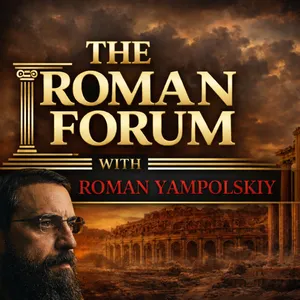
Join Dr. Roman V. Yampolskiy on The Roman Forum for uncensored conversations about AI, superintelligence, simulation theory, consciousness, the singularity, and the future of everything. Barely edited, intellectually fearless, and unsurprisingly funny.
Latest Episodes
The most recent episodes — sign up to get AI-powered summaries of each one.
- 2 weeks ago1h 24m
Superintelligence Author: We May Already Have AGI | Nick Bostrom
Nick Bostrom joins Roman Yampolskiy for a wide-ranging conversation about simulation theory, AI alignment, superintelligence, digital consciousness, AI rights, human uploads, effective altruism, and whether humanity is prepared for what comes next. They also discuss whether current AI may already qualify as AGI, why superintelligence may be impossible to keep permanently contained, and why our treatment of digital minds today could influence our future relationship with them.
- 3 weeks ago1h 40m
Humanity Is Not the Final Form: Dan Faggella on AI and Posthuman Evolution
Dan Faggella is the founder of Emerj Artificial Intelligence Research, where he has interviewed nearly a thousand AI executives, founders, and researchers about the real-world impact of artificial intelligence. More recently, his work has turned toward a much bigger question: if humanity eventually creates intelligence beyond itself, can we ensure that what comes next is a worthy successor rather than simply our replacement or destruction? Today we talk about posthuman intelligence, consciousness, evolution, AI governance, and whether humanity should ultimately survive, transform, or give way to something greater. danfaggella.com
- 3 weeks ago2h 1m
AI Could Make the Economy Double Every Month | Robin Hanson
Robin Hanson is one of the most original and relentlessly contrarian thinkers working at the intersection of economics, artificial intelligence, rationality, governance, and the long-term future. He is an economist at George Mason University, a former research associate at Oxford’s Future of Humanity Institute, and the inventor or early developer of several influential ideas, including prediction markets, the Logarithmic Market Scoring Rule, Futarchy, and the Great Filter hypothesis. Before becoming an economist, he worked on artificial intelligence, Bayesian statistics, and related technologies at organizations including NASA and Lockheed. He is also the author of The Age of Em and co-author of The Elephant in the Brain.In this episode of The Roman Forum, we range across almost everything Robin has spent his career thinking about. We revisit his famous debate with Eliezer Yudkowsky over whether artificial intelligence will “foom” into superintelligence, and ask whether fifteen years of subsequent AI progress has vindicated either side. Robin explains why he remains skeptical of a sudden intelligence explosion, while accepting a very different possibility: that advanced AI may eventually become humanity’s more powerful descendants and ultimately replace us.We debate AI alignment, existential risk, rationality, cryonics, and what Robin believes the AI safety community is getting fundamentally wrong. His central challenge is provocative: perhaps we should stop thinking of future AIs primarily as alien rivals and start thinking of them as descendants. Whether that framing makes the future safer, more dangerous, or simply stranger is one of the central disagreements of this conversation.Subscribe to The Roman Forum with Roman Yampolskiy for conversations about artificial intelligence, superintelligence, AI safety, consciousness, simulation, and the future of humanity.
- Aug 20, 20261h 49m
Max Tegmark’s P(Doom) Is Over 90%
What happens when the race to build superintelligence is actually a suicide race?MIT physicist and AI researcher Max Tegmark joins Roman Yampolskiy for an uncompromising discussion about artificial general intelligence, uncontrollable superintelligence, AI governance, mechanistic interpretability, formal verification, recursive self-improvement, and the probability that humanity loses control of its future.Tegmark explains why he abandoned much of his mechanistic interpretability research, why understanding a neural network may inadvertently accelerate AI capabilities, and why he now favors “verified coding”: using AI to produce conventional software accompanied by mathematical proofs that it behaves as specified. He argues that safe, controllable AI tools could deliver enormous benefits without requiring humanity to deploy autonomous black-box systems more intelligent than their creators.The conversation examines whether advanced AI should be regulated like pharmaceuticals, nuclear technology, or dangerous biological research. Tegmark proposes an “FDA for AI,” under which developers would have to demonstrate that powerful systems provide greater benefits than harms before they can be trained or deployed. He argues that voluntary safety commitments are structurally inadequate because even well-intentioned AI executives remain trapped in a competitive race.Despite the existential risks, Tegmark ends on an optimistic message: humanity has a winning position, but it must stop playing as though only seconds remain on the clock. Safe AI could help cure disease, expand human agency, and allow life to flourish for billions of years. The central danger is not that such a future is impossible, but that humanity may squander it by moving too quickly.Subscribe to The Roman Forum with Roman Yampolskiy for conversations about artificial intelligence, superintelligence, AI safety, consciousness, simulation, and the future of humanity.#MaxTegmark #RomanYampolskiy #ArtificialIntelligence #AISafety #AGI #Superintelligence #AIAlignment #ExistentialRisk #FutureOfLife #AIGovernance
- Jul 4, 20261h 32m
Nate Soares on P(Doom), Alien Superintelligence, Human Enhancement, and the Future of AI
Why did one of the world’s earliest and most influential AI alignment research organizations fail to solve the problem it was created to address?In this episode of The Roman Forum, Dr. Roman Yampolskiy speaks with Nate Soares, president of the Machine Intelligence Research Institute and co-author of If Anyone Builds It, Everyone Dies, about the unresolved problem of aligning superintelligent AI with human values. Soares argues that alignment may be physically possible in principle, yet remains far beyond the reach of current methods. Humanity may need centuries of intellectual progress to solve it, while advanced AI could arrive within years.The conversation examines why MIRI’s technical research did not produce a workable solution, whether an AI can genuinely care about human flourishing, and why ordinary scientific trial and error may be impossible when a single failed experiment could become irreversible. They also discuss coherent extrapolated volition, human value aggregation, the distinction between alignment and control, the point of no return, alien superintelligence, the Fermi paradox, acausal trade, P(doom), human cognitive enhancement, and the possibility of enforcing a global pause on frontier AI development.Soares’s central proposal is direct: humanity should stop the race toward superintelligence before systems become capable of automating AI research and accelerating beyond meaningful human control. He explains why a pause would need to be international, how advanced chips and large data centers could be monitored, and why the world may need to treat superintelligence development with a seriousness comparable to nuclear proliferation. http://so8res.com/
Get The Roman Forum summaries in your inbox
Free AI-powered daily recaps. Key takeaways, quotes, and mentions — in a 5-minute read.
Get Free Summaries →Free forever for up to 3 podcasts. No credit card required.
You Might Also Like
Podcasts in similar categories.

Morbid
A true crime and spooky history podcast blending research with dark humor, hosted by an autopsy technician and a hairstylist.

The Room Podcast
Tech founders and funders share behind-the-scenes stories from pivotal moments in their careers.

The Joe Rogan Experience
A podcast hosted by comedian Joe Rogan featuring conversations on a wide range of topics.

This Past Weekend w/ Theo Von
Discusses events from the host's recent weekends and other days.

Giggly Squad
Hannah Berner and Paige DeSorbo humorously dissect pop culture, relationships, and personal experiences with unfiltered honesty.

Tony Mantor's : Almost Live..... Nashville
Music producer Tony Mantor hosts candid conversations with entertainment industry figures about their careers and challenges.

Good Hang with Amy Poehler
Amy Poehler talks with celebrities and friends about their lives, careers, and what makes them laugh in casual, fun conversations.

SmartLess
Three hosts engage in improvised conversations with a mystery guest, blending humor and personal stories through authentic dialogue.
About The Roman Forum
Join Dr. Roman V. Yampolskiy on The Roman Forum for uncensored conversations about AI, superintelligence, simulation theory, consciousness, the singularity, and the future of everything. Barely edited, intellectually fearless, and unsurprisingly funny.
Customized Recaps
AI-powered recaps with compact key takeaways, quotes, and insights.
Straight to Your Inbox
Get key takeaways from The Roman Forum in a 5-minute read.
Save Hours Every Week
Stay current on your favorite podcasts without falling behind.
Frequently Asked Questions
What is Podzilla's The Roman Forum daily summary?
It's a free AI-powered email that summarizes new episodes of The Roman Forum as soon as they're published. You get the key takeaways, notable quotes, and links & mentions — all in a quick read.
How does the The Roman Forum podcast summary work?
When a new episode drops, our AI transcribes and analyzes it, then generates a personalized summary tailored to your interests and profession. It's delivered to your inbox every morning.
Is this an official The Roman Forum product?
No. Podzilla is an independent service that summarizes publicly available podcast content. We're not affiliated with or endorsed by Dr. Roman V. Yampolskiy, PhD.
Can I get summaries of other podcasts too?
Absolutely! The free plan covers up to 3 podcasts, any in the catalog. Basic raises that to 15, Pro to 40 and Max to 100. Browse our full catalog at /podcasts.
How often does The Roman Forum release new episodes?
The Roman Forum publishes monthly. Our AI generates a summary within hours of each new episode.
What topics does The Roman Forum cover?
The Roman Forum covers topics including Comedy, Technology, Comedy Interviews. Our AI identifies the specific themes in each episode and highlights what matters most to you.
Start getting The Roman Forum summaries tomorrow morning.
Free forever for up to 3 podcasts. No credit card required.
Free forever for up to 3 podcasts. No credit card required.