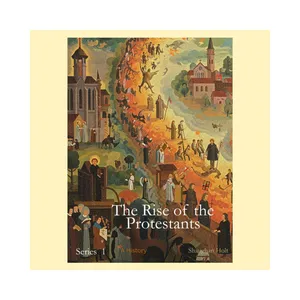
Free Daily Podcast Summary
The Rise of the Protestants: Daily Summaries Delivered
by Shaughan Holt
Welcome to my podcast.This podcast examines the rise of Protestantism, its challenge to established traditions, its transformation of core beliefs, and its role in initiating global change.England’s Nonconformist and Separatist movements are central to this narrative, and their influence continues to shape the broader Christian tradition.By examining these movements within the broader context of Christian history, we can understand how they altered doctrine, influenced Western Christianity, and intensified the enduring division between Roman Catholicism and emerging Protestant groups.The series follows a chronological timeline, beginning in early 16th-century Germany with Martin Luther’s excommunication and concluding a century later on England’s southern coast.The initial 12-episode series highlights the contributions of Beza, Vermigli, Calvin, Tyndale, Knox, and Robert Browne, who is often called the father of Congregationalism.The series does not seek to persuade listeners or
Latest Episodes
The most recent episodes — sign up to get AI-powered summaries of each one.
- 3 weeks ago34 min
(New) Series 1 Episode 8 - John Knox and the Campaign for Further reform: Revised and updated.
Regular episode Season 1 Episode 8 (New) Series 1 Episode 8 - John Knox and the Campaign for Further reform: Revised and updated.© 20 26 The Rise of the Protestants., Author, Shaughan Holt.Audio • Season 1 • Episode 8 - John Knox and the Campaign for Further reform: Revised and updated.The Artwork is The International Monument to the Reformation, usually known as the Reformation Wall, was inaugurated in 1909 in Geneva, Switzerland. The Wall, stands within the premises of the University of Geneva, honouring the legacy of John Calvin, its founder. At the centre of the monument, (from left to right) four 5 metre tall statues of Calvinism's main proponents are depicted: William Farel (1489–1565), John Calvin (1509–1564), Theodore Beza (1519–1605), John Knox (c.1513–1572).To the left of the central statues are 3 metre tall statues of:Frederick William of Brandenburg (1620–1688). William the Silent (1533–1584), Gaspard de Coligny (1519–1572).To the right are 3 metre tall statues of:Roger Williams (1603–1684), Oliver Cromwell (1599–1658), Stephen Bocskai (1557–1606).Along the wall, to either side of the central statues, is engraved the motto of both the Reformation and Geneva: Post Tenebras Lux (Latin for After darkness, light). On the central statues' pedestal is engraved a Christogram: ΙΗΣ.The Wall is in the grounds of the University of Geneva, which was founded by John Calvin, and was built to commemorate the 400th anniversary of Calvin's birth and the 350th anniversary of the university's establishment. It is built into the old city walls, and the monument's location there is designed to represent the integral importance of the fortifications, and therefore of the city of Geneva, to the Reformation.The Music 1 Why Fum'th In Fight. Third Psalm Tune for Archbishop Parker's Psalter of 1567. Psalm 2:1. Composer Thomas Tallis. Masterworks Gallery. Plays for the first 55 secondsThe lyrics of this are included in the Epilogue.Music 2 Psalm 91. (Scottish Metrical Psalms) Stevenston High Kirk. Plays at 28 minutes 15 seconds, - for 2 minutes 35 seconds.Music 3 Why Fum'th In Fight. second half. Plays at the end for 2 minutes 7 seconds.Notes:In this episode, we explore why Elizabeth’s Protestant settlement left many reformers dissatisfied. Disputes over clerical clothing widened to questions about worship, the authority of bishops, and who should govern the Church. As Thomas Cartwright argued for further reform at Cambridge, some London Protestants began worshipping separately from the established Church.We also return to Scotland, tracing the influence of George Wishart and John Knox, whose preaching helped reshape the nation’s religious life. As Knox’s life drew to a close in 1572, the struggle over what a truly reformed Church should look like remained far from settled.© 20 26 The Rise of the Protestants., Author, Shaughan Holt."All rights reserved. No part of this podcast may be reproduced, translated, distributed, or transmitted in any form or by any means, including photocopying, recording, or other electronic or mechanical methods, without the prior written permission of the copyright holder, except in the case of brief quotations embodied in critical reviews and certain other non-commercial uses permitted by copyright law". Requests regarding translation, licensing, republication or Feedback should be directed to: sholt@nashcom.co.ukYour feedback is important to me, suggestions, or criticisms. I read every message.
- Oct 17, 202632 min
(New) Series 1 Episode 7 - Mary Queen of Scots: Revised and Updated.
Regular episode Season 1 Episode 7 (New) Series 1 Episode 7 - Mary Queen of Scots: Revised and Updated.© 20 26 The Rise of the Protestants., Author, Shaughan Holt.Audio • Season 1 • Episode 7 Mary Queen of ScotsThe Artwork is A Miniature of Mary Queen of Scots. c 1559 by François Clouet.This exquisite miniature is related to a drawing by the artist François Clouet, held in the Bibliothèque nationale de France Paris, likely dated slightly earlier to 1555. Her clothing is updated in the miniature, particularly the detail of the ruff in the drawing, which is changed into an open-standing collar.The original drawing is only bust-length, whereas the miniature includes the sitter's hands, indicating their significance to the portrait's function. The gesture of placing a ring on the fourth finger of her right hand is thought to allude to Mary Queen of Scots’ marriage to the French Dauphin, the future Francis the Second, in 1558.This portrait was commissioned by the French royal family from their court artist to commemorate the royal marriage. The size and details of the miniature are: A watercolour, 8.3 x 5.7 cm, on a canvas panel stretcher.The miniature was almost certainly Queen Elizabeth's personal possession and would later become part of the British Royal Family's Collection.The Music is Alas Madame. French, Bayeux Manuscript (English: Alas my Lady)The Bayeux Manuscript (not the Tapestry) is an illustrated manuscript that contains one hundred and three songs, and was compiled by Charles III, Duke of Bourbon, in the early 16th century. These songs were composed in the late 15th century, shortly after the conclusion of the Hundred Years' War. The manuscript is housed in the Bibliothèque Nationale de France.The music plays for the first 40 seconds, and the last 15 seconds,.Notes:Mary, Queen of Scots, returned from France in 1561 to rule a country transformed by Protestant reform. A committed Catholic, she needed the support of Protestant nobles, while John Knox challenged her worship and her understanding of royal authority.This episode follows Mary from her childhood and brief reign as Queen Consort of France to the marriages, rivalries and rebellions that cost her the Scottish throne. It explores how faith and political ambition shaped her struggle to govern, ending with her flight to England in search of Elizabeth’s help.© 20 26 The Rise of the Protestants., Author, Shaughan Holt."All rights reserved. No part of this podcast may be reproduced, translated, distributed, or transmitted in any form or by any means, including photocopying, recording, or other electronic or mechanical methods, without the prior written permission of the copyright holder, except in the case of brief quotations embodied in critical reviews and certain other non-commercial uses permitted by copyright law".Requests regarding translation, licensing, republication or Feedback should be directed to: sholt@nashcom.co.ukYour feedback is important to me, suggestions, or criticisms. I read every message.
- Oct 4, 202621 min
(New) Series 1 Episode 6 - Elizabeth’s Religious Settlement: Revised and Updated.
Regular episode Season 1 Episode 6 (New) Series 1 Episode 6 - Elizabeth’s Religious Settlement: Revised and Updated.© 20 26 The Rise of the Protestants., Author, Shaughan Holt.Episode 6 : Elizabeth’s Religious Settlement: A Church Divided.Since I first published this episode, I’ve gone back to the episode and incorporated your feedback.As the series has grown, I've noticed a few areas that needed improvement or clarification, so I’ve updated parts of the original episode. The story and purpose are still the same, but I hope returning readers enjoy this updated version. If you’re new to the series, this is the starting point of our story. The accompanying transcript also includes an epilogue with additional historical notes for those who would like to explore the story further.The Artwork is a Portrait of Elizabeth I, Queen of England, by anonymous Artist.It location is The Rijks Museum, Amsterdam. The Music is The Volta, a couples' renaissance dance.The music plays for the first 50 seconds.Episode Notes :When Elizabeth the First became queen in 1558, she inherited a country divided by decades of religious change. Her settlement restored Protestant worship and royal authority over the Church, but it could not resolve every disagreement.This episode explores what changed in England’s churches, why some welcomed the settlement while others demanded further reform, and how Cecil and Parker helped establish and defend it. We also follow events across the Scottish border, where the Treaty of Berwick drew Elizabeth’s government into another struggle over religion and royal power© 20 26 The Rise of the Protestants., Author, Shaughan Holt."All rights reserved. No part of this podcast may be reproduced, translated, distributed, or transmitted in any form or by any means, including photocopying, recording, or other electronic or mechanical methods, without the prior written permission of the copyright holder, except in the case of brief quotations embodied in critical reviews and certain other non-commercial uses permitted by copyright law". Requests regarding translation, licensing, or republication should be directed to: sholt@nashcom.co.ukYour feedback matters, send me an email at sholt@nashcom.co.uk, with any comments, suggestions, or criticisms.I read every message.
- Sep 27, 202616 min
(New) Series 1 Episode 5 Part Three. Geneva — The Bible that troubled a King.
Regular episode • Season 1 • Episode 5 • (New) Series 1 Episode 5 Part Three. Geneva — The Bible that troubled a King.The artwork is: The Frontispiece to the King James' Bible, 1611.The title page text reads: The Holy Bible , containing the Old Testament, and the New. Newly Translated out of the Original tongues and with the former Translations diligently compared and requested by his Majesties special Commandment.Appointed to be read in Churches. Imprinted at London by Robert Barker, Printer to the Kings most Excellent Majesty. At the bottom is "C. Boel made this in Richmond"Cornelis Boel c. 1576 – c. 1621, was born at Antwerp, he was a Flemish draughtsman and engraver.Cornelis Boel engraved the illustrated main title page of the original 1611 King James Bible. It shows the Twelve Apostles at the top. Moses and Aaron flank the central text. In the four corners sit Matthew, Mark, Luke, and John, authors of the four gospels, with their symbolic animals. At the top, over the Holy Spirit in a form of a dove, is the Tetragrammaton "YHWH". The Tetragrammaton is the four-letter Hebrew name for God, which translates to "to be," "to exist," or "to cause to become"The Music is: Psalm 8:1, 3-9 sung by Free Church of Scotland: Psalmody Conference Selections .Presented by the The Westminster Covenanter. Further details, including lyrics are included in the epilogue. The music plays for the first 30 seconds.Notes: Part Three begins at the Hampton Court Conference of 1604, where King James objected to the Geneva Bible’s marginal notes and supported a new English translation. It follows the scholars who produced the Bible published in 1611, showing how their work drew upon earlier translations, including the Geneva Bible itself.The story then asks whether James really banned the Geneva Bible, traces its continued use in Britain and North America, and considers the lasting influence of the English exiles’ work.© 20 26 The Rise of the Protestants., Author, Shaughan Holt."All rights reserved. No part of this podcast may be reproduced, translated, distributed, or transmitted in any form or by any means, including photocopying, recording, or other electronic or mechanical methods, without the prior written permission of the copyright holder, except in the case of brief quotations embodied in critical reviews and certain other non-commercial uses permitted by copyright law". Requests regarding translation, licensing, or republication should be directed to: sholt@nashcom.co.ukYour feedback matters, send me an email, with any comments, suggestions, or criticisms. I read every message.
- Sep 25, 202626 min
(New) Series 1 Episode 5 Part Two. Geneva — The Bible of a Generation.
Regular episode • Season 1 • Episode 5 • (New) Series 1 Episode 5 Part Two. Geneva — The Bible of a Generation.The artwork is: A copy of the Bassandyne Bible, the first full Bible printed in the country.In 1579, Scotland reached an important milestone with the publication of the Bassandyne Bible, the first complete Bible printed in the country. Begun in Edinburgh by Thomas Bassandyne and completed by Alexander Arbuthnot after Bassandyne’s death, it was a large folio reprint of the 1561 Geneva Bible. Every parish kirk was required to obtain a copy, helping to establish the Geneva translation at the heart of Scottish religious life.While the preface and dedication, - "To the heich and michtie Prince James the Sext King of Scottis", - is in Scots, the main text is in English. Since the Bible was the most popular book in Scotland – and often the only book found in poorer households – the English text had a very damaging impact on the Scots language. Literacy was largely driven by a desire to read the Bible, so schooling, gradually became associated with English rather than Scots. Its widespread use therefore contributed to the growing importance of English in Scottish worship, education and culture. Ironically, the king named in its dedication would later condemn some of its marginal notes at Hampton Court. A rare surviving copy is now held by Edinburgh Central Library.The Music is: Psalm 18:28-35. The Lord will light my candle so, that it shall shine full bright.Sung by the Evangelical Presbyterian Church Launceston Tasmania. Presented by the The Westminster Covenanter. Further details, including lyrics are included in the epilogue.The music plays for the first 30 seconds.Notes: Part Two explores the features that made the Geneva Bible both popular and controversial. It examines the thousands of notes printed in its margins, including their explanations of Scripture and the small number that challenged religious and political authority.It also follows the Bible’s spread through England and Scotland, revealing who actually read it and why it cannot simply be described as the Puritan Bible. Along the way, we encounter bishops, Shakespeare and the famous Breeches Bible, before discovering why its marginal notes would eventually trouble King James.© 20 26 The Rise of the Protestants., Author, Shaughan Holt."All rights reserved. No part of this podcast may be reproduced, translated, distributed, or transmitted in any form or by any means, including photocopying, recording, or other electronic or mechanical methods, without the prior written permission of the copyright holder, except in the case of brief quotations embodied in critical reviews and certain other non-commercial uses permitted by copyright law". Requests regarding translation, licensing, or republication should be directed to: sholt@nashcom.co.ukYour feedback matters, send me an email, with any comments, suggestions, or criticisms. I read every message.
- Sep 19, 202625 min
(New) Series 1 Episode 5 Part One. Geneva — The Bible of the Exiles.
Regular episode • Season 1 • Episode 5 • (New) Series 1 Episode 5 Part One. Geneva — The Bible of the Exiles.The artwork is the cover from an original copy of the Geneva Bible dated 1560.First published in 1560, the Geneva Bible became one of the most historically significant English translations of Scripture. It appeared twenty-two years before the Rheims New Testament and fifty-one years before the King James Bible.The Geneva Bible became the most widely read English Protestant Bible of the late sixteenth century. Its language was known to writers and religious figures including William Shakespeare, John Knox and John Donne, although they also encountered other English translations. Copies of the Geneva Bible were later carried across the Atlantic by English settlers, helping to establish its influence in North America.The Music is I Greet Thee, Who My Sure Redeemer Art. Sung by the Capitol Hill Baptist Church, Washington, D.C. Author: Anonymous. Source: French, 1545; French Psalter, Strasbourg, 1545. The full text of the hymn appears in the epilogue.Notes: First published in 1560, the Geneva Bible was a groundbreaking work that represented a remarkable achievement in Renaissance scholarship, printing, and Reformation theology.Part One tells the story of the English Protestant exiles who fled the reign of Queen Mary and attempted to rebuild their religious community in continental Europe.It follows their disputes in Frankfurt, their journey to Geneva, and the work of William Whittingham and his companions as they created a Bible designed not only to be read, but to be studied and understood by ordinary people.© 20 26 The Rise of the Protestants., Author, Shaughan Holt."All rights reserved. No part of this podcast may be reproduced, translated, distributed, or transmitted in any form or by any means, including photocopying, recording, or other electronic or mechanical methods, without the prior written permission of the copyright holder, except in the case of brief quotations embodied in critical reviews and certain other non-commercial uses permitted by copyright law". Requests regarding translation, licensing, or republication should be directed to: sholt@nashcom.co.ukYour feedback matters, send me an email, with any comments, suggestions, or criticisms. I read every message.
- Sep 18, 20262 min
(New) Revisiting Geneva — Why Episode Five Has Been Rewritten.
Regular episode • Season 1 • Episode 5 • (New) Revisiting Geneva — Why Episode Five Has Been Rewritten.Bonus Episode: Revisiting Geneva — Why Episode Five Has Been Rewritten.A Quick Note Before We Begin.Some of you may remember that I previously released Episode Five as a single program. Since then, I have returned to the subject and undertaken a substantial revision.As my research continued, I discovered that the story of the Geneva Bible was broader, more complicated, and in several respects, rather different from the account, I had originally presented. I therefore decided, not simply, to just make a few corrections. Instead, I substantially rewrote and expanded the original episode.This new version, tells the story in much greater depth.It follows the English exiles in Geneva, as they first created, and then printed their own Bible. It then explores, the Bible’s, marginal notes, the people who read it, its influence on the future King James Bible, and its later journey across the Atlantic.One particularly important source during this revision, was Biblion’s detailed history of the Geneva Bible. Its careful examination of surviving editions, historical documents and frequently repeated stories led me to reconsider several parts of my original account. I am extremely grateful for this work, which has helped make the revised version considerably stronger and more accurate. https://biblionapp.com/genevaThe interpretation and presentation you will hear remain my own, and I have also drawn upon a range of other historical sources. Nevertheless, Biblion’s research played an important part in rebuilding Episode Five, and it deserves particular acknowledgement.As the new script developed, it became clear, that telling the complete story in one episode would make it far too long. I've therefore divided Episode Five into three parts.Part One tells the story of the English exiles and the creation of the Geneva Bible.Part Two examines its marginal notes, its spread throughout England and Scotland, and the remarkably varied people who read it.Part Three explores, why the Geneva Bible so troubled King James, how it influenced the Bible of 1611, and the legacy it left behind.The three parts, will start to be released in coming weeks, under the following titles.Series 1, Episode 5, Part One: Geneva — The Bible of the Exiles.Series 1, Episode 5, Part Two: Geneva — The Bible of a Generation.and finally, Series 1, Episode 5, Part Three: The Geneva Bible — The Bible, That Troubled a King.Together, these three parts replace the original episode, and now form the complete revised edition of Episode Five.Whether you read or listened to the earlier version, or are encountering this story for the first time, I hope you will join me, as we return to Geneva and begin again.© 20 26 The Rise of the Protestants., Author, Shaughan Holt."All rights reserved. No part of this podcast may be reproduced, translated, distributed, or transmitted in any form or by any means, including photocopying, recording, or other electronic or mechanical methods, without the prior written permission of the copyright holder, except in the case of brief quotations embodied in critical reviews and certain other non-commercial uses permitted by copyright law". Requests regarding translation, licensing, or republication should be directed to: sholt@nashcom.co.ukYour feedback matters, send me an email with any comments, suggestions, or criticisms.I read every message.
- Sep 7, 202634 min
(new) Series 1 Episode 4 - Bloody Mary, Revised and Updated.
Regular episode Season 1 Episode 4 (new) Series 1 Episode 4 - Bloody Mary, Revised and Updated.© 20 26 The Rise of the Protestants., Author, Shaughan Holt.Episode 4: Bloody Mary.Since I first published this episode, I’ve gone back to the episode and incorporated your feedback.As the series has grown, I've noticed a few areas that needed improvement or clarification, so I’ve updated parts of the original episode. The story and purpose are still the same, but I hope returning readers enjoy this updated version. If you’re new to the series, this is the starting point of our story. The accompanying transcript also includes an epilogue with additional historical notes for those who would like to explore the story further.The artwork is Portrait of Mary Tudor by the artist Antonis Mor, painted around 1554.The oil-on-panel portrait shows Queen Mary I of England at about the age of thirty-eight.The music is "The Lord Is My Light and My Salvation", based on Psalm 27 and performed as an Anglican chant.It plays for around forty seconds at both the beginning and the end of the recording.Episode notes: After the death of Edward VI in July 1553, England entered another period of religious and political upheaval. Lady Jane Grey was proclaimed Queen, but her reign lasted only nine days before Mary Tudor successfully claimed the throne.On 1 October 1553, Mary was crowned at Westminster Abbey, becoming the first woman to rule England in her own right. A committed Catholic, Mary set about reversing the Protestant reforms of Edward VI and restoring England's relationship with Rome.Her reign would become closely associated with the persecution of Protestants, with around 280 men and women burned for heresy. Among the most famous were John Hooper, Hugh Latimer, Nicholas Ridley and Thomas Cranmer.At the same time, many Protestants fled abroad, while others continued to worship secretly in England. These years of exile, persecution and religious division would have a lasting influence on the future of English Protestantism.This episode follows Mary's attempt to restore Catholic England, the resistance she faced, and the events that would help shape the next stage of the English Reformation."All rights reserved. No part of this podcast may be reproduced, translated, distributed, or transmitted in any form or by any means, including photocopying, recording, or other electronic or mechanical methods, without the prior written permission of the copyright holder, except in the case of brief quotations embodied in critical reviews and certain other non-commercial uses permitted by copyright law". Requests regarding translation, licensing, or republication should be directed to: sholt@nashcom.co.ukYour feedback matters, send me an email at sholt@nashcom.co.uk, with any comments, suggestions, or criticisms.I read every message.
Get The Rise of the Protestants summaries in your inbox
Free AI-powered daily recaps. Key takeaways, quotes, and mentions — in a 5-minute read.
Get Free Summaries →Free forever for up to 3 podcasts. No credit card required.
You Might Also Like
Listeners also like.
In Our Time: Religion
Explores religious movements, their theories, and key figures.
The History of England
A chronological history of England from the end of Roman rule, covering major events and daily life.

Ask NT Wright Anything
A weekly podcast where listeners submit questions on theology and scripture for scholar NT Wright to answer, hosted by Mike Bird.

I was a Teenage Fundamentalist. An Exvangelical podcast.
Two former megachurch leaders examine their experiences in and aftermath of Christian fundamentalism.

PROCLAIM x BIBLEin365
A daily Bible reading podcast with book backgrounds to help listeners understand Scripture and grow in faith.

The Rest Is History
Historians Tom Holland and Dominic Sandbrook analyze major historical events and figures with narrative depth and scholarly insight.
This is History: The Tudors
The Tudor dynasty's rise begins with Henry VII seizing the throne in 1485, sparking decades of power struggles, religious change, and royal intrigue.

Standard of Truth
Explores Latter-Day Saint history to deepen understanding and strengthen faith, hosted by a BYU professor of Church History and Doctrine.

The Alisa Childers Podcast
Addressing progressive Christianity and skeptical challenges to the gospel from a biblical perspective.
New Books in Medieval History
New Books Network

The British History Podcast
A narrative exploration of British history focused on the lives, motivations, and personal stories of the people who shaped the nation.

In Detail...
Investigates major news stories and controversies across England, from political defiance to cults and environmental crimes.
About The Rise of the Protestants
Welcome to my podcast.This podcast examines the rise of Protestantism, its challenge to established traditions, its transformation of core beliefs, and its role in initiating global change.England’s Nonconformist and Separatist movements are central to this narrative, and their influence continues to shape the broader Christian tradition.By examining these movements within the broader context of Christian history, we can understand how they altered doctrine, influenced Western Christianity, and intensified the enduring division between Roman Catholicism and emerging Protestant groups.The series follows a chronological timeline, beginning in early 16th-century Germany with Martin Luther’s excommunication and concluding a century later on England’s southern coast.The initial 12-episode series highlights the contributions of Beza, Vermigli, Calvin, Tyndale, Knox, and Robert Browne, who is often called the father of Congregationalism.The series does not seek to persuade listeners or
Customized Recaps
AI-powered recaps with compact key takeaways, quotes, and insights.
Straight to Your Inbox
Get key takeaways from The Rise of the Protestants in a 5-minute read.
Save Hours Every Week
Stay current on your favorite podcasts without falling behind.
Frequently Asked Questions
What is Podzilla's The Rise of the Protestants daily summary?
It's a free AI-powered email that summarizes new episodes of The Rise of the Protestants as soon as they're published. You get the key takeaways, notable quotes, and links & mentions — all in a quick read.
How does the The Rise of the Protestants podcast summary work?
When a new episode drops, our AI transcribes and analyzes it, then generates a personalized summary tailored to your interests and profession. It's delivered to your inbox every morning.
Is this an official The Rise of the Protestants product?
No. Podzilla is an independent service that summarizes publicly available podcast content. We're not affiliated with or endorsed by Shaughan Holt.
Can I get summaries of other podcasts too?
Absolutely! The free plan covers up to 3 podcasts, any in the catalog. Basic raises that to 15, Pro to 40 and Max to 100. Browse our full catalog at /podcasts.
How often does The Rise of the Protestants release new episodes?
The Rise of the Protestants publishes every few days. Our AI generates a summary within hours of each new episode.
What topics does The Rise of the Protestants cover?
The Rise of the Protestants covers topics including History, Religion & Spirituality, Spirituality, Christianity, Culture, Society & Culture. Our AI identifies the specific themes in each episode and highlights what matters most to you.
Start getting The Rise of the Protestants summaries tomorrow morning.
Free forever for up to 3 podcasts. No credit card required.
Free forever for up to 3 podcasts. No credit card required.