Free Daily Podcast Summary
The Reluctant Entrepreneur Podcast: Daily Summaries Delivered
by Mike Konrad
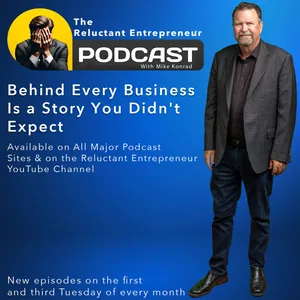
I’m your host, Mike Konrad, the author of The Reluctant Entrepreneur - Anatomy of a Business Start-Up - From Uncertainty to Unstoppable, available on Amazon as a paperback, e-book, and an audible book, and I’m excited to share real stories that reveal the many paths people take to build their own businesses. Whether you stumbled into entrepreneurship or you’ve always known it was your calling, this podcast is for you.Let’s start with what it means to be a reluctant entrepreneur. Many entrepreneurs don’t set out with a grand plan to build a business. Maybe you worked for a company that didn’t value your vision, and one day you thought, “I could do this myself”, that was my story. Or maybe life pushed you in an unexpected direction—losing a job, facing a personal crisis, or discovering a passion that grew into a business. Reluctant entrepreneurs often find themselves starting a business not because they always dreamed of it, but because it was the best—or only—option available. And then there are intentional entrepreneurs. These are the people who’ve known from the start that they were meant to create something of their own. They may have planned meticulously, crafted their vision, and followed a well-laid path to build a business. Intentional entrepreneurs are often seen as risk-takers, those with a drive to innovate, disrupt, and lead in their industries. But even with all the planning in the world, intentional entrepreneurs face their own share of unexpected challenges, setbacks, and doubts.On The Reluctant Entrepreneur podcast, we celebrate both types of entrepreneurs—the ones who jump in with both feet, and the ones who tiptoe cautiously into the water. So, join me as we explore the many ways people navigate the complex and rewarding world of entrepreneurship. Whether you’re here for inspiration, advice, or just a great story, I hope you find something valuable in every episode of The Reluctant Entrepreneur Podcast.
Latest Episodes
The most recent episodes — sign up to get AI-powered summaries of each one.
- 2 days ago54 min
The Problem Everyone Accepted: Tina Larsson on Building a Business by Asking Why
Most people who discover that their building is wasting hundreds of thousands of dollars complain about it.My guest today helped organize a board takeover, fixed the problem, and accidentally discovered a business opportunity hiding inside the chaos.Some businesses begin with a carefully researched idea, a detailed plan, and a founder determined to become an entrepreneur. Others begin with a frustrating question: Why do the costs keep going up when no one can explain where the money is going?My guest today wasn’t searching for a business opportunity. She was trying to understand why her New York City co-op had raised its fees year after year while the building continued to be poorly managed. Drawing on their backgrounds in financial analysis, she and her husband began examining the building’s operations. What they discovered led them to organize their neighbors, replace the majority of the board, and uncover hundreds of thousands of dollars in unnecessary expenses.But solving the problems in their own building revealed something much larger. Co-op and condo boards throughout New York were facing similar challenges, often without the experience, information, or time needed to address them.That realization became the foundation of The Folson Group, a consulting firm that helps New York City co-op and condo boards reduce expenses, oversee major projects, improve governance, and protect the value of their buildings.Tina Larsson is the co-founder and CEO of The Folson Group. She’s also the author of Living the High Life: How Smart Co-op and Condo Owners Protect Themselves and Their Investment.Today, we’ll talk about how a Wall Street analyst became an accidental entrepreneur, what it took to turn one building’s problems into a successful consulting company, and why some of the best business opportunities are hiding inside problems everyone else has learned to accept.The Folson Grouphttps://www.thefolsongroup.comLiving the High Life: How Smart Co-op and Condo Owners Protect Themselves and Their Investmenthttps://a.co/d/0fIJoH6A
- 6 days ago1h 11m
The Exit Trap: Matt DiFrancesco on Planning Before It’s Too Late
Successful business owners rarely ignore exit planning because they don’t care about the future. They postpone it because the business is thriving, customers keep coming, and leaving still feels years away. But waiting too long can reduce a company’s value, limit an owner’s options, and turn an expected transition into a difficult financial and personal crisis.We’ve explored exit planning with other guests, but this conversation examines it through a very different lens. Matt DiFrancesco is a Financial Advisor and Certified Exit Planner™ who has built his practice around the collision repair industry. These businesses often combine family ownership, expensive equipment, rapidly changing technology, skilled labor challenges, industry consolidation, and complicated succession decisions.In this episode of The Reluctant Entrepreneur, Matt explains why successful owners fall into the exit trap, what makes a business valuable without its founder, and why preparing for an eventual transition can improve a company long before the owner intends to leave. We also discuss Matt’s entrepreneurial journey, the advantages of serving a highly specialized market, and what business owners in every industry can learn from the challenges facing collision repair shops.High Lift Financialhttps://highliftfinancial.com
- 1 weeks ago59 min
Build the Moat First: Scherrie L. Prince on Protecting What Entrepreneurs Create
Most entrepreneurs spend their time thinking about how to build a business.How do I find customers?How do I increase revenue?How do I grow faster?'But far fewer stop to ask a different set of questions.What happens if my partner and I have a falling-out?What happens if the business is sued?What happens if I become seriously ill or die?And what happens to everything I’ve worked so hard to build if I never created a plan to protect it?Those aren’t particularly exciting questions. They don’t generate the same enthusiasm as launching a product, closing a major sale, or reaching a new revenue milestone. But ignoring them can turn years of entrepreneurial success into years of financial and emotional pain.My guest today understands these risks from both sides of the desk.Scherrie L. Prince is an attorney, entrepreneur, asset protection coach, speaker, and host of the Play Big Faster Podcast. She is also the founder and managing partner of Prince & Associates, where she helps entrepreneurs navigate business structure, contracts, regulatory compliance, asset protection, litigation, and succession planning.But Scherrie’s path into law was anything but conventional.She grew up on a farm in Mississippi, lost her mother when she was only 16, and later watched a painful family dispute unfold after her grandparents died without an adequate estate plan. Before becoming an attorney, she worked in communications and operations, became a real estate broker and mortgage broker, and entered into a business partnership based largely on a handshake. The business performed well, but the partnership ultimately failed because it lacked the structure needed to survive.Then came the mortgage crisis of 2008. Scherrie lost her business and found herself starting over while raising two very young children. That experience prompted a dramatic pivot into law school and eventually gave her a new mission: helping entrepreneurs protect the businesses, families, and legacies they’re working so hard to build.Today, Scherrie teaches entrepreneurs how to merge their business plans with their estate plans and create what she calls a moat around their assets.During the first part of our conversation, we’ll explore her unconventional journey from entrepreneur to law student, attorney, and business owner, including the personal and professional setbacks that shaped her work.Then, in the second part, we’ll discuss the legal and structural mistakes entrepreneurs commonly make, why forming an LLC isn’t enough, and how business owners can build companies that aren’t only positioned to grow, but structured to endure.Prince & Associates:https://scherrieprince.comPlay Big Faster Podcast:https://www.youtube.com/@scherriespeaks
- 1 weeks ago56 min
Built It, Nearly Lost It, Built Again: Joshua Griffin on Reinvention and Resilience
Building a successful business is difficult. Building one, watching it begin to fall apart, and then finding the courage to start again is something entirely different.Entrepreneurship is often presented as a steady climb. You start with an idea, work hard, gain momentum, and eventually arrive at success. But for many entrepreneurs, the real journey looks nothing like that. It includes exhaustion, financial pressure, painful decisions, and moments when the person behind the business begins to disappear beneath the weight of keeping it alive.My guest today is Joshua Griffin, an award-winning entrepreneur, marketing strategist, and co-founder of Intrinzi.Joshua left school with few qualifications and spent years working in jobs that offered stability but little sense of purpose. While working extraordinarily long days, he began building businesses of his own. One of those businesses became Joshua Lloyd, a gender-neutral fashion brand that earned national recognition and multiple awards.From the outside, Joshua appeared to be living the entrepreneurial success story. Behind the scenes, however, the pressure was taking a devastating toll. The business he’d worked so hard to build brought him close to losing everything.When he began rebuilding, success looked very different. Joshua has described sleeping in his clothes to avoid turning on the heat and selling possessions from his home while creating what would eventually become Intrinzi.Today, Joshua uses the lessons from those experiences to help other entrepreneurs avoid fragmented systems, empty strategies, and what he calls the implementation gap: the distance between knowing what should be done and actually getting it done. Intrinzi combines marketing, CRM, automation, and AI to help small and medium-sized businesses operate and grow more effectively.Intrinzi:https://www.intrinzi.com
- 1 weeks ago1h 5m
Revenue Rich, Freedom Poor: James Graham on Building a Business Without Becoming Its Prisoner
There’s a dangerous moment in entrepreneurship that doesn’t get talked about nearly enough. It’s the moment when your business starts looking successful from the outside, but inside, you realize you’ve created something that can’t function without you.The revenue is growing. The customers are coming in. Employees are depending on you. By almost every traditional measure, things are going well.Except you can’t leave.Every decision still comes across your desk. Every problem eventually finds its way back to you. And instead of owning a business, the business starts owning you.That’s exactly what happened to today’s guest.My guest today is James Graham, founder of Scalify OS.Before launching Scalify, James built a painting company that grew to roughly $2.5 million in annual revenue. On paper, it looked like a successful business. But James eventually came to a difficult realization. He had built a company that depended far too heavily on him. When he became a father, that realization became even harder to ignore.Ultimately, James sold the business, and what he learned from that experience would completely change the way he thought about entrepreneurship, leadership, systems, and the value of a company.He later spent years working with entrepreneurs and business leaders, learning what separates a company that simply produces revenue from one that can actually operate, grow, and create value without its founder being involved in every decision.Today, through Scalify OS, James helps entrepreneurs make that transition from being the person who does everything to becoming the leader of an organization that can scale beyond them.During our conversation, we’ll talk about James’s own entrepreneurial journey, the lessons he learned from building and selling his first company, why successful founders so often become the bottleneck in their own businesses, and what entrepreneurs can do to build companies that give them more freedom instead of less.We’ll also explore the difference between being a business owner and essentially creating a very demanding job for yourself.Because growing revenue is one thing. Building a business that can thrive without you is something entirely different.Scalify OShttps://www.scalifyos.com
- 2 weeks ago48 min
The Accidental Entrepreneur’s Second Act: Mary Ann Bautista on Mistakes, Growth, and Starting Again
Some entrepreneurs spend years planning the business they hope to build. Others answer the phone, agree to help one client, then another, and eventually look around and realize they’ve accidentally created a company.But building a successful business by accident doesn’t mean the lessons come easily.Sometimes success can hide the underpricing, the wrong opportunities, the inability to say no, and a business that depends too heavily on the person who started it. The real test comes when you have the opportunity to build again.Do you repeat what worked, or do you finally confront everything that didn’t?My guest today is Mary Ann Bautista, co-founder of TurboRank and a direct-response marketing professional with more than 30 years of experience.Mary Ann didn’t begin her career with a grand plan to become an entrepreneur. Her phone rang, she answered it, and one client led to another. Before long, she had unintentionally built a successful marketing agency that would operate for nearly three decades.Along the way, she experienced many of the challenges familiar to entrepreneurs. She chased opportunities that weren’t right for the business, underpriced her services, said yes too often, and learned some of her most important lessons the hard way.Mary Ann has worked on direct-response campaigns for recognizable consumer brands, including Hooked on Phonics and the Pimsleur language system. Today, she and her business partner are applying that experience to TurboRank, a YouTube growth company focused on helping businesses improve their organic visibility, audience engagement, and conversions.This time, however, Mary Ann isn’t building accidentally.She’s building intentionally, using the lessons from her first entrepreneurial journey to make better decisions about opportunities, clients, pricing, growth, and the kind of company she wants to create.We’ll also discuss why referrals and paid advertising may no longer be enough to sustain a business, what it means to create an authority footprint, and how useful content can begin building trust with a prospective customer long before the first sales conversation takes place.TurboRankhttps://turborank.co
- 2 weeks ago56 min
Why Visionary Founders Need an Operational Second-in-Command with Derek Fredrickson
Most entrepreneurs start a business because they want more freedom. But as the company grows, many discover that they haven’t created freedom at all. They’ve created a business that depends on them for every decision, every approval, and every solution. Instead of owning the business, the business begins to own them.At some point, the founder who built the company can become the very person preventing it from reaching the next level.My guest today has spent much of his career helping entrepreneurs overcome the very challenges I just described. He’s built teams, introduced accountability, developed operating systems, and helped founders turn ambitious ideas into scalable companies. But his own entrepreneurial journey followed an unusual path.Many entrepreneurs begin with a vision and then spend years learning how to become effective operators. My guest began as the operator. For more than 16 years, he worked behind the scenes as a chief operating officer and second-in-command, helping other entrepreneurs translate their visions into action.He began his career on Wall Street before helping scale his wife Fabienne Fredrickson’s business to multiple seven figures. Along the way, he discovered that his greatest strength was creating the structure, systems, and accountability needed to help founder-led companies grow.Eventually, however, the person who had spent years helping other entrepreneurs build their businesses decided to build one of his own.Derek Fredrickson is the founder and CEO of The COO Solution, a fractional COO firm that helps established business owners strengthen their teams, improve execution, and step away from the daily operational demands that keep them trapped inside their companies.Today, we’ll talk about Derek’s transition from second-in-command to founder, what surprised him when he moved from the COO role into the CEO’s chair, and what he’s learned about the systems, people, and leadership required to build a company that doesn’t depend on its founder for everything.We’ll also explore why successful entrepreneurs often become bottlenecks inside their own businesses, why delegation frequently fails, and how the right operational leader can help turn a founder’s vision into consistent execution.The COO Solutionhttps://thecoosolution.com
- 2 weeks ago1h 1m
From Film Sets to Firearms: Michael Pierce on Reinvention and Building American Gun Owners
Some entrepreneurs spend their careers becoming experts in one industry. Others keep walking away from what they know, entering unfamiliar territory and betting that the lessons from their last chapter will somehow prepare them for the next one.But moving from Hollywood to venture capital, and then into one of the most complicated, regulated, and emotionally charged industries in America, isn’t simply a career pivot. It’s a decision to build where trust, responsibility, customer uncertainty, and government regulation all collide.My guest today has spent much of his career betting on ideas, creative people, and businesses that others might overlook.Michael Pierce co-founded Pierce Williams Entertainment and Zero Gravity Management and produced and financed films including The Cooler, Running Scared, and Flawless. He later moved into technology investing, founding Digi Ventures and backing early-stage companies across several industries. Today, Michael is the founder and CEO of American Gun Owners, a company created to simplify the experience for first-time firearm buyers. The platform combines guided product selection, bundled starter kits, local pickup, educational resources, and access to professional training. The goal is to replace confusion and intimidation with knowledge, confidence, and responsible ownership.American Gun Ownershttps://www.americangunowners.com
About The Reluctant Entrepreneur Podcast
I’m your host, Mike Konrad, the author of The Reluctant Entrepreneur - Anatomy of a Business Start-Up - From Uncertainty to Unstoppable, available on Amazon as a paperback, e-book, and an audible book, and I’m excited to share real stories that reveal the many paths people take to build their own businesses. Whether you stumbled into entrepreneurship or you’ve always known it was your calling, this podcast is for you.Let’s start with what it means to be a reluctant entrepreneur. Many entrepreneurs don’t set out with a grand plan to build a business. Maybe you worked for a company that didn’t value your vision, and one day you thought, “I could do this myself”, that was my story. Or maybe life pushed you in an unexpected direction—losing a job, facing a personal crisis, or discovering a passion that grew into a business. Reluctant entrepreneurs often find themselves starting a business not because they always dreamed of it, but because it was the best—or only—option available. And then there are intentional entrepreneurs. These are the people who’ve known from the start that they were meant to create something of their own. They may have planned meticulously, crafted their vision, and followed a well-laid path to build a business. Intentional entrepreneurs are often seen as risk-takers, those with a drive to innovate, disrupt, and lead in their industries. But even with all the planning in the world, intentional entrepreneurs face their own share of unexpected challenges, setbacks, and doubts.On The Reluctant Entrepreneur podcast, we celebrate both types of entrepreneurs—the ones who jump in with both feet, and the ones who tiptoe cautiously into the water. So, join me as we explore the many ways people navigate the complex and rewarding world of entrepreneurship. Whether you’re here for inspiration, advice, or just a great story, I hope you find something valuable in every episode of The Reluctant Entrepreneur Podcast.
Customized Recaps
AI-powered recaps with compact key takeaways, quotes, and insights.
Straight to Your Inbox
Get key takeaways from The Reluctant Entrepreneur Podcast in a 5-minute read.
Save Hours Every Week
Stay current on your favorite podcasts without falling behind.
Frequently Asked Questions
What is Podzilla's The Reluctant Entrepreneur Podcast daily summary?
It's a free AI-powered email that summarizes new episodes of The Reluctant Entrepreneur Podcast as soon as they're published. You get the key takeaways, notable quotes, and links & mentions — all in a quick read.
How does the The Reluctant Entrepreneur Podcast podcast summary work?
When a new episode drops, our AI transcribes and analyzes it, then generates a personalized summary tailored to your interests and profession. It's delivered to your inbox every morning.
Is this an official The Reluctant Entrepreneur Podcast product?
No. Podzilla is an independent service that summarizes publicly available podcast content. We're not affiliated with or endorsed by Mike Konrad.
Can I get summaries of other podcasts too?
Absolutely! The free plan covers up to 3 podcasts. Upgrade to Pro for 15, or Premium for 50. Browse our full catalog at /podcasts.
How often does The Reluctant Entrepreneur Podcast release new episodes?
The Reluctant Entrepreneur Podcast publishes every few days. Our AI generates a summary within hours of each new episode.
What topics does The Reluctant Entrepreneur Podcast cover?
The Reluctant Entrepreneur Podcast covers topics including Business, Marketing, Entrepreneurship. Our AI identifies the specific themes in each episode and highlights what matters most to you.
Start getting The Reluctant Entrepreneur Podcast summaries tomorrow morning.
Free forever for up to 3 podcasts. No credit card required.
Free forever for up to 3 podcasts. No credit card required.