Free Daily Podcast Summary
The R42 Podcast: Daily Summaries Delivered
by R42 Institute
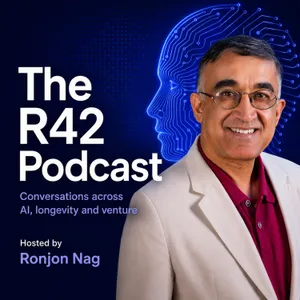
The R42 Podcast explores what’s next at the intersection of AI, longevity science, and venture. Hosted by inventor, entrepreneur, investor, and Stanford professor Ronjon Nag, the show brings together scientists, founders, investors, and other experts to explore emerging ideas, challenge assumptions, and uncover what may matter next.
Latest Episodes
The most recent episodes — sign up to get AI-powered summaries of each one.
- 6 days ago1h 5m
Human Brain Cells on a Chip Play Pong. Could They Become Conscious? | Alon Loeffler, Cortical Labs
Human brain cells grown on a chip can control a paddle in the video game Pong. What does that reveal about biological learning, and could increasingly complex living computers ever become conscious?Dr. Alon Loeffler of Cortical Labs joins Ronjon Nag to explore the emerging field of biological computing. Alon describes how a serious neurological illness as a teenager led him into neuroscience, how adult donor cells can be converted into neurons, and how electrical signals allow those neurons to interact with a computer.They discuss Cortical Labs' CL1 biological computer and Cortical Cloud, the Pong and Doom demonstrations, what biological neurons might offer that conventional AI does not, and the major challenges of memory, scalability, and keeping cell cultures alive. The conversation also explores potential applications in neurological drug discovery and the ethics of consciousness in biological systems.In this episode:How researchers grow human neurons and connect them to silicon chipsHow electrical feedback allows the cells to control PongThe CL1 platform and a recent Doom demonstrationLearning, memory, and biological versus artificial neural networksPotential applications in epilepsy and neurodegenerative disease researchWhether biological computers could ever develop consciousnessFollow The R42 Podcast for conversations where AI, longevity science, and venture intersect.Learn more: https://r42podcast.lovable.app/Cortical Labs: https://corticallabs.com/Alon Loeffler on LinkedIn: https://au.linkedin.com/in/alon-loefflerDisclosure: R42 has collaborated with Cortical Labs on student research projects. This discussion is for informational and educational purposes only and should not be considered medical or investment advice.
- 3 weeks ago1h 0m
Sleep and Longevity: What a Stanford Sleep Doctor Says About Wearables & AI
Are you getting enough sleep? Can your Oura Ring, WHOOP, or Apple Watch really tell you how well you're sleeping? And what if going to bed at the same time every night matters more than getting eight hours?In Episode 2 of the R42 Podcast, host Ronjon Nag sits down with Dr. Martin Kawalski, a physician and Stanford sleep researcher, to explore what science tells us about sleep, longevity, and the technologies that promise to help us sleep better.From the surprising importance of sleep regularity to the limitations of wearable sleep scores, Martin challenges conventional wisdom and shares practical insights for improving sleep and long-term health.In this episode:Why we sleep: How sleep supports brain health, memory, hormones, metabolism, and healthy aging.How much sleep is enough? Why seven to eight hours isn't a universal rule—and why consistency may matter more than duration.Can you trust your sleep tracker? What Oura, WHOOP, and Apple Watch measure well, and where their accuracy falls short.What disrupts sleep? The effects of alcohol, sleep apnea, stress, and irregular schedules.Do sleep supplements work? Martin's perspective on melatonin, magnesium, glycine, and other popular sleep aids.Sleep and longevity: What Martin is learning from studying centenarians and their sleep habits.The future of sleep: How AI, personalized wearables, and emerging therapies could transform sleep optimization—and whether we might someday need less sleep.Martin also introduces First Light, an AI-assisted platform he's developing to turn wearable data and lifestyle information into personalized sleep recommendations.Whether you're a longevity enthusiast, a wearable technology fan, or simply someone who wants better sleep, this conversation offers a fresh perspective on one of the most important foundations of good health.R42 Podcast — Where AI, longevity science, and venture intersect.Follow the R42 Podcast for more conversations with innovators exploring the future of health, technology, and venture.Disclosure: The discussion in this episode is for informational and educational purposes only and should not be considered medical or investment advice.
- Aug 29, 202647 min
Can You Make Your Brain Younger? Brain Age & the Younger Competition — Christin Glorioso
Christin Glorioso, founder and CEO of NeuroAge, joins Ronjon Nag to explore a provocative question: Can we measure, and potentially influence, how quickly our brains are aging?Christin shares how her family experience with Alzheimer’s led her to focus on brain health, why cognitive decline can begin long before obvious symptoms appear, and how NeuroAge is working to estimate and track brain age.They also discuss the Younger Competition, a six-month challenge that asks participants to see whether they can improve measures of biological and brain aging through personalized lifestyle and health strategies.Register for the Younger Competition: exclusive 15% off for R42 Podcast listenersThe conversation explores:• What “brain age” actually means and how it can be measured• Alzheimer’s risk and the importance of earlier detection• Exercise, diet, sleep and cognitive activity for brain health• The Younger Competition and what may change over six months• Personalized approaches to longevity and healthy aging• Peptides, supplements and the limits of current evidence• Creatine, nootropics and potential cognitive benefits• Where the science of brain aging may be headed nextDisclosure: R42 is an investor in NeuroAge Therapeutics. The discussion in this episode is for informational and educational purposes only and should not be considered medical or investment advice.Follow The R42 Podcast on Spotify to hear new conversations across AI, longevity and venture.Learn more and get podcast updates at r42podcast.lovable.appRonjon Nag on LinkedIn, Stanford ProfilesR42 Website Christin Glorioso on LinkedIn, PublicationsNeuroage websiteTimestamps00:00 Podcast Intro00:00 Meet Dr. Christin Glorioso & NeuroAge02:27 Personal Journey and Motivation Behind NeuroAge04:26 The Genetics and Lifestyle of Alzheimer’s Risk07:25 Beyond Amyloid & Soap Operas: Rethinking Alzheimer’s09:53 Memory, Neurons & Brain Adaptability17:15 What Does Brain Age Mean?19:29 Brain Aging vs. Cognitive Performance22:48 Strategies for Healthy Brain Aging: 9 Pillars25:55 The Younger 2027 Competition: Bigger Brains in 6 Months29:49 How to Win30:55 Win-Win: What the Younger Competition Could Teach Us31:46 From Testing to the Retreat34:02 Bonus: Exploring Personal Health Protocols34:15 Ronjon’s Own Longevity Protocol35:17 The Peptide Boom: Hype or Hope?38:19 Christin & Ronjon's Personal Supplement Stacks41:15 Peptide & Supplement Safety44:53 The Future of Aging and Health Measurement44:54 Exploring Creatine for Brain Health: Nootropic vs Neurorestrorative47:03 YHIHF: Your Six-Month Journey to YoungerSpecial thanks to Creative Producer/Editor, Ally Koh!
- Aug 29, 202638 min
Introducing The R42 Podcast with Ronjon Nag
Before we launch our first guest conversation, Executive Producer Steve Sprich, a longtime consumer technology leader with a current focus on AI, health and longevity, sits down with host Ronjon Nag to introduce The R42 Podcast and the ideas behind it.Ronjon shares why R42 is focused on the intersection of artificial intelligence, longevity science and venture, what he hopes to explore through the podcast, and why this is such an interesting moment for emerging science and technology.Join The R42 Podcast for conversations with scientists, entrepreneurs, investors and other experts exploring what may matter next across AI, longevity and venture.Follow The R42 Podcast on Spotify to hear new conversations across AI, longevity and venture.Learn more and get podcast updates at r42podcast.lovable.appRonjon Nag on LinkedIn, Stanford ProfilesR42 Website Timestamps00:00 Introduction: The R42 Podcast00:45 From AI Invention to Longevity Investor02:45 Why Longevity, Why Now03:51 Lifelong Learning & Interdisciplinary Thinking04:45 R42 Origins & Pillars: Institute, Venture, Invention07:39 What R42 Looks For in Founders08:50 Inside the Portfolio: Moonshots, Breakthroughs & an Aging Vaccine11:43 An Investment Mistake, Silicon Valley's Network, and Advice for Young Entrepreneurs13:32 Thoughts on Machine Consciousness15:15 Why the R42 Podcast? Why Now? Bridging AI, Longevity, and Venture17:41 Starting With Questions & Finding the People to Answer Them18:17 Challenging Accepted Ideas & Learning from Outsiders19:25 How AI Could Accelerate Longevity20:57 Wearables, Health Data, and the Growing Role of AI in Personal Health22:59 Do Not Check Your Brain at the Door23:51 Dear Listener (Anyone with a Pulse)24:56 A Safe Space for Big Ideas to Reality & Lessons from the Wright Brothers26:31 Axis on New Ideas27:12 Overhyped in AI vs the Human Brain: Can We Do More with Less?28:54 AI Disruption, Human Ingenuity, and the Future of Work30:35 Learning in an AI-Driven World: A Lesson from Captain Kirk32:43 Vision of Success: Strategic Foresight34:02 Longevity Debate: Genetics vs Lifestyle35:25 Ronjon's Personal Health Stack36:46 The Impossible Today: A Vaccine for Aging37:55 Episode Wrap37:55 Follow the Podcast, Find R4238:24 Exploring the Frontier of ScienceSpecial thanks to Steve Sprich & Creative Producer/Editor, Ally Koh!
- Aug 29, 20260 min
The R42 Podcast — Official Trailer
What happens when artificial intelligence, longevity science and venture collide?The R42 Podcast, hosted by Ronjon Nag, brings together scientists, entrepreneurs, investors and other experts to explore emerging ideas, challenge assumptions and uncover what may matter next.Follow The R42 Podcast on Spotify to hear new conversations across AI, longevity and venture.Learn more and get podcast updates at r42podcast.lovable.appRonjon Nag on LinkedIn, Stanford ProfilesR42 Website Special thanks to Producer/Editor, Ally Koh!
About The R42 Podcast
The R42 Podcast explores what’s next at the intersection of AI, longevity science, and venture. Hosted by inventor, entrepreneur, investor, and Stanford professor Ronjon Nag, the show brings together scientists, founders, investors, and other experts to explore emerging ideas, challenge assumptions, and uncover what may matter next.
Customized Recaps
AI-powered recaps with compact key takeaways, quotes, and insights.
Straight to Your Inbox
Get key takeaways from The R42 Podcast in a 5-minute read.
Save Hours Every Week
Stay current on your favorite podcasts without falling behind.
Frequently Asked Questions
What is Podzilla's The R42 Podcast daily summary?
It's a free AI-powered email that summarizes new episodes of The R42 Podcast as soon as they're published. You get the key takeaways, notable quotes, and links & mentions — all in a quick read.
How does the The R42 Podcast podcast summary work?
When a new episode drops, our AI transcribes and analyzes it, then generates a personalized summary tailored to your interests and profession. It's delivered to your inbox every morning.
Is this an official The R42 Podcast product?
No. Podzilla is an independent service that summarizes publicly available podcast content. We're not affiliated with or endorsed by R42 Institute.
Can I get summaries of other podcasts too?
Absolutely! The free plan covers up to 3 podcasts, any in the catalog. Basic raises that to 15, Pro to 40 and Max to 100. Browse our full catalog at /podcasts.
What topics does The R42 Podcast cover?
The R42 Podcast covers topics including Science, Life Sciences. Our AI identifies the specific themes in each episode and highlights what matters most to you.
Start getting The R42 Podcast summaries tomorrow morning.
Free forever for up to 3 podcasts. No credit card required.
Free forever for up to 3 podcasts. No credit card required.