
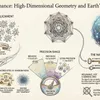
This podcast (52min) was generated by NotebookLM to simplify complex scientific concepts into an accessible format — based entirely on my own research.From Kepler’s Nesting Dolls to the Celtic Cross: A Deep Dive into the Harmonic Architecture of the Solar SystemImagine standing in front of a weathered stone monument in the Irish countryside. A traditional Celtic Cross, carved by monks perhaps a thousand years ago. You trace the geometry with your eyes — the perfectly proportioned squares, the concentric circles, the octagon inscribed within them. A beautiful and ancient design.Now imagine someone tapping you on the shoulder and telling you that the precise mathematical geometry used to construct that stone cross can predict the orbital distance of Pluto to within 1%.That’s not a metaphor. That’s what mathematics does.This post is a long-form companion to the 52-minute audio discussion above — a deep dive into the research behind Scala Harmonica and its companion paper, The Harmonic Architecture of the Solar System. If you want the accessible overview, the shorter post covers that. This one is for those who want to understand the full argument: the history, the mathematics, the physics of orbital resonance, the prediction, and the haunting question it leaves open.Part I: The Graveyard of Beautiful TheoriesTo appreciate what the Silver Ratio Harmonic Framework actually achieves, you have to understand what came before it — and why those attempts failed.Kepler’s Nesting Dolls (1619)Johannes Kepler is one of the pillars of modern astronomy. The same man who discovered that planets move in ellipses, whose laws of planetary motion NASA still relies upon today to send probes to Mars. But before he locked down those mechanical laws, his grand consuming passion was a different question entirely: why are the planets spaced the way they are?In 1619, he published Harmonices Mundi — The Harmony of the World — proposing that the answer lay in the five Platonic solids. There are exactly five regular three-dimensional shapes in all of geometry: the tetrahedron, cube, octahedron, dodecahedron, and icosahedron. And in Kepler’s time, only six planets were known — meaning exactly five gaps between them. He took this numerical coincidence as a sign of divine intention.His model nested the five solids inside one another, alternating with spheres: the sphere of Saturn’s orbit enclosing a cube, inside which fit the sphere of Jupiter’s orbit, inside which a tetrahedron, and so on, all the way down to Mercury. It is arguably one of the most beautiful scientific theories ever proposed.It was also wrong. Against modern precise orbital data, Kepler’s polyhedral model produces a mean error of over 10%. In the vastness of space, 10% can mean being off by hundreds of millions of miles. And when William Herschel discovered Uranus in 1781, the model shattered entirely — there are only five Platonic solids, and no geometric architecture could accommodate a seventh planet.Kepler’s failure was a failure of top-down thinking: he took a philosophical ideal — the cosmos must be built from perfect shapes — and tried to force physical data into it.The Titius-Bode Law (1766–1846)The Titius-Bode law took the opposite approach. No grand geometric philosophy — just pure pattern-matching. Johann Titius noticed a simple arithmetic sequence that seemed to match planetary distances: start with 0, 3, 6, 12, 24... double each time, add 4, divide by 10. The numbers aligned remarkably well with the known planets.When Uranus was discovered in 1781, it landed almost exactly where the law predicted. Vindication. And when the sequence revealed a gap at 2.8 AU — a predicted planet between Mars and Jupiter — astronomers went looking. In 1801, Giuseppe Piazzi discovered Ceres at 2.77 AU. The champagne flowed.Then came Neptune.Discovered in 1846, Neptune sits at 30 AU. The Titius-Bode law predicted a planet at 38.8 AU — off by nearly a billion miles. Pluto made things worse. The law was abandoned. It became a cautionary tale about the difference between finding a pattern and understanding one.The diagnosis: Kepler failed because his geometry had no physical basis. Titius-Bode failed because its numerical sequence had no underlying geometry. Both were, in different ways, curve-fitting exercises masquerading as laws.Part II: Why Chaos Produces OrderBefore introducing the Silver Ratio Harmonic Framework, there is a physical question that needs answering: if planetary formation is chaotic, violent, and essentially random, why should any neat mathematical pattern emerge at all?The answer lies in orbital resonance — one of the most profound and
Podzilla Summary coming soon
Sign up to get notified when the full AI-powered summary is ready.
Free forever for up to 3 podcasts. No credit card required.
Listen to This Episode



Get summaries like this every morning.
Free AI-powered recaps of The Quantum Blueprint Podcast and your other favorite podcasts, delivered to your inbox.
Free forever for up to 3 podcasts. No credit card required.