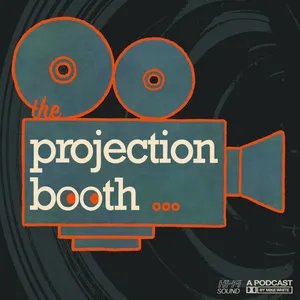
Free Daily Podcast Summary
The Projection Booth: Daily Summaries Delivered
by Weirding Way Media
The Projection Booth has been recognized as a premier film podcast by The Washington Post, The A.V. Club, IndieWire, Entertainment Weekly, and Filmmaker Magazine. With over 700 episodes to date and an ever-growing fan base, The Projection Booth features discussions of films from a wide variety of genres with in-depth critical analysis while regularly attracting special guest talent eager to discuss their past gems.
Latest Episodes
The most recent episodes — sign up to get AI-powered summaries of each one.
- Today19 min
Special Report: Never After Dark (2026)
Dave Boyle built Never After Dark (2026) around a lifelong passion for ghost stories and a desire to find something new in a "well-worn genre." He tells Mike White and co-star Moeka Hoshi about the sound design holding the film together: Japanese sound designer Natsuko Inoue (Godzilla Minus One, House of Ninjas), who handled all sound design and foley in Tokyo before flying to Los Angeles to mix at Warner Bros. with longtime American mixer Carlos, plus composer Jonathan Snipes — a deliberate pairing of Japanese and Western collaborators Boyle says rarely happens across either country's insular film industries.Hoshi, who plays wandering medium Airi, talks about the unusual challenge of acting opposite co-star Kurumi Inagaki's dead-sister character Miku, who appears only as a reflection — meaning entire scenes were performed without ever actually making eye contact with her scene partner, down to taping marks on walls to hit precise mirror angles. Boyle also details the funnier-than-scripted performance castmate Mutsuo Yoshioka brought to the film's mysterious man, and a hint of what's next: his in-development remake of the J-horror classic Pulse, based on what he calls his favorite script he's ever been handed.Become a supporter of this podcast: https://www.spreaker.com/podcast/the-projection-booth--5513239/support.Become a supporter of The Projection Booth at http://www.patreon.com/projectionbooth
- Today19 min
Special Report: The Deputy (2026)
First-time feature director Matt Sukkar cold-approached William H. Macy with a letter to land his Sheriff Krueger, then built The Deputy's tone around Scorsese's After Hours: "one bad decision leading you on the course of a night where the protagonist is trying to get things back to normal, and reality is becoming increasingly absurd the whole time." Adapted from Victor Gischler's novel — relocated from Oklahoma to Natchez, Mississippi, where Sukkar did a full dialect-and-reference pass on Carlo Bernard's long-dormant script — the film follows rookie deputy Toby Sawyer (Duke Nicholson) through one disastrous overnight shift, flanked by an ensemble Sukkar calls "eccentric, weird, but real": Macy, Tiffany Haddish, Stephen Dorff, Billie Lourd, and Julia Fox among them.Sukkar tells Mike White about matching Natchez's genuinely low-budget sheriff's station — a converted mechanic shop dressed by production designer Julie Tosh with taxidermy and desk-drawer trinkets — to the film's own scrappiness, shooting nights capped by hours limits for underage cast, and editing across four cities (Mississippi, New York, Mexico City, and LA) with editor Javier Velasco, chasing a different room each time to keep the same footage feeling fresh. He also talks about living with his real-life close friend and star, Duke Nicholson, for the length of the shoot, and the nationwide theater tour and Q&A run following the film's September 25 release.Become a supporter of this podcast: https://www.spreaker.com/podcast/the-projection-booth--5513239/support.Become a supporter of The Projection Booth at http://www.patreon.com/projectionbooth
- Today23 min
Special Report: Hellbilly Hollow (2026)
After getting killed off in John Carpenter's 2018 Halloween and walking that film's red carpet, musician-actor Kurt Deimer called his friend Kevin Wayne with a pitch: let's start our own horror franchise, the way Halloween launched Michael Myers. Wayne had already heard about a haunted attraction in Vincent, Alabama — Hellbilly Hollow — and the two built their new killers, hulking Bull (Deimer) and childlike, disfigured Tickles (Wayne, who also directs), around the real attraction's actual layout, shooting the whole film on-site and living in campers on the property.Wayne and Deimer tell Mike White about the three-week shoot, the freedom Wayne gave his co-star to improvise Bull's "deep inner soul of craziness," the pandemic slowdown that gave Deimer time to finish producing the original songs (mixed with mentor Chris Lord-Alge) that score the carnage, and the slate of horror-franchise sequels and other genre roles already lined up behind Hellbilly Hollow, including a new killer for producer Andy Gould (House of 1000 Corpses, The Devil's Rejects).Become a supporter of this podcast: https://www.spreaker.com/podcast/the-projection-booth--5513239/support.Become a supporter of The Projection Booth at http://www.patreon.com/projectionbooth
- Today2h 10m
Special Report: Digger (2026)
The Projection Booth and The Kulturecast cross the streams to dig into Digger, Alejandro G. Iñárritu's bombastic, heavily spoiled satire starring Tom Cruise as Digger Rockwell, an oil tycoon racing to convince the world he can fix the Arctic disaster he caused. Mike White and Chris Stachiw land on opposite sides of the "is it a $125 million folly or a willfully strange swing worth defending" debate, but agree the film's biggest surprise is its structural twist.They dig into the cast firing on all cylinders (Riz Ahmed, Sandra Hüller as Emma Rockwell, John Goodman's increasingly unhinged dictator-president, and Jesse Plemons as Kenny, whose late reveal recontextualizes the whole film), the production's garish, Lanthimos-adjacent art direction, and why the movie's box-office failure and its placement as Warner Bros.' swan-song release before the Paramount merger became as much a talking point as the film itself. They also get into Cruise's career-long pattern of go-for-broke choices, from Tropic Thunder to Vanilla Sky, and whether this one eventually finds its audience the way The Bride likely never will.Become a supporter of this podcast: https://www.spreaker.com/podcast/the-projection-booth--5513239/support.Become a supporter of The Projection Booth at http://www.patreon.com/projectionbooth
- Yesterday19 min
Special Report: Murder at the Movies (2026)
Alicia Malone has spent years watching screwball comedies and noir thrillers for Turner Classic Movies — now she's put herself inside one. The TCM host talks with Mike White about Murder at the Movies: A Movie Palace Mystery, her first novel and the first fiction title TCM and Running Press have ever published.Malone traces the book back to an accidental pitch over coffee with her editor, Cindy Sipala, and to her own fantasy of running a theater — the inspiration behind Audrey Sullivan, the Los Angeles transplant who inherits her grandmother's movie palace on a fictional Maine island only to find a body in the aisle after a Hitchcock screening goes wrong. Malone talks about disciplining herself to a deadline and a word count, getting early notes from noir historian Eddie Muller, and loading the book with classic-film Easter eggs for TCM viewers to spot.She and Mike also cover her favorite cozy-mystery writers, from Lorna Barrett's Book Town series to Richard Osman's Thursday Murder Club, the already-underway sequel (A Killer in the Credits), and how she splits her time between the novels and her TCM, The Gilded Age, and Reel Destinations work. Murder at the Movies is out October 6th from Running Press.Become a supporter of this podcast: https://www.spreaker.com/podcast/the-projection-booth--5513239/support.Become a supporter of The Projection Booth at http://www.patreon.com/projectionbooth
- Yesterday20 min
Special Report: Appofeniacs (2026)
Music-video veteran Chris Marrs Piliero (The Black Keys, Kesha, Ariana Grande) traces his feature debut, Appofeniacs, to two obsessions: the ease of deepfake manipulation, and apophenia — our compulsion to find connections in things that aren't actually connected. He tells Mike White how fan theories about his own music videos (imagined hidden messages, imagined Illuminati symbolism) convinced him the premise had teeth: a small, trivial fake video of a friend can chain-react into real violence.Piliero also walks through the guerrilla reality of self-financing a feature that refuses to stay in one location — rewriting scenes around which of his friends' apartments and neighborhood businesses (a coffee shop, a smoke shop) he could talk his way into — and premiering the deepfake-horror film at Fantastic Fest and FrightFest to crowds cheering the gore.Become a supporter of this podcast: https://www.spreaker.com/podcast/the-projection-booth--5513239/support.Become a supporter of The Projection Booth at http://www.patreon.com/projectionbooth
- Yesterday21 min
Special Report: Beware Boiúna (2026)
"What if Sorcerer was a creature feature?" That question is what unlocked Beware Boiúna for director Mike P. Nelson, who tells Mike White how William Friedkin's doomed-expedition structure — immerse the audience in an environment, let it become a character, then release the beast — became his blueprint after he initially turned down a "giant snake movie" pitch from producers Jeremy Bolt and Robert Kulzer.Nelson details the real jungle: flooded sets, a tarantula bite, a broken bone, and a shoot on a moving river boat that rewrote the schedule daily, plus the VFX philosophy of showing the title creature only through the narrowest slivers of frame so her scale registers even half-glimpsed. Stars Jessica Rothe (Alli) and Kiana Madeira (Lena) join for a separate conversation about shooting on the actual Amazon River instead of faking it on a soundstage, the poisonous dart frog that turned up on a cast chair, the snake wrangler who cleared every space before a take, and finally seeing the finished film with an audience at Fantastic Fest.Become a supporter of this podcast: https://www.spreaker.com/podcast/the-projection-booth--5513239/support.Become a supporter of The Projection Booth at http://www.patreon.com/projectionbooth
- 1 weeks ago20 min
Special Report: The World of Nancy Kwan
Nancy Kwan talks with Mike about The World of Nancy Kwan, her new memoir written with Deborah Davis and a foreword by her nephew Kevin Kwan. Kwan revisits how she landed The World of Suzie Wong almost by accident, tagging along to watch her favorite Hong Kong actresses screen-test before a casting director pulled her in front of the camera, which led to a Hollywood contract, acting lessons with Jeff Corey, and a national tour of the stage production after France Nuyen won the film role.They dig into working with William Holden on Suzie Wong, the yellow cheongsam that made her a fashion sensation, Flower Drum Song's ensemble of Miyoshi Umeki, James Shigeta, and Jack Soo under choreographer Hermes Pan, and being directed by her husband on Walking the Edge. Kwan also talks about her friendship with Bruce Lee, their $10 bet over Kung Fu, and Asian representation in Hollywood then and now.The World of Nancy Kwan is out now.Become a supporter of this podcast: https://www.spreaker.com/podcast/the-projection-booth--5513239/support.Become a supporter of The Projection Booth at http://www.patreon.com/projectionbooth
Get The Projection Booth summaries in your inbox
Free AI-powered daily recaps. Key takeaways, quotes, and mentions — in a 5-minute read.
Get Free Summaries →Free forever for up to 3 podcasts. No credit card required.
You Might Also Like
Listeners also like.
Weirdhouse Cinema
Two hosts explore the history and cultural impact of bizarre, surreal, and experimental films across all genres and eras.
The Kulturecast
A film and pop culture podcast exploring how movies shape and are shaped by society, with deep dives and rotating co-hosts.

Cinema Spectator
Discusses classic films from the cinematic canon to evaluate their relevance and entertainment value for modern, casual audiences.
Don't Go Out There Horror Movie Review Podcast
Four friends discuss horror movies and interview industry legends.
Critical Darlings
Film critics analyze new movie releases, from blockbusters to award contenders, discussing what’s shaping cinematic conversations each week.
HOLLYWOODLAND
Examines crimes connected to Hollywood figures and film history, from murders to conspiracies and scandals.
The Filmcast
Film critics and guests discuss recent movies, TV shows, and entertainment news with analysis and debate.

The Weekly Planet
Discusses movies, TV shows, and comics with a focus on pop culture and genre entertainment.
The New Flesh Horror Movies Horror News Scary Movie
A podcast covering horror movies, franchises, news, and the horror lifestyle.
WHAT WENT WRONG
Examines the chaotic behind-the-scenes failures and challenges of infamous Hollywood movie productions.
Unspooled
Two film enthusiasts analyze classic and contemporary movies, breaking down scenes, characters, and cultural impact.
Pod Mortem: A Horror Podcast
Scene-by-scene reviews of classic, contemporary, and cult horror films with trivia, commentary, and humor.
About The Projection Booth
The Projection Booth has been recognized as a premier film podcast by The Washington Post, The A.V. Club, IndieWire, Entertainment Weekly, and Filmmaker Magazine. With over 700 episodes to date and an ever-growing fan base, The Projection Booth features discussions of films from a wide variety of genres with in-depth critical analysis while regularly attracting special guest talent eager to discuss their past gems.
Customized Recaps
AI-powered recaps with compact key takeaways, quotes, and insights.
Straight to Your Inbox
Get key takeaways from The Projection Booth in a 5-minute read.
Save Hours Every Week
Stay current on your favorite podcasts without falling behind.
Frequently Asked Questions
What is Podzilla's The Projection Booth daily summary?
It's a free AI-powered email that summarizes new episodes of The Projection Booth as soon as they're published. You get the key takeaways, notable quotes, and links & mentions — all in a quick read.
How does the The Projection Booth podcast summary work?
When a new episode drops, our AI transcribes and analyzes it, then generates a personalized summary tailored to your interests and profession. It's delivered to your inbox every morning.
Is this an official The Projection Booth product?
No. Podzilla is an independent service that summarizes publicly available podcast content. We're not affiliated with or endorsed by Weirding Way Media.
Can I get summaries of other podcasts too?
Absolutely! The free plan covers up to 3 podcasts. Upgrade to Pro for 15, or Premium for 50. Browse our full catalog at /podcasts.
How often does The Projection Booth release new episodes?
The Projection Booth publishes daily. Our AI generates a summary within hours of each new episode.
What topics does The Projection Booth cover?
The Projection Booth covers topics including History, Film, TV & Film, Film Reviews, Comedy Interviews. Our AI identifies the specific themes in each episode and highlights what matters most to you.
Start getting The Projection Booth summaries tomorrow morning.
Free forever for up to 3 podcasts. No credit card required.
Free forever for up to 3 podcasts. No credit card required.