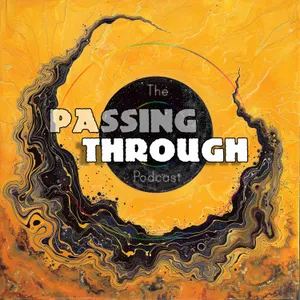
Free Daily Podcast Summary
The Passing Through Podcast: Daily Summaries Delivered
by Danny
I currently live in a German-made van named Wilma with my partner. We’ve given up our old way of life and are touring Europe – passing through farms and eco-villages while I record a rambling, ranting podcast examining the in-betweens of consciousness, ecology, animacy, and the human condition. Fasten your seatbelt and come along for the ride!
Latest Episodes
The most recent episodes — sign up to get AI-powered summaries of each one.
- 2 days ago1h 12m
E135 | David Rothenberg | Interspecies Melodies: Making Music With Whales & Birds
Educator, philosopher, composer, jazz musician and author, David Rothenberg, creates art in a very unusual way. He plays music, with other species. Accompanied by non-human musicians such as birds, insects, whales and even underwater plants, David has released more than forty albums and written numerous books like <em>Survival of the Beautiful</em>, <em>Whale Songs</em>, and <em>Bug Music: How Insects Gave Us Rhythm and Noise</em>. David has dedicated his life to investigating the relationship between humanity and nature. He argues birdsong doesn’t just sound like music—it <em>is</em> music. And he should know, he’s a jazz clarinetist who jams with nightingales and humpback whales. A naturalist and avid lover of nature, he’s even studied with Arne Naess, considered to be the grandaddy of the Deep Ecology movement. David’s been the subject of feature-length documentaries such as <em>Why Birds Sing</em>, and <em>Nightingales In Berlin</em>. He teaches at The New Jersey Institute of Technology where he’s a professor of philosophy and music. A lifelong explorer of ecology, the more-than-human, and those strange, liminal spaces at the edge of the ordinary, he’s a natural fit for this show. I hope you enjoy our meandering conversation as much as I did. You can learn more about David at his website at davidrothenberg.net, or by listening to his music or watching the films I mentioned. The music you just heard was from his album <em>The Secret Songs of Ponds</em>, which I really recommend.
- 1 weeks ago1h 10m
E134 | Halloween Special | A Century of Cinematic Monsters: The Zombie, Vampire & Frankenstein
Is a zombie just a mindless reanimated corpse cursed with an insatiable hunger for warm brains? Or are their pained groans an attempt to tell us something real about consumption, imperial extraction, plantation capitalism and the loss of bodily autonomy under oppressive settler-colonial regimes? Modern audiences may have forgotten this, but zombies, in their proper cultural context, didn’t eat flesh. In the original Haitian folklore from which the zombie arises, the monster is metaphor for the horrors of transatlantic chattel slavery. Signaling the ultimate, tragic horror of resurrecting a body—removing it from its final resting place—and condemning it to a frightful fate of forced labor for all eternity. Enslaved not just in life but also in death; a total denial of freedom. Everything that has come to be understood as monstrous to the modern mind arose alongside—and in relationship to—Western colonial expansion and Enlightenment thought. Today, much of what’s perceived of as frightening isn’t merely biological, but rather culturally constructed. These constructs haunt us. They lurk and linger in the shadowy recesses of our synapses; whispering words from the dark alleys we’d rather not walk down. They invite us to sit with deep discomfort, existential dread, grief, numbness, hopelessness and despair, the terror of unmitigated malice. The monstrous is unboundaried, unpredictable, illogical, illegible, incorrigible, inexorable. French Philosopher and author Michele Foucault had this to say about monsters: “The monster is the fundamental figure around which bodies of power and domains of knowledge are disturbed and reorganized.” We do not invent monsters out of thin air; we construct them out of what our culture refuses to face. Let’s take a good look at some monsters.
- 3 weeks ago1h 2m
E133 | Mary-Jane Rubenstein | Pantheologies: Gods, Worlds, Monsters
Mary-Jane Rubenstein is a philosopher of religion and science, and the author of numerous books, including Pantheologies: Gods, Worlds, Monsters. In this episode, we discuss her work on pantheology, the idea that the world itself is divine. We talk about how certain ideas and bodies become monstrous. Not only is the title of this book absolutely wicked, it’s one of those books I couldn’t put down and couldn’t stop thinking about once I did. It weaves together medieval heresies, Ancient Greek Gods and philosophies, general relativity, quantum mechanics, nonlinear biologies like Gaia Theory, multiverse and indigenous cosmologies, ecofeminism, animal and vegetal studies, and more. You can find Mary-Jane and learn more about this book and her work at https://www.maryjanerubenstein.com.
- Oct 7, 202650 min
E132 | Cornell 7 | Masculinity, Harm and Monsters
Listen to this episode with caution. The themes are more explicit than usual; they concern the Cornell 7 rape allegations and the larger societal forces which enable sexual violence and harm. There are two corrections I wanted to make since recording the audio. First, that not every one of the students had to write an essay as punishment. It appears only some students did. Additionally, I mentioned that women are were responsible for most of the labor in the world, and I want to clarify that my point was about UNPAID labor. This episode digs into how we talk about women under modernity, and how we think of men and masculinity. I explore how our thoughts and perceptions contribute to forces that literally govern bodies. These are racial forces, gendered forces, political forces, cultural forces that run so deep they pierce the marrow of our bones. Swell and pulse in the throbbing reproductive organs of men. I also ask what's happening when we describe other people as monsters. Does this language and framing reproduce the very systems they seek to dismantle? Perhaps it's a learned tactic of the oppressor; a linguistic tool purposed to dehumanize and explain problems away in isolated, reductionist terms which lend themselves to carceral systems and punitive thinking. What does accountability look like when we have to sit with the monster instead of locking it in a room with other monsters?
- Sep 25, 202617 min
E131 | Goodbye Spotify & Where to Find This Podcast
I'm leaving Spotify, and I've setup a Patreon. This is the last and only episode of this show you should see listed here. If you want to find this podcast, search for it wherever you listen to podcasts, or check it out at www.thepassingthroughpodcast.com. You can find it on YouTube, Apple Podcasts, Overcast, Castbox, Pocket Casts, Podcast Addict, iHeartRadio, and most other places you listen to podcasts. This episode is sponsored by SWILK. It's what bones crave!
- Sep 16, 202653 min
E130 | Getting Back in the Saddle
I'm back after a bit of time away. Join me for a chat about what I've been up to, where I was, and what's next for the podcast. I also talk about some of the things I've been reading, and share a few thoughts on the state of the world. This episode is brought to you by Defecation Desecration.
- Aug 11, 202613 min
E129 | Leaving On a Jet Plane
I'm leaving for a little while for a brief adventure. I'll be back again in about a month. Enjoy the down time!
- Aug 5, 20261h 32m
E128 | Skye Cielita Flor | Curanderismo, Ayahuasca & Animist Perception
When you think of plant medicine, one of the first things you think of is probably ayahuasca. An Intensely psychedelic kaleidoscopic weekend of hallucination and vomiting hopefully accompanied by profound shifts in consciousness. You may know someone who’s attended an ayahuasca ceremony, you may have even attended one or more yourself, but you probably haven’t heard the stories of someone who’s studied with indigenous Shipibo people of the Peruvian Amazon. This week’s guest spent 5 years in the jungle, embedded in an animist culture, undergoing plant dietas while learning medicine songs called icaros as she deepened her understanding of both plant intelligences and the ancient practice of Amazonian Curanderismo. Skye has also spent three years apprenticing with Chinese medicine, she’s a Grief Ritualist, a facilitator in Experiential Deep Ecology. Skye currently co-facilitates Josh’s yearlong study group The Mythic Body, and leads her own events focused on reclaiming animist perception, developing mythic imagination and helping people reconnect to the living, breathing, more-than-human world all around us. She leads various study groups on Practical Animism and Grief work, as Nature Connection Mentor, Folk Herbalist, Plant Medicine Ritualist, Naturalist and as someone who spends a lot of time outdoors, in ritual or in focused practice on the land.Honestly, I can’t think of a more fitting guest than Skye. This is one of my favorite conversations on this show and I hope you enjoy it too. Skye’s WebsiteBlogsCuranderismoPlant DietaIcarosPsychedelic-Assisted PsychotherapySkye's Upcoming EventsSkye’s Upcoming Workshop on Plant IntelligenceReferencesRobert Johnson’s Inner WorkStephen Harrod Buhner’s Plant Intelligence And The Imaginal RealmJosh Schrei’s The Emerald Podcast — Animism Is Normative Consciousness Previous EpisodesJohn SeedFrancis WellerJosh SchreiBayo Akomolafe
Get The Passing Through Podcast summaries in your inbox
Free AI-powered daily recaps. Key takeaways, quotes, and mentions — in a 5-minute read.
Get Free Summaries →Free forever for up to 3 podcasts. No credit card required.
You Might Also Like
Listeners also like.

Wayfinder: Life-Changing Travel
Travel stories exploring transformation through cultural encounters, food, and off-the-map journeys guided by curiosity.

Traveling Through with David Prior
Conversations with cultural figures explore how travel, objects, and meaningful experiences shape identity.

A World With
Futures In Draft & Storythings

Forum Borealis
In-depth interviews with authors and thinkers on unconventional topics in history, science, philosophy, and politics.

WorldAroundEwe's Podcast
World Around Ewe/ Jack Devaney

Far From Home
A journalist travels to remote regions and cultural hotspots, documenting immersive stories from across the globe.
Posting Through It
Investigative journalists explore how social media shapes modern politics through reporting, analysis, and guest interviews.
Stuff To Blow Your Mind
Explores the strange edges of science, consciousness, and reality through neuroscience, cosmology, evolution, and emerging technology.

Earth and Spirit Podcast
Earth and Spirit Center

Weird Studies
Conversations on art and philosophy that explore unsettling ideas and works challenging the boundaries of reality.

Wanderer Chronicles Radio
A sentient starship's archivist narrates philosophical science fiction parables from across the cosmos.
hidden experience audio
In-depth interviews exploring the personal impact of UFO contact and the broader UFO mystery.
About The Passing Through Podcast
I currently live in a German-made van named Wilma with my partner. We’ve given up our old way of life and are touring Europe – passing through farms and eco-villages while I record a rambling, ranting podcast examining the in-betweens of consciousness, ecology, animacy, and the human condition. Fasten your seatbelt and come along for the ride!
Customized Recaps
AI-powered recaps with compact key takeaways, quotes, and insights.
Straight to Your Inbox
Get key takeaways from The Passing Through Podcast in a 5-minute read.
Save Hours Every Week
Stay current on your favorite podcasts without falling behind.
Frequently Asked Questions
What is Podzilla's The Passing Through Podcast daily summary?
It's a free AI-powered email that summarizes new episodes of The Passing Through Podcast as soon as they're published. You get the key takeaways, notable quotes, and links & mentions — all in a quick read.
How does the The Passing Through Podcast podcast summary work?
When a new episode drops, our AI transcribes and analyzes it, then generates a personalized summary tailored to your interests and profession. It's delivered to your inbox every morning.
Is this an official The Passing Through Podcast product?
No. Podzilla is an independent service that summarizes publicly available podcast content. We're not affiliated with or endorsed by Danny.
Can I get summaries of other podcasts too?
Absolutely! The free plan covers up to 3 podcasts, any in the catalog. Basic raises that to 15, Pro to 40 and Max to 100. Browse our full catalog at /podcasts.
What topics does The Passing Through Podcast cover?
The Passing Through Podcast covers topics including Culture, Society & Culture. Our AI identifies the specific themes in each episode and highlights what matters most to you.
Start getting The Passing Through Podcast summaries tomorrow morning.
Free forever for up to 3 podcasts. No credit card required.
Free forever for up to 3 podcasts. No credit card required.