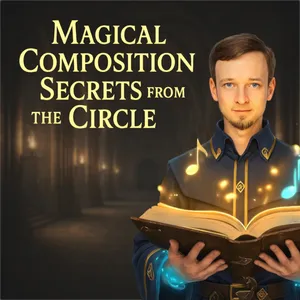
Free Daily Podcast Summary
The Music Interval Theory Podcast: Daily Summaries Delivered
by The Music Interval Theory Podcast
Get key takeaways, quotes, and insights from The Music Interval Theory Podcast in a 5-minute read. Delivered straight to your inbox.
Latest Episodes
The most recent episodes — sign up to get AI-powered summaries of each one.
- Yesterday5 min
Think In Energy, Not Chords
https://www.skool.com/circle-of-interval-magicians/about In this episode, Frank explores why adding more complex chords doesn’t always improve your music. Instead of focusing on chord labels, he invites you to think in terms of musical energy—shaped by elements like density, register, rhythm, and orchestration. By aligning harmony with the energy a moment truly needs, your compositions can feel more intentional, clear, and expressive.
- 4 days ago5 min
Fix The Context, Not The Chord
https://www.skool.com/circle-of-interval-magicians/about In this episode, Frank explores the idea that “wrong” chords are often just incomplete musical moments. By adding context, adjusting harmony, and staying curious a little longer, composers can transform uncertainty into expressive and original harmonic choices. The episode encourages a shift from judgment to exploration in the creative process.
- 6 days ago5 min
Momentum Over Perfection
https://www.skool.com/circle-of-interval-magicians/about In this episode, Frank explores how early self-judgment can quietly shut down your creative flow. By allowing your first ideas to be rough and unfinished, you create space for momentum, connection, and playful exploration. The focus shifts from proving something to simply building something, helping you reconnect with a more natural and enjoyable composing process.
- 1 weeks ago5 min
When Simple Is Strong
https://www.skool.com/circle-of-interval-magicians/about In this episode, I explore why trying to “improve” a good melody can sometimes weaken it. I talk about the strength of diatonic, whistleable melodies and how they create trust and clarity for the listener. Instead of forcing complexity too early, I suggest using simple melodies as a foundation and adding tension with intention, not insecurity.
- 1 weeks ago5 min
The Power of A Story
https://www.skool.com/circle-of-interval-magicians/about In this episode, I explore why choosing chords can feel random when there’s no clear story behind your music. I share how defining a simple “story container” — like a scene, emotion, or memory — can guide your harmonic decisions and bring clarity to your composition. When the intention is clear, harmony becomes purposeful instead of accidental.
- 1 weeks ago4 min
Stop Composing Alone
https://www.skool.com/circle-of-interval-magicians/about In this episode, I explore the hidden limitations of composing in isolation and how it can slow down your creative growth. I share why getting feedback and being part of a community can accelerate your progress, help you spot patterns faster, and make better creative decisions. The key idea is simple: growth doesn’t just come from doing more, but from seeing more.
- 2 weeks ago7 min
Why Basics Unlock Magic
https://www.skool.com/circle-of-interval-magicians/about In this episode, Frank explores why interval theory often feels difficult and how the real challenge may lie in unclear fundamentals rather than complex concepts. He shares how becoming comfortable with treble and bass clef transforms intervals from abstract calculations into visual, intuitive tools. The episode highlights how small improvements in note recognition can remove creative friction and make composing feel more natural and enjoyable.
- 2 weeks ago3 min
Find Your Musical Edge (With Interval Theory)
https://www.skool.com/circle-of-interval-magicians/about In this episode, I explore how relying on proven formulas can lead to familiar results, and why that’s not necessarily a problem. The real shift happens when you expand those foundations with your own perspective. This episode focuses on how originality comes from shaping what already works into something that feels personal and authentic.
Get The Music Interval Theory Podcast summaries in your inbox
Free AI-powered daily recaps. Key takeaways, quotes, and mentions — in a 5-minute read.
Get Free Summaries →Free forever for up to 3 podcasts. No credit card required.
You Might Also Like
Listeners also like.
Beyond Music Theory
Pedro Murino Almeida

Musicality Now
Musical U

Guitar Music Theory
Desi Serna

Music Student 101
Jeremy Burns, Matthew Scott Phillips
Mind Music Mastery
Tileyard Education
Music Production Podcast
Brian Funk

Chamber of Metrix
Camel Brothers
The Little Harmonies Podcast
Little Harmonies
Music Production and Mixing Tips for Beginner Producers | Inside The Mix
Music Production and Mixing Tips for Beginner Producers

The Music Room
The Sound Boutique

Creativity Excitement Emotion
David Andrew Wiebe
Master Your Mix Podcast
Mike Indovina
About The Music Interval Theory Podcast
Many composers feel stuck writing the same old ideas, wondering why their music doesn’t sound as original as they want. Inside the Music Interval Theory Academy (MITA) and our community (The Circle of Interval Magicians), we reveal the deeper architecture behind music, the interval magic that helps you break free from the generic sound and step into your own creative power.The truth is, the composers you admire weren’t born with secret gifts. They learned "spells." They trained their ears, sharpened their instincts, and discovered the hidden structures that shape emotional storytelling. And you can learn them, too.If you’re the kind of composer who wants to tell powerful musical stories, confidently, clearly, and with your own unmistakable voice, then you already belong here. You just need the right tools, the right guidance, and a way to finally see how music truly works beneath the surface.Conventional theory often leaves composers confused or boxed in, and that’s why so many
Customized Recaps
AI-powered recaps with compact key takeaways, quotes, and insights.
Straight to Your Inbox
Get key takeaways from The Music Interval Theory Podcast in a 5-minute read.
Save Hours Every Week
Stay current on your favorite podcasts without falling behind.
Frequently Asked Questions
What is Podzilla's The Music Interval Theory Podcast daily summary?
It's a free AI-powered email that summarizes new episodes of The Music Interval Theory Podcast as soon as they're published. You get the key takeaways, notable quotes, and links & mentions — all in a quick read.
How does the The Music Interval Theory Podcast podcast summary work?
When a new episode drops, our AI transcribes and analyzes it, then generates a personalized summary tailored to your interests and profession. It's delivered to your inbox every morning.
Is this an official The Music Interval Theory Podcast product?
No. Podzilla is an independent service that summarizes publicly available podcast content. We're not affiliated with or endorsed by The Music Interval Theory Podcast.
Can I get summaries of other podcasts too?
Absolutely! The free plan covers up to 3 podcasts. Upgrade to Pro for 15, or Premium for 50. Browse our full catalog at /podcasts.
How often does The Music Interval Theory Podcast release new episodes?
The Music Interval Theory Podcast publishes every few days. Our AI generates a summary within hours of each new episode.
What topics does The Music Interval Theory Podcast cover?
The Music Interval Theory Podcast covers topics including Education, How To. Our AI identifies the specific themes in each episode and highlights what matters most to you.
Start getting The Music Interval Theory Podcast summaries tomorrow morning.
Free forever for up to 3 podcasts. No credit card required.
Free forever for up to 3 podcasts. No credit card required.