Free Daily Podcast Summary
by Karen Wong
Get key takeaways, quotes, and insights from The Meaning Code in a 5-minute read. Delivered straight to your inbox.
The most recent episodes — sign up to get AI-powered summaries of each one.
This interview between Karen and Annette Poizner focuses on Annette's new book "Weaving the Way: Jewish and Chinese Teachings for a Fractured World," about the intersections between Jewish and Chinese wisdom traditions. Annette, a clinical social worker and psychologist, relates how both cultures share similar philosophical concepts, particularly around the five elements theory in Chinese medicine and corresponding elements in Jewish thought. Exploring how these ancient wisdom traditions can provide frameworks for understanding personality types, mental health, and spiritual balance, the conversation also covers upcoming events during Asian and Jewish Heritage Month, including lectures by various scholars and a free display honoring prominent Chinese and Jewish civic contributors. Both Jewish and Chinese cultures embrace a "dignity culture" rather than victim mentality. The conversation concludes with a brief discussion about publishing the interview on Sunday morning May 10 to coincide with the free book download availability.
How did language develop its rich, complex properties and what led to your epiphany about language’s nature? Elan framed a recent realization that language may possess an internal, self-generative structure revealed by large language models. He argued that modern language models work by learning statistical relations in sequences rather than by possessing external world knowledge or reference. Elan proposed that human speech may be language “running on its own,” with the speaker acting mainly as a prompt to an internal informational system. He reported conducting computational and empirical work over the past ~18 months to test and develop this intuition about language. Elan suggested language likely evolved from preexisting biological sequence-generating mechanisms rather than appearing de novo in humans. He proposed music as a possibly purer autogenerative domain that may have preceded or informed early language forms. EMIC analysis (emic) is used to derive internal musical rules from large samples of transcribed songs to enable generative composition that insiders can validate. Generative analysis aims to produce compositions that are stylistically authentic based on derived internal structures. Historical precedents exist for algorithmic composition; the Arca Musarithmica mechanically generated musical settings for Latin texts in the 17th century. Was the 17th‑century Arca Musarithmica an actual physical machine? Are all musical forms capturable by emic/generative techniques and do musical universals exist analogous to linguistic universals? Elan raised two core research questions: whether all musical forms are capturable by this technique and whether cross‑cultural musical universals exist. Ethnomusicologists are generally skeptical of declaring broad universals and emphasize cultural distinctiveness. Drew argued that the act of singing is a likely universal behavior with implications for intonation, audiation, scales, harmony, and rhythm. Does disciplinary bias (postmodernism) explain ethnomusicologists’ reluctance to assert universals? Quranic recitation exemplifies a vocal tradition that resembles music to outsiders but is treated as elevated intonation internally, and reciters often receive formal singing training. Serialist and some 20th-century art music intentionally separate musical sound from social function. Most music functions socially to connect people and express shared feelings beyond mere acoustics. Postmodern art and music challenged conventional notions of beauty and meaning by redefining what counts as art. Peirce’s semiotic categories (icon, index, symbol) map cleanly onto musical modes of signification. How is music conveying meaning when tonal pieces evoke emotions without explicit narrative? Indexical musical features, like minor chords, commonly signal sadness through shared or embodied associations. Cultural familiarity determines whether listeners register symbolic musical cues and extract meaning. Language and music both operate as relational systems that create expectations and structure meaning without direct reference. Music functions as a program that generates emotional responses rather than transmitting explicit narratives. Popular-song phrases can reliably evoke emotion across broad audiences due to stable structural hooks. How do you define and operationalize “meaning” in language versus music within this autogenerative framework, and what concrete predictions does this yield for experiments? In an autogenerative framework, both language and music are treated as systems that generate expectations over time, but they differ in what those expectations are anchored to and how “meaning” stabilizes. How “meaning” is defined
Exploring Lisa Barrett's relational realism and its implications for counseling, linking philosophical, clinical, biological, and spiritual perspectives. The video we are discussing: https://youtu.be/T1b7nEj7IlQ?si=FzNbMcnLRU28NR1j Distinctions between maps and territory; Ryan contrasted a Cartesian epistemology that treats perception as isolated with a constructivist view in which clients build internal "maps" and therapists help update those maps when they no longer match reality. Examples — including C.S. Lewis's image of removing irrational fear — to frame therapy's goal as restoring choice rather than imposing a single truth. Tensions between modern counseling/psychiatry and traditional spiritual guidance Limits of a detached scientific "view from nowhere" given changing cultures and replication issues. Strongest outcomes combine top-down meaning work and bottom-up biological intervention, emphasizing embodied, practice-based recovery through small actions and service. Is medication necessary for severe cases? Biological adaptability evidence, citing Barbara McClintock and rapid posture changes from bodywork. Connecting adaptation to belief and repentance (James 1:2–8) and recommending a localized, role-based perspective to reduce cognitive overload while remaining aware of broader systems. How communities can provide orienting vision.
Karen and Adam discussed Adam's new YouTube summarization app called Headwater, which helps users quickly understand video content without having to watch entire videos. Adam, a dentist pursuing a master's in computer science, explained his philosophical reflections on computation and technology, drawing parallels between computer science concepts and fundamental aspects of reality. They explored topics including Michael Levin's bowtie architecture concept as an analogy to the implications of AI on society, and the challenges of digital attention fragmentation. The conversation also touched on Adam's previous experience with YouTube content creation and his family life, including the upcoming birth of his fifth child. Be one of the first to try out headwaterapp.com. User flow: paste a video link, follow channels by channel ID, and receive a prioritized email digest that includes a full summary for the top channel and condensed summaries for others. Adam noted summaries persist even if the original video is removed, initial testing is limited to roughly 20 users, feedback is routed to headwater.com emails.
From a talk with Annie Crawford about the C S Lewis novel: That Hideous Strength, which she likens to Augustine's City of God with its discussion of the kingdom of heaven versus the kingdoms of this world. The whole talk is here: https://youtu.be/c-_iu0jPfGo?si=6w5ezl5mfZO6G7Xl
Perry Marshall, Author of Evolution 2.0 and creator of the $10 million Evolution 2.0 prize for a patentable theory of the Origin of Information, to be judged by George Church and Denis Noble. Glen, physicist and mathematician who has had many appearances on The Meaning Code discussing information theory, entropy and robotics. The whole episode can be found here: https://youtu.be/PXDC4sIy5dA?si=ORZxIquCl4bkiltZ
'Electracy, coined by theorist Gregory Ulmer, is the cultural, cognitive, and skill-based shift from print literacy to the digital age, representing the "literacy" for electronic media like the internet, social media, and virtual worlds, emphasizing play, performance, and affective connection over purely rational thought, and involving new ways of identity, learning, and meaning-making. It's a dynamic cultural apparatus, not just a set of tech skills, blending "electricity" and "trace" to capture both technology's power and its inherent relational meanings.' We hear Parker's story and his introduction to Paul VanderKlay and TLC, along with news of and details about his search engine for the 10000 videos that have been generated by TLC affiliates. The "flotilla" is on the move!
Dr. Iain McGilchrist and Dr. Chris E W Green join The Meaning Code to speak of the way back from our current wandering in the wilderness. Introductions to the two follow the timestamps, which regrettably only cover the first hour. If anyone wants to add the second hour, go for it. Timestamps: 00:00 Introduction 01:00 Reflections on Spirituality and Hope 01:25 Iain McGilchrist reads poem by Hermes Trismegistus 06:37 The impact of Reductionism on Art and Experience 13:16 The interplay of Death, Life and Storytelling 19:01 The danger of grasping mode in human experience 31:40 The nature of understanding and intelligence 36:09 The temptation to turn resistances into tools for personal gain 40:30 The importance of making space for growth 45:00 Opposites and Dark Sides - George MacDonald 49:04 The importance of acknowledging darkness for health and society 52:50 Rituals and Henri de Lubac 56:00 Sentimentality is cruelty Iain McGilchrist is a former Fellow of All Souls College, Oxford, an associate Fellow of Green Templeton College, Oxford, a Fellow of the Royal College of Psychiatrists, a Fellow of the Royal Society of Arts, a Consultant Emeritus of the Bethlem and Maudsley Hospital, London, a former research Fellow in Neuroimaging at Johns Hopkins University Medical School, Baltimore, and a former Fellow of the Institute of Advanced Studies in Stellenbosch. His books include Against Criticism (Faber), The Master and his Emissary: The Divided Brain and the Making of the Western World (Yale UP), The Divided Brain and the Search for Meaning; Why Are We So Unhappy? (Yale UP), and Ways of Attending (Routledge). Chris E W Green Chris Green is Professor of Public Theology at Southeastern University (Lakeland, FL) and Director for St Anthony Institute of Theology, Philosophy, and Liturgics. He is the author and editor of a number of books, popular and scholarly, including most recently All Things Beautiful: An Aesthetic Christology (Baylor University Press), the first volume of a forthcoming trilogy.
Free AI-powered daily recaps. Key takeaways, quotes, and mentions — in a 5-minute read.
Get Free Summaries →Free forever for up to 3 podcasts. No credit card required.
Listeners also like.
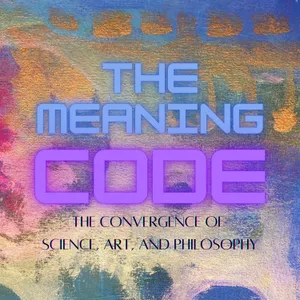
Mapping the universe through discussions about physics, art, economics, philosophy, and more. The search for meaning through connections from one domain of knowledge to another. Finding the code that connects the substructures of the universe. For video recordings of these podcasts: https://www.youtube.com/channel/UCgp_r6WlBwDSJrP43Mz07GQ Find me on Twitter: https://twitter.com/klwong43 View my art here: https://karenwongartcom
AI-powered recaps with compact key takeaways, quotes, and insights.
Get key takeaways from The Meaning Code in a 5-minute read.
Stay current on your favorite podcasts without falling behind.
It's a free AI-powered email that summarizes new episodes of The Meaning Code as soon as they're published. You get the key takeaways, notable quotes, and links & mentions — all in a quick read.
When a new episode drops, our AI transcribes and analyzes it, then generates a personalized summary tailored to your interests and profession. It's delivered to your inbox every morning.
No. Podzilla is an independent service that summarizes publicly available podcast content. We're not affiliated with or endorsed by Karen Wong.
Absolutely! The free plan covers up to 3 podcasts. Upgrade to Pro for 15, or Premium for 50. Browse our full catalog at /podcasts.
The Meaning Code publishes biweekly. Our AI generates a summary within hours of each new episode.
The Meaning Code covers topics including Science, Philosophy, Culture, Society & Culture. Our AI identifies the specific themes in each episode and highlights what matters most to you.
Free forever for up to 3 podcasts. No credit card required.