Free Daily Podcast Summary
The Mater Podcast: Daily Summaries Delivered
by Maddie Rose Hills
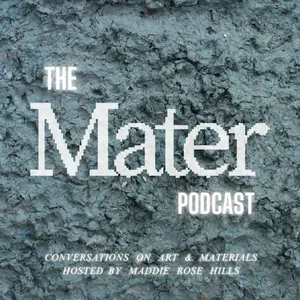
The Mater Podcast explores materials through the eyes of artists and makers. I'm your host, Maddie Rose Hills, and I invite guests to discuss what draws them to the materials they make with. I speak with pigment makers, artists, upholsterers, comedians, geologists, writers, philosophers, archaeologists, and curators about what materials can teach us about ourselves and the world. The podcast is created off the back of Mater: a research and publishing project promoting conversations with artists about materials.
Latest Episodes
The most recent episodes — sign up to get AI-powered summaries of each one.
- 4 days ago1h 3m
Colour Names with Evie Hatch
The fabulous Evie Hatch is back on the podcast as our first ever return guest.. Evie came on last year with artist Ginny Elston to talk about pigments, and now she's back on her own to chat about how she got into this subject, and what she has been up to since our last conversation.Evie suggested the topic of this conversation: the poetics of colour names, and the way these names shape how we imagine and use colour. Burnt sienna, vermillion, prussian blue, cadmium.. the names of paint colours are so familiar in the world of traditional art materials, but what do they actually mean? where do they come from? And what can they reveal about the history of colour?Evie Hatch is a pigment specialist and art historian, who writes and presents the hugely popular Jacksons Art Supplies Pigment Stories. She also lectures, and has talked for the National gallery and Dulwich Picture Gallery on colour and pigments. Yes.. this is a conversation about colour names, but it's really about so much more. It's about insects, rocks and plants.. And it's about people, mysteries, accidental discoveries, feuds, poetry, and secret recipesI hope you enjoy this conversation!Follow Evie Hatch: https://www.instagram.com/evie_hatch/?hl=enJacksons Art Supplies: https://www.instagram.com/jacksons_art/?hl=en Hosted on Acast. See acast.com/privacy for more information.
- 1 weeks ago53 min
Arsenic with Verity Babbs
This is a conversation with Verity Babbs (art historian and comedian) about Arsenic - which is a naturally occurring element that is toxic to humans. Arsenic is used in many traditional pigment recipes, and ended up being used widely during the Victorian era in paintings, clothing and wallpaper. If you are interested in people and the stories that make us human, then this is a conversation for you. Often the odd quirks of people can be forgotten through history, because it they don’t fit with a narrative around their work. But for Verity the often challenging aspects of people’s personalities is what makes her understand them as actual humans.. And in the case of arsenic the figure we are focussing on is the designer, poet, artist, writer, and socialist activist William Morris, often associated with the British Arts and Crafts movement, whose incredibly famous wallpaper once contained arsenic based pigments. Verity Babbs is a Presenter, Art Historian & Comedian. Her work focuses on making art history more accessible and bringing laughter into cultural spaces. She is the author of ‘The History of Art in One Sentence’ which was published by Bloomsbury in 2025. And is the founder of Art Laughs live art-themed comedy events which frequently perform at the National Gallery. She graduated with a History of Art Degree from the University of Oxford and was named one of BBC HistoryExtra's '30 Under 30' in 2024.LinksVerity Babbs on Instagram: https://www.instagram.com/veritybabbsart/Art Laughs: https://www.veritybabbs.com/art-laughsThe History of Art in One Sentence: https://www.bloomsbury.com/uk/history-of-art-in-one-sentence-9781526686893/ Hosted on Acast. See acast.com/privacy for more information.
- 2 weeks ago50 min
Salvage with Tim Ralston & Alice Bonnot
Today’s conversation is all about Salvage.. Which is the finding, rescuing & gathering of materials and objects that have had a previous life, and might otherwise be discarded. My guests are Tim Ralston, director of the art residency PADA Studios and an artist himself, working primarily with wood. Alice Bonnot is an independent art curator, and environmental sustainability consultant, who has been working with PADA in an ongoing project to become more sustainable and reduce their carbon footprint. Alice is the founder of Villa Villa - a platform & consultancy ‘advocating for climate-conscious arts’We recorded this conversation at the PADA residency site which is located a short ferry and walk from Lisbon city centre, in a former industrial park with roots dating back to 1885. I was also lucky to take part in the residency in 2023.I was so excited to speak about Salvage because it’s an idea that so many of the artists I speak to connect with. There are so many practical benefits for this - but one of the most compelling reasons outlined today is because salvaged materials are imbued with this incredible social layer which connects us to human histories. Through salvage we discuss material memory, craft, care, the preservation of the resources we have, as well as thinking about why things are wasted, over-consumption, and some very insightful ways that we can break away from this habit. Tim: https://www.instagram.com/tim.ralston/Alice: https://www.instagram.com/bonnota/PADA: https://www.padastudios.com/Villav Villa: https://villavilla.co/Environmentally Sustainable Artist Studio Practices: https://drive.google.com/file/d/1QaR74WWopZtIefHqDhXeGCR764aVAUNN/view Hosted on Acast. See acast.com/privacy for more information.
- 3 weeks ago1h 4m
Pigment Making with Lucy Mayes
InstagramLucy’s websiteLucy Mayes has been making pigments and paints since 2018 and has taught the craft since 2020. She is the founder of London Pigment - a project making pigment from waste stream materials. We also discuss her book -The Natural Pigment Handbook: A Maker’s Guide to the Art, Stories and Recipes for Creating Paint - published in 2025. We recorded this conversation earlier this year in Lucy’s public studio and shop in Portsmouth's historic Hotwalls Studios. Pigment Making is officially recognised as an endangered craft on the Heritage Craft red list. Lucy writes “Every hand-made pigment carries within it a chain of knowledge linking geology, landscape, chemistry, art and history, making the preservation of the craft about far more than simply producing colour.” And this what i think is so significant about her way of working - this work speaks to our connection with place, history, the materiality of colour, what it is to engage with a heritage craft, all through the act of making pigments.The Natural Pigment Handbook, Lucy MayesWe spoke about the artist Michelle Stuart Hosted on Acast. See acast.com/privacy for more information.
- Jun 1, 202633 min
Joya: AiR Residency with Simon and Donna Beckmann
APPLY to Joya AiR + Mater residency (plus info and terms & conditions): https://joya-air.org/joya-mater-applyJoya: AiR is a landmark international, interdisciplinary arts residency grounded in the intersection of creative practice, ecological inquiry, and sustainable cultural engagement. Situated within an off‑grid, climate‑positive environment in rural Andalucía, the residency fosters an intellectually rigorous and generative context where artists, writers, and researchers from diverse disciplinary backgrounds can deepen their practice, expand critical perspectives, and engage collaboratively with ecological and cultural challenges. Joya AiR website: https://joya-air.org/Joya AiR on Instagram: https://www.instagram.com/joya_air/Mater is an evolving research & publishing project founded by Maddie Rose Hills, exploring our relationship with materials through commissioned writing, interviews, exhibitions, and podcasting. Mater brings together artists, geologists, architects, curators, ecologists, gardeners and writers, investigating what draws us to particular materials, the stories materials hold, and how they shape our lives.Mater website: https://mater.digital/Mater on Instagram: https://www.instagram.com/mater________/Email me with any questions: info@maddierosehills.co.uk Hosted on Acast. See acast.com/privacy for more information.
- Mar 4, 20261h 5m
Minerals with Marcia Bjornerud & Mále Uribe
My two guests are completely passionate about the subject of Minerals... artist Mále Uribe and writer/geoloist Marcia BjornerudMále Uribe is a Chilean architect and artist whose work explores material culture, the value of natural resources, myths, chemical properties, industrial processes and microworlds. As designer in residence at London’s Design Museum in 2019, her installation Salt Imaginaries focused on the extractive processes around minerals located in the Atacama desert in Chile. and her 2025 Somerset House installation for the Chilean Pavilion at London Design Biennale was a investigation of minerals from the Andes titled’ Minerasophia: Underground Cycles. In her work materials are understood as vibrant and autonomous entities that carry a transformative power. Male suggested Marcia Bjornerud for this podcast.. Marcia is a structural geologist whose research focuses on the physics of earthquakes and mountain building. Bjournerud has written several books including Turning to Stone: Discovering the Subtle Wisdom of Rocks, and Timefulness: How thinking Like a Geologist Can Help Save the World. She is a Fellow of the Geological Society and a contributing writer to The New Yorker, Wired, the Wall Street Journal and the Los Angeles Times.. Marcia Bjornerudhttps://www.lawrence.edu/people/marcia-bjornerud-walter-schober-professor-of-environmental-studies-and-professor-of-geosciencesEmergence essay, Wrinkled Time: https://emergencemagazine.org/essay/wrinkled-time/Turning to Stone: Discovering the Subtle Wisdom of Rocks. Book by Marcia BjornerudTimefulness: How Thinking Like a Geologist Can Help Save the World. Book by Marcia BjornerudMále UribeInstagram: https://www.instagram.com/estudio.male/?hl=enSalt Imaginaries, London Design Museum: https://designmuseum.org/exhibitions/designersinresidence2019cosmic/salt-imaginaries-by-mle-uribe-forsMinerasophia, Chile Pavilion and Design Biennale, Somerset House: https://londondesignbiennale.com/pavilions/2025/chile'La Medula' Poem by Ursula le Guin (referenced by Male): https://www.instagram.com/p/BuqP-zPl8xb/Vibrant Matter: A Political Ecology of Things. Book by Jane BennettMaterhttps://mater.digital/Find more images from our conversation on the Mater instagram: https://www.instagram.com/mater________/?hl=enGet in touch: info@maddierosehills.co.uk Hosted on Acast. See acast.com/privacy for more information.
- Nov 29, 20251h 6m
Rembrandt's Materials with Petria Noble & Leonore van Sloten
This fascinating conversation was recorded at the Rembrandthuis museum in Amsterdam, where I had the pleasure of speaking with The Rembrandt House curator, and the former head of paintings conservation at the Rijksmuseum. We were discussing the paintings of the 17th century Dutch artist Rembrandt van Rijn: about Rembrandt’s pigments, the evolution of his painting process, and the art of painting conservation. My two guests couldn't be more perfect for this podcast because they have both been at the forefront of both unveiling and sharing the latest discoveries into Rembrandt’s materials..Petria Noble is the former Head of Paintings Conservation at the Rijksmuseum, a position she held between 2014 and 2022. She is a researcher specialised in paintings by Rembrandt van Rijn, and an expert in the material aspects of his paintings. Prior to joining the Rijksmuseum, Petria worked for 18 years as a Paintings Conservator at the Mauritshuis museum in The Hague. Leonore van Sloten has held a position as curator at The Rembrandt House Museum in Amsterdam since 2005, here she’s responsible for various exhibitions and publications on Rembrandt and related themes.. She initiated and curated amongst others the 2019 exhibition Rembrandt Laboratory: Rembrandt’s Technique Unravelled, the exhibition that we discuss in this conversation, which shone a spotlight on the world of scientific research into materials and techniques. I'm Maddie Rose Hills, and you have been listening to The Mater PodcastFind images from our conversation on the Mater Instagram account: https://www.instagram.com/mater________/?hl=en-gb Related linksRembrandt House Museum: https://www.rembrandthuis.nl/en/?gad_source=1&gad_campaignid=692326751&gbraid=0AAAAADSRQune0nZ9wB8TfU1tnowVtWEeI&gclid=Cj0KCQiA0KrJBhCOARIsAGIy9wBP9jrDMiXcvx-b-bCP7UN7yffJpwk_csoiU9bx7erGmLeE_ftk9gkaAhFcEALw_wcBPetria Noble: https://dutchmethodunfolded.humanities.uva.nl/?page_id=474Leonore van Sloten: https://www.leonorevansloten.com/Mauritshuis: https://www.mauritshuis.nl/en?gad_source=1&gad_campaignid=1613811005&gbraid=0AAAAADuJqF0q5DhmqQoriFVNj5wZ7Kuwt&gclid=Cj0KCQiA0KrJBhCOARIsAGIy9wC2-pIUMtAUUgxiUzjJYrDJNwt6u8xX_5m1lWHykc1HmpHLyBsKHNwaAgC9EALw_wcBArt Matters Journal: https://www.amjournal.org/ Hosted on Acast. See acast.com/privacy for more information.
- Sep 30, 202547 min
Ceramics & Clay with Clare Wood (British Ceramics Biennial)
BCB: https://www.britishceramicsbiennial.com/ This year’s programme: https://www.britishceramicsbiennial.com/news/full-programme-announced-for-british-ceramics-biennial-2025/Clare Wood: https://www.britishceramicsbiennial.com/person/clare-wood/Burleigh Pottery: https://www.burleigh.co.uk/pages/about-usReForm Herritage: https://re-form.org/Recast programme BCB: https://www.britishceramicsbiennial.com/project/recast/The podcast that Clare mentions about the Recast programme: https://open.spotify.com/episode/750cQoCFPCXBv8YjQGJWLNClaire Baily episode of The Mater Podcast: https://podcasts.apple.com/gb/podcast/the-mater-podcast/id1749226924?i=1000694666344 Hosted on Acast. See acast.com/privacy for more information.
About The Mater Podcast
The Mater Podcast explores materials through the eyes of artists and makers. I'm your host, Maddie Rose Hills, and I invite guests to discuss what draws them to the materials they make with. I speak with pigment makers, artists, upholsterers, comedians, geologists, writers, philosophers, archaeologists, and curators about what materials can teach us about ourselves and the world. The podcast is created off the back of Mater: a research and publishing project promoting conversations with artists about materials.
Customized Recaps
AI-powered recaps with compact key takeaways, quotes, and insights.
Straight to Your Inbox
Get key takeaways from The Mater Podcast in a 5-minute read.
Save Hours Every Week
Stay current on your favorite podcasts without falling behind.
Frequently Asked Questions
What is Podzilla's The Mater Podcast daily summary?
It's a free AI-powered email that summarizes new episodes of The Mater Podcast as soon as they're published. You get the key takeaways, notable quotes, and links & mentions — all in a quick read.
How does the The Mater Podcast podcast summary work?
When a new episode drops, our AI transcribes and analyzes it, then generates a personalized summary tailored to your interests and profession. It's delivered to your inbox every morning.
Is this an official The Mater Podcast product?
No. Podzilla is an independent service that summarizes publicly available podcast content. We're not affiliated with or endorsed by Maddie Rose Hills.
Can I get summaries of other podcasts too?
Absolutely! The free plan covers up to 3 podcasts. Upgrade to Pro for 15, or Premium for 50. Browse our full catalog at /podcasts.
How often does The Mater Podcast release new episodes?
The Mater Podcast publishes biweekly. Our AI generates a summary within hours of each new episode.
What topics does The Mater Podcast cover?
The Mater Podcast covers topics including Arts, Visual Arts. Our AI identifies the specific themes in each episode and highlights what matters most to you.
Start getting The Mater Podcast summaries tomorrow morning.
Free forever for up to 3 podcasts. No credit card required.
Free forever for up to 3 podcasts. No credit card required.