Free Daily Podcast Summary
The Last Days Of Jeffrey Epstein: Daily Summaries Delivered
by Bobby Capucci
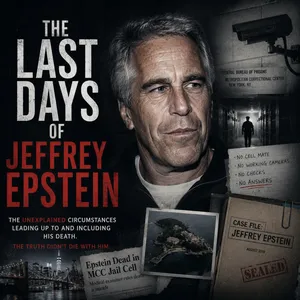
The Last Days of Jeffrey Epstein is a long-form investigative podcast that serves as both an archive and a real-time chronicle of the events surrounding the life, imprisonment, and death of Jeffrey Epstein. From the moment of his arrest in 2019 through the unanswered questions that continue to emerge years later, the podcast follows the timeline piece by piece — examining court filings, jail records, witness statements, surveillance failures, media reports, government investigations, and newly released documents as they become public. Rather than treating the story as a closed chapter, the series approaches it as an evolving historical event whose consequences continue to ripple through politics, finance, intelligence circles, law enforcement, and the media. Every episode is designed to preserve the record while also analyzing how the narrative around Epstein has shifted over time, what information has surfaced, what remains hidden, and why the case continues to gener
Latest Episodes
The most recent episodes — sign up to get AI-powered summaries of each one.
- Today12 min
The OIG Report Detailing The Investigation Into Epstein's NPA (Part 51)
The Department of Justice Office of the Inspector General (OIG) report into Jeffrey Epstein’s 2007 Non-Prosecution Agreement (NPA) presents a disturbing portrait of federal cowardice, systemic failures, and deliberate abdication of prosecutorial duty. Instead of zealously pursuing justice against a serial predator with dozens of underage victims, the U.S. Attorney’s Office in the Southern District of Florida, under Alexander Acosta, caved to Epstein’s high-powered legal team and crafted a sweetheart deal that immunized not just Epstein, but unnamed potential co-conspirators—many of whom are still shielded to this day. The report shows that career prosecutors initially prepared a 53-page indictment, but this was ultimately buried, replaced by state charges that led to minimal jail time, lenient conditions, and near-total impunity. The OIG paints the decision as a series of poor judgments rather than criminal misconduct, but this framing betrays the magnitude of what actually occurred: a calculated retreat in the face of wealth and influence.Critically, the report fails to hold any individuals truly accountable, nor does it demand structural reform that could prevent similar derelictions of justice. It accepts, without sufficient pushback, the justifications offered by federal prosecutors who claimed their hands were tied or that the case was too risky—despite overwhelming evidence and a mountain of victim statements. The OIG sidesteps the glaring reality that this was not just bureaucratic failure, but a protection racket masquerading as legal discretion. It treats corruption as incompetence and power as inevitability. The conclusion, ultimately, feels like a shrug—a bureaucratic absolution of one of the most disgraceful collapses of federal prosecutorial integrity in modern history. It is less a reckoning than a rubber stamp on institutional failure.to contact me:bobbycapucci@protonmail.comsource:dl (justice.gov)
- Today10 min
Robert Garcia Targets Susie Wiles Over Secret White House Meetings About Jeffrey Epstein
Former White House Chief of Staff Susie Wiles is facing renewed congressional scrutiny over her alleged involvement in the Trump administration's handling of the Jeffrey Epstein files and discussions surrounding convicted sex trafficker Ghislaine Maxwell. Democratic Representative Robert Garcia sent Wiles a three-page letter on November 18, 2026, demanding information about secretive White House meetings in which senior administration officials reportedly discussed strategies for managing the political fallout from the Epstein scandal. According to Garcia, some of those discussions took place inside the White House Situation Room and involved decisions about the disclosure of sensitive Epstein-related documents and efforts to control public attention surrounding the controversy. Garcia questioned whether Wiles played a significant role in coordinating the administration's response and demanded that she identify the dates, locations, and participants in those meetings. He also sought the names of officials responsible for decisions involving the Epstein records, raising questions about whether the administration prioritized political damage control over transparency and accountability. Wiles was given until December 2, 2026, to provide the requested information.The congressional inquiry also focused on the circumstances surrounding Ghislaine Maxwell's prison interview with then-Deputy Attorney General Todd Blanche and her subsequent transfer to a minimum-security federal prison camp. Garcia cited allegations that senior administration officials had discussed interviewing Maxwell as a possible way to counter the political damage caused by renewed scrutiny of Trump's relationship with Epstein. Maxwell's transfer following her interview with Blanche raised additional concerns about whether she had received preferential treatment in exchange for providing statements favorable to the administration. Garcia demanded information identifying who authorized, directed, or participated in discussions concerning the interview and transfer, as well as Wiles's possible involvement in those decisions. Although the inquiry did not establish that Maxwell received favorable treatment in exchange for her cooperation or that Wiles personally authorized her transfer, it opened another avenue of congressional scrutiny into the administration's handling of the Epstein scandal. With Democrats preparing to exercise greater oversight authority, the questions surrounding Wiles, Blanche, and Maxwell threatened to bring additional attention to decisions made behind closed doors and whether political considerations influenced the government's handling of Epstein-related evidence.to contact me:bobbycapucci@protonmail.comsource:Susie Wiles Faces Congressional Scrutiny Over Epstein Files
- Today10 min
Federal Judge Grants Class Action Status to Epstein Survivors in FirstBank Lawsuit
A federal judge in Manhattan has granted class-action status to a lawsuit brought by Jeffrey Epstein survivors against FirstBank Puerto Rico and its parent company, First BanCorp, over allegations that the financial institution helped sustain Epstein's sex trafficking operation for more than two decades. U.S. District Judge Jed Rakoff issued his decision on November 12, 2026, allowing women who were abused or trafficked by Epstein between January 1, 1998, and August 10, 2019, to pursue their claims collectively. The lawsuit, filed in June by survivor Julia Molchonova, accused FirstBank of maintaining accounts and processing millions of dollars in transactions connected to Epstein's criminal network despite numerous warning signs about his activities. FirstBank challenged Molchonova's suitability to represent the survivors, pointing to allegations that she had recruited other women for Epstein, but Rakoff rejected that argument, finding that her experiences were consistent with Epstein's established pattern of exploiting vulnerable women and girls. The judge determined that questions concerning the bank's knowledge of Epstein's activities, its alleged participation in the trafficking enterprise, and the financial benefits it received could be examined collectively rather than requiring separate trials for every survivor.The ruling represented another significant legal victory for Epstein survivors seeking to hold financial institutions accountable for allegedly facilitating his trafficking operation. Rakoff examined records from previous litigation involving JPMorgan Chase, Deutsche Bank, and Bank of America, identifying 218 approved survivor claims involving abuse or trafficking during the relevant period, including 51 involving conduct in 2016 or later. The court also identified 157 claims involving abuse that occurred at least partly in New York City, supporting the survivors' claims under the city's Gender-Motivated Violence Protection Act. The plaintiffs are additionally pursuing claims under the federal Trafficking Victims Protection Act, which permits civil damages against businesses that knowingly benefit from participating in trafficking ventures they knew or should have known involved exploitation. FirstBank has denied wrongdoing, maintaining that it provided legitimate banking services and had no knowledge of Epstein's criminal activities, and may appeal the class-certification decision. Although the ruling did not establish the bank's liability, it substantially strengthened the survivors' ability to pursue their allegations collectively and increased pressure on another major financial institution accused of maintaining Epstein's financial infrastructure despite years of evidence concerning his sexual abuse and trafficking activities.to contact me:bobbycapucci@protonmail.comsource:Epstein Survivors Win Class Action Ruling Against FirstBank | Law Commentary
- Today13 min
Ro Khanna Calls for State Investigations Into Jeffrey Epstein's Criminal Network
Democratic Congressman Ro Khanna accused Attorney General Todd Blanche and the Trump administration of engaging in a coverup of Jeffrey Epstein's criminal network by withholding millions of investigative records and failing to pursue additional criminal investigations. Khanna argued that the Justice Department had ignored its obligations under the Epstein Files Transparency Act, which required the disclosure of unclassified investigative materials within 30 days of its enactment in November 2025. Although approximately 3.5 million pages had been made public, the department subsequently announced that roughly 2.5 million additional pages would remain withheld. Khanna maintained that those records contained information about wealthy and influential individuals accused of sexually abusing Epstein's victims and criticized Blanche for failing to initiate new investigations. He specifically highlighted billionaire Leon Black, who had been held in contempt by the House Oversight Committee after refusing to cooperate with its investigation, questioning why Black had not faced greater scrutiny. Khanna also demanded that Donald Trump and Melania Trump testify under oath about their knowledge of Epstein, arguing that they should face the same congressional questioning as Bill and Hillary Clinton.Khanna also emphasized the importance of empowering state prosecutors to investigate Epstein's associates independently of the Justice Department, particularly in jurisdictions where federal authorities had allegedly obstructed access to critical evidence. Working alongside Republican Congressman Thomas Massie, Khanna advanced the Epstein Files Transparency Act II, which would allow state attorneys general, local prosecutors, members of Congress, and survivors to challenge the DOJ's withholding of records in federal court. The legislation would also give state investigators access to unredacted documents needed for criminal investigations and allow survivors to obtain their own complete FBI records. New Mexico stood to benefit significantly from the proposal after Attorney General Raúl Torrez sued the Justice Department in August 2026 to obtain records concerning Epstein's Zorro Ranch, where numerous women alleged they had been abused. Khanna argued that state authorities should no longer be dependent on a federal government he accused of protecting powerful individuals from accountability. He also maintained that public anger over Epstein had contributed to Republican losses in the 2026 midterms, reflecting widespread frustration with a political system that protected influential figures while failing survivors. With the second transparency bill advancing toward a House vote, Khanna framed the next phase of the Epstein investigation as an effort to remove federal roadblocks and give state prosecutors the tools necessary to pursue criminal accountability.to contact me:bobbycapucci@protonmail.comsource:Rep. Ro Khanna accuses AG Blanche of 'cover-up' in Epstein files case
- Today14 min
The Epstein Files and the Coming Congressional Reckoning for Donald Trump
The fight over Jeffrey Epstein's remaining government records is entering a new phase following the 2026 midterm elections, with Democrats preparing to take control of the House of Representatives and use their investigative authority to challenge the Trump administration's handling of the files. Despite the Epstein Files Transparency Act becoming law in November 2025, the Justice Department has faced continuing allegations that it withheld substantial amounts of material, improperly redacted records, and failed to comply fully with congressional disclosure requirements. Representative Robert Garcia, who is expected to lead the House Oversight Committee, has already demanded that senior administration officials preserve documents concerning the Epstein files, including communications involving Vice President JD Vance, Attorney General Todd Blanche, and former White House Chief of Staff Susie Wiles. Democrats have also questioned White House discussions about managing the political fallout from the disclosures and the circumstances surrounding Ghislaine Maxwell's transfer to a minimum-security prison.The incoming Democratic majority could substantially increase pressure on the administration through subpoenas, sworn testimony, public hearings, and renewed investigations into the records the Justice Department has not produced. However, congressional oversight would not automatically guarantee disclosure, particularly if the administration challenged subpoenas, asserted executive privilege, or refused to cooperate. Republican Congressman Thomas Massie's second Epstein transparency initiative has also secured the 218 signatures necessary to advance toward a House vote, proposing additional legal mechanisms for survivors, lawmakers, and state prosecutors to challenge improperly withheld evidence. Together, these developments create the prospect of a much more confrontational struggle over Epstein-related transparency in 2027, with the central issue shifting from promises of disclosure to whether Congress can compel the federal government to provide a substantially more complete accounting of its investigations.to contact me:bobbycapucci@protonmail.comsource:Trump's days of downplaying Epstein are about to run out | Opinion
- Today11 min
The OIG Report Detailing The Investigation Into Epstein's NPA (Part 50)
The Department of Justice Office of the Inspector General (OIG) report into Jeffrey Epstein’s 2007 Non-Prosecution Agreement (NPA) presents a disturbing portrait of federal cowardice, systemic failures, and deliberate abdication of prosecutorial duty. Instead of zealously pursuing justice against a serial predator with dozens of underage victims, the U.S. Attorney’s Office in the Southern District of Florida, under Alexander Acosta, caved to Epstein’s high-powered legal team and crafted a sweetheart deal that immunized not just Epstein, but unnamed potential co-conspirators—many of whom are still shielded to this day. The report shows that career prosecutors initially prepared a 53-page indictment, but this was ultimately buried, replaced by state charges that led to minimal jail time, lenient conditions, and near-total impunity. The OIG paints the decision as a series of poor judgments rather than criminal misconduct, but this framing betrays the magnitude of what actually occurred: a calculated retreat in the face of wealth and influence.Critically, the report fails to hold any individuals truly accountable, nor does it demand structural reform that could prevent similar derelictions of justice. It accepts, without sufficient pushback, the justifications offered by federal prosecutors who claimed their hands were tied or that the case was too risky—despite overwhelming evidence and a mountain of victim statements. The OIG sidesteps the glaring reality that this was not just bureaucratic failure, but a protection racket masquerading as legal discretion. It treats corruption as incompetence and power as inevitability. The conclusion, ultimately, feels like a shrug—a bureaucratic absolution of one of the most disgraceful collapses of federal prosecutorial integrity in modern history. It is less a reckoning than a rubber stamp on institutional failure.to contact me:bobbycapucci@protonmail.comsource:dl (justice.gov)
- Today13 min
The OIG Report Detailing The Investigation Into Epstein's NPA (Part 49)
The Department of Justice Office of the Inspector General (OIG) report into Jeffrey Epstein’s 2007 Non-Prosecution Agreement (NPA) presents a disturbing portrait of federal cowardice, systemic failures, and deliberate abdication of prosecutorial duty. Instead of zealously pursuing justice against a serial predator with dozens of underage victims, the U.S. Attorney’s Office in the Southern District of Florida, under Alexander Acosta, caved to Epstein’s high-powered legal team and crafted a sweetheart deal that immunized not just Epstein, but unnamed potential co-conspirators—many of whom are still shielded to this day. The report shows that career prosecutors initially prepared a 53-page indictment, but this was ultimately buried, replaced by state charges that led to minimal jail time, lenient conditions, and near-total impunity. The OIG paints the decision as a series of poor judgments rather than criminal misconduct, but this framing betrays the magnitude of what actually occurred: a calculated retreat in the face of wealth and influence.Critically, the report fails to hold any individuals truly accountable, nor does it demand structural reform that could prevent similar derelictions of justice. It accepts, without sufficient pushback, the justifications offered by federal prosecutors who claimed their hands were tied or that the case was too risky—despite overwhelming evidence and a mountain of victim statements. The OIG sidesteps the glaring reality that this was not just bureaucratic failure, but a protection racket masquerading as legal discretion. It treats corruption as incompetence and power as inevitability. The conclusion, ultimately, feels like a shrug—a bureaucratic absolution of one of the most disgraceful collapses of federal prosecutorial integrity in modern history. It is less a reckoning than a rubber stamp on institutional failure.to contact me:bobbycapucci@protonmail.comsource:dl (justice.gov)
- Today12 min
The OIG Report Detailing The Investigation Into Epstein's NPA (Part 48)
The Department of Justice Office of the Inspector General (OIG) report into Jeffrey Epstein’s 2007 Non-Prosecution Agreement (NPA) presents a disturbing portrait of federal cowardice, systemic failures, and deliberate abdication of prosecutorial duty. Instead of zealously pursuing justice against a serial predator with dozens of underage victims, the U.S. Attorney’s Office in the Southern District of Florida, under Alexander Acosta, caved to Epstein’s high-powered legal team and crafted a sweetheart deal that immunized not just Epstein, but unnamed potential co-conspirators—many of whom are still shielded to this day. The report shows that career prosecutors initially prepared a 53-page indictment, but this was ultimately buried, replaced by state charges that led to minimal jail time, lenient conditions, and near-total impunity. The OIG paints the decision as a series of poor judgments rather than criminal misconduct, but this framing betrays the magnitude of what actually occurred: a calculated retreat in the face of wealth and influence.Critically, the report fails to hold any individuals truly accountable, nor does it demand structural reform that could prevent similar derelictions of justice. It accepts, without sufficient pushback, the justifications offered by federal prosecutors who claimed their hands were tied or that the case was too risky—despite overwhelming evidence and a mountain of victim statements. The OIG sidesteps the glaring reality that this was not just bureaucratic failure, but a protection racket masquerading as legal discretion. It treats corruption as incompetence and power as inevitability. The conclusion, ultimately, feels like a shrug—a bureaucratic absolution of one of the most disgraceful collapses of federal prosecutorial integrity in modern history. It is less a reckoning than a rubber stamp on institutional failure.to contact me:bobbycapucci@protonmail.comsource:dl (justice.gov)
Get The Last Days Of Jeffrey Epstein summaries in your inbox
Free AI-powered daily recaps. Key takeaways, quotes, and mentions — in a 5-minute read.
Get Free Summaries →Free forever for up to 3 podcasts. No credit card required.
You Might Also Like
Listeners also like.

Court Junkie
Covers wrongful convictions and unsolved crimes by analyzing court documents, attending trials, and interviewing affected individuals.

The Last Archive
A historical exploration of truth, knowledge, and the cultural forces shaping belief in the modern era.

Wait a Second...
A podcast exploring conspiracies, true crime, and viral news stories with Jason Concepcion and Tyler游戏副本.

Dead End: Crime and Politics
Investigates the murders of John and Joyce Sheridan and the corruption case against Senator Bob Menendez, revealing ties between crime and power in New Jersey.

The Final Hours with Sarah Turney and Kourtney Nichole
Two women with personal experience in crime examine overlooked details in investigations every Monday.

Sidebar with Katie Phang
Legal and political analysis from a former prosecutor cutting through spin to deliver factual clarity on major headlines.

Last Podcast On The Left
Explores real and fictional horrors, from serial killers and cults to demons and slashers, with in-depth research and dark humor.

True Crime Tonight
Five nights a week, a deep dive into true crime cases, celebrity scandals, and trials with analysis and listener discussions.

Serial
A true crime podcast that investigates a single case over multiple episodes with deep reporting and narrative storytelling.

Law&Crime Sidebar
Daily legal news and true-crime stories analyzed in under twenty minutes.

Stay Tuned with Preet
A former U.S. attorney analyzes legal issues in the news and interviews experts on power, policy, and justice.

Disclosure
A podcast exploring government transparency through Freedom of Information Act requests, revealing hidden details and bureaucratic secrets.
About The Last Days Of Jeffrey Epstein
The Last Days of Jeffrey Epstein is a long-form investigative podcast that serves as both an archive and a real-time chronicle of the events surrounding the life, imprisonment, and death of Jeffrey Epstein. From the moment of his arrest in 2019 through the unanswered questions that continue to emerge years later, the podcast follows the timeline piece by piece — examining court filings, jail records, witness statements, surveillance failures, media reports, government investigations, and newly released documents as they become public. Rather than treating the story as a closed chapter, the series approaches it as an evolving historical event whose consequences continue to ripple through politics, finance, intelligence circles, law enforcement, and the media. Every episode is designed to preserve the record while also analyzing how the narrative around Epstein has shifted over time, what information has surfaced, what remains hidden, and why the case continues to gener
Customized Recaps
AI-powered recaps with compact key takeaways, quotes, and insights.
Straight to Your Inbox
Get key takeaways from The Last Days Of Jeffrey Epstein in a 5-minute read.
Save Hours Every Week
Stay current on your favorite podcasts without falling behind.
Frequently Asked Questions
What is Podzilla's The Last Days Of Jeffrey Epstein daily summary?
It's a free AI-powered email that summarizes new episodes of The Last Days Of Jeffrey Epstein as soon as they're published. You get the key takeaways, notable quotes, and links & mentions — all in a quick read.
How does the The Last Days Of Jeffrey Epstein podcast summary work?
When a new episode drops, our AI transcribes and analyzes it, then generates a personalized summary tailored to your interests and profession. It's delivered to your inbox every morning.
Is this an official The Last Days Of Jeffrey Epstein product?
No. Podzilla is an independent service that summarizes publicly available podcast content. We're not affiliated with or endorsed by Bobby Capucci.
Can I get summaries of other podcasts too?
Absolutely! The free plan covers up to 3 podcasts, any in the catalog. Basic raises that to 15, Pro to 40 and Max to 100. Browse our full catalog at /podcasts.
What topics does The Last Days Of Jeffrey Epstein cover?
The Last Days Of Jeffrey Epstein covers topics including News, Commentary. Our AI identifies the specific themes in each episode and highlights what matters most to you.
Start getting The Last Days Of Jeffrey Epstein summaries tomorrow morning.
Free forever for up to 3 podcasts. No credit card required.
Free forever for up to 3 podcasts. No credit card required.