Free Daily Podcast Summary
The Keifer Madness Podcast: Daily Summaries Delivered
by Keifer Gilbert
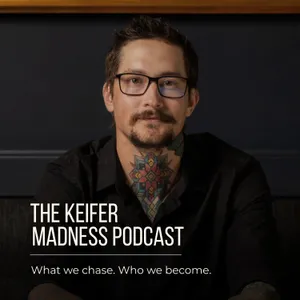
The Keifer Madness Podcast is a deep dive into the human experience. Hosted by ultrarunner, endurance athlete, and former bartender Keifer Gilbert, the show brings together fascinating people from all walks of life for unfiltered conversations exploring human potential, mental toughness, sobriety, personal growth, and the experiences that shape our perspectives. From endurance sports and extraordinary achievements to philosophy, mental health, and everything in between, it's an exploration of what makes us who we are and what we're capable of becoming.
Latest Episodes
The most recent episodes — sign up to get AI-powered summaries of each one.
- 1 weeks ago47 min
The Curse of Grit - Mason Wright "Buffrunner"
Mason Wright, better known as Buff Runner, joins me to talk about his unconventional journey into ultrarunning, becoming the first American to run 1,000 miles around a track, and the consequences of pushing his body beyond its limits.We get into his transition from a 285-pound football player to an ultra-endurance athlete, the challenges of carving his own path in the running community, and what really goes into planning and executing massive, self-supported endurance efforts.Mason also opens up about his recent backyard ultra, the lasting nerve damage from his 1,000-mile run, and the uncertainty surrounding his future in the sport.It's a conversation about ambition, resilience, failure, and the fine line between being tough enough to accomplish something extraordinary and being too tough for your own good.
- Oct 8, 20261h 10m
Who Gets to Police Ultra Running? - Jacob Puzey
Who gets to decide what accountability looks like in ultrarunning?This week, I'm joined by longtime ultrarunner and race director Jacob Puzey for a conversation about the controversy surrounding Cam Hanes, Mike McKnight, anti-doping regulations, and the growing divide within the ultrarunning community.With over 20 years of experience directing races, Jacob brings a perspective that's been largely missing from the conversation: what responsibility do race directors actually have when it comes to enforcing anti-doping rules, and where does that responsibility end?But this conversation goes well beyond WADA policies and banned substances.We get into the court of public opinion, the dangers of reducing people to their worst decisions, the difference between holding someone accountable and publicly destroying their reputation, and why we've seemingly lost the ability to disagree with someone without making them an enemy.It's a conversation about ultrarunning, but more importantly, it's about how we treat each other.The Keifer Madness Podcast explores endurance, personal growth, and the conversations that challenge the way we think.
- Sep 21, 20261h 34m
Nearly 400 Pounds to Ultra Runner - Tyson Black
At his heaviest, Tyson Black was nearly 400 pounds.Behind the weight was a much deeper story — years of grief, addiction, shame, unresolved trauma, and the feeling that he was wasting a life he knew could be used for something more.Today, Tyson is sober, running ultramarathons, reconnecting with his faith, serving the trail running community, and chasing a version of himself he spent years being afraid to find.In this episode, we talk about losing multiple friends at a young age, drugs and alcohol, working in a funeral home, PTSD, nearly reaching 400 pounds, and the people who eventually helped Tyson start rebuilding his life.We also get into his transformation through running, the role faith and service now play in his life, the unique community he found in ultrarunning, and the unexpected path that eventually put him alongside Harvey Lewis at Mid-State and Last Soul Ultra in Germany.This is a conversation about grief, addiction, sobriety, faith, friendship, purpose, and what happens when you finally decide to stop running from your own potential.
- Sep 11, 20261h 7m
The Victor Gets to Write History - Brian "Wolfie" Peterson
Brian “Wolfie” Peterson joins me for a conversation about competition, ego, suffering, and some of the unwritten rules shaping ultrarunning right now.We get into whether running is actually building resilience or sometimes just becoming another crutch, the role ego and anger can play in performance, and why maybe you don’t have to smile your way through every hard thing.From there, we dig into the current evolution of Backyard Ultras: Phil Gore’s solo effort, pacing and sleep deprivation, the competitive psychology of the format, and the controversy surrounding Mark Dowdle and Ello at Last Soul Ultra.At the center of it all is a bigger question:What do we actually want competition to look like?Because when it’s over, the victor gets to write history.
- Sep 4, 20261h 6m
The Leadville 100 Crew Debacle - Blake Bender
A 20 second crew meeting in the middle of the Leadville 100 turned into nearly 400,000 views and a whole lot of opinions.Blake Bender joins me to unpack what actually happened at Twin Lakes, why a quick conversation with his family and crew pissed off so much of the internet, and the weird pace shaming conversation that followed.But this episode goes well beyond the controversy. Blake spent nearly a decade coaching college basketball before losing that identity, finding ultra running at 30, and signing up for his first 100 miler before he had even finished a marathon.We get into family, crewing, taking something seriously even when you’re never going to win it, the growing culture clash inside ultra running, and why Blake has decided the response to getting dragged online is to put himself out there even more.Plus, we look ahead to his first crack at the Tahoe 200 and the crew book that started this whole damn thing.
- Aug 17, 20261h 43m
From Major League Baseball to Mental Performance - John Baker
John Baker has spent most of his life figuring out what allows people to perform when things get hard.He played professional baseball for more than a decade, reaching the Major Leagues with the Marlins, Padres, and Cubs before eventually moving from the field into coaching, mental skills, player development, and performance psychology. His career would ultimately take him from being an MLB player to helping build and lead performance systems responsible for hundreds of professional players and coaches.But this conversation goes well beyond baseball.John and I originally met years ago on the jiu-jitsu mats, and that shared background became the jumping-off point for a much bigger conversation about why some of us are drawn toward difficult things in the first place.We talk about the strange trust that exists between two people trying to choke each other unconscious, why shared suffering creates some of the strongest relationships in our lives, and what jiu-jitsu, professional baseball, military environments, and ultrarunning unexpectedly have in common.We also get deep into performance psychology: visualization, attention training, managing arousal under pressure, learning to become the observer of your own thoughts, and why the popular definition of "mental toughness" might have very little to do with simply being willing to suffer more.John's definition is much simpler:Mental toughness is the ability to pay attention to the right thing, at the right time, regardless of the circumstances.We unpack what that actually looks like when you're standing at the plate in a Major League Baseball game, stepping onto a jiu-jitsu mat, or trying to keep moving forward 100 hours into a 250-mile race.This is a conversation about performance, but even more than that, it's about deliberately choosing difficult things, understanding what you value, and learning how to keep showing up.
- Aug 10, 20261h 13m
The Art of Balance: Sobriety, Cocktails, and Endurance - Josh Harris
Josh Harris and I have more than a few things in common. We both built careers behind the bar, found sobriety along the way, and eventually discovered a very different kind of obsession in endurance running.Josh has been sober for 22 years, spending nearly his entire professional career in the cocktail industry without drinking. We talk about what sobriety looked like in an industry that wasn't nearly as accepting of it two decades ago, how bartending actually helped build his confidence in early sobriety, and how the cocktail world has changed since. Then we get into running.Josh went from rediscovering running during 2020 to ultras, back-to-back 100 milers, the Triple Crown of 200s, and completing 314 miles of The Speed Project solo and self-supported. But some of my favorite parts of this conversation aren't about how far he's gone. They're about knowing when not to keep going.We talk about his DNF at Tahoe 200, walking away from Bigfoot, the difference between doing hard things because you want to and doing them because you feel like you have something to prove, and Josh's philosophy that real strength comes from finding balance between the heart, mind, and body.
- Jul 27, 202656 min
Building a Life on Purpose - Shelby Harrington
Episode DescriptionWhat happens when the thing that once defined you is taken away?In this episode, I sit down with Shelby Harrington to unpack a story that's about far more than Ironman racing. Shelby shares how she went from being a single mom with no endurance background to signing up for an Ironman in the middle of one of the hardest seasons of her life. Along the way, we talk about training without headphones, learning to embrace discomfort, recovering from a major cycling accident just weeks before race day, and the mindset that carried her through it all.But the conversation doesn't stop there.After being diagnosed with adrenal insufficiency and surviving multiple life-threatening medical emergencies, Shelby was forced to step away from the sport she loved. We dive into what it means to grieve an identity, redefine success, and build a life that's rooted in intention rather than achievement.We also explore:Why endurance sports reveal who you really areMental tools for navigating adversity during races and in everyday lifeThe importance of adaptability over perfectionParenting, mortality, and living with purposeHow showing up authentically creates better leaders, athletes, and humansWhy "work-life balance" might be the wrong goal altogetherWhether you're training for your next race, navigating a major life transition, or simply trying to become more intentional with how you spend your time, this conversation is packed with practical insights and perspective.You can connect with Shelby on Instagram at @shelbyonpurpose, where she shares resources and coaching centered around intentional living, leadership, and personal growth.If you enjoyed this episode, be sure to subscribe, leave a review, and share it with someone who could use the reminder that resilience isn't something you're born with—it's something you build, one intentional decision at a time.
About The Keifer Madness Podcast
The Keifer Madness Podcast is a deep dive into the human experience. Hosted by ultrarunner, endurance athlete, and former bartender Keifer Gilbert, the show brings together fascinating people from all walks of life for unfiltered conversations exploring human potential, mental toughness, sobriety, personal growth, and the experiences that shape our perspectives. From endurance sports and extraordinary achievements to philosophy, mental health, and everything in between, it's an exploration of what makes us who we are and what we're capable of becoming.
Customized Recaps
AI-powered recaps with compact key takeaways, quotes, and insights.
Straight to Your Inbox
Get key takeaways from The Keifer Madness Podcast in a 5-minute read.
Save Hours Every Week
Stay current on your favorite podcasts without falling behind.
Frequently Asked Questions
What is Podzilla's The Keifer Madness Podcast daily summary?
It's a free AI-powered email that summarizes new episodes of The Keifer Madness Podcast as soon as they're published. You get the key takeaways, notable quotes, and links & mentions — all in a quick read.
How does the The Keifer Madness Podcast podcast summary work?
When a new episode drops, our AI transcribes and analyzes it, then generates a personalized summary tailored to your interests and profession. It's delivered to your inbox every morning.
Is this an official The Keifer Madness Podcast product?
No. Podzilla is an independent service that summarizes publicly available podcast content. We're not affiliated with or endorsed by Keifer Gilbert.
Can I get summaries of other podcasts too?
Absolutely! The free plan covers up to 3 podcasts, any in the catalog. Basic raises that to 15, Pro to 40 and Max to 100. Browse our full catalog at /podcasts.
How often does The Keifer Madness Podcast release new episodes?
The Keifer Madness Podcast publishes biweekly. Our AI generates a summary within hours of each new episode.
What topics does The Keifer Madness Podcast cover?
The Keifer Madness Podcast covers topics including Education, Sports, Fitness, Running, Health & Fitness, Self-Improvement. Our AI identifies the specific themes in each episode and highlights what matters most to you.
Start getting The Keifer Madness Podcast summaries tomorrow morning.
Free forever for up to 3 podcasts. No credit card required.
Free forever for up to 3 podcasts. No credit card required.