Free Daily Podcast Summary
The Iran Breakdown with Mark Dubowitz: Daily Summaries Delivered
by FDD
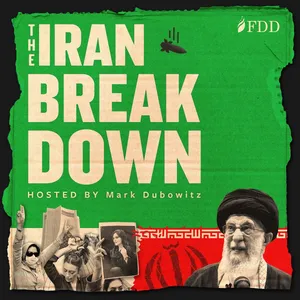
Welcome to The Iran Breakdown. Hosted by Mark Dubowitz, this show is here to guide you through one of the most critical geopolitical and human rights challenges facing the world today. The Islamic Republic of Iran has been a central player in global headlines for decades: its pursuit of nuclear weapons, development of a massive missile and drone arsenal, funding of terror groups like Hezbollah, Hamas, the Houthis, and others; its oppression of the Iranian people; and its growing alliances with global power states like China, Russia, and North Korea. But beneath the headlines lies a deeper story: a regime that is losing legitimacy, battered nuclear and missile programs, a crumbling economy, a restless population hungry for freedom, and a global community with many conflicting ideas about how to respond. But a regime still standing and dangerous. And that’s what we’ll cover on The Iran Breakdown.
Latest Episodes
The most recent episodes — sign up to get AI-powered summaries of each one.
- 1 weeks ago1h 3m
Iran’s Nightmare: No War, No Relief (feat. Miad Maleki)
The Islamic Republic may discover that surviving the war was the easy part. Its military has been mauled, its deterrence shattered, its proxies weakened, and now an already dysfunctional economy faces relentless pressure — with no victory to rally around and no economic rescue on the horizon.On the latest episode of The Iran Breakdown, host Mark Dubowitz is joined by FDD’s Miad Maleki, a former senior Treasury sanctions official, to explain why the regime’s greatest threat may no longer come from American bombers or Israeli jets, but from an economic crisis it cannot bomb, repress, or print its way out of.
- Aug 20, 20261h 2m
After Iran: Is Erdogan’s Turkey the Middle East’s Next Great Threat? (feat. Steven A. Cook and Jonathan Schanzer)
For decades, Washington and Jerusalem worried about Iran dominating the Middle East. But as the Islamic Republic weakens, is Erdogan’s Turkey positioning itself to become the region’s next great revisionist power?Mark Dubowitz is joined by two Turkey and Middle East experts: Steven A. Cook, the Eni Enrico Mattei Senior Fellow for Middle East and Africa Studies at the Council on Foreign Relations and Jonathan Schanzer, executive director at FDD.They discuss Erdogan’s ambitions, Turkey’s growing confrontation with Israel in Syria, Ankara’s support for Hamas, its complicated relationship with Tehran, its future in NATO—and whether Turkey could eventually pursue nuclear weapons.The central question: As Iran declines, is Turkey the next big Islamist threat?
- Aug 18, 202653 min
Energy Wars: America, Iran and the Battle of Hormuz (feat. Rich Goldberg)
In this episode of The Iran Breakdown, Mark Dubowitz sits down with FDD’s Rich Goldberg for a wide-ranging discussion on Iran, the Strait of Hormuz, global energy markets and America’s growing energy dominance.Rich leads FDD’s Energy and National Security Program and served in the second Trump administration, where he helped establish the White House National Energy Dominance Council. During the first Trump administration, he served at the White House as director for countering Iranian weapons of mass destruction. A former Navy intelligence officer with experience on the Joint Staff and in Afghanistan, Rich also spent years on Capitol Hill, where he was a lead architect of sanctions against Iran. Iran sanctioned him in 2020Mark and Rich examine the current situation in the Strait of Hormuz, the resilience and the risks in global energy markets, emerging workarounds to bypass the strait, America’s expanding energy power and China’s role in the equation. It’s a conversation about more than barrels and pipelines—it’s about energy, economics and military power, and the central question: Does Iran have Trump over a barrel—or is it the other way around?Relevant article: Tehran is losing its grip on Hormuz, and with it all its leverage
- Aug 14, 202656 min
The Islamic Republic’s Revolutionary DNA (feat. Haviv Rettig Gur)
What makes the Islamic Republic of Iran different from a conventional regime seeking security, prosperity, and survival? Its ideological DNA fuses Maoist revolutionary thought, Frantz Fanon’s vision of anticolonial struggle and redemptive violence—channeled through Iranian intellectual Ali Shariati—and a revolutionary Shia theology of martyrdom, resistance, and struggle against oppression.Ayatollah Ruhollah Khomeini, founder and first Supreme Leader of the Islamic Republic, forged these currents into a revolutionary state whose legitimacy rests not simply on governing Iran, but on resisting an international order it considers fundamentally unjust.That helps explain the regime’s remarkable ability to turn military defeats, economic devastation, and mass suffering into narratives of resistance, sacrifice, and even victory.Haviv Rettig Gur—Middle East analyst at The Free Press, and host of Ask Haviv Anything—joins Mark Dubowitz on The Iran Breakdown to unpack the ideological DNA of the Islamic Republic, why it has endured, and what its enemies still misunderstand about the regime they are fighting.
- Aug 6, 20261h 3m
Subterranean Warfare: Can Pickaxe Mountain Be Destroyed?
The next battlefield isn’t in the sky or at sea—it’s underground.The Islamic Republic, together with Hamas and Hezbollah, spent decades building a subterranean fortress: hundreds of miles of terror tunnels beneath Gaza and Lebanon, and deeply buried nuclear and missile facilities designed to survive even the most powerful airstrikes. At the center of that strategy is Pickaxe Mountain, where Tehran is constructing hardened underground infrastructure intended to shield its nuclear weapons program from U.S. and Israeli airpower.In this episode of The Iran Breakdown, host Mark Dubowitz sits down with Yadin Soffer, co-founder and CEO of Traysar, a startup developing autonomous systems for underground warfare. They explore how this emerging technology could detect, penetrate, and neutralize subterranean threats—and whether advances in underground warfare could change the strategic equation against deeply buried targets like Pickaxe Mountain.
- Jul 21, 202640 min
Pickaxe Mountain: Iran’s “Unbustable” Nuclear Bunker? (feat. Andrea Stricker)
Iran isn’t dismantling its nuclear program—it’s burying it deeper underground.At the center of growing U.S. concern is Pickaxe Mountain, a massive underground complex that signals the regime has no intention of abandoning its nuclear ambitions. Buried deep beneath solid rock and heavily fortified, the facility may be the most challenging nuclear target the United States has ever confronted, raising difficult questions about whether it can be destroyed by conventional means.Andrea Stricker, deputy director and research fellow in FDD’s Nonproliferation and Biodefense Program, joins Mark Dubowitz on The Iran Breakdown to explain why Pickaxe Mountain matters, what makes it so difficult to neutralize, what military and non-military options remain, and which other parts of Iran’s nuclear program deserve urgent attention.
- Jul 10, 202651 min
The End of the Ceasefire as We Know It? (feat. Rich Goldberg)
The United States has launched a fresh wave of strikes against Iran, hitting roughly 90 targets along the country's coastline, as tensions over the Strait of Hormuz threaten to unravel a fragile ceasefire between Washington and Tehran. With diplomatic channels strained and the regime holding Hormuz hostage, the path back to de-escalation looks increasingly uncertain.To unpack what comes next, FDD Senior Advisor Richard Goldberg joins Mark Dubowitz on The Iran Breakdown to break down the state of the ceasefire, the latest developments in the Strait of Hormuz, and Washington's shifting strategy.
- Jul 1, 202648 min
Lebanon: More than "a Piece of the Puzzle" (feat. Carine Hajjar)
The Israel-Lebanon framework brokered by Secretary Rubio may be historic, but Hezbollah still hasn't disarmed. The deal ties Israeli withdrawal to the Lebanese army securing designated pilot zones — yet Hezbollah and its parliamentary allies have already rejected it outright. Meanwhile, the U.S.-Iran MOU threatens to undercut the whole effort, handing Tehran leverage over Israel's right to self-defense and potentially unlocking billions of dollars for the regime that arms Hezbollah in the first place. With Hezbollah the linchpin of Tehran's "axis of resistance," leaving Lebanon unaddressed is a danger that can't be ignored.Carine Hajjar — opinion journalist at The Washington Post and Steamboat Institute fellow with deep roots in Lebanon — joins Mark Dubowitz on The Iran Breakdown to ask whether this is Lebanon's real chance to break free of Iran's grip, or another false dawn.
Get The Iran Breakdown with Mark Dubowitz summaries in your inbox
Free AI-powered daily recaps. Key takeaways, quotes, and mentions — in a 5-minute read.
Get Free Summaries →Free forever for up to 3 podcasts. No credit card required.
You Might Also Like
Listeners also like.

Iran: The Latest
Analysis of Iran's role in Middle East conflicts, covering military actions, nuclear tensions, and regional alliances with Israel and the US.

The Truth of the Matter
Breaks down complex global policy issues through informed, balanced discussions without spin or sensationalism.

Brian Lehrer: A Daily Politics Podcast
Daily discussions on current events and political developments.

Mo News
Daily news coverage with analysis, interviews, and listener Q&A on global headlines from Mosheh Oinounou and Jill Wagner.

One Decision
Former intelligence leaders and journalists examine high-stakes decisions that shaped global events.

Breaking Points with Krystal and Saagar
Political analysis and interviews challenging mainstream narratives and holding power to account.
Bulwark Takes
Daily news analysis from a conservative perspective, featuring insights and commentary by Bulwark staff on current political events.

The Kyle Kulinski Show
A progressive host analyzes U.S. politics, class issues, and media with sharp commentary and leftist critique.

Independent Americans with Paul Rieckhoff
A daily news podcast breaking down key U.S. issues and interviewing influential figures from an independent political perspective.

The DSR Daily
Daily news coverage of foreign policy and national security developments from global media sources.

The DSR Network
The DSR Network

Call Me Back - with Dan Senor
Discusses challenges and dilemmas facing Israelis and Jews worldwide.
About The Iran Breakdown with Mark Dubowitz
Welcome to The Iran Breakdown. Hosted by Mark Dubowitz, this show is here to guide you through one of the most critical geopolitical and human rights challenges facing the world today. The Islamic Republic of Iran has been a central player in global headlines for decades: its pursuit of nuclear weapons, development of a massive missile and drone arsenal, funding of terror groups like Hezbollah, Hamas, the Houthis, and others; its oppression of the Iranian people; and its growing alliances with global power states like China, Russia, and North Korea. But beneath the headlines lies a deeper story: a regime that is losing legitimacy, battered nuclear and missile programs, a crumbling economy, a restless population hungry for freedom, and a global community with many conflicting ideas about how to respond. But a regime still standing and dangerous. And that’s what we’ll cover on The Iran Breakdown.
Customized Recaps
AI-powered recaps with compact key takeaways, quotes, and insights.
Straight to Your Inbox
Get key takeaways from The Iran Breakdown with Mark Dubowitz in a 5-minute read.
Save Hours Every Week
Stay current on your favorite podcasts without falling behind.
Frequently Asked Questions
What is Podzilla's The Iran Breakdown with Mark Dubowitz daily summary?
It's a free AI-powered email that summarizes new episodes of The Iran Breakdown with Mark Dubowitz as soon as they're published. You get the key takeaways, notable quotes, and links & mentions — all in a quick read.
How does the The Iran Breakdown with Mark Dubowitz podcast summary work?
When a new episode drops, our AI transcribes and analyzes it, then generates a personalized summary tailored to your interests and profession. It's delivered to your inbox every morning.
Is this an official The Iran Breakdown with Mark Dubowitz product?
No. Podzilla is an independent service that summarizes publicly available podcast content. We're not affiliated with or endorsed by FDD.
Can I get summaries of other podcasts too?
Absolutely! The free plan covers up to 3 podcasts. Upgrade to Pro for 15, or Premium for 50. Browse our full catalog at /podcasts.
How often does The Iran Breakdown with Mark Dubowitz release new episodes?
The Iran Breakdown with Mark Dubowitz publishes weekly. Our AI generates a summary within hours of each new episode.
What topics does The Iran Breakdown with Mark Dubowitz cover?
The Iran Breakdown with Mark Dubowitz covers topics including News, History, Religion & Spirituality, Spirituality, Culture, Society & Culture. Our AI identifies the specific themes in each episode and highlights what matters most to you.
Start getting The Iran Breakdown with Mark Dubowitz summaries tomorrow morning.
Free forever for up to 3 podcasts. No credit card required.
Free forever for up to 3 podcasts. No credit card required.