Free Daily Podcast Summary
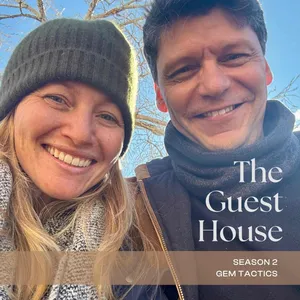
The Guest House: "Gem Tactics": Daily Summaries Delivered
by Shawn Parell and David Keplinger
Welcome to The Guest House, a commonweal meditation on the complexities and creative potential of being human in an era of radical change. In Season Two, cohosts Shawn Parell and David Keplinger are exploring what Emily Dickinson called "Gem Tactics," the practices by which we polish our creative engagement with life.
Latest Episodes
The most recent episodes — sign up to get AI-powered summaries of each one.
- Jul 19, 20268 min
Narrated Essay: Pictures For The Future
Registration will close this month for The Tender Harvest, a harvest yoga, meditation, and culinary retreat at world-class Ballymaloe House in County Cork, Ireland. Join this Sept 20-26, 2026, for a time of deep nourishment, learning, and inspiration. Just 2 rooms still available!A dog’s retching yanks me from sleep. I’ve been floating between worlds all night, and suddenly I’m across the room before a thought can take shape. The dense atmosphere of a dream lingers as I kneel to wipe the floor, then thins as my mind reaches for it. I was in a foreign place, though the landscape felt familiar. I was with friends, though they were not themselves. There was a house. The house was a river. Its rooms were water.With a sigh, the dog returns to bed. The house settles back into stillness. I move mutely to my meditation cushion. Incense lit, tea steeping, for a time, I watch tendrils of smoke and steam mingle in the dawning air.Practice teaches us to notice what’s here. Gradually, our attention steadies and we begin to perceive what is real—the interplay of spirit and matter, psyche and body—through the tuning fork of our awareness. We grow quieter, more supple, more receptive—less beholden to neurosis and fixed assumptions. What we lose in certainty, we gain in texture and attunement.As humans, especially now, our well-being depends on how honestly we inhabit the faculties of our aliveness. What do we know to be true, and by what inner or outer measure? How much doubt do we allow in the margins of confirmation? What may appear real, yet on closer examination, carries the subtle signature of an illusion? And, inversely: where have we developed trust in modes of knowing that defy rational explanation?In classical yoga philosophy, pramana offers a basic epistemic map. It names three valid sources of knowledge: direct perception (pratyaksha), inference (anumana), and trusted testimony (sabda). I know the river is cold because I have placed my hand in it. I know the river is cold because it flows from glacial melt. I know the river is cold because someone I trust has told me so.Of these, direct perception carries the weight of fact. Yet fact alone does not confer context. The elephant’s tail may still seem a pestle to a blind man, as the Buddhist parable goes. Here, the animal’s trumpet or a friend’s account can augment our own perception. Thus, these three sources of knowledge uphold one another.But in Paris last month, standing beneath Hilma af Klint’s paintings at the Grand Palais, I sensed how this era of dissolving certainties is inviting us to loosen and refine our frameworks for human intelligence. Knowing is not the intellect’s final stamp of approval. It is a function of our embodied, psychic, and spiritual capacities—and it keeps calling us to widen what we recognize as real.Born in 1862, af Klint painted vast, abstract diagrams of a reality folded within this one: swirls of color, spirals, botanical forms, and galaxies. Her pioneering abstract works, begun as early as 1906, were long kept hidden and revealed only, at her direction, decades after her death. Working with a circle of women known as The Five, she participated in séances where language and image moved through them. One presence, whom she called Ananda, instructed her to create a series of paintings “for the temple.” These “pictures for the future” were meant for the future, for an audience who could see beyond the pastoral and parlor depictions of her time.Standing before af Klint’s paintings a century later, I considered what it takes to be faithful to what arrives through intuition—to stake our knowing on image, or symbol, or an inner insistence just beyond explanation.Carl Jung described intuition as that which “mediates perceptions in an unconscious way… and has the character of being given.” Distinguishing it from the more rational functions of thinking, sensing, and feeling, Jung characterized intuition as irrational, bypassing conscious logic to immediately grasp hidden patterns, meanings, and future possibilities.In the years surrounding the First World War, Jung recorded dreams, visions, and dialogues with figures arising from his psyche. He came to understand that aspects of the psyche “produce themselves and have their own life.” The Red Book was later compiled as a document of these encounters and his willingness to be reshaped by
- May 12, 20267 min
Narrated Essay: Entering the Estuary
I’ll be teaching yoga & meditation this September 20-26 at Ballymaloe House in Ireland with Erin Doerwald. It’s a profoundly beautiful, nurturing setting for retreat. Join us for rhythms of daily practice, exquisite farm-to-table meals, and cultural exploration. Plus cedar saunas and a cold sea plunge! We welcome you to join us for this extraordinary retreat—more info at shawnparell.com/irelandI was puttering around on my desktop last week—doing anything to avoid beginning this draft—when an email arrived from Satya Doyle Byock, Director of the Salomé Institute of Jungian Studies, psychotherapist, and author of Quarterlife: The Search for Self in Early Adulthood. I’m connected to Satya’s work through a yearlong course in Jungian psychology, so it felt synchronous that her voice should reach me in the midst of a procrastination I had entered but not yet named.In her newsletter, Satya reflected on how AI-generated content has begun to drain her motivation to write, or at least to write in the digital landscape:“The existential (or is it creative?) concern is not only that I don’t know that I can keep up; it’s that I’m not sure I want to.I don’t want to feel frenzied for any reason, let alone in order to keep pace with robots.”I felt an immediate resonance. A similar resistance has been gathering at the edges of my awareness in recent months. As ever, I am drawn to the practice of writing; I feel reluctant, though, to keep step with machines, and wary of the subtle infiltration of AI’s manufactured voice into the written word. Its outputs are refining by the day, but its velocity, seamlessness, and casual superiority register as categorically inhuman. Even the term content betrays the shift: it names a product, not a process. Writing still implies the grist of a mind at work.Momentarily, I consider abandoning the whole imperfect enterprise of these essays. Why compete with the speed of light? Human attention—my attention—has already been profoundly shaped, even warped, by life in the digital age. Like Satya, I am unwilling to have my nervous system further conscripted into that race.But then I pause. Because keeping pace is not, and never was, the aim of this work.In 1884, William James insisted, in his early challenge to Cartesian dualism, that “a purely disembodied human emotion is a nonentity.” Emotion, for James, arises from embodied sensation—from the interplay of pulse and breath, fascia and nerve synapse. What, then, are we encountering in AI’s frictionless outputs, if not language severed from the very conditions that allow for feeling?Beyond its basic communicative function, writing is one of the ways humanity has revealed itself to itself across generations. Its deeper value—like all art—is metabolic. The artist’s task is to sustain attention—to lower a bucket into the shadowed recesses of the psyche and draw up something true. Something we can hold up to the light and marvel: this has been here all along.Silene stenophylla—the narrow-leafed campion—offers a botanical echo of this process through millennia. Revived from 32,000-year-old tissue preserved in the frozen burrows of Arctic ground squirrels, its cells were coaxed back into bloom. Its resurrection gestures toward the truth that creation unfolds according to its own tempos, on timescales that exceed human urgencies. No algorithm can hasten such an emergence. It belongs to the potential of living systems. Silene stenophylla stands for all that has yet to be brought to light.My family is moving through a health circumstance that has re-angled the light on everything. I find myself asking, with unusual clarity, what it means to be human. What is this brief and improbable flare of existence, this particular arrangement of spirit and days—and what, in fact, matters within it? I am learning that no intelligence outside nature’s intelligence—the one that moves through this body, shaped by my relationships, my encounters, my losses and blessings—can do this work for me. Integration is not transferable. It is slow chemistry, the metabolism of meaning, made possible by contact and time.In this unprecedented modern experiment—this “rough initiation,” to borrow Francis Weller’s phrase from In the Absence of the Ordinary—we are tasked not only with preserving our shared existence, but with tending the intricate ecology by which we make sense of being human at all.To that end, I was struck by <a target="_blank" href="https://substack.com/pr
- Mar 23, 20264 min
Narrated Essay: The Finch's Song
“I never saw a wild thing sorry for itself.” —D. H. LawrenceThe sky is a flawless blue above the high mountain desert of Northern New Mexico. Though the air is thick with dust and pollen, transitional winds sharpen the senses and sweep away winter’s accumulations. White blossoms rise from the upturned branches of the apricot tree while the ground beneath them cracks with thirst.Strange, precarious, hopeful, persistent—spring is arriving like this.The footnote beneath every casual conversation about the weather is the acknowledgment that winter never truly came. There was no white hush of falling snow, no soft crunch of boots on morning trails. Instead, we drifted mildly between seasons. And now, as one season seems to step over the stalled breath of another, some disturbed, animal part of us still seems to be waiting for what should have been.Meanwhile, my son runs into the kitchen sobbing. He has found his black betta fish floating belly-up among artificial sea grass and smooth glass pebbles. He holds our hands and dares to look again at the body of the fish that drifts motionless with its long, obsidian streamers. He asks us unanswerable questions. Inside this clear bowl with its fabricated landscape is a miniature initiation with a force more surprising and less negotiable than anything he has known.So, we speak softly about the kingdom of the living, and how every living thing will one day cease to be as it was, about energy, and spirit, and how time moves all things.The earth tilts, and so must we. Even in grief, the world continues making its arrangements, asking us to gather ourselves and show up for its manifold losses and resurrections.For one example, house finches are nesting in the transoms above my downtown office, their tangled warbling made of brief, insistent notes, repeated and rearranged over and over again. Their lives are delicate, I know, but their song carries no hint of brevity or mourning.Equinox offers a momentary balance in the forward thrust of light. It reminds us how we, too, can find our way to equilibrium, and thereby resource the heart as it learns to bear its own weather. Framed by all manner of human suffering, current and perennial, simple acts of care can become green shoots rising up through hardened soil. A hand held, a stranger respected, a woman rested—these are all defenses against despair.“Care”—from the Old English caru, cearu—once referred to the burdens that bend the heart: “sorrow,” “anxiety,” “concern,” “grief.” In this sense, the impulse to nurture began as a name for the wound itself. Before it meant to tend or guard, to care meant to ache, to remain near the pain.True care does not hover above suffering, nor does it rescue; it simply shows up with a willing heart and persists. What appears small is not, therefore, insignificant. The heart hears the finch’s song and remains willing to listen, not because it is promised anything, not because the world is kind or comforting, but because it still knows how, and that counts for something. This is a public episode. If you'd like to discuss this with other subscribers or get access to bonus episodes, visit shawnparell.substack.com/subscribe
- Feb 22, 20266 min
Narrated Essay: Deconstructing the Caterpillar
Just as there are darkened seasons in human history—times when the structures sustaining civilization collapse in on themselves and humanity finds itself stiff-fisted, grasping at brittle branches, slipping between worlds—so too is every individual subject to phases of undoing in the metamorphosis of a lifetime.Entering the chrysalis is rarely a matter of choice. We would resist if we could. One morning, we awaken with a pit in the stomach, a visceral unease that signals change even before we can name its source. Quite all of a sudden, we find we have entered a dream with no solid ground and no turning back. Loss feels imminent, along with the uncertainty of what comes next or how we will get there. We try to keep moving, mistaking busyness for control of circumstance. We hoist the blueprints of our former lives above our heads to keep them dry, trying to shore up what is already dissolving.We try very hard, as all creatures do, not to die. Yet for the caterpillar, entering the chrysalis is a form of programmed death—a gruesome act of self-digestion. What can the larva comprehend of its own metamorphosis as it surrenders to darkness and enzymatic dissolution? Before it can be reconstituted, the caterpillar’s whole body must pupate—which is to say liquify. Epithelial cells breaking down, muscles and mandibles lysed by their own enzymes, the entire body reduced to a nutrient slurry.Every winter, nature takes this serious turn. Fallen leaves coil in on themselves, roots retreat, seeds release, and stillness wraps the living world. Here’s orientation from a recent column in our cherished local magazine, the Santa Fe New Mexican —“In winter, our arid steppe climate shows us the value of leaving things alone. Grasses left standing become shelter. Seed heads become sustenance. Evergreen shrubs offer cover from wind and predators when the world feels most exposed. What looks untidy to us is, in fact, a carefully balanced system of protection and patience. The garden does not ask us to fix it in January—only to witness it.”The winter gardener knows not to try to fix such depression, but instead to witness and accompany the world beyond control. For the winter gardener recognizes the fallows as sanctuary, the outer casings of seed heads and pale grasses as fortresses of transformation, and death as a passage between birthing seasons. This is the winter gardener’s regenerative faith.Similarly, with respect to human development, Jungian analyst and author Marion Woodman called the chrysalis “a twilight between past, present, and future,” a place where the psyche must “tolerate annihilation—just long enough for the new form to begin assembling itself.” She described the sojourn of life as a series of “border crossings between what we were and what we cannot yet imagine.”For the caterpillar, the dream of the butterfly is carried by imaginal cells—tiny, sac-like clusters that, through the primordial twilight of metamorphosis, give rise at last to compound eyes, scaled wings—a new and elegant anatomy. This is how a creature built for crawling holds within its body the imagination of flight.In his 1910 Oxford lecture, The Birth of Humility, anthropologist Robert Ranulph Marett described metamorphic thresholds as “psycho-physical,” when body and mind falter so that “latent energies [may] gather strength for activity on a fresh plane.”The most courageous way we can enter the chrysalis is with attunement. “Pause,” Marett wrote, “is the necessary condition of the development of all those higher purposes which make up the rational being.” James Baldwin attested that the darkest hour can “force a reconciliation between oneself and all one’s pain and error.” We cannot will ourselves to grow, for transformation is an act of presence, not power. But within the privacy of our consciousness, with patience and attention, we can rediscover the forces shaping our evolution and develop faith in what is becoming.In Jungian terms, the collective mirrors the individual psyche: what deconstructs in the outer world—painfully, though necessarily—reflects what must be reimagined from within. Today, democratic principles and ecological balance are slipping from their axes. But, as Marett observed, “Not until the days of this period of chrysalis life have been painfully accomplished can [a person] emerge a new and glorified creature.”Some silent, imaginal knowledge within us already knows the way. Here in the high desert, the earliest bloomers will soon appear: proof that the intelligence of life has been preparing the ground, all along, for the resurrection of some new and common beauty.Together, we’re making sense of what it means to be human in an
- Jan 25, 20265 min
Narrated Essay: The Baring Season
Nearing the end of January, I’m only beginning to feel the sinew of this new year. Here in the United States, we’re reckoning with what seems like a sudden surge of authoritarianism—though, as Hemingway reminds us in The Sun Also Rises, collapse happens “two ways. Gradually, then suddenly.” The hubris we’ve unleashed from within now sends shockwaves through the world, unmooring the institutions we’ve depended on and unsettling the nervous system of our species.Staying human amidst the swirl has become a practice unto itself. We must maintain the pleasantries of our daily lives, yoke ourselves to the people and practices that organize and buoy the mind, and make actionable the indignance of our deeper values—all while sifting through the muck and shimmer of the collective unconscious.Of those in privileged circumstances, many are divesting themselves of accountability or arming up for an uncertain future. Even a question like “How’s it going?” can land strangely if it feels insulated from the existential tremors of the moment.Winter, of course, is the barest season. It’s a time when thin, long-shadowed light clarifies sight and stillness disciplines attention, when branches shiver as the wind exposes the decorative notions of warmer seasons.A few weeks ago, I sat down with two friends, David Keplinger and Lindsay Whalen, whose companionship is like wool wrapped around the cold turnings of life. Our purpose was to interview Lindsay about the poet Mary Oliver—the subject of her forthcoming biography from Penguin Press—and to trace the threads of synchronicity and coherence among us.I imagine that rendering anyone’s soul requires discipline and sustained concentration. But Mary’s life, as her poetry reflects, was singular, cloistered, and prolific, demanding of her biographer an uncommon devotion. In our conversation, Lindsay explained that she misses Mary less than she might another deceased friend, given that she remains in constant contact with her. Yet there’s one quality of Mary’s presence she said she misses: “When she looked at you, she really looked at you. It was a sustained gaze.” David, whose friendship with Mary spanned decades, smiled in agreement: “In her life, as in her work, she looked longer instead of looking away.”The word concentration derives from the Latin concentrātiō, meaning “the action or act of coming together at a single place.” It breaks down to con- (“together, with”) + centrum (“center”)—literally “bringing to a common center.” Originally, it described physical gathering, such as converging on a single point, and later evolved to refer to mental focus.In the prose collection Winter Hours, Mary distinguishes faith—“tensile, and cool, and [having] no need of words”—from hope, which she portrays more vigorously as “a fighter and a screamer.” And in her poem “The Clam,” we see how even a lowly, languageless creature is granted “a muscle that loves being alive.”Winter, too, does this work, sucking vital force inward to the quick. Every living thing must concentrate to survive. Trees shunt sap to heartwood and root; slow-breathing bears dream of thaw; squirrels make their caloric calculations. Even seeds, dark-bound beneath frozen ground, aspire toward germination.Hope, in this sense, is muscular. It is the fight to make the world a place we can live in. Not mere optimism, but the tender refusal to shut down in the face of suffering. It is the muscle that strengthens our will, linking imagination to endurance and promise to conviction.I have attempted several commentaries on this deranged geopolitical moment, wishing to say to friends around the world that we have a long history of abusive power dynamics to reckon with in the U.S.—which is no excuse. But we also have citizens like Renée Good, whose last words were “I’m not mad at you.”So, don’t give up on us.Even winter seems uncertain now, bringing tepid temperatures and pallid light where once it cut clean. So we train our gaze on what’s alive and here. We look closer, we grope for strength, for the sinews of our common sense—those cords that connect fibrous muscle to bare bone. A blackbird’s caw splits a sodden field. Hope does not flinch; it fastens.Together, we are making sense of being human in an era of radical change. Your presence here matters. Thank you for reading, sharing, ‘heart’ing, commenting, and subscribing to The Guest House. This is a public episode. If you'd like to discuss this with other subscribers or get access to bonus episodes, visit shawnparell.substack.com/subscribe
- Jan 18, 20261h 0m
The Poet of Dawn is the Poet of Darkness: A Talk with Mary Oliver Biographer Lindsay Whalen
Seven years after Mary Oliver’s death, her work feels even more vital, showing us how to love the world with its myriad faces.In this episode, we have the sincere honor of speaking with biographer Lindsay Whalen, whose forthcoming book from Penguin Press explores the life behind the beloved poet. Our conversation ranges from the poet’s focus on real life and her famous anonymity to David’s and Lindsay’s shared experiences with Mary in the years they knew her.Gathering these voices who represent the small group of surviving friends of the poet, the conversation goes deep into the links between Mary’s influence on Shawn’s practice as a yogi and therapist, David’s poetry, and Lindsay’s much-anticipated account of this singular human life.Lindsay Whalen is writing the first biography of the poet Mary Oliver, forthcoming from The Penguin Press. She is the recipient of the CUNY Graduate Center’s Leon Levy Center for Biography Fellowship and is a graduate of Brooklyn College’s MFA in Fiction. She began her career in publishing, and continues to work with authors as an independent editor.Resource Links:Learn more about Lindsay and her work:Upcoming Seminar: Lindsay Whalen on Mary Oliver and “The Human Seasons” *Begins Jan 20, 2026. Scholarship applications due by Friday, Jan 16, 2026.Instagram: @lwhalen13NYMag Article: How Mary Oliver’s Biographer Finally Met the Legendary PoetMore from David - book releases, workshops, mindfulness talks, upcoming events, and more:Website: Davidkeplingerpoetry.comInstagram: @DavidKeplingerPoetrySubstack: Another Shore with David KeplingerSubstack Author Page: https://substack.com/@davidkeplingerMore from Shawn - free audio meditations, upcoming events, retreats, monthly essays, yoga classes, and music alchemy:Website: Shawnparell.comInstagram: @ShawnParellSubstack: The Guest HouseSubstack Author Page: https://substack.com/@shawnparellTogether, we’re being human in an era of radical change. Your presence here matters. Bless our work algorithmically with your This is a public episode. If you'd like to discuss this with other subscribers or get access to bonus episodes, visit shawnparell.substack.com/subscribe
- Dec 14, 20256 min
Narrated Essay: The Secret Title of Every Good Poem
You’re invited next September 20-26, 2026, to The Tender Harvest, a week-long retreat amidst the golden hues and organic bounty of the world-class Ballymaloe House in County Cork, Ireland. Each day will feature yoga, meditation, farm-to-table meals, and curated excursions—plus ample time for rest, self-nurturance, and imagination.__I awake to the murmur of a boy speaking to his slumbering father. All night long, the darkening stillness of December had settled over the house, and, as usual, our son had scampered down the hall just before dawn, burrowed under a breathing mound of blankets, and reached toward whichever one of us was nearest. “I love you so much,” I hear my child sigh as he tucks himself beneath the warm weight of his father’s arm.I have no language to measure such a moment, ordinary though it may seem. I have only an attention born of it, a residue of tenderness reminding me that somehow –however improbable, fleeting, and marvelous – we are here together, and here at all.Later, diagonal rays of winter sunlight beam across the sky, a fact bright enough to leave an afterimage seared on the inside of my eyelids. Of this event, too, I keep only what impression remains: a momentary flash that lingers and softens.Which brings me to the medicine of tenderness—our capacity not just to intellectualize or conceptualize, but to feel the invisible textures of this living world. The word “tender” shares its etymological parent, the Latin word tendere–meaning “to extend outward or upward, to stretch toward or hold out, to offer; to direct toward, to aim toward”–with the verb “to tend,” in the sense of caring for, but also with “intention,” “attention,” and “tenders,” the small boats that carry people or goods from larger vessels to shore.A thruline here links the practices of intention and attention, guiding our consciousness toward what we care about, with a whole-bodied suppleness of presence. The metaphor of tender boats bridges the mutual nature of tenderness. How can one person’s practice of tenderness bring another to shore in a gradual and reciprocal softening of nervous systems? How is it that when one person rests with awareness in the tender weight of their body, heart, and mind, it can signal to another that their bruises are safe from further harm?Ezra Klein recently shared an interview with Patti Smith, the iconic musician, writer, and visual artist—sometimes called the “godmother of punk”—who rejects those labels wholesale. With a shrug that suggests the humbler, deeper values of her practice, she says, “call me a worker.” I love her for that.Many moments resonate in their conversation, but none so much as when she likens a good poem to a teardrop: “If you’re thirsty and you get that drop of water, it suddenly becomes the most welcome thing in the world.” My mind catches on what kind of thirst—what invisible needfulness—a good poem can satisfy. This is not the thirst of the yarrow or migrating whitethroat, not even the thirst of the bear in autumn. It seems a uniquely human thirst that calls out for the sincerity of real art.On the subject of death and spiritual thirst, Mary Oliver wrote: “Who knows what will finally happen or where I will be sent, yet already I have given a great many things away, expecting to be told to pack nothing, except the prayers which, with this thirst, I am slowly learning.”I believe this kind of thirst, of the nature of wanting to understand and be nourished by the mystery of our existence—by the grace of what it means that we are alive and able to wonder at the circumstances of our aliveness—dwells somewhere beneath the surface of every human being. This thirst lives in the unseen currents of heartache, uncertainty, and longing that flow like water beneath a frozen river.According to fellow poet Jane Hirshfield, Galway Kinnell once called “Tenderness” “the secret title of every good poem.” That line, for me, speaks to the particular mechanism within poetry that can meet such thirst. Tenderness is the dynamic tension between bearing witness to our shared fragility and strengthening our capacity for wholehearted presence and connection with ourselves and each other. It is the alchemy of kindness that can distill cold facts into feelings, thaw a hardened heart, and show us how we’re not alone. Like a teardrop, a gesture of tenderness can be small and exact, yet it can quench us with vital sustenance and healing.Strangely, the image of a teardrop has seeped into my morning practice like a quiet teaching. As I reach for some nearby poem, my mind skidding over the uneven terrain of the hours ahead, I
- Nov 25, 202555 min
Listening into Wholeness | Parker Palmer
In conversation with poet Parker Palmer, we trace the quiet art of listening for one’s true vocation, the solace of circles where no one is fixed or saved, and the long, harrowed path toward a wholeness that does not deny its own fractures.Parker J. Palmer is a writer, speaker and activist who focuses on issues in education, community, leadership, spirituality and social change. He is founder and Senior Partner Emeritus of the Center for Courage & Renewal, which supports people in every walk of life in nurturing deep integrity and relational trust for the sake of personal and social transformation.Palmer holds a Ph.D. in sociology from the University of California at Berkeley, fourteen honorary doctorates, and two Distinguished Achievement Awards from the National Educational Press Association. Among his honors, he is a recipient of the William Rainey Harper Award, previously given to Margaret Mead, Elie Wiesel, and Paolo Freire. In 2021, the Freedom of Spirit Fund, a UK-based foundation, gave him their Lifetime Achievement Award in honor of work that promotes and protects spiritual freedom.Palmer is the author of ten books—including several award-winning titles—that have sold over two and a half million copies and been translated into twenty languages. Anniversary editions of three of his books were issued in 2024: Healing the Heart of Democracy, A Hidden Wholeness, and Let Your Life Speak. An updated edition of On the Brink of Everything and a 30th anniversary edition of The Courage to Teach are due in late 2026.Resource Links:Learn more about Parker and his work:Website: Center for Courage & RenewalSubstack: Living the Questions with Parker J. PalmerSubstack Author Page: https://substack.com/@parkerjpalmer861952Facebook: Facebook Author PageMore from David - book releases, workshops, mindfulness talks, upcoming events, and more:Website: Davidkeplingerpoetry.comInstagram: @DavidKeplingerPoetrySubstack: Another Shore with David KeplingerSubstack Author Page: https://substack.com/@davidkeplingerMore from Shawn - free audio meditations, upcoming events, retreats, monthly essays, yoga classes, and music alchemy:Website: Shawnparell.comInstagram: @ShawnParellSubstack: The Guest HouseSubstack Author Page: https://substack.com/@shawnparellTogether, we’re being human in an era of radical change. Your presence here matters. Bless our work algorithmically with your This is a public episode. If you'd like to discuss this with other subscribers or get access to bonus episodes, visit shawnparell.substack.com/subscribe
About The Guest House: "Gem Tactics"
Welcome to The Guest House, a commonweal meditation on the complexities and creative potential of being human in an era of radical change. In Season Two, cohosts Shawn Parell and David Keplinger are exploring what Emily Dickinson called "Gem Tactics," the practices by which we polish our creative engagement with life.
Customized Recaps
AI-powered recaps with compact key takeaways, quotes, and insights.
Straight to Your Inbox
Get key takeaways from The Guest House: "Gem Tactics" in a 5-minute read.
Save Hours Every Week
Stay current on your favorite podcasts without falling behind.
Frequently Asked Questions
What is Podzilla's The Guest House: "Gem Tactics" daily summary?
It's a free AI-powered email that summarizes new episodes of The Guest House: "Gem Tactics" as soon as they're published. You get the key takeaways, notable quotes, and links & mentions — all in a quick read.
How does the The Guest House: "Gem Tactics" podcast summary work?
When a new episode drops, our AI transcribes and analyzes it, then generates a personalized summary tailored to your interests and profession. It's delivered to your inbox every morning.
Is this an official The Guest House: "Gem Tactics" product?
No. Podzilla is an independent service that summarizes publicly available podcast content. We're not affiliated with or endorsed by Shawn Parell and David Keplinger.
Can I get summaries of other podcasts too?
Absolutely! The free plan covers up to 3 podcasts. Upgrade to Pro for 15, or Premium for 50. Browse our full catalog at /podcasts.
How often does The Guest House: "Gem Tactics" release new episodes?
The Guest House: "Gem Tactics" publishes monthly. Our AI generates a summary within hours of each new episode.
What topics does The Guest House: "Gem Tactics" cover?
The Guest House: "Gem Tactics" covers topics including Fitness, Religion & Spirituality, Spirituality, Health & Fitness, Mental Health. Our AI identifies the specific themes in each episode and highlights what matters most to you.
Start getting The Guest House: "Gem Tactics" summaries tomorrow morning.
Free forever for up to 3 podcasts. No credit card required.
Free forever for up to 3 podcasts. No credit card required.