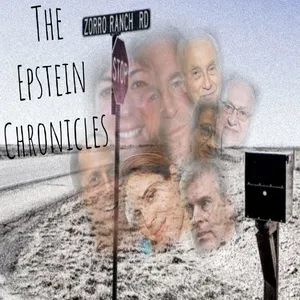
Free Daily Podcast Summary
The Epstein Chronicles: Daily Summaries Delivered
by Bobby Capucci
Jeffrey Epstein was a multi millionaire who had political and business ties to some of the most rich and powerful people in the world. From businessmen to politicians at the highest levels, Epstein broke bread with them all. Yet for years the Legacy media and the rest of high society looked the other way and ignored his behavior as multiple women came forward with allegations of abuse. Even after he was convicted and subsequently received a sweetheart deal those same so called elites welcomed him back with open arms. Now after his death and the arrest of Maxwell, the real story is starting to come together and the curtain has begun to be drawn back and what it has revealed is truly disturbing. From Princes to Ex Presidents, the cast of scoundrels in this play spans continents and political affiliations leaving us with a transcontinental criminal conspiracy possibly unlike any we have ever seen before. In this podcast we will e
Latest Episodes
The most recent episodes — sign up to get AI-powered summaries of each one.
- Today10 min
The USVI And Their Motion In Opposition To JP Morgan's Request For Dismissal (Part 1) (9/20/26)
The U.S. Virgin Islands (USVI) filed a motion opposing JPMorgan Chase's request to dismiss the lawsuit related to Jeffrey Epstein. The USVI argues that JPMorgan played a crucial role in enabling and facilitating Epstein's illegal activities by maintaining his accounts and providing financial services, despite knowing about his criminal conduct. The motion asserts that the bank ignored numerous red flags and allowed Epstein to conduct transactions that supported his sex trafficking operation.The USVI contends that JPMorgan's actions or lack thereof contributed significantly to the harm caused by Epstein and his network. The motion further emphasizes that the lawsuit is valid and should proceed, as it seeks to hold the bank accountable for its alleged complicity in Epstein's activities, despite JPMorgan's efforts to dismiss the case. The USVI aims to prove that the bank's involvement goes beyond mere negligence, arguing that it knowingly benefited from its relationship with Epstein.to contact me:bobbycapucci@protonmail.comsource:gov.uscourts.nysd.591653.48.0.pdf (courtlistener.com)Become a supporter of this podcast: https://www.spreaker.com/podcast/the-epstein-chronicles--5003294/support.
- Today54 min
Mega Edition: Jeffrey Epstein And The Unexplained Departure Of Evidence (9/20/26)
Questions about items removed from Jeffrey Epstein’s properties have persisted because records show that potentially important material was moved before investigators could fully examine it, raising concerns about what evidence may have disappeared from the official record. In Palm Beach, a private investigator working for Epstein’s defense team removed computers, address books, sexually explicit material, women’s underwear, cash and dozens of pornographic tapes shortly before police executed a search warrant in 2005. Investigators later noted that file folders appeared to have been emptied and that security cameras were present but no longer connected to recording equipment. Years later, FBI records from the 2019 investigation showed another example of valuables being moved: Epstein’s property manager said Richard Kahn instructed him to pack passports, notebooks, envelopes and jewelry boxes from Epstein’s safe into two suitcases and take them to Kahn’s residence shortly after Epstein’s arrest.The unresolved issue has been not just what was removed, but whether law enforcement ever recovered all of it and whether potentially significant evidence was lost, withheld or protected behind claims of privilege. DOJ’s own later review said the computers removed in 2005 could have contained “potentially critical” evidence, yet authorities apparently never obtained the full trove, and some material seems to have remained in the hands of Epstein’s representatives for years. That history has fueled suspicion because Epstein’s operation was unusually dependent on records, photographs, contact books, financial documents and electronic material that could have identified associates, victims and the mechanics of his network. There is no public proof that every missing or relocated item contained incriminating evidence, but the repeated movement of material before or around law-enforcement searches left a significant evidentiary gap and helped create the enduring question of how much of Epstein’s documentary and electronic trail was never fully secured.to contact me:bobbycapucci@protonmail.comBecome a supporter of this podcast: https://www.spreaker.com/podcast/the-epstein-chronicles--5003294/support.
- Today48 min
Mega Edition: From Silicon Valley To Paris. They Knew What Epstein Was (9/20/26)
It strains credulity to believe that the world around Jeffrey Epstein and Ghislaine Maxwell—filled with elite elites in finance, tech, entertainment, and fashion—was completely unaware of what was going on. For example, Ellen Pao, former Reddit CEO and one-time partner at venture firm Kleiner Perkins, publicly stated that Maxwell was invited to a Silicon Valley holiday party in 2011 despite existing reports that she was supplying underage girls for sex. Pao wrote that “we knew about her supplying underage girls for sex” and yet “that was fine with the ‘cool’ people who managed the tightly controlled guest list.” This confession suggests that circles of power didn’t just “miss” what was happening—they arguably chose to ignore it.Similarly, the modeling industry had whispered about the predatory nature of agents like Jean‑Luc Brunel long before the Epstein-Maxwell drama exploded. Brunel was a longtime model scout and agency boss who received millions from Epstein to expand his business, and his name repeatedly came up in allegations of sexual misconduct dating back decades. The fact that such warnings were circulating in fashion—well before the mainstream reckoning—raises the question: how could so many people connected to these men claim no knowledge, no signs, no suspicion? When one entire industry quietly signals something is rotten, it becomes much harder to swallow wholesale claims of unaware innocence.to contact me:bobbycapucci@protonmail.comBecome a supporter of this podcast: https://www.spreaker.com/podcast/the-epstein-chronicles--5003294/support.
- Today40 min
Mega Edition: Jeffrey Epstein And The Downplayed Relationship With The Clinton's (9/20/26)
Bill and Hillary Clinton have repeatedly described their ties to Jeffrey Epstein and Ghislaine Maxwell as limited, incidental or primarily connected to philanthropy, but the documentary record has shown a relationship that was broader and more sustained than those descriptions suggest. Bill Clinton acknowledged traveling on Epstein’s plane in 2002 and 2003 for Clinton Foundation-related work, while flight logs documented numerous individual flight legs involving Clinton. Epstein and Maxwell also appeared in the Clinton orbit well beyond those trips: Epstein visited the Clinton White House repeatedly in the 1990s, Maxwell accompanied Clinton on overseas travel, participated in Clinton-related events and fundraisers, and later remained socially connected to the family. Maxwell attended Chelsea Clinton’s 2010 wedding, had vacationed with Chelsea, attended Clinton Global Initiative events and continued appearing around Clinton-linked activities years after Epstein’s 2008 conviction. CNN reported that Maxwell remained involved with CGI as late as 2015 and that Bill Clinton had dinner with her in Los Angeles in 2014.That record has made the Clintons’ efforts to portray the relationships as distant increasingly difficult to reconcile with the paper trail. During her 2026 congressional deposition, Hillary Clinton repeatedly said she did not know Epstein, did not recall meeting him and had little information about his activities, while Maxwell herself told DOJ investigators that she had met Hillary and had been invited to the Clintons’ Chappaqua home several times. Bill Clinton has maintained that his contact with Epstein was connected to charitable work and that he knew nothing about Epstein’s crimes, and there is no evidence establishing that either Clinton participated in Epstein’s abuse. But the larger credibility problem has remained the gap between the language of minimization and the accumulated record of flights, White House access, fundraisers, family events, private dinners and years of continuing contact with Maxwell. The issue is not that association alone proves wrongdoing; it is that the relationship documented over time was plainly more substantial than the casual, arms-length version the Clintons have often presented publicly.to contact me:bobbycapucci@protonmail.comBecome a supporter of this podcast: https://www.spreaker.com/podcast/the-epstein-chronicles--5003294/support.
- Yesterday54 min
Mega Edition: Jeffrey Epstein And The Amnesia Plague (9/20/26)
One of the most striking patterns to emerge around Jeffrey Epstein’s social circle was how often people who had spent years around him suddenly claimed not to remember basic details once those relationships came under scrutiny. Former friends, business associates and social contacts repeatedly minimized the depth of their connections, described Epstein as little more than an acquaintance, or said they could not recall meetings, trips, conversations and introductions that later surfaced in flight logs, photographs, emails, calendars and testimony. Ghislaine Maxwell herself leaned heavily on formulations such as “I don’t recall” and “I have no memory” when questioned about specific people and events, even while acknowledging that Epstein had moved in elite circles for years. Hillary Clinton similarly testified in 2026 that she did not recall meeting Epstein and described Maxwell as only a casual acquaintance. The recurring theme was difficult to miss: as documentary evidence made the relationships harder to deny, the recollections of the people involved often became noticeably less precise.That collective amnesia became one of the reasons the Epstein story generated so much public skepticism. A photograph alone did not prove wrongdoing, a flight did not establish knowledge of abuse and a social relationship did not make someone a participant in Epstein’s crimes. But the constant retreat into faulty memory created a credibility problem when the same people were confronted with records showing repeated contact over long periods of time. Maxwell’s later DOJ interviews were filled with examples of her saying she could not remember specific recruiting, travel or social details while simultaneously offering confident recollections when discussing subjects that helped her own narrative. The pattern did not prove that every forgotten detail concealed misconduct, but it reinforced the impression that association with Epstein became something many people wanted to shrink, blur or forget only after the consequences of being closely connected to him became impossible to ignore.to contact me:bobbycapucci@protonmail.comBecome a supporter of this podcast: https://www.spreaker.com/podcast/the-epstein-chronicles--5003294/support.
- Yesterday48 min
Mega Edition: Ghislaine Maxwell's Legal Team And The Allegations Of Juror Misconduct (9/19/26)
After Ghislaine Maxwell was convicted in December 2021, her legal team moved quickly when Juror 50, Scotty David, revealed in post-trial interviews that he had been sexually abused as a child and had discussed that experience during deliberations. The disclosure raised an immediate problem because the jury questionnaire had specifically asked prospective jurors whether they or close family members had been victims of sexual abuse, and David had answered no. Maxwell’s attorneys argued that the omission amounted to juror misconduct and deprived them of the chance to question him further or seek his removal during jury selection. Prosecutors responded that a new trial was not automatically warranted and that the key questions were whether David had intentionally lied and whether his personal history showed actual bias. Judge Alison Nathan ordered a formal evidentiary hearing rather than deciding the issue from media reports alone.At that hearing, David testified under oath that he had rushed through the questionnaire and had not deliberately concealed his past in order to get on the jury. He also acknowledged that he had drawn on his own experience during deliberations when discussing why abuse survivors might remember events imperfectly or disclose them inconsistently. Maxwell’s lawyers argued that this showed his personal experience had improperly influenced the jury, while prosecutors maintained that jurors were allowed to bring ordinary life experience into deliberations so long as they remained impartial and followed the court’s instructions. Judge Nathan ultimately found that David’s incorrect questionnaire answer was inadvertent, not a calculated deception, and that Maxwell had failed to prove he was biased against her. She denied the motion for a new trial, allowing the convictions to stand despite one of the most serious juror-conduct controversies to emerge from the case.to contact me:bobbycapucci@protonmail.comBecome a supporter of this podcast: https://www.spreaker.com/podcast/the-epstein-chronicles--5003294/support.
- Yesterday28 min
Julie K. Brown Calls Out The USVI For Their Epstein Hypocrisy (Part 2)
Julie K. Brown, the investigative reporter for the Miami Herald, not only reignited the Jeffrey Epstein case by exposing the sweetheart non-prosecution agreement in Florida but also turned her spotlight to Epstein’s Caribbean operations. In a 2023 Miami Herald piece titled “U.S. Virgin Islands cozied up to Jeffrey Epstein. Now they’re profiting from his sex crimes,” Brown detailed how Epstein benefited from deep ties to the territory’s institutions—securing lavish tax breaks and beneficial financial dealings through shell companies like Southern Trust. Her reporting underscored how USVI authorities, including those in positions of power, either overlooked or enabled Epstein’s operations, which later came under legal scrutiny through lawsuits and settlements.In the piece, Brown argued that the USVI not only allowed Epstein to operate with little interference but later positioned itself to collect financial benefits through penalties and settlements after his death. This framing suggested that the government was both complicit in allowing the criminal enterprise to flourish and opportunistic in profiting from its collapse. The article sparked strong pushback, including from the University of the Virgin Islands, which issued a public response disputing some of the claims. The controversy reflected the tension between investigative reporting that sought to highlight systemic failures and local institutions that rejected the characterization of their role.to contact me:bobbycapucci@protonmail.comsource:U.S. Virgin Islands profiting from Jeffrey Epstein’s crimes | Miami HeraldBecome a supporter of this podcast: https://www.spreaker.com/podcast/the-epstein-chronicles--5003294/support.
- Yesterday21 min
Julie K. Brown Calls Out The USVI For Their Epstein Hypocrisy (Part 1)
Julie K. Brown, the investigative reporter for the Miami Herald, not only reignited the Jeffrey Epstein case by exposing the sweetheart non-prosecution agreement in Florida but also turned her spotlight to Epstein’s Caribbean operations. In a 2023 Miami Herald piece titled “U.S. Virgin Islands cozied up to Jeffrey Epstein. Now they’re profiting from his sex crimes,” Brown detailed how Epstein benefited from deep ties to the territory’s institutions—securing lavish tax breaks and beneficial financial dealings through shell companies like Southern Trust. Her reporting underscored how USVI authorities, including those in positions of power, either overlooked or enabled Epstein’s operations, which later came under legal scrutiny through lawsuits and settlements.In the piece, Brown argued that the USVI not only allowed Epstein to operate with little interference but later positioned itself to collect financial benefits through penalties and settlements after his death. This framing suggested that the government was both complicit in allowing the criminal enterprise to flourish and opportunistic in profiting from its collapse. The article sparked strong pushback, including from the University of the Virgin Islands, which issued a public response disputing some of the claims. The controversy reflected the tension between investigative reporting that sought to highlight systemic failures and local institutions that rejected the characterization of their role.to contact me:bobbycapucci@protonmail.comsource:U.S. Virgin Islands profiting from Jeffrey Epstein’s crimes | Miami HeraldBecome a supporter of this podcast: https://www.spreaker.com/podcast/the-epstein-chronicles--5003294/support.
Get The Epstein Chronicles summaries in your inbox
Free AI-powered daily recaps. Key takeaways, quotes, and mentions — in a 5-minute read.
Get Free Summaries →Free forever for up to 3 podcasts. No credit card required.
You Might Also Like
Listeners also like.
The Epstein Files
An AI-driven investigation into the Jeffrey Epstein case, analyzing millions of documents to uncover hidden connections and patterns.

The Tara Palmeri Show
A political journalist reveals behind-the-scenes dynamics and unfiltered realities of power in Washington and beyond.

Julian Dorey Podcast
Features diverse guests and topics such as true crime, geopolitics, history, and investigative journalism.

Legal AF by MeidasTouch
Legal analysis of major law and politics stories from experienced attorneys, with deep dives and breaking news updates.

The Megyn Kelly Show
Provocative conversations with influential figures in politics, law, and culture, featuring candid and fearless dialogue.
True Sunlight
Journalists investigate true crime and systemic corruption, focusing on victims and accountability with rigorous, empathetic reporting.

Court Junkie
Covers wrongful convictions and unsolved crimes by analyzing court documents, attending trials, and interviewing affected individuals.

The Counsel
A former prosecutor analyzes high-profile legal cases and the intersection of law, politics, and current events.

There Are No Girls on the Internet
Bridget Todd documents how marginalized communities have influenced and shaped internet culture from its early days.

Real Baron Podcast
Baron Coleman

Brief Recess: A Legal Podcast with Michael Foote & Mélissa Malebranche
Two lawyers dissect viral legal stories, answer listener questions, and explain how to use the law for social change.

Swindled
Explores white-collar crime and corporate misconduct through immersive storytelling and archival audio.
About The Epstein Chronicles
Jeffrey Epstein was a multi millionaire who had political and business ties to some of the most rich and powerful people in the world. From businessmen to politicians at the highest levels, Epstein broke bread with them all. Yet for years the Legacy media and the rest of high society looked the other way and ignored his behavior as multiple women came forward with allegations of abuse. Even after he was convicted and subsequently received a sweetheart deal those same so called elites welcomed him back with open arms. Now after his death and the arrest of Maxwell, the real story is starting to come together and the curtain has begun to be drawn back and what it has revealed is truly disturbing. From Princes to Ex Presidents, the cast of scoundrels in this play spans continents and political affiliations leaving us with a transcontinental criminal conspiracy possibly unlike any we have ever seen before. In this podcast we will e
Customized Recaps
AI-powered recaps with compact key takeaways, quotes, and insights.
Straight to Your Inbox
Get key takeaways from The Epstein Chronicles in a 5-minute read.
Save Hours Every Week
Stay current on your favorite podcasts without falling behind.
Frequently Asked Questions
What is Podzilla's The Epstein Chronicles daily summary?
It's a free AI-powered email that summarizes new episodes of The Epstein Chronicles as soon as they're published. You get the key takeaways, notable quotes, and links & mentions — all in a quick read.
How does the The Epstein Chronicles podcast summary work?
When a new episode drops, our AI transcribes and analyzes it, then generates a personalized summary tailored to your interests and profession. It's delivered to your inbox every morning.
Is this an official The Epstein Chronicles product?
No. Podzilla is an independent service that summarizes publicly available podcast content. We're not affiliated with or endorsed by Bobby Capucci.
Can I get summaries of other podcasts too?
Absolutely! The free plan covers up to 3 podcasts. Upgrade to Pro for 15, or Premium for 50. Browse our full catalog at /podcasts.
How often does The Epstein Chronicles release new episodes?
The Epstein Chronicles publishes daily. Our AI generates a summary within hours of each new episode.
What topics does The Epstein Chronicles cover?
The Epstein Chronicles covers topics including News, Commentary, Daily News. Our AI identifies the specific themes in each episode and highlights what matters most to you.
Start getting The Epstein Chronicles summaries tomorrow morning.
Free forever for up to 3 podcasts. No credit card required.
Free forever for up to 3 podcasts. No credit card required.