Free Daily Podcast Summary
The Dirt: an eKonomics podKast: Daily Summaries Delivered
by eKonomics
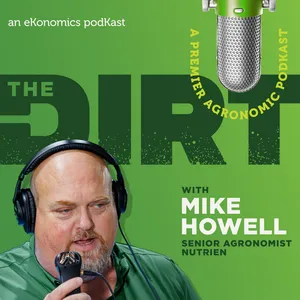
An eKonomics podKast featuring down-and-dirty agronomic science to help grow crops and bottom lines. Inspired by nutrien-eKonomics.com, farming's go-to information resource, we break down the latest crop nutrition research and news — helping farmers make better business decisions through actionable insights.
Latest Episodes
The most recent episodes — sign up to get AI-powered summaries of each one.
- 1 weeks ago30 min
What Millions of Soil Tests Reveal About Soil Fertility
Are soils supplying the nutrients crops need? Millions of soil tests from across the U.S. and Canada offer a revealing picture. In this episode, Dr. Karl Wyant is joined by Dr. Leanna Nigon, director of agronomy and research at The Fertilizer Institute (TFI), to explore findings from the latest TFI Soil Test Summary, drawing on approximately 10.2 million soil samples from across the U.S. and Canada. With more than 40 percent of samples testing below critical levels for phosphorus and potassium, Leanna explains what those thresholds mean for fertilizer decisions and how nutrient needs vary across regions. They also explore soil pH and soil organic matter levels, why regional averages only tell part of the story and how consistently testing your own fields can help you track changes and plan ahead. Explore the new data as soon as it's available: https://www.nutrienttools.org/getting-started/soil-test-summary/ Looking for the latest in crop nutrition research? Visit nutrien-ekonomics.com Subscribe to our YouTube channel: https://www.youtube.com/@NutrieneKonomics
- 2 weeks ago21 min
Behind the Granule: How Potash Fertilizer is Made
Ever wondered how the potash fertilizer you apply is actually made? There's more to the process than you might think. In this episode, Lyle Cowell is joined by Courtney Rohachuk, manager of Nutrien's Pilot Plant, to explore how mined potash ore becomes finished fertilizer. Courtney walks us through the process, explaining how potassium chloride is separated from other salts, how granules are sized for blending and application and how Nutrien helps protect product quality during shipping and handling. Go behind the scenes of potash production, hear how Nutrien's Pilot Plant supports improvements across its six Saskatchewan potash sites and discover the teamwork it takes to produce the fertilizer that reaches your farm. Looking for the latest in crop nutrition research? Visit nutrien-ekonomics.com Subscribe to our YouTube channel: https://www.youtube.com/@NutrieneKonomics
- 3 weeks ago23 min
Putting Ag Innovation to the Test
With so much new technology entering the market, how do we figure out what's actually helpful? This week, we're coming to you from Nutrien Ag Solutions' Innovation Farm in Champaign, Illinois. Dr. Karl Wyant joins Thaddeus Bates, senior manager of the Innovation Farm Network, to explore how the farms put new equipment, products and practices to the test. Hear how grower needs shape their work, why taking research from small plots to commercial acres matters and what research at the speed of farming looks like in practice. At the heart of their approach is building on what growers already do well and finding practical changes that fit their farms, make better use of their time and offer opportunities to improve return on investment. Looking for the latest in crop nutrition research? Visit nutrien-ekonomics.com Subscribe to our YouTube channel: https://www.youtube.com/@NutrieneKonomics
- 4 weeks ago24 min
Connecting Soil Research to the Field
Soil research is most valuable when it reflects the real challenges growers are seeing and helps them make better management decisions. In this episode, host Lyle Cowell is joined by Dr. Chantel Chizen, Assistant Professor in the Department of Soil Science at the University of Saskatchewan, to discuss how conversations with farmers have helped shape priorities for her new research group. Chantel explores her current research into low-yielding and marginal areas of fields, prairie wetlands, soil carbon, soil health and soil variability across Saskatchewan. They also discuss how tools such as satellite and drone imagery and digital soil mapping are changing the way soils are studied, efforts to build a new provincial soil data hub and interpretation guide and why continued engagement with farmers and agronomists is essential to keeping soil research connected to the field. Looking for the latest in crop nutrition research? Visit nutrien-ekonomics.com Subscribe to our YouTube channel: https://www.youtube.com/@NutrieneKonomics
- Oct 6, 202636 min
Which Potash Fertilizer Fits Your Fields?
What should you consider when choosing a potassium source? In this episode, host Dr. Alan Blaylock is joined by David Holden, owner of Holden Research and Consulting, to explore how crop needs, soil properties, water source and the nutrients supplied alongside potassium can affect how well a particular source fits into a system. They compare potassium chloride (MOP) and potassium sulfate (SOP), discuss why chloride can create challenges for certain crops and explain what growers should think about when evaluating each source. They also explore how potassium rate, timing and placement can align with crop demand, why potassium availability matters as crops develop and how irrigation can influence the source you select. The conversation offers practical considerations for selecting and evaluating potassium sources, including potassium chloride, potassium sulfate, potassium thiosulfate and potassium nitrate. Looking for the latest in crop nutrition research? Visit nutrien-ekonomics.com Subscribe to our YouTube channel: https://www.youtube.com/@NutrieneKonomics
- Sep 29, 202632 min
Understanding the Soil Factors Limiting Yield
Soil fertility isn't always the yield-limiting factor. Compaction, salinity, soil acidity and water management can all affect how well crops grow and how effectively they access nutrients. In this episode, Lyle Cowell is joined by Marla Riekman, Soil Fertility Specialist with Manitoba Agriculture, to explore some of the other factors that can hold back crop performance and productivity. They discuss how salinity and compaction are connected to water management, how soil acidity can affect crop growth and what growers and agronomists can look for when diagnosing underperforming areas of a field. They also explore practical approaches to managing and minimizing the impacts of soil salinity and compaction, along with how growers can think about soil health, field variability and the factors they can influence to support crop growth. Looking for the latest in crop nutrition research? Visit nutrien-ekonomics.com Subscribe to our YouTube channel: https://www.youtube.com/@NutrieneKonomics
- Sep 22, 202626 min
What Really Influences Soil Organic Matter?
Building soil organic matter has become a common goal for farmers looking to improve soil health, but increasing soil organic matter levels can be harder than we'd expect. In this episode, host Amy Crozier is joined by Andrew McGuire, Irrigated Cropping Systems Extension Agronomist and Grant County Director with Washington State University, to explore what influences soil organic matter (SOM) and which management practices can actually help build or maintain it over time. They discuss the balance between biomass inputs and losses, how harvest and erosion affect SOM, the value and limitations of different soil-building practices and debunk the claim that nitrogen fertilizer burns up SOM. Andrew also shares how growers can evaluate soil health products, set realistic expectations and focus on practices that address measurable problems in their fields. Looking for the latest in crop nutrition research? Visit nutrien-ekonomics.com Subscribe to our YouTube channel: https://www.youtube.com/@NutrieneKonomics
- Sep 15, 202625 min
Building Better Yield Forecasts with Farm Data
Crop yield forecasting isn't new, but the information used to build them has changed. Today, field observations and grower experience can be combined with satellite imagery, weather data and historical records to provide a more complete view of expected production. In this episode, Dr. Karl Wyant is joined by Megan Nunes, founder and CEO of Bountiful, to explore what goes into crop yield forecasting and how forecasting can support budgeting, cash flow and other planning and business decisions before harvest. They discuss how satellite imagery and other farm data are combined through machine learning to forecast yields in specialty crops, how forecasts evolve as new information becomes available and why connecting data from across the operation can make it more useful for planning. Looking for the latest in crop nutrition research? Visit nutrien-ekonomics.com Subscribe to our YouTube channel: https://www.youtube.com/@NutrieneKonomics
Get The Dirt: an eKonomics podKast summaries in your inbox
Free AI-powered daily recaps. Key takeaways, quotes, and mentions — in a 5-minute read.
Get Free Summaries →Free forever for up to 3 podcasts. No credit card required.
You Might Also Like
Listeners also like.

Regenerative Agriculture Podcast
Explores the science and practices of regenerative agriculture to help growers improve soil health, crop quality, and farm profitability.

Regenerative Agriculture: Buzzwords & Bullsh*t
A no-nonsense look at the realities and myths behind regenerative agriculture practices and the claims they generate.
On-Farm Trials Podcast with the PNW Farmers' Network
Carol McFarland explores on-farm trials and agricultural innovations with experts across the inland Pacific Northwest.

Running on Grass
Two ranchers discuss practical challenges of grass management, drought, cattle markets, and daily life on a working ranch.
Teaming With Microbes
A podcast about organic gardening and the soil food web.

Dirt From The Dugout
A podcast offering expert advice and strategies for parents navigating youth and high school baseball.

Grassfed Life
Covers small-scale farming, grass-fed livestock, and farm-based entrepreneurship with seasonal insights and practical guidance.

Economist Podcasts
Daily global news analysis from correspondents on major international stories.

Gastropod
Explores the science and history behind food and farming, from ancient feasts to modern aquaculture and everything in between.

Barn Talk
A weekly conversation between a father and son exploring agriculture, business, current events, and everyday life with humor and insight.

The Economics of Everyday Things
A journalist explores the hidden economic forces behind everyday objects and routines.

Freakonomics, M.D.
A physician-economist explores surprising studies where healthcare and economics intersect, uncovering hidden patterns in medical data.
About The Dirt: an eKonomics podKast
An eKonomics podKast featuring down-and-dirty agronomic science to help grow crops and bottom lines. Inspired by nutrien-eKonomics.com, farming's go-to information resource, we break down the latest crop nutrition research and news — helping farmers make better business decisions through actionable insights.
Customized Recaps
AI-powered recaps with compact key takeaways, quotes, and insights.
Straight to Your Inbox
Get key takeaways from The Dirt: an eKonomics podKast in a 5-minute read.
Save Hours Every Week
Stay current on your favorite podcasts without falling behind.
Frequently Asked Questions
What is Podzilla's The Dirt: an eKonomics podKast daily summary?
It's a free AI-powered email that summarizes new episodes of The Dirt: an eKonomics podKast as soon as they're published. You get the key takeaways, notable quotes, and links & mentions — all in a quick read.
How does the The Dirt: an eKonomics podKast podcast summary work?
When a new episode drops, our AI transcribes and analyzes it, then generates a personalized summary tailored to your interests and profession. It's delivered to your inbox every morning.
Is this an official The Dirt: an eKonomics podKast product?
No. Podzilla is an independent service that summarizes publicly available podcast content. We're not affiliated with or endorsed by eKonomics.
Can I get summaries of other podcasts too?
Absolutely! The free plan covers up to 3 podcasts, any in the catalog. Basic raises that to 15, Pro to 40 and Max to 100. Browse our full catalog at /podcasts.
How often does The Dirt: an eKonomics podKast release new episodes?
The Dirt: an eKonomics podKast publishes weekly. Our AI generates a summary within hours of each new episode.
What topics does The Dirt: an eKonomics podKast cover?
The Dirt: an eKonomics podKast covers topics including Science, Education. Our AI identifies the specific themes in each episode and highlights what matters most to you.
Start getting The Dirt: an eKonomics podKast summaries tomorrow morning.
Free forever for up to 3 podcasts. No credit card required.
Free forever for up to 3 podcasts. No credit card required.