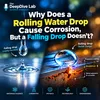
The Electric Rain: How Water Drops Trigger Corrosion
A water droplet looks harmless. But what if a moving droplet could generate thousands of volts—and use that hidden electricity to damage the very coatings designed to protect metal? ⚡💧In this episode of The DeepDive Lab, we explore a surprising mechanism behind corrosion: slide electrification. When water moves across an insulating surface, it can spontaneously acquire electrical charge. A single drop sliding only a few centimeters can accumulate roughly 0.2–2 nanocoulombs, producing electric potentials above 1 kilovolt under the conditions studied.As the charged droplet approaches metal, its electric field can become intensely concentrated, deforming the liquid into a Taylor cone and triggering localized dielectric breakdown. The resulting microscopic damage can chemically alter protective polymers and expose the underlying metal to corrosion.From rain and melting snow to ocean spray, vehicles, buildings, and industrial coatings, this discovery reveals a hidden electrical side of water—and suggests that future protective materials may need to control not just water, but charge. 🔬⚡🌧️Source: Ni, Z., Li, X., Ratschow, A. D., et al. (2026), Spontaneously charged water drops induce corrosion, Nature, doi:10.1038/s41586-026-10941-6.#Corrosion #MaterialsScience #Physics #WaterDrops #Electrification #Engineering #TheDeepDiveLab
Podzilla Summary coming soon
Sign up to get notified when the full AI-powered summary is ready.
Free forever for up to 3 podcasts. No credit card required.
Listen to This Episode
More from The Deep Dive Lab: Unraveling Materials Science
Why Do Humans Gradually Stop Cooperating?
Can Electrochemistry Tell a Good Coffee from a Bad One? ☕⚡

Default Mode Network: Memory, Imagination & the Self

Why Are Humans Ticklish? The Hidden Map on Your Skin
Get summaries like this every morning.
Free AI-powered recaps of The Deep Dive Lab: Unraveling Materials Science and your other favorite podcasts, delivered to your inbox.
Free forever for up to 3 podcasts. No credit card required.