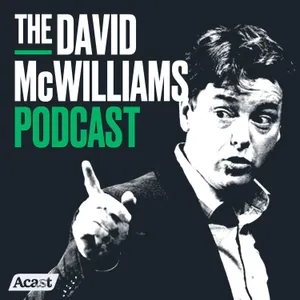
Free Daily Podcast Summary
The David McWilliams Podcast: Daily Summaries Delivered
by David McWilliams & John Davis
Get key takeaways, quotes, and insights from The David McWilliams Podcast in a 5-minute read. Delivered straight to your inbox.
Latest Episodes
The most recent episodes — sign up to get AI-powered summaries of each one.
- Today44 min
Immigration: What's The Plan?
No policy. No plan. No housing. Sinead O'Sullivan is back to explain why Ireland took in more immigrants per head than any country in Europe, and why the middle class is about to feel what the working class has been shouting about for years. Hosted on Acast. See acast.com/privacy for more information.
- 5 days ago39 min
China Is Winning, Trump Doesn't Know It Yet
China is winning, and Trump doesn't know it yet. As the two leaders sit down in Beijing today, we explain why the Chinese think America is an empire in decline, and why they might be right. Hosted on Acast. See acast.com/privacy for more information.
- 1 weeks ago34 min
Why Your Barista Has a Master's Degree
What happens when a country produces more graduates than it has elite jobs to give them? According to Peter Turchin, the Russian-American thinker behind End Times, that's exactly the moment civilisations start to crack. This week, we get into his theory of "elite overproduction" and ask whether Ireland is staring straight into it. We unpack the stats: most educated population in the EU, master's degrees doubling in 15 years, and nearly one in three graduates working in jobs that don't need a degree. We talk about why the barista with a first-class honours and the barman with an economics master's are not just funny anecdotes, they're leading indicators of political instability. We look at how the public sector is quietly absorbing the overflow that the private sector can't, why AI is about to pour petrol on the fire, and why historically it's not the abject poor who revolt, it's the relatively rich and bitterly disappointed. Hosted on Acast. See acast.com/privacy for more information.
- 1 weeks ago38 min
The UAE, Iran, and the Hostage at the Heart of the Oil War
The UAE has just walked out of OPEC after nearly 60 years, and the timing is no accident. This week, we head to Abu Dhabi and Dubai to ask what's really going on. Why now? Why leave the cartel in the middle of a war? What does it mean for the price of petrol in your car, for Trump's midterms, and for the geopolitics of the Gulf? We get into the strange tacit alliance between the UAE and Israel, why Iran's real leverage isn't the Straits of Hormuz but the Emirates themselves, and how Saudi Arabia's old swing-producer power is being quietly dismantled. We also draw a much bigger lesson for small countries everywhere, including Ireland: the multilateral world that small states have hidden inside since the 1940s is breaking down, and the UAE's gamble is a glimpse of the hard choices that lie ahead. Oil, war, money, and the end of an era, all in one episode. Hosted on Acast. See acast.com/privacy for more information.
- 2 weeks ago42 min
The Failure Premium: Where is the Money Going?
This week, Sinead O'Sullivan is back, and she's got an answer that official Ireland really doesn't want to hear. We dig into the "failure premium", the staggering cost of a state that knows how to hand out subsidies but has forgotten how to coordinate, build, or own anything. We follow the money: why HAP quietly inflates the rent into the landlord's pocket, why housing a refugee costs €99 a night here and €13 in the Netherlands, and why we're paying premium prices for second-rate outcomes across housing, health, and infrastructure. We look at how a country adapts to dysfunction, sheds in back gardens, hollowed-out city centres, kids emigrating, until we stop noticing it's not normal. What happens when the multinational money slows down and we're left holding the infrastructure deficit we never fixed? Hosted on Acast. See acast.com/privacy for more information.
- 2 weeks ago41 min
Ireland Is Killing Its Entrepreneurs
Ireland is now officially the worst country in Europe for young entrepreneurs. Just 5.1% of our 20-somethings are building their own businesses, less than half the rate in Slovakia. So what the hell happened? This week, we ask why young Irish people have stopped backing themselves, and why a country that looks rich on paper is quietly losing the very people who make economies dance. We get into the difference between wealth that's extracted (the multinationals) and wealth that's created (the Ryanairs), and why one is far more fragile than it looks. We bring in Schumpeter and Nassim Taleb, follow a hypothetical 27-year-old called Kiera as the numbers crush her before she's even begun, and ask whether Ireland has become a nation of doubters, quietly punishing anyone who dares to have a go. We float a fix: stop parking the multinational windfall in a pension fund our 25-year-olds will never see, and turn it into a startup fund they can actually use. Because without risk-takers, there's no return, and without return, there's no economy. Hosted on Acast. See acast.com/privacy for more information.
- 3 weeks ago44 min
Is America Losing Control?
The global economy runs on one thing: the US dollar. What happens when trust in that system starts to crack? In this episode, we go deep into the mechanics of global finance, from dollar “swap lines” to shadow banking, to explain how the United States became the financial centre of the world, and why that dominance may now be under threat. At the heart of it all is a simple but unsettling reality: America doesn’t just produce goods, it produces money. The rest of the world needs dollars to trade, invest, and survive financial shocks. That gives the US enormous power, but also creates dangerous imbalances. We explore how decades of financialisation have concentrated wealth and influence in a small group of investors, reshaping both the American economy and global politics. Meanwhile, rising geopolitical tensions, particularly around Iran, raise a bigger question: could a single strategic misstep do to the US what the Suez Crisis did to Britain, quietly ending its era of dominance? Hosted on Acast. See acast.com/privacy for more information.
- 3 weeks ago44 min
The Premature State: Why Ireland Can’t Build Itself
Ireland is one of the richest countries in Europe, so why does it feel like it isn’t? We sit down with economist and engineer Sinead O'Sullivan to unpack a deceptively simple but deeply uncomfortable idea: Ireland is a premature state. Despite extraordinary wealth on paper, everyday life tells a different story. Housing is broken, infrastructure lags behind, public services struggle to deliver. So where is all the money going? The answer, as Sinead argues, is structural. Ireland has become exceptionally good at spending money, but never properly learned how to build systems. For centuries, key functions of the state were outsourced, first to the British Empire, then the Church, then the EU, and now multinational corporations. The result is a country rich in resources, but lacking the institutional muscle to turn that wealth into a functioning society. We also take on the reaction to this kind of thinking; the “nitpickers” who focus on minor details to avoid confronting big, uncomfortable truths. If Ireland’s problem isn’t money, but capacity, then the implications are far more serious than any short-term fix. Hosted on Acast. See acast.com/privacy for more information.
Get The David McWilliams Podcast summaries in your inbox
Free AI-powered daily recaps. Key takeaways, quotes, and mentions — in a 5-minute read.
Get Free Summaries →Free forever for up to 3 podcasts. No credit card required.
You Might Also Like
Listeners also like.

Comedian v Economist
Equity Mates Media
The Econoclasts
UnHerd

Reuters Econ World
Reuters

Money Talks from The Economist
The Economist
The Peter McCormack Show
Peter McCormack
Economist Podcasts
The Economist

The Intelligence from The Economist
The Economist
Competent Man Podcast
Tom Bodrovics

Eurodollar University
Jeff Snider
The Irish Times World View Podcast
The Irish Times
State of the Markets
State of the Markets Podcast
Macroscopic Podcast
GoldRepublic
About The David McWilliams Podcast
The aim of this weekly podcast is to make economics easy, uncomplicated and accessible. With the world at a political, technological and financial tipping point, economics has never been so important to all of us and yet, it’s made inaccessible and complicated by so many.I’ve always thought what is complicated is rarely important and what is important is rarely complicated.That will be our motto.Every week we are going to tease out some big economic or political issue facing us, not just here in Ireland but in Europe and further afield. Globalisation has brought us all together. We all face similar challenges whether you live in Dublin, London, Minnesota or Milan.If you would like to enjoy all of our content ad-free and have early access to episodes, subscribe to DMCW+ on Apple Podcast.If you would like to support the show, please consider becoming a patron at www.patreon.com/DavidMcWilliams.<p style='color:grey; font-size:0
Customized Recaps
AI-powered recaps with compact key takeaways, quotes, and insights.
Straight to Your Inbox
Get key takeaways from The David McWilliams Podcast in a 5-minute read.
Save Hours Every Week
Stay current on your favorite podcasts without falling behind.
Frequently Asked Questions
What is Podzilla's The David McWilliams Podcast daily summary?
It's a free AI-powered email that summarizes new episodes of The David McWilliams Podcast as soon as they're published. You get the key takeaways, notable quotes, and links & mentions — all in a quick read.
How does the The David McWilliams Podcast podcast summary work?
When a new episode drops, our AI transcribes and analyzes it, then generates a personalized summary tailored to your interests and profession. It's delivered to your inbox every morning.
Is this an official The David McWilliams Podcast product?
No. Podzilla is an independent service that summarizes publicly available podcast content. We're not affiliated with or endorsed by David McWilliams & John Davis.
Can I get summaries of other podcasts too?
Absolutely! The free plan covers up to 3 podcasts. Upgrade to Pro for 15, or Premium for 50. Browse our full catalog at /podcasts.
What topics does The David McWilliams Podcast cover?
The David McWilliams Podcast covers topics including News, Politics. Our AI identifies the specific themes in each episode and highlights what matters most to you.
Start getting The David McWilliams Podcast summaries tomorrow morning.
Free forever for up to 3 podcasts. No credit card required.
Free forever for up to 3 podcasts. No credit card required.