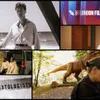
It felt apt that Neil and I were both in London for this year’s edition of the festival. Over the years of The Cinematologists, we’ve covered a range of international events, always striving to capture not just our critical responses to the films, but something of the atmosphere, the resonance of the experience itself.Living in London, I usually don’t feel that full, immersive festival bubble. There’s always the pull of everyday life at the edges. By contrast, attending an international festival abroad brings with it a heightened sense of dislocation—a kind of lived difference that reanimates the senses. That estrangement, combined with the charged intensity of being inside a self-contained epicentre of cinematic energy, somehow deepens both the viewing experience and one’s critical focus.With Neil in town for what amounted to an extended long weekend, I resolved to pack as much into five intense days of screenings, conversations, and cinematic overload. Normally, I prefer to experience films alone, especially at festivals. The solitude seems to both sharpen my concentration in the watching itself. But after a decade of co-hosting The Cinematologists, Neil and I have developed an unspoken rhythm - an ease in conversation and, just as importantly, sit together in that post-screening quiet, letting the film settle before the dialogue begins.We recorded the episode after our final screening together—François Ozon’s adaptation of Albert Camus’ L’Étranger. It proved an apt conclusion: gorgeously shot, restrained yet expressive, and, to my mind, remarkably faithful to the source material. Neil and I found ourselves immediately drawn into questions of form and aesthetics—recurring preoccupations on the podcast in recent years. How, and why, do filmmakers adopt particular visual modes to explore aspects of the human condition? And, more provocatively, is there an ethical contradiction in rendering violence, trauma, crisis, or poverty with beauty?Across this year’s programme, that tension between sensuous visuality and political critique felt ever-present—a paradox that became the connective tissue of our conversations throughout the episode. Many of the films, often formally inventive and emotionally arresting, provoked questions about how cinema confronts and represents the cruel absurdities of contemporary experience, something I’ve been preoccupied with throughout this cinematic year.Ozon’s film, of course, approaches this quite literally, but for me, so many of the works we saw continued a broader trend: filmmakers striving to make sense of senselessness through audio-visual forms that both frame the social and implicate the viewer. Themes of displacement, memory, alienation, and the ethics of representation ran through much of our discussion, as did a shared sense that contemporary filmmakers are consciously reconfiguring documentary, fiction, and hybrid modes to articulate a pervasive cultural unease.We hope you enjoy the conversation, and as usual, we welcome any comments on the films or what we say about them.As always, thanks for coming back or clicking for the first time on Contrawise. If you’re here for the first time, I’m an errant academic, writing and speaking about cinema, media, and art with a philosophical approach.Films discussed on the episodeThe Stranger (dir. Francois Ozon)Ozon’s adaptation of Camus’ existential classic centres on Meursault, a detached and indifferent Frenchman in colonial Algeria who, weeks after his mother’s funeral, impulsively kills an unnamed Arab man on a sun-drenched beach. The subsequent trial becomes an inquiry not only into the murder but into the absurdist senselessness.Starring the excellent Benjamin Voisin, embodying the character’s apathy, alienation, and refusal to conform to moral expectations. Shot with Ozon’s characteristically meticulous visual control, the film is gorgeously rendered—its romantic luminosity almost at odds with the bleakness of the material. In our discussion, we consider whether this sumptuous aesthetic intensifies or undermines the sense of existential ennui that lies at the heart of Camus’ seminal text.Kontinental ‘25 (dir. Radu Jude)Perhaps the most compelling film of the festival for both of us, Kontinental 25 cements Jude’s positio
Podzilla Summary coming soon
Sign up to get notified when the full AI-powered summary is ready.
Free forever for up to 3 podcasts. No credit card required.
Listen to This Episode
More from The Cinematologists Podcast
Sinners, Warfare and One to One: John and Yoko
Best films of 2025 and our final podcast.
The Clinical Trials of David Cronenberg w/Violet Lucca

Taxonomy of the Lone Killer
Get summaries like this every morning.
Free AI-powered recaps of The Cinematologists Podcast and your other favorite podcasts, delivered to your inbox.
Free forever for up to 3 podcasts. No credit card required.