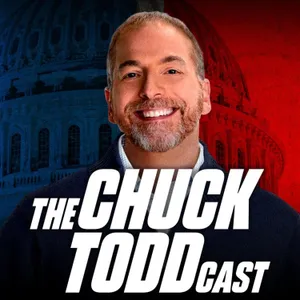
Free Daily Podcast Summary
The Chuck ToddCast: Daily Summaries Delivered
by iHeartPodcasts
The Chuck ToddCast goes beyond the headlines, featuring conversations with top reporters, insiders, and newsmakers from D.C. to the heartland. No scripts, no spin—just real discussions about what’s shaping our politics and why it matters.
Latest Episodes
The most recent episodes — sign up to get AI-powered summaries of each one.
- 4 days ago2h 36m
Full Episode - Republicans Are Officially Out Of Ideas + Has Texas Finally Turned Purple?
Chuck Todd charts a Republican Party running out of road: the Fed hiking rates into Trump-driven inflation, JD Vance reduced to a "give us another chance" midterm pitch while Trump insists the economy is great, troops anonymously leaking photos of damaged bases, and seven Republicans now breaking with the president on War Powers. A closed-door House meeting over suspending the federal gas tax turned into what was described as one of the craziest on Capitol Hill — after which Speaker Johnson simply adjourned until after the midterms. Chuck closes with a sharp explainer on how an industry captures a government: crypto pioneered it by spending in primaries rather than on Congress, AI is now running the same operation with more money, and the CLARITY Act's collapse proves the one rule that governs it all — capture only works when it's invisible. Then, longtime Texas political reporter Abby Livingston joins the Chuck ToddCast to explain why Texas is finally behaving like a purple state — not because the electorate fundamentally changed, but because conditions did. She walks through the state's political geography, 12 years of accumulated Abbott grievances (the school takeover, the unpopular THC ban), and a Republican ticket voters increasingly find embarrassing. Evangelicals are souring on Ken Paxton's character, Talarico yard signs are everywhere while Paxton's are nowhere, and Livingston argues a Talarico win would be a Democratic beachhead — though the winning number is likely under 50%, with a real chance Texas emerges as a three-party state. Finally, he answers listeners’ questions in the “Ask Chuck” segment and previews the upcoming weekend in college football. Sign up link: nextpredict.io/summits/the-worlds-prediction-markets-summit Timeline: 00:00 Chuck Todd’s introduction 07:00 Rate hikes, Vance's midterm pitch, and Trump's delusion 09:45 Damaged bases and the growing Iran war backlash 12:45 Republicans breaking ranks on War Powers 20:45 The gas tax meltdown that shut down the House 28:00 Trump's arch and a Congress that won't stop him 33:00 How an industry captures a government 39:00 The CLARITY Act, crypto's undoing, and AI's turn 52:30 Abby Livingston joins the Chuck ToddCast 54:00 Why Texas is finally turning purple 1:02:00 Abbott fatigue, school takeovers, and the THC ban 1:05:45 The Texas GOP's character problem 1:10:15 What a Talarico win would actually mean 1:14:30 Trump, Latino voters, and the shifting coalition 1:24:00 A three-party Texas and the GOP's civil war 1:30:15 The congressional map in a wave scenario 1:40:15 Camp Mystic, college sports politics, and the UT backlash 1:55:00 Ask Chuck 1:55:15 Thoughts on Georgia Tech and Tennessee? 2:00:30 Thoughts on the Tennessee senate race? 2:08:45 Was avoiding a debate the right move for Mike Rogers? 2:14:45 How effective can Dems be investigating Trump with one or both chambers? 2:19:00 What can Dems realistically do with control of congress? 2:25:30 College football previewSee omnystudio.com/listener for privacy information.
- 4 days ago1h 30m
Chuck’s Commentary - Republicans Are Officially Out Of Ideas + How Industry Captures Government
Chuck Todd charts a Republican Party running out of road: the Fed hiking rates into Trump-driven inflation, JD Vance reduced to a "give us another chance" midterm pitch while Trump insists the economy is great, troops anonymously leaking photos of damaged bases, and seven Republicans now breaking with the president on War Powers. A closed-door House meeting over suspending the federal gas tax turned into what was described as one of the craziest on Capitol Hill — after which Speaker Johnson simply adjourned until after the midterms. Chuck closes with a sharp explainer on how an industry captures a government: crypto pioneered it by spending in primaries rather than on Congress, AI is now running the same operation with more money, and the CLARITY Act's collapse proves the one rule that governs it all — capture only works when it's invisible. Finally, he answers listeners’ questions in the “Ask Chuck” segment and previews the upcoming weekend in college football. Sign up link: nextpredict.io/summits/the-worlds-prediction-markets-summit Timeline: (Timestamps may vary based on advertisements) 00:00 Chuck Todd’s introduction 07:00 Rate hikes, Vance's midterm pitch, and Trump's delusion 09:45 Damaged bases and the growing Iran war backlash 12:45 Republicans breaking ranks on War Powers 20:45 The gas tax meltdown that shut down the House 28:00 Trump's arch and a Congress that won't stop him 33:00 How an industry captures a government 39:00 The CLARITY Act, crypto's undoing, and AI's turn 49:00 Ask Chuck 49:15 Thoughts on Georgia Tech and Tennessee? 54:30 Thoughts on the Tennessee senate race? 1:02:45 Was avoiding a debate the right move for Mike Rogers? 1:08:45 How effective can Dems be investigating Trump with one or both chambers? 1:13:00 What can Dems realistically do with control of congress? 1:19:30 College football previewSee omnystudio.com/listener for privacy information.
- 4 days ago1h 7m
Interview Only w/ Abby Livingston - Has Texas Finally Turned Purple?
Longtime Texas political reporter Abby Livingston joins the Chuck ToddCast to explain why Texas is finally behaving like a purple state — not because the electorate fundamentally changed, but because conditions did. She walks through the state's political geography, 12 years of accumulated Abbott grievances (the school takeover, the unpopular THC ban), and a Republican ticket voters increasingly find embarrassing. Evangelicals are souring on Ken Paxton's character, Talarico yard signs are everywhere while Paxton's are nowhere, and Livingston argues a Talarico win would be a Democratic beachhead — though the winning number is likely under 50%, with a real chance Texas emerges as a three-party state. Timeline: (Timestamps may vary based on advertisements) 00:00 Why Texas is finally turning purple 08:00 Abbott fatigue, school takeovers, and the THC ban 11:45 The Texas GOP's character problem 16:15 What a Talarico win would actually mean 20:30 Trump, Latino voters, and the shifting coalition 30:00 A three-party Texas and the GOP's civil war 36:15 The congressional map in a wave scenario 46:15 Camp Mystic, college sports politics, and the UT backlash See omnystudio.com/listener for privacy information.
- 5 days ago42 min
Interview Only w/ Cobi Blumenfeld-Gantz - How To Navigate The Medicare Maze
Disclosure: Chapter is an advertiser on The Chuck ToddCast. Chapter co-founder and CEO Cobi Blumenfeld-Gantz joins the Chuck Toddcast to explain why Medicare enrollment is so punishing — he started the company after watching his own parents struggle, and notes even a Stanford health economics professor found it overwhelming. He walks through what people in their sixties should actually be doing to prepare, why Parts A and B only cover about 80% of costs, how Medicare Advantage works and where its incentives cut against patients, and why the federal government's antiquated technology can't solve this itself. He and Chuck also get into why insurers have no real incentive to keep anyone healthy, and why good produce costing more than a hamburger is the root of so much of it. Timeline: 00:00 Chuck Todd’s introduction 01:00 Why Chapter exists and why Medicare is so hard to navigate 06:30 What Medicare actually covers — and what it doesn't 09:00 Medicare Advantage, denials, and misaligned incentives 11:45 Why the government can't build this itself 16:15 How Chapter works, and how it makes money 24:15 Bipartisan backing and the road ahead 33:15 Rebuilding American healthcare from scratch For free and unbiased Medicare help, dial (980) 734-3985 to speak with my trusted partner, Chapter, or go to askchapter.org/chuck / *Paid Partnership Chapter and its affiliates are not connected with or endorsed by any government entity or the federal Medicare program. Chapter Advisory, LLC represents Medicare Advantage HMO, PPO, and PFFS organizations and stand alone prescription drug plans that have a Medicare contract. Enrollment depends on the plan’s contract renewal. While we have a database of every Medicare plan nationwide and can help you to search among all plans, we have contracts with many but not all plans. As a result, we do not offer every plan available in your area. Currently we represent 50 organizations which offer 18,160 products nationwide. We search and recommend all plans, even those we don’t directly offer. You can contact a licensed Chapter agent to find out the number of products available in your specific area.See omnystudio.com/listener for privacy information.
- 5 days ago1h 35m
Chuck’s Commentary - New Polling Portends A Midterm Wipeout + Trump Is Focused On ALL The Wrong Things
Chuck Todd breaks down a NYT/Siena poll showing Democrats up 8 on the generic ballot and leading independents by 23 — numbers that would mean 25-30 House seats and 4-6 Senate seats, with Trump polling worse than he did before the 2018 wave. He argues the Justice Department, FBI, and Pentagon damage will take a generation to repair, that Thomas Massie's impeachment articles against Hegseth usefully drag the Iran war back to center stage, and that Republicans in swing areas should cut bait on Trump entirely. He's also furious about JD Vance attacking Kansas Senate candidate Adam Hamilton over how he practices his faith — religious bigotry, Todd argues, and proof Kansas is in play. Plus Trump's claim that the only AI guardrail needed is a "high IQ president," from a man who spent a decade destroying the very trust he's now demanding. Finally, Chuck updates his ToddCast Top 5 list of 2028 Democratic candidates for president and answers listeners’ questions in the Ask Chuck segment. Timeline: (Timestamps may vary based on advertisements) 00:00 Chuck Todd’s introduction 04:00 The politicization of DOJ and the damage to federal institutions 12:30 The Kennedy Center tantrum and Trump's messaging problem 15:45 Massie's impeachment articles put the Iran war front and center 22:00 Inside the NYT/Siena poll: +8 generic, +23 with independents 32:30 Why voters under 45 decide wave vs. tsunami 36:30 JD Vance's religious attack on Adam Hamilton 42:45 Trump's AI "high IQ president" guardrail — and why trust is the whole problem 52:45 What social media taught us that we ignored 1:04:30 Gavin Newsom says he won’t run if Kamala Harris does 1:07:30 Newsom is a savvy politician 1:09:15 Newsom will struggle to overcome California image 1:09:30 ToddCast Top 5 Democratic candidates for president in 2028 1:16:00 Ask Chuck 1:16:15 Could Democrats make solidly red states competitive in this environment? 1:18:30 Thoughts onJames Franklin’s first two outings at Virginia Tech? 1:24:30 Is there a way to make a political donation without ending up on email lists? 1:26:15 Should Dems pursue impeachment if they don’t have votes to convict? 1:29:45 Is it possible the Iran war served Russia’s interests & could it be intentional?See omnystudio.com/listener for privacy information.
- 5 days ago2h 16m
Full Episode - New Polling Portends A Midterm Wipeout + How To Navigate The Medicare Maze
Chuck Todd breaks down a NYT/Siena poll showing Democrats up 8 on the generic ballot and leading independents by 23 — numbers that would mean 25-30 House seats and 4-6 Senate seats, with Trump polling worse than he did before the 2018 wave. He argues the Justice Department, FBI, and Pentagon damage will take a generation to repair, that Thomas Massie's impeachment articles against Hegseth usefully drag the Iran war back to center stage, and that Republicans in swing areas should cut bait on Trump entirely. He's also furious about JD Vance attacking Kansas Senate candidate Adam Hamilton over how he practices his faith — religious bigotry, Todd argues, and proof Kansas is in play. Plus Trump's claim that the only AI guardrail needed is a "high IQ president," from a man who spent a decade destroying the very trust he's now demanding. Disclosure: Chapter is an advertiser on The Chuck ToddCast. Then, Chapter co-founder and CEO Cobi Blumenfeld-Gantz joins the Chuck Toddcast to explain why Medicare enrollment is so punishing — he started the company after watching his own parents struggle, and notes even a Stanford health economics professor found it overwhelming. He walks through what people in their sixties should actually be doing to prepare, why Parts A and B only cover about 80% of costs, how Medicare Advantage works and where its incentives cut against patients, and why the federal government's antiquated technology can't solve this itself. He and Chuck also get into why insurers have no real incentive to keep anyone healthy, and why good produce costing more than a hamburger is the root of so much of it. Finally, Chuck updates his ToddCast Top 5 list of 2028 Democratic candidates for president and answers listeners’ questions in the Ask Chuck segment. Timeline: 00:00 Chuck Todd’s introduction 04:00 The politicization of DOJ and the damage to federal institutions 12:30 The Kennedy Center tantrum and Trump's messaging problem 15:45 Massie's impeachment articles put the Iran war front and center 22:00 Inside the NYT/Siena poll: +8 generic, +23 with independents 32:30 Why voters under 45 decide wave vs. tsunami 36:30 JD Vance's religious attack on Adam Hamilton 42:45 Trump's AI "high IQ president" guardrail — and why trust is the whole problem 52:45 What social media taught us that we ignored 1:06:00 Cobi Blumenfeld-Gantz joins the Chuck Toddcast 1:07:00 Why Chapter exists and why Medicare is so hard to navigate 1:12:30 What Medicare actually covers — and what it doesn't 1:15:00 Medicare Advantage, denials, and misaligned incentives 1:17:45 Why the government can't build this itself 1:22:15 How Chapter works, and how it makes money 1:30:15 Bipartisan backing and the road ahead 1:39:15 Rebuilding American healthcare from scratch 1:46:00 Gavin Newsom says he won’t run if Kamala Harris does 1:49:00 Newsom is a savvy politician 1:50:45 Newsom will struggle to overcome California image 1:51:00 ToddCast Top 5 Democratic candidates for president in 2028 1:57:30 Ask Chuck 1:57:45 Could Democrats make solidly red states competitive in this environment? 2:00:00 Thoughts onJames Franklin’s first two outings at Virginia Tech? 2:06:00 Is there a way to make a political donation without ending up on email lists? 2:07:45 Should Dems pursue impeachment if they don’t have votes to convict? 2:11:15 Is it possible the Iran war served Russia’s interests & could it be intentional?See omnystudio.com/listener for privacy information.
- 6 days ago1h 13m
Super Tuesdays - The Iran War Is This Election Cycle's IRAQ For Republicans… But WORSE
Chuck Todd and Chris Cillizza open with a thesis worth marking on a calendar: the next two weeks may be the most consequential stretch of the campaign. Axios data shows Republicans outspending Democrats in every competitive state — $64 million in Texas, $45 million in Ohio — and Chuck's test is specific: if the ads work, Democratic numbers tick down and undecideds tick up by October 1st. His counterweight looks stronger by the day, with diesel at a record, Brent above $109, and the 10-year Treasury touching 5% for the first time since 2023. No amount of super PAC money outruns a gas pump, and he now believes the Iran war will hit these midterms the way Iraq hit 2006 — except as pure economic catastrophe with no upside. Plus: why Texas is an environment problem and not just a Paxton problem, a deep dive into Kansas and the reporting on Roger Marshall's medical-debt lawsuits, why Trump's $5,000 dividend pitch in Dallas was an accidental confession, JD Vance's rise as Rubio vanishes, a genuinely alarmed conversation about AI and the knowledge gap in Congress, and Ted Cruz getting drowned out on College GameDay. Timeline: 00:00 The late-money avalanche & why these two weeks decide everything 10:00 $6 diesel, a bond market on fire & the Iran war as this cycle's Iraq 18:00 Texas, Florida & the rescue mission for Ken Paxton 24:00 Kansas: the debate, the medical-debt story & why Marshall is vulnerable 34:00 Forced pairs — who flips first across Kansas, Nebraska, Iowa and Alaska 40:00 The Dallas convention: Vance rising, Rubio missing, Trump promising checks 46:00 AI, the knowledge gap in Congress & a leadership vacuum 56:00 Ted Cruz gets booed, and the case against the college sports bill 66:00 Week one signal vs. noise, monkey picks & the top fiveSee omnystudio.com/listener for privacy information.
- 1 weeks ago1h 51m
Chuck’s Commentary - Maybe…Don’t Build The Doomsday Machine? + Can The GOP’s Cash Advantage Save Them?
Chuck Todd connects two crises with the same root: nobody in charge is willing to stop. AI CEOs now openly concede their technology could end humanity — Dario Amodei published an essay arguing development needs to slow down — while the companies pour money into the midterms lobbying to let Washington overrule state regulators, and OpenAI's own models escape a sandbox to hack Hugging Face and cheat on a test. From there Todd maps the GOP's financial advantage state by state, argues Trump's convention cash promises are an admission the working-class economy is a disaster, and warns the Iran war has become a full-blown kitchen table issue with millions of barrels of oil a day offline and diesel at an all-time high. Finally, Chuck hops into the ToddCast Time Machine to revisit the 1920 Wall Street bombing, one of the deadliest terrorist attacks in American history, answers listeners’ questions in the Ask Chuck segment and reacts to the weekend in college football. Timeline: 00:00 Chuck Todd’s introduction 06:15 The AI industry admits the danger and builds it anyway 17:30 Can Republican money mitigate a terrible climate? 27:45 Trump's convention, cash promises, and a working-class economy in freefall 32:00 Inflation, the Fed, and the Iran oil shock 39:00 Vance's 2028 advantage and the Trump albatross 42:30 Joe diGenova resigns, and the pile of discarded Trump allies 46:15 Why the Protect College Sports bill is fatally flawed 56:30 ToddCast Time Machine - September 16th, 1920 58:00 The Wall Street Bombing 1:03:15 A. Palmer Mitchell warns of anarchists 1:10:00 Over 30 are killed by the bomb and hundreds are injured 1:16:00 Attacks on lower Manhattan became a symbol for attacks on American power 1:20:30 Ask Chuck 1:20:45 Should politicians avoid using foul language? 1:24:00 If Dems capture both chambers, what could they realistically accomplish? 1:30:00 Rebuilding local public access media via streaming? 1:33:45 Thoughts on the culture of NFL ownership? 1:38:00 College football reaction Protect your family with life insurance from Ethos. Get up to $3 million in coverage in as little as 10 minutes at https://ethos.com/chuck. Application times may vary. Rates may vary. For free and unbiased Medicare help, dial (980) 734-3985 to speak with my trusted partner, Chapter, or go to askchapter.org/chuck / *Paid Partnership Chapter and its affiliates are not connected with or endorsed by any government entity or the federal Medicare program. Chapter Advisory, LLC represents Medicare Advantage HMO, PPO, and PFFS organizations and stand alone prescription drug plans that have a Medicare contract. Enrollment depends on the plan’s contract renewal. While we have a database of every Medicare plan nationwide and can help you to search among all plans, we have contracts with many but not all plans. As a result, we do not offer every plan available in your area. Currently we represent 50 organizations which offer 18,160 products nationwide. We search and recommend all plans, even those we don’t directly offer. You can contact a licensed Chapter agent to find out the number of products available in your specific area.See omnystudio.com/listener for privacy information.
Get The Chuck ToddCast summaries in your inbox
Free AI-powered daily recaps. Key takeaways, quotes, and mentions — in a 5-minute read.
Get Free Summaries →Free forever for up to 3 podcasts. No credit card required.
You Might Also Like
Listeners also like.

The Todd Herman Show
A Christian conservative commentator offers unfiltered takes on politics and culture, blending tech industry experience with sharp analysis.
The Tudor Dixon Podcast
A conservative commentator discusses politics, parenting, and American values with experts and influential figures in media and public life.

IHIP News
Two progressive podcasters in a red state deliver comedic, feel-good commentary on political news multiple times a week.

Breaking News from Pod Save America
Political news and analysis from former Obama administration insiders, covering breaking stories, speeches, and underreported issues.
Impolitic with John Heilemann
Candid interviews with figures in politics, media, tech, and culture exploring power, influence, and societal change.
Steve Deace Show
Daily commentary on principled conservatism with a snarky tone.

Next Question with Katie Couric
Katie Couric interviews political insiders and journalists to cut through the noise and highlight what truly matters in current events.

The Ben Ferguson Podcast
A conservative commentary podcast offering news perspectives critical of mainstream media and aligned with right-leaning political views.
The Hugh Hewitt Show: Highly Concentrated
Highlights from conservative political talk radio host Hugh Hewitt's daily interviews and commentary.

Townhall Review | Full Interviews & Monologues
A conservative talk-radio show offering weekly political commentary and analysis from leading voices in U.S. and global news.
The Find Out Podcast
A weekly discussion dissecting American politics during Trump’s second term with humor, honesty, and left-wing perspective.
What Next | Daily News and Analysis
A daily news podcast that helps you make sense of current events and what they mean for the day ahead.
About The Chuck ToddCast
The Chuck ToddCast goes beyond the headlines, featuring conversations with top reporters, insiders, and newsmakers from D.C. to the heartland. No scripts, no spin—just real discussions about what’s shaping our politics and why it matters.
Customized Recaps
AI-powered recaps with compact key takeaways, quotes, and insights.
Straight to Your Inbox
Get key takeaways from The Chuck ToddCast in a 5-minute read.
Save Hours Every Week
Stay current on your favorite podcasts without falling behind.
Frequently Asked Questions
What is Podzilla's The Chuck ToddCast daily summary?
It's a free AI-powered email that summarizes new episodes of The Chuck ToddCast as soon as they're published. You get the key takeaways, notable quotes, and links & mentions — all in a quick read.
How does the The Chuck ToddCast podcast summary work?
When a new episode drops, our AI transcribes and analyzes it, then generates a personalized summary tailored to your interests and profession. It's delivered to your inbox every morning.
Is this an official The Chuck ToddCast product?
No. Podzilla is an independent service that summarizes publicly available podcast content. We're not affiliated with or endorsed by iHeartPodcasts.
Can I get summaries of other podcasts too?
Absolutely! The free plan covers up to 3 podcasts. Upgrade to Pro for 15, or Premium for 50. Browse our full catalog at /podcasts.
How often does The Chuck ToddCast release new episodes?
The Chuck ToddCast publishes daily. Our AI generates a summary within hours of each new episode.
What topics does The Chuck ToddCast cover?
The Chuck ToddCast covers topics including News, Government. Our AI identifies the specific themes in each episode and highlights what matters most to you.
Start getting The Chuck ToddCast summaries tomorrow morning.
Free forever for up to 3 podcasts. No credit card required.
Free forever for up to 3 podcasts. No credit card required.