Free Daily Podcast Summary
The Book of Enoch - Explained: Daily Summaries Delivered
by Sol Good Media
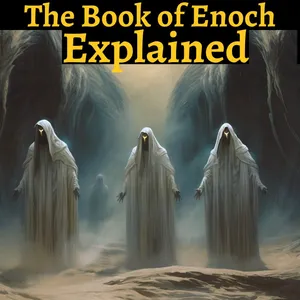
The Book of Enoch, is an ancient, non-canonical Jewish work. Estimates vary on the actual dates of authorship. However, Enoch was alive during the Antediluvian period as recorded in the Hebrew Bible. Fragments of the text, along with the Dead Sea Scrolls, were discovered in cave 4 of the Qumran caves in 1948. https://www.solgood.org - Check out our Streaming Service for our full collection of audiobooks, podcasts, short stories, & 10 hour sounds for sleep and relaxation at our website
Latest Episodes
The most recent episodes — sign up to get AI-powered summaries of each one.
- Today4h 43m
Through Broadland in a Breydon Punt-Arthur Henry Patterson
"Through Broadland in a Breydon Punt" by Arthur Henry Patterson invites listeners on a captivating journey through the picturesque landscapes of Broadland, exploring the charm and character of this unique region. The narrative captures the essence of adventure and the simple pleasures of life, showcasing the beauty of nature and the joy of exploration. As listeners traverse the waterways in a traditional punt, they are reminded of the enduring appeal of connecting with the environment and embracing the tranquility it offers. This timeless tale resonates today, emphasizing the importance of appreciating the world around us and finding solace in nature's embrace.
- Yesterday4h 57m
Christ's Eternal Existence and the Dignity of His Person Asserted and Proved-Thomas Manton
"Christ's Eternal Existence and the Dignity of His Person Asserted and Proved" by Thomas Manton delves into the profound theological concepts surrounding the eternal nature of Christ and the inherent dignity of His person. Manton meticulously argues for the significance of Christ's existence beyond time and space, asserting that this understanding is crucial for a robust faith. The themes of divinity, dignity, and eternal existence resonate deeply in contemporary discussions about identity and purpose, making this work as relevant today as it was in its time. By engaging with Manton's insights, listeners will gain a clearer perspective on the foundational beliefs that continue to shape Christian thought and spirituality.
- 2 days ago4h 29m
The Book of Enoch - Explained
The Book of Enoch by Explained delves into the ancient text attributed to Enoch, the great-grandfather of Noah, exploring themes of divine judgment, the nature of evil, and the fate of humanity. This work presents a vivid portrayal of the fallen angels and their influence on Earth, serving as a cautionary tale about moral decay and the consequences of straying from divine paths. Its exploration of the cosmic struggle between good and evil resonates today, reminding listeners of the ongoing relevance of ethical choices and spiritual integrity. The Book of Enoch invites reflection on the complexities of faith, the mysteries of the divine, and the importance of heeding warnings against corruption and injustice. Engaging with this text offers timeless insights into humanity's quest for meaning and the enduring battle between light and darkness.
- 2 days ago4h 29m
The Book of Enoch - Explained
The Book of Enoch by Explained delves into the ancient text attributed to Enoch, the great-grandfather of Noah, exploring themes of divine judgment, the nature of evil, and the fate of humanity. This work presents a vivid portrayal of the fallen angels and their influence on Earth, serving as a cautionary tale about moral decay and the consequences of straying from divine paths. Its exploration of the cosmic struggle between good and evil resonates today, reminding listeners of the ongoing relevance of ethical choices and spiritual integrity. The Book of Enoch invites reflection on the complexities of faith, the mysteries of the divine, and the importance of heeding warnings against corruption and injustice. Engaging with this text offers timeless insights into humanity's quest for meaning and the enduring battle between light and darkness.
- 2 weeks ago4h 29m
The Book of Enoch - Explained
The Book of Enoch by Explained delves into the ancient text attributed to Enoch, the great-grandfather of Noah, exploring themes of divine judgment, the nature of evil, and the fate of humanity. This work presents a vivid portrayal of the fallen angels and their influence on Earth, serving as a cautionary tale about moral decay and the consequences of straying from divine paths. Its exploration of the cosmic struggle between good and evil resonates today, reminding listeners of the ongoing relevance of ethical choices and spiritual integrity. The Book of Enoch invites reflection on the complexities of faith, the mysteries of the divine, and the importance of heeding warnings against corruption and injustice. Engaging with this text offers timeless insights into humanity's quest for meaning and the enduring battle between light and darkness.
- 3 weeks ago3h 23m
Boys' Life of Booker T Washington - Walter Clinton Jackson
Booker T. Washington was one of the first nationally recognized African American leaders after the Civil War. He was born to a slave woman in Virginia, who then took him as a young boy to West Virginia after the emancipation. Booker became a leader in education heading the Tuskegee Institute for more than 30 years and working with other universities. He advocated a moderate approach to elevating the African Americans through education and business, but worked behind the scenes to change discriminatory laws and practices, and became an adviser to the White House. He authored 14 books, and many articles and speeches, including his autobiography, Up from Slavery. - Summary by Larry Wilson
- 3 weeks ago7h 55m
Rough Notes Taken During Some Rapid Journeys Across the Pampas and Among the Andes - Francis Bond Head
“Galloped on with no stopping, but merely to change horses until five o’clock in the evening—very tired indeed, but . . . saw fresh horses in the corral, and resolved to push on. At half-past seven, after having galloped a hundred and fifty-three miles, and been fourteen hours and a half on horseback got to the post—quite exhausted—I could scarcely speak . . . an hour before daylight was awakened by the Gaucho, got up, had some mate, mounted my horse, and as I galloped along felt pleased that the sun should find me at my work. . .” Later in life nicknamed “Galloping Head,” for his exploits on the Argentine pampas, Sir Frances Head Bond, went to the Argentine in 1825 as mining supervisor for the Rio Plata Mining Association, a group of English speculators whose ill-planed and financially disastrous idea it was to send Cornish miners to re-open old gold and silver mines in the former Spanish colonies. His “Rough Notes,” often written in a staccato style that is surprisingly fresh, show a gusty, resourceful adventurer— riding across the Andes on mules who sank into snow above their knees at every step, obliging the riders to balance their feet on the mules’ ears; clambering down 250 feet of notched sticks to inspect a silver mine; foraging bluntly for food for his men in a land of scarcity: “We found they had got dry peaches and live goats. We put some of the former in a pot to boil . . . and because I was very hungry, I put a pistol to (the goat’s) ear, and in a short time he was roasting on the burning embers.” Sir Bond Head later served as lieutenant-governor of Upper Canada 1835-1837. (Summary by Sue Anderson)
- 3 weeks ago7h 19m
Basis Of Morality - Arthur Schopenhauer
In 1837, the Danish Royal Society of Sciences offered a prize to any essayist who could satisfactorily answer the question, "Is the fountain and basis of Morals to be sought for in an idea of morality which lies directly in the consciousness (or conscience), and in the analysis of the other leading ethical conceptions which arise from it? Or is it to be found in some other source of knowledge?" The Basis of Morality is the essay submitted in 1840 by German philosopher Arthur Schopenhauer. In it, he first mercilessly deconstructs the prevailing Western theory of morality as championed by Immanuel Kant, among others, before establishing a series of maxims and thought experiments which lead him to a conclusion which points squarely at compassion as the cardinal virtue upon which all morality rests. In the appendix to this essay, he links his own conclusion with the conclusions reached millennia earlier by the authors of the Vedas and Upanishads. The essay was ultimately rejected for the prize despite being the only entry, a minor scandal with some speculation that the result was due in no small part to Schopenhauer's onslaught against Hegel—the judge of the contest being the author of a Hegelian theory of morals. (Summary by Jeffrey Allen Stumpf)
About The Book of Enoch - Explained
The Book of Enoch, is an ancient, non-canonical Jewish work. Estimates vary on the actual dates of authorship. However, Enoch was alive during the Antediluvian period as recorded in the Hebrew Bible. Fragments of the text, along with the Dead Sea Scrolls, were discovered in cave 4 of the Qumran caves in 1948. https://www.solgood.org - Check out our Streaming Service for our full collection of audiobooks, podcasts, short stories, & 10 hour sounds for sleep and relaxation at our website
Customized Recaps
AI-powered recaps with compact key takeaways, quotes, and insights.
Straight to Your Inbox
Get key takeaways from The Book of Enoch - Explained in a 5-minute read.
Save Hours Every Week
Stay current on your favorite podcasts without falling behind.
Frequently Asked Questions
What is Podzilla's The Book of Enoch - Explained daily summary?
It's a free AI-powered email that summarizes new episodes of The Book of Enoch - Explained as soon as they're published. You get the key takeaways, notable quotes, and links & mentions — all in a quick read.
How does the The Book of Enoch - Explained podcast summary work?
When a new episode drops, our AI transcribes and analyzes it, then generates a personalized summary tailored to your interests and profession. It's delivered to your inbox every morning.
Is this an official The Book of Enoch - Explained product?
No. Podzilla is an independent service that summarizes publicly available podcast content. We're not affiliated with or endorsed by Sol Good Media.
Can I get summaries of other podcasts too?
Absolutely! The free plan covers up to 3 podcasts. Upgrade to Pro for 15, or Premium for 50. Browse our full catalog at /podcasts.
What topics does The Book of Enoch - Explained cover?
The Book of Enoch - Explained covers topics including History, Education, Religion & Spirituality, Spirituality. Our AI identifies the specific themes in each episode and highlights what matters most to you.
Start getting The Book of Enoch - Explained summaries tomorrow morning.
Free forever for up to 3 podcasts. No credit card required.
Free forever for up to 3 podcasts. No credit card required.