Free Daily Podcast Summary
The Bio Report: Daily Summaries Delivered
by Levine Media Group
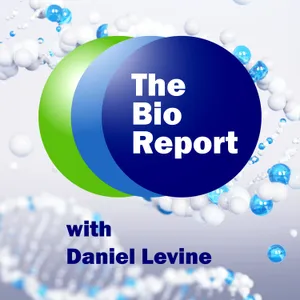
The Bio Report podcast, hosted by award-winning journalist Daniel Levine, focuses on the intersection of biotechnology with business, science, and policy.
Latest Episodes
The most recent episodes — sign up to get AI-powered summaries of each one.
- Yesterday36 min
Making Opioids a Last Resort
Pain is one of medicine’s most common complaints, yet finding effective alternatives to opioids has proved remarkably difficult. Latigo Biotherapeutics is developing experimental medicines that target NaV1.8, a sodium channel involved in transmitting pain signals through peripheral nerves, with the goal of relieving pain without the addiction risk and other side effects associated with opioids. We spoke with Nima Farzan, CEO of Latigo, about the science behind the company’s approach to treating pain, what its clinical results suggest about the potential to reduce opioid use after surgery, and what clinicians and insurers will need to see beyond regulatory approval.
- 1 weeks ago44 min
Capitol Gains: Confronting Biotech’s Policy Risks
Biotech investors have long considered scientific uncertainty, clinical setbacks, and commercial risk when making investments. John Stanford, founder and executive director of the policy advocacy organization Incubate argues that the life sciences venture capital firms he represents need to pay increasing attention to Washington due to instability at the U.S. Food and Drug Administration, competitive threats from China’s emergence as an innovation powerhouse, and reduced federal investment in research. Stanford discusses how drug-pricing policy and FDA leadership turnover influence which companies get funded, why he sees the Inflation Reduction Act’s treatment of small-molecule drugs as a particular problem, and why protecting American leadership requires supporting the entire drug-development ecosystem.
- 2 weeks ago41 min
Developing an Off-the-Shelf Cell-Based Immunotherapy for Metastatic Breast Cancer
For patients with metastatic breast cancer, successive treatments can lose effectiveness as tumors evolve and resistant cancer cells survive, leaving those who have received multiple therapies with limited options. BriaCell is seeking to address that problem with an experimental, off-the-shelf, cell-based immunotherapy designed to stimulate the immune system against multiple cancer-associated targets rather than a single target. Its lead candidate, Bria-IMT, is being studied in combination with a checkpoint inhibitor in a phase 3 trial, while its next-generation programs aim to offer personalized treatment using off-the-shelf cells. William Williams, CEO of BriaCell, discusses how its therapies work, what earlier clinical findings suggest, and the development path forward.
- 3 weeks ago35 min
A Gut-Level Pivot from Diabetes to a GLP-1 Off-Ramp
GLP-1 medicines have transformed obesity treatment, but what happens when patients stop taking them? For Fractyl Health, the challenge of preventing weight regain has become the focus of its development strategy. The company is advancing Revita, an experimental outpatient procedure designed to regenerate the lining of the duodenum and potentially change how the body regulates weight and blood sugar. Harith Rajagopalan, co-founder and CEO of Fractyl Health, discusses the company’s shift from focusing on type 2 diabetes to maintaining weight loss after patients stop taking GLP-1 medicines, the biology behind its approach, and what it takes to turn the promise of a metabolic reset into a treatment option.
- 4 weeks ago42 min
Targeting Residual Inflammation in Cardiovascular Disease
Cardiovascular disease remains the world's leading cause of death, yet many patients still face substantial risks even after conventional factors such as LDL cholesterol and blood pressure are controlled. Rezera is developing its experimental therapy ruvonoflast, an NLRP3 inhibitor, to address this residual inflammatory risk. The therapy is designed to suppress chronic, tissue-based inflammation while preserving the immune system's ability to respond to infection. Rezera CEO Geoff McDonough discusses the role of inflammation in heart disease, the company’s phase 3 trial of ruvonoflast in peripheral artery disease, and its next-generation, brain-penetrant NLRP3 inhibitor in development for neuroinflammatory conditions.
- Sep 30, 202637 min
Neutralizing Tumor Acidity to Improve Cancer Immunotherapy
Many cancer treatments fail not because immune cells can’t recognize a tumor, but because the hostile environment surrounding it can prevent them from doing their job. Dyve Biosciences is seeking to address that problem by targeting tumor acidity, which the company says can suppress T-cell activity, promote immune evasion, and contribute to resistance to checkpoint inhibitors and other therapies. Its solution is a transdermal drug-delivery platform designed to move a buffering agent through the skin and into systemic circulation. The company’s lead oncology candidate, DYV 800, is intended to raise extracellular tumor pH and thereby make the tumor microenvironment more hospitable to immune attack. Ryan Beal, CEO of Dyve Biosciences, discusses why the company sees acidity as an overlooked but foundational target in oncology, how its delivery technology may overcome the limitations of oral bicarbonate dosing, and indications beyond cancer that the company is pursuing.
- Sep 23, 202626 min
How a Breast-Milk-Derived Peptide Could Change Bladder Cancer Care
For people with non-muscle-invasive bladder cancer, treatment can involve repeated procedures, a high risk of tumor recurrence, toxic therapies and, in some cases, removal of the bladder. Hamlet Biopharma is developing Alpha1H, a synthetic peptide inspired by a protein complex found in human breast milk. Catharina Svanborg, chair of Hamlet Biopharma, discusses how Alpha1H is designed to selectively target bladder tumor cells while sparing healthy tissue, the science that led to the program, and the clinical-development path ahead.
- Sep 16, 202629 min
Targeting Visceral Fat with RNA Therapeutics
GLP-1 therapies have dramatically reshaped obesity care, but the next generation of medicines may be judged by more than how much weight patients lose. A central question is whether treatments can selectively reduce the visceral fat associated with cardiometabolic disease while maintaining the muscle needed for physical function, metabolic health, and durable weight management. Erik Ingelsson, chief scientific officer of Wave Life Sciences, discusses the biology behind a new RNA-based approach designed to remove a natural brake on fat breakdown, how the company is thinking about clinical endpoints and patient populations, and why precision approaches to fat loss could change the definition of success in obesity treatment.
Get The Bio Report summaries in your inbox
Free AI-powered daily recaps. Key takeaways, quotes, and mentions — in a 5-minute read.
Get Free Summaries →Free forever for up to 3 podcasts. No credit card required.
You Might Also Like
Listeners also like.

The Long Run with Luke Timmerman
In-depth conversations with biotech leaders navigating the challenges and opportunities of advancing science for human health.

The BioHub - by Avetix
Conversations with leading biotech experts reveal the strategies and stories driving innovation in the biotechnology industry.

Renee Belz & Lauren Sambataro
Biohacker Babes

Biohack-it
A weekly exploration of biohacking, holistic health, and science-driven strategies for optimizing physical and mental well-being.

Get Better Faster
Doctors and researchers discuss functional medicine and root-cause approaches to chronic illness and health optimization.
The Dr. Hyman Show
Explores root causes of chronic disease and promotes functional medicine, nutrition, and preventive health through expert discussions.

Made for Health | Peptides | Lyme | Chronic Infections | Long Covid | Insulin Resistance | Hypermobility
A physician explores science-based approaches to treating chronic conditions and restoring health.

The Hunter Williams Podcast
Explores cutting-edge science in peptides, hormone optimization, and biohacking with experts pushing the limits of human performance.

The Genomics Lab
Olivia Grant

Paul Saladino MD podcast
A physician explores the root causes of chronic disease and optimal health through science and personal experimentation.

The Biohacking Standards
A deep dive into biohacking fundamentals—nutrition, movement, sleep, and mindfulness—grounded in science and holistic wellness principles.

Unbiased Science
Dr. Jess Steier and guests analyze viral health claims using scientific evidence and explain key findings for everyday conversations.
About The Bio Report
The Bio Report podcast, hosted by award-winning journalist Daniel Levine, focuses on the intersection of biotechnology with business, science, and policy.
Customized Recaps
AI-powered recaps with compact key takeaways, quotes, and insights.
Straight to Your Inbox
Get key takeaways from The Bio Report in a 5-minute read.
Save Hours Every Week
Stay current on your favorite podcasts without falling behind.
Frequently Asked Questions
What is Podzilla's The Bio Report daily summary?
It's a free AI-powered email that summarizes new episodes of The Bio Report as soon as they're published. You get the key takeaways, notable quotes, and links & mentions — all in a quick read.
How does the The Bio Report podcast summary work?
When a new episode drops, our AI transcribes and analyzes it, then generates a personalized summary tailored to your interests and profession. It's delivered to your inbox every morning.
Is this an official The Bio Report product?
No. Podzilla is an independent service that summarizes publicly available podcast content. We're not affiliated with or endorsed by Levine Media Group.
Can I get summaries of other podcasts too?
Absolutely! The free plan covers up to 3 podcasts, any in the catalog. Basic raises that to 15, Pro to 40 and Max to 100. Browse our full catalog at /podcasts.
How often does The Bio Report release new episodes?
The Bio Report publishes weekly. Our AI generates a summary within hours of each new episode.
What topics does The Bio Report cover?
The Bio Report covers topics including Science, Business, Medicine, Fitness, Health & Fitness, Life Sciences. Our AI identifies the specific themes in each episode and highlights what matters most to you.
Start getting The Bio Report summaries tomorrow morning.
Free forever for up to 3 podcasts. No credit card required.
Free forever for up to 3 podcasts. No credit card required.