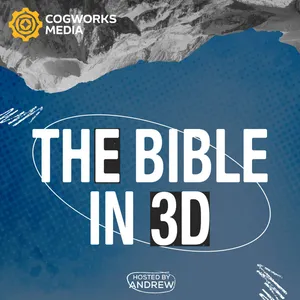
Free Daily Podcast Summary
The Bible in 3D: Daily Summaries Delivered
by Cogworks Media
Join host Andrew, known from Biblical Reflections, on "The Bible in 3D," where we delve into the depths of Scripture through captivating stories and narratives, blending scholarly insights with conversational warmth to illuminate what God's Word truly teaches believers at every stage of their faith journey. Produced by Cogworks Creative Media Company, this non-profit series invites you to discover transformative understanding—explore more at cogworksmedia.org.
Latest Episodes
The most recent episodes — sign up to get AI-powered summaries of each one.
- 5 days ago25 min
Matthew 13: The Hinge, Part 1 — Why Jesus Turned to Parables
Before the series on Moses begins in the new year, The Bible in 3D bridges the holidays with a short series on one chapter: Matthew 13, the hinge on which the gospel of Matthew turns. In Part 1, Andrew sets the stage by asking why Jesus suddenly changes how He teaches.**Matthew, the hinge.** Matthew was one of the Twelve, a former tax collector, writing to Jews living outside Israel. The Old Testament leaves its readers waiting for a Messiah, and Matthew writes as an eyewitness to say that the wait is over, citing prophecy after prophecy fulfilled in Jesus of Nazareth. For twelve chapters, Jesus teaches the crowds directly, beginning with the Sermon on the Mount, presenting Himself as King and announcing that the kingdom of heaven is here.**What happened in chapter 12.** Jesus clashes with the Pharisees over the Sabbath, first over grain picked in the fields and then over healing a man with a withered hand. When He heals a blind and mute man, the crowds ask, "Can this be the Son of David?" Rather than lose their position, the Pharisees claim He works by the power of Beelzebul. Jesus warns them about blasphemy against the Spirit, calls that generation evil and adulterous, offers them only the sign of Jonah, and names those who do the Father's will as His true family. The people follow their leaders and walk away.**The turn.** In chapter 13, Jesus sits in a boat and speaks to the crowd in parables, and from then on He teaches the public only in parables. A parable, from the Greek for "to throw alongside," explains a deeper truth by comparison. The disciples ask why, and Jesus answers that the secrets of the kingdom have been given to them but not to those who see without perceiving, as Isaiah prophesied. He explains the first two parables, giving us the tools to understand the rest.The seven parables of Matthew 13 describe the age we live in now. Next time: the parable of the sower, or better, the parable of the four soils.Part 1 of Matthew 13: The Hinge, a short bridge series on The Bible in 3D.The Bible in 3D is a Christ-centered Bible teaching podcast from Cogworks Media, hosted by Andrew. Find more shows and ways to give at cogworksmedia.org. Cogworks Media is a 501(c)(3) public charity, and gifts are tax-deductible.Music: The Epic Hero by Keys of Moon | https://soundcloud.com/keysofmoonAttribution 4.0 International (CC BY 4.0) | https://creativecommons.org/licenses/by/4.0/Music promoted by https://www.chosic.com/free-music/all/
- 1 weeks ago32 min
Thanksgiving Special: The Deep Roots of Giving Thanks
Today Thanksgiving means family, a lot of food, football, and maybe an argument at the table. But Thanksgiving is a civic holiday with a foundation older than any of that: thanking God. In this special episode, Andrew traces where the holiday really comes from.**The law of Moses.** People have always brought offerings to their gods, sometimes to appease them and sometimes to say thank you. Under the law of Moses, Israel brought sacrifices to cover sin and also to give thanks for a harvest or a child. Part of the offering went to God, part to the priest, and part came back to the worshiper, who celebrated with a feast.**Medieval feast days.** The medieval church gave saints feast days, often paid for by wealthy patrons or trade guilds as an act of penance. For the poor, those feasts were a lifeline in hard times. They also became known for drunkenness and immorality, and the Reformers replaced them with days of prayer and fasting, followed by a shared meal of thanksgiving.**The Pilgrims.** The Separatists crossed the Atlantic on the Mayflower and landed at Cape Cod in November 1620. Many died that first winter. With help from the Wampanoag, who were seeking allies against the Narragansett, they brought in a harvest, and in 1621 they held a feast of thanks to God that the Wampanoag joined. Andrew also sets the record straight on King Philip's War fifty years later, when Native nations and colonists fought on both sides.**A nation gives thanks.** England declared a day of thanksgiving after defeating the Spanish Armada in 1588. Washington and the governors called for days of thanksgiving during the Revolution, and after Gettysburg, Lincoln proclaimed a national day of Thanksgiving in 1863. Later, FDR moved the date to give shoppers more time before Christmas.The common thread is giving thanks to God for bringing us through hard times. So this year, at some point around the table, let someone thank God for your blessings, whatever your situation.A Thanksgiving special from The Bible in 3D.The Bible in 3D is a Christ-centered Bible teaching podcast from Cogworks Media, hosted by Andrew. Find more shows and ways to give at cogworksmedia.org. Cogworks Media is a 501(c)(3) public charity, and gifts are tax-deductible.Music: The Epic Hero by Keys of Moon | https://soundcloud.com/keysofmoonAttribution 4.0 International (CC BY 4.0) | https://creativecommons.org/licenses/by/4.0/Music promoted by https://www.chosic.com/free-music/all/
- 2 weeks ago17 min
Covenants and Promises, Part 2: The Old Covenant, the New, and Israel Today
If the covenant of Moses is no longer in effect, is God finished with the Jewish people? And does His plan for Israel mean Christians owe unconditional support to the modern state of Israel? In Part 2, Andrew sets the Mosaic covenant beside the new covenant and the covenant with Abraham to answer both questions from Scripture.**The Mosaic covenant.** Made with Israel through Moses at Sinai, it was conditional: blessing for obedience and curses for disobedience. It was never meant to be permanent. No one could keep it except Jesus Christ, and it pointed forward to Him.**The new covenant.** Jeremiah foretold it centuries before Christ (Jeremiah 31:31–32), and Jesus inaugurated it at the Last Supper: "This cup is the new covenant in my blood" (Luke 22:20). Hebrews explains that the old covenant is now obsolete and its sacrifices were a shadow of the reality, Christ. On the cross He said, "It is finished." Salvation is offered to Jews and Gentiles alike through the one mediator, Jesus Christ.**God is not done with Israel.** Daniel 9 decrees seventy weeks for "your people and your holy city." Sixty-nine have passed, and the seventieth is still to come, a time when God turns His focus back to Israel and leads to their recognizing Jesus as Messiah. Paul confirms it in Romans 11: God has not rejected His people, a partial hardening has come until the fullness of the Gentiles comes in, and His gifts and calling are irrevocable.**What that does and doesn't mean.** Andrew rejects replacement theology, the idea that the church has permanently replaced Israel in God's plan. But the promises were made to a covenant people, and the modern political state is not in covenant with God, so Scripture gives no command of unconditional political support. What it does command: pray for the peace of Jerusalem and the salvation of the Jewish people, and reject antisemitism.He closes with a word on Christians who choose to observe parts of the law of Moses. There's no requirement to, but a Messianic Passover can deepen our understanding of sacrifice and the new covenant.This concludes the two-part look at Old Testament covenants and promises.Part of the Hot Topics series on The Bible in 3D.The Bible in 3D is a Christ-centered Bible teaching podcast from Cogworks Media, hosted by Andrew. Find more shows and ways to give at cogworksmedia.org. Cogworks Media is a 501(c)(3) public charity, and gifts are tax-deductible.Music: The Epic Hero by Keys of Moon | https://soundcloud.com/keysofmoonAttribution 4.0 International (CC BY 4.0) | https://creativecommons.org/licenses/by/4.0/Music promoted by https://www.chosic.com/free-music/all/
- 3 weeks ago40 min
Covenants and Promises, Part 1: Escaping the Covenant
The covenants and promises of the Old Testament were made thousands of years ago, yet they sit underneath what is happening in the Middle East today. Andrew opens this two-part Hot Topics study with a pattern he has seen many times: people who leave the faith they grew up in, and the few who feel guilty about it and go on to attack it. He then looks at three ways Jewish thinkers tried to argue their way out from under the covenant of Moses, with its blessings and curses.**Sigmund Freud.** Near the end of his life, the father of psychoanalysis claimed that Moses was really a priest of the Aten, the single god of the pharaoh Akhenaten. Andrew tells the story of Akhenaten, his abandoned capital at Amarna, Nefertiti, and the boy king Tutankhamun, and points out the problem with Freud's theory: later pharaohs erased Akhenaten so completely that a century later no one would have known what to borrow from him.**Immanuel Velikovsky.** Velikovsky granted that Moses existed but not that God did. In Worlds in Collision he argued that a body thrown off by Jupiter, which later became Venus, passed close to the earth and caused the plagues and the parting of the sea.**Arthur Koestler and Shlomo Sand.** The third approach questions descent itself. Sand, a historian at Tel Aviv University, challenged the idea of a mass exile after the Bar Kokhba revolt. Koestler's The Thirteenth Tribe argued that Ashkenazi Jews descend from the converted Khazar kingdom. If you are not descended from those who swore to the covenant, the argument goes, it doesn't bind you.**The covenant with Abraham.** Andrew sees the Mosaic covenant as temporary and fulfilled in Christ, but the covenant with Abraham in Genesis 12, 15 and 17 as everlasting, and that includes the promise of land from the Nile to the Euphrates. Who are Abraham's descendants, and what does that covenant mean today? Those questions are why this is still a hot topic.Next time: how Christians should evaluate the covenants with Abraham and Moses, and what, if anything, we owe the modern state of Israel.Part of the Hot Topics series on The Bible in 3D.The Bible in 3D is a Christ-centered Bible teaching podcast from Cogworks Media, hosted by Andrew. Find more shows and ways to give at cogworksmedia.org. Cogworks Media is a 501(c)(3) public charity, and gifts are tax-deductible.Music: The Epic Hero by Keys of Moon | https://soundcloud.com/keysofmoonAttribution 4.0 International (CC BY 4.0) | https://creativecommons.org/licenses/by/4.0/Music promoted by https://www.chosic.com/free-music/all/
- Oct 15, 202621 min
Revelation, Part 4: Babylon, the Great White Throne, and What Jesus Said
Who is the great prostitute riding the scarlet beast? In the final part of the series, Andrew follows one of Revelation's most shifting symbols to its end, then steps back to the great white throne, the new creation, and what Jesus Himself told His disciples about His return.**The great prostitute and the scarlet beast.** In Revelation 17–18 the woman is first a great prostitute, then Babylon the Great, then the one who sits on seven hills, the familiar description of Rome. Yet when she falls in chapter 18, she looks like a great port city, and everyone weeping over her is involved in commerce. Andrew suggests the change is deliberate: the prostitute is the economic system, and it sits on top of Satan, who has ruled through one great commercial city after another. In the end, all of it comes down.**The end of the story.** Chapter 19 brings the wedding feast of the Lamb and Christ's return on a white horse. In chapter 20 Satan is bound for a thousand years, the beasts are thrown into the lake of fire, and after one final rebellion with Gog and Magog, Satan follows them. Then comes the great white throne, where earth and sky flee away and nothing is left to rebuild. Those who are not saved must give an account before the living God.**The good news.** The saved stand instead before the judgment seat of Christ, where rewards are given for faithfulness (2 Corinthians 5:10; 1 Corinthians 3:10–15). Then God makes a new heaven and a new earth, and His people dwell forever in the New Jerusalem.**What Jesus said.** In the Olivet Discourse (Matthew 24–25), the disciples ask three questions on the Mount of Olives. From Jesus' answers, Andrew draws seven points: Jesus is coming again; no one knows when; we are to watch faithfully; His coming will be unmistakable to everyone; believers will be evaluated for rewards; the wicked will be judged before the great white throne; and a seventh, more disputed question about what the world will be like when He comes and how we should prepare.That last question isn't settled by any chart or date. It comes down to how we use what God has entrusted to us, so that we hear Him say, "Well done, good and faithful servant."This concludes the four-part series on Revelation.The Bible in 3D is a Christ-centered Bible teaching podcast from Cogworks Media, hosted by Andrew. Find more shows and ways to give at cogworksmedia.org. Cogworks Media is a 501(c)(3) public charity, and gifts are tax-deductible.Music: The Epic Hero by Keys of Moon | https://soundcloud.com/keysofmoonAttribution 4.0 International (CC BY 4.0) | https://creativecommons.org/licenses/by/4.0/Music promoted by https://www.chosic.com/free-music/all/
- Oct 8, 202631 min
Revelation, Part 3: Recapitulation and Repetition
Seven seals, seven trumpets, seven bowls. Are there 21 separate judgments in Revelation, or seven judgments told three times? In Part 3, Andrew turns from how we read Revelation to the shape of the narrative itself.The cycle of threes. Semitic writers often say the same thing three times, adding or stripping away detail with each pass. In Job, Eliphaz, Bildad, and Zophar make their case in three rounds, each shorter and weaker until Zophar doesn't speak at all, showing that their argument collapses. Peter's vision of the sheet comes three times before he goes to the house of Cornelius. Jesus says "love your enemies" three ways in Luke 6.Seals, trumpets, and bowls. Read this way, the three sets of judgments are the same seven seen from different angles, growing worse each time: a fourth of the earth, then a third, then "It is done." That's why the mountains and islands can flee more than once, and why the battle at Armageddon in chapter 16 and the rider on the white horse in chapter 19 may be one battle told twice.The interludes. Between the judgments come words of encouragement. When the mighty hide in caves asking "who can stand?", chapter 7 answers with the 144,000 and a great multitude from every nation. Chapters 10 and 11 bring the little scroll and the two witnesses, raised after three and a half days. Andrew connects the seven-sealed scroll of chapter 5 to the book Daniel was told to seal until the end.The spiritual battle. Chapters 12–13 show the dragon, the beast of the sea, and the beast of the land, and the mark of the beast. No one knows for certain what 666 means, but the mark can only be taken willingly, and the angels of chapter 14 warn: don't take it.Like Daniel's visions, Revelation was written to give hope. Terrible times are coming, but God's people will come out on the other side.Part 3 of a four-episode series on Revelation.—The Bible in 3D is a Christ-centered Bible teaching podcast from Cogworks Media, hosted by Andrew.▶ Subscribe for teaching that takes Scripture seriously🔗 More shows and ways to give: cogworksmedia.orgCogworks Media is a 501(c)(3) public charity — gifts are tax-deductible.Music: The Epic Hero by Keys of Moon | https://soundcloud.com/keysofmoonAttribution 4.0 International (CC BY 4.0) | https://creativecommons.org/licenses/by/4.0/Music promoted by https://www.chosic.com/free-music/all/
- Oct 1, 202628 min
Revelation, Part 2: Schools of Interpretation and the Sequence of Events
What you get out of Revelation depends on which school of interpretation you follow, and once you buy into one, it colors every symbol you read. In Part 2, Andrew lays out the four recognized schools and then turns to sequencing: where the millennium, the tribulation, and the rapture fall.The idealist school. Revelation as allegory, a moral story about persecution and God's final victory, much like Aesop's fables. Andrew reads Revelation 20:1–6 and asks whether the thousand years is real or symbolic. He also notes that the final battle with Gog and Magog comes after the millennium, not at Armageddon.The historicist school. Revelation as a symbolic preview of church history. From Martin Luther placing the Reformation in its pages to missionaries in 1930s Germany who were sure Hitler was the beast, every generation finds itself in the book, and every generation has been wrong so far.The preterist school. Everything, or nearly everything, in Revelation has already happened. Its strongest argument is Revelation 1:1, "the things that must soon take place," and Nero is its usual Antichrist.The futurist school. Chapter 1 is the prologue, chapters 2–3 are messages to seven churches that still apply today, chapters 4–21 are still to come, and chapter 22 is the epilogue.The millennium. Premillennial, postmillennial, and amillennial views, and why a plain reading of Revelation 20 points to Christ returning bodily to reign on the earth.The tribulation. The idea goes back to Daniel 9 and the seventy sevens: a 490-year clock that pauses when the Anointed One is cut off after 483 years. Paul's words in Romans 11 about the full number of the Gentiles fit with that pause. The final seven years restart the clock, and the worst of it comes in the last three and a half.The rapture. It isn't in Revelation at all. Andrew covers 1 Thessalonians 4:16–17, why the Thessalonians feared they'd been left behind, and the pre-, mid-, and post-tribulation positions.The point isn't to win the sequencing argument. Christ is coming again, and our faith and trust belong in Him.Part 2 of a four-episode series on Revelation.—The Bible in 3D is a Christ-centered Bible teaching podcast from Cogworks Media, hosted by Andrew.▶ Subscribe for teaching that takes Scripture seriously🔗 More shows and ways to give: cogworksmedia.orgCogworks Media is a 501(c)(3) public charity — gifts are tax-deductible.Music: The Epic Hero by Keys of Moon | https://soundcloud.com/keysofmoonAttribution 4.0 International (CC BY 4.0) | https://creativecommons.org/licenses/by/4.0/Music promoted by https://www.chosic.com/free-music/all/
- Sep 24, 202653 min
Revelation, Part 1: It Is All in the Symbols
There is no shortage of material on Revelation, and most of it offers to tell you the timing, the world players, and the geopolitics of the end. It's often entertaining and it always leaves us unsatisfied — Jesus himself said no one knows the timing of his return. So this four-part series takes a different approach: Revelation as great literature, and the literary challenges of studying it.Foreword and Introduction. Revelation means to unveil or disclose; the Greek behind it gives us "apocalypse," which we have since narrowed to mean the end of the world. John received the vision on Patmos around AD 96, exiled under Domitian, ninety miles from the coast of what is now Turkey — a date confirmed by Irenaeus, a second-generation disciple of John himself. Sixty-three years earlier, John had leaned against Jesus at the Last Supper. Now, an old man, he falls down as though dead. Chapter 1:19 sets the structure for everything that follows: the things you have seen, the things that are, and the things that are to take place after this. Chapters 2–3 are the things that are — Christ's messages to seven churches, six of them planted out from Ephesus. Chapters 4–22 are the things to come, opening with the throne room and the scroll that only the Lion of Judah, the Lamb who was slain, is worthy to open.Part 1 — The medium of communication. Scripture uses prose, poetry, types, and symbols. John uses symbols, and almost everything in Revelation is one. The other book that works this way is Daniel — Nebuchadnezzar's dreams, the four beasts — which is why the Old Testament is the best available key. When the sea appears, it stands for the Gentile nations; when the land appears, it points to Israel. That is how the two beasts of chapter 13 come into focus.Part 2 — Secondary gain. Borrowed from medicine, "secondary gain" names the hidden advantages a person gets from a condition. Scholars and churchmen carry their own, consciously or not, and nowhere do they show more than in Revelation. Andrew works through chapter 12 — the woman clothed with the sun, the dragon, the male child — and shows how Joseph's dream in Genesis identifies the woman as Israel, and how traditions committed to the view that God is finished with the Jews must read her as something else. The same pressure appears again over the 144,000 and the great multitude in chapter 7.The takeaway for the reader: know what biases you, and your church, bring to the table, because they will determine what you get out of this book.And one command to carry regardless of where you land on any of it: do not take the mark of the beast, and do not worship the beast.Next episode: the schools of interpretation.—The Bible in 3D is a Christ-centered Bible teaching podcast from Cogworks Media, hosted by Andrew.🔗 More shows and ways to give: cogworksmedia.orgCogworks Media is a 501(c)(3) public charity — gifts are tax-deductible.Music: The Epic Hero by Keys of Moon | https://soundcloud.com/keysofmoonAttribution 4.0 International (CC BY 4.0) | https://creativecommons.org/licenses/by/4.0/Music promoted by https://www.chosic.com/free-music/all/
Get The Bible in 3D summaries in your inbox
Free AI-powered daily recaps. Key takeaways, quotes, and mentions — in a 5-minute read.
Get Free Summaries →Free forever for up to 3 podcasts. No credit card required.
You Might Also Like
Listeners also like.

The Bible Recap Deep Dive
Explores key biblical themes and answers listener questions from The Bible Recap's weekly reading plan.
Bible Mysteries
Explores hidden meanings in the Bible to reveal insights about the modern world.

BibleProject
Explores the Bible and theological concepts through detailed discussions that complement animated video content.

Kids Bible Stories
Bible stories for children brought to life with sound and playful voices to help them connect faith to daily life.
The Scriptures Are Real
Examines the Book of Mormon and LDS scriptures through historical, archaeological, and personal perspectives.
The Ten Minute Bible Hour Podcast
A daily breakdown of Bible books, one passage at a time, with concise explanations and a conversational tone.

The Bible in a Year (with Fr. Mike Schmitz)
Fr. Mike Schmitz provides daily commentary and prayer while guiding listeners through the entire Bible in a year.

Data Over Dogma
A Bible scholar and an atheist podcaster examine the Bible’s content, misconceptions, and historical impact.

The Holy Post
Phil Vischer and Skye Jethani discuss pop culture, media, and theology from a Christian perspective in a post-Christian world.
Kids Bible in a Year with Julia Jeffress Sadler
iHeartPodcasts and Pray.com
Ten Minute Bible Talks Devotional Bible Study
A daily devotional exploring one Bible passage with practical insights for everyday life.

The Bible For Normal People
A weekly podcast discussing the Bible with hosts Peter Enns and Jared Byas.
About The Bible in 3D
Join host Andrew, known from Biblical Reflections, on "The Bible in 3D," where we delve into the depths of Scripture through captivating stories and narratives, blending scholarly insights with conversational warmth to illuminate what God's Word truly teaches believers at every stage of their faith journey. Produced by Cogworks Creative Media Company, this non-profit series invites you to discover transformative understanding—explore more at cogworksmedia.org.
Customized Recaps
AI-powered recaps with compact key takeaways, quotes, and insights.
Straight to Your Inbox
Get key takeaways from The Bible in 3D in a 5-minute read.
Save Hours Every Week
Stay current on your favorite podcasts without falling behind.
Frequently Asked Questions
What is Podzilla's The Bible in 3D daily summary?
It's a free AI-powered email that summarizes new episodes of The Bible in 3D as soon as they're published. You get the key takeaways, notable quotes, and links & mentions — all in a quick read.
How does the The Bible in 3D podcast summary work?
When a new episode drops, our AI transcribes and analyzes it, then generates a personalized summary tailored to your interests and profession. It's delivered to your inbox every morning.
Is this an official The Bible in 3D product?
No. Podzilla is an independent service that summarizes publicly available podcast content. We're not affiliated with or endorsed by Cogworks Media.
Can I get summaries of other podcasts too?
Absolutely! The free plan covers up to 3 podcasts, any in the catalog. Basic raises that to 15, Pro to 40 and Max to 100. Browse our full catalog at /podcasts.
How often does The Bible in 3D release new episodes?
The Bible in 3D publishes weekly. Our AI generates a summary within hours of each new episode.
What topics does The Bible in 3D cover?
The Bible in 3D covers topics including Religion & Spirituality, Spirituality, Christianity. Our AI identifies the specific themes in each episode and highlights what matters most to you.
Start getting The Bible in 3D summaries tomorrow morning.
Free forever for up to 3 podcasts. No credit card required.
Free forever for up to 3 podcasts. No credit card required.