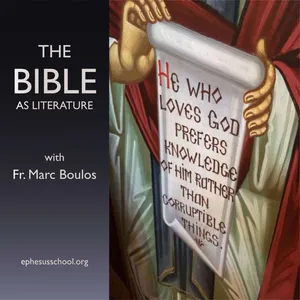
Free Daily Podcast Summary
The Bible as Literature: Daily Summaries Delivered
by The Ephesus School
Each week, Fr. Marc Boulos discusses the content of the Bible as literature. On Tuesdays, Fr. Paul Tarazi presents an in-depth analysis of the biblical text in the original languages.
Latest Episodes
The most recent episodes — sign up to get AI-powered summaries of each one.
- 2 days ago27 min
Reference and Function: Semitic Roots and Chinese Characters
Do Chinese characters work the way Semitic roots do? Fr. Marc Boulos talks with Matthew Franklin Cooper about his comparative lexicography of Chinese, Hebrew and Arabic, and about how the Bible traveled east along the roads of Asia.Matthew Franklin Cooper is the author of two commentaries on the Gospel of John and of the two-volume Jiè Jīng Shuō Wén: A Comparative Sinitic-Semitic Lexicography, with a third volume under way. The study began with a footnote on the Chinese character dào and a word of encouragement from Fr. Paul Nadim Tarazi. In this conversation he explains how each character in the five Chinese classics functions much like a Semitic triliteral root, how Michael Rostovtzeff traced Mesopotamian art across Central Asia into China, and why words such as tiān (heaven) and the Hebrew and Arabic terms for the heights may share more than a chance likeness. Fr. Marc and Matthew then turn to Alopen, the Syriac-speaking monk who carried the Peshitta to the Tang court and set Isaiah and the Gospel of John before a Chinese audience in Buddhist terms, and to what that work has in common with ikhlāṣ in the Qurʾan, with usia in the Gospel of Luke, and with the scriptural critique of theosis, Sufi "Neoplatonism" and the project of the self. Two terms hold the conversation together: reference and function.CHAPTERS0:00 Introducing Matthew Franklin Cooper2:20 A footnote on the Chinese character dào4:00 The five classics as a Chinese canon5:06 Chinese characters and the Semitic triliteral root6:25 Rostovtzeff and the land routes of Central Asia8:31 The khamsa, heaven and the heights10:39 The odes and the Pauline household12:41 Alopen carries the Peshitta to China14:14 Isaiah and John in Buddhist terms16:10 Logos as a poison pill17:32 Ikhlāṣ: the same teaching18:02 Reference and function19:49 Theosis and the project of the self22:09 The Sufis, Tibet, and "you and I are not him"24:19 Where the Taoists went wrong25:56 Matthew's books and where to find themBOOKS MENTIONEDMatthew Franklin Cooper, The Lamb Before Its Shearers: https://www.ocabspress.org/news/2025/5/31/the-lamb-before-its-shearersMatthew Franklin Cooper, In the Houses of the Poor: https://www.ocabspress.org/news/2025/10/18/in-the-houses-of-the-poor-by-matthew-franklin-cooperMatthew Franklin Cooper, Jiè Jīng Shuō Wén: A Comparative Sinitic-Semitic Lexicography, Volume One: https://www.ocabspress.org/news/2025/12/20/jie-jing-shuo-wen-a-comparative-sinitic-semitic-lexicography-volume-one-by-matthew-franklin-cooperVolume Two: https://www.ocabspress.org/news/2026/10/19/jie-jing-shuo-wen-a-comparative-sinitic-semitic-lexicography-volume-two-by-matthew-franklin-cooperMatthew Franklin Cooper, The Madness of the Shepherd: https://www.ocabspress.org/news/2026/3/1/the-madness-of-the-shepherd-by-matthew-franklin-cooperIbn Janāḥ, Kitāb al-Uṣūl, edited by Blaise Webster and Marc Philip Boulos: https://www.ocabspress.org/news/2026/10/11/kitab-al-usul-edited-by-blaise-webster-and-marc-philip-boulosMichael Rostovtzeff, Iranians and Greeks in South Russia (1922): https://archive.org/details/cu31924028575060WEBSITES MENTIONEDOCABS: https://ocabs.orgThe Ephesus School Network: https://ephesusschool.orgThe Voice of the Shepherd (Fr. Marc Boulos): https://marcboulos.substack.comSkeireins (Matthew Franklin Cooper): https://skeireins.substack.comUnto Instruction (Blaise Webster): https://blaisewebster.substack.com#BibleStudy #BibleAndQuran #LexicographySUPPORT THIS WORKThe Bible as Literature is free and made possible by listeners.Patreon: https://patreon.com/bibleListen: https://ephesusschool.orgSubscribe here on YouTube or wherever you listen to podcasts.A production of the Ephesus School Network.Opening music: "Too Cool" by Kevin MacLeod (incompetech.com), licensed under Creative Commons Attribution 4.0. https://creativecommons.org/licenses/by/4.0/ ★ Support this podcast on Patreon ★
- 6 days ago51 min
The Tenth Belongs to God
Deliverance is not for sale.Balak sent the elders of Moab and Midian to Balaam with the fee for divination in their hands. Pharaoh's magicians asked about their reward before they threw down their ropes. A frightened man with money hires someone to do what only the unseeable God is able to do.In Luke 9:40 a father says, "I begged Your disciples to cast it out, and they could not." Fr. Marc Boulos takes the verse one verb at a time. To beg, in Scripture, is to soften a face, and the face is always God's. To cast out is God's own verb, from Eden to Egypt. And "they could not" is Paul's charge against Corinth, a church sorted into Paul, Apollos and Cephas, each party begging its steward for what a steward cannot give.The Torah counts ten blows against Egypt. The Qurʾan counts nine signs. While Jesus is on the mountain with three, nine disciples are left on the plain. The father is walked past nine doors that will not open, so that he arrives at the tenth with his pockets turned inside out.Hebrew, Greek and Arabic terms, triliteral roots and scripture quotations appear on screen as they are discussed.SCRIPTURE DISCUSSEDLuke 9:1, 9:40–42 · Numbers 22:6–7 · Exodus 33:19 · 1 Samuel 13:12 · Genesis 3:24, 45:5–11 · Jeremiah 2:13 · Daniel 2:10, 5:8 · 1 Corinthians 1:12–13, 3:1–2, 4:7 · Galatians 4:30 · 1 Chronicles 29:14Qurʾan: Sūrat al-Aʿrāf 7:113–114, 7:128, 7:137 · Sūrat Maryam 19:13 · Sūrat Āl ʿImrān 3:159–160 · Sūrat Yūsuf 12:67, 12:88 · Sūrat al-Anbiyāʾ 21:105SUPPORT THIS WORKThe Bible as Literature is free and made possible by listeners.Patreon: https://patreon.com/bibleListen: https://ephesusschool.orgSubscribe here on YouTube or wherever you listen to podcasts.A production of the Ephesus School Network.Opening music: "Too Cool" by Kevin MacLeod (incompetech.com), licensed under Creative Commons Attribution 4.0. https://creativecommons.org/licenses/by/4.0/ ★ Support this podcast on Patreon ★
- 3 weeks ago36 min
The Illusion of Choice
This week the Bible as Literature podcast steps outside its usual format. Fr. Marc Boulos sits down with two parishioners of St. Elizabeth: Bethany Saros, former parish council president, and Carter Grenz. Bethany describes leaving the church, trying other paths, and coming back once she read the Gospels straight through and found she had run out of options. Carter, who grew up non-religious and came to Christianity through evangelical churches, recounts how Fr. Paul Nadim Tarazi’s work dismantled the sectarian and nationalist assumptions he had absorbed there. ★ Support this podcast on Patreon ★
- Oct 8, 202658 min
Crossing into Judgment
Fr. Marc Boulos presents "Crossing into Judgment: The ʿIbri, the ʿArabah, and the Philological Manufacture of an Ethnos" at the 2026 OCABS Symposium, held October 2–3, 2026, at St. Elizabeth Orthodox Church in St. Paul, Minnesota. Drawn from his forthcoming book Man of Letters, the sequel to The Eucharist: A Grammar of Thanksgiving, the talk hears the Abrahamic text on its own terms: as a scripture that stands against Plato, against Homer, and against Odysseus. The 2026 OCABS Symposium gathered speakers in person and online around a single theme: Scripture, Bible and Qurʾan, heard on its own terms. ★ Support this podcast on Patreon ★
- Oct 6, 20261h 35m
The Scriptural Canon
Fr. Paul Nadim Tarazi's final public presentation, "The Scriptural Canon," delivered as the keynote address at the 2026 OCABS Symposium, held Saturday, October 3, 2026, at St. Elizabeth Orthodox Church in St. Paul, MN. ★ Support this podcast on Patreon ★
- Sep 7, 202651 min
You Are Not the Subject
In Episode 590, Father Marc Boulos examines Luke 9:39 through Ezekiel, 3 Maccabees, and the linguistic connections between Greek, Hebrew, and Arabic. He challenges modern ideas of choice, agency, and the “pursuit of happiness,” showing how Scripture presents God—not the human being—as the true subject and actor. ★ Support this podcast on Patreon ★
- Aug 22, 20261h 8m
Look Upon My Son
غ ن يAcademic institutions, like religious institutions, are metropolitan in nature, gathering where the Scriptural God scatters. They are the elephant whose snout hoards knowledge for the tyrants of the earth like the Egyptian scribes (Genesis 41:8), inscribing their will with an iron stylus on the foreskins of human hearts, concealing them from God (The Eucharist, 270).The psychē (ψυχή) fights against God by clinging to the sarx (σάρξ), desperately struggling to shut out the pneuma (πνεῦμα) with all its might, concealing the uncircumcised heart from the Almighty God under cover of the circumcision of human institutions.Oh yes, Hellenists love the psyche. It’s what they “turn” (to) and in, epistrephein (ἐπιστρέφειν, Corinthians 3:16), away from him, spinning as they spin their rejection of the sufficiency of God. It’s the source of all they talk about on their podcasts. They gather it up in their communities to meditate on it and its endless crisis of “loneliness.” (2 Timothy 3:2–4) “If only they knew.” (Qurʾan, Sūrat al-ʿAnkabūt سورة العنكبوت “The Spider” 29:64)But God, in his sufficiency, is all seeing and all knowing, and their schemes will fail.Each moment in life, each kairos, each encounter with the unseen God in the crossing of neighbors in the ʿarabah terrifies the human institution, because the crossing presents each living, breathing soul with a divine uncovering, and the possibility of a revelation: we do not need the institutions.We never did.It’s ironic. The academy will insist it exists to question, to challenge and to tear down, but of its nature a building is incapable of the apostle’s turning in his withering, let alone the prophet’s birth-pains. Yes, they critique, but not to tear down, one stone from another.No.They critique in order to build their artificial mother. Their blasphemous alma mater.“Because they disbelieved and uttered terrible slander against Mary.” (Qurʾan, Sūrat al-Nisāʾ سورة النساء “The Women” 4:156)Yet, “God is not mocked” (Galatians 6:7), for everyone knows that milk sweetened with chemicals is toxic.Well, not everyone.Against them, and all who are like them, the Abrahamic scriptures neither build nor synthesize. They present no dogma. People who “read” them do, of course. That’s how we end up with buildings and tribes, which all three scrolls summarily condemn.Instead, what these texts offer is a method for hearing and seeing in daily living, so that each of us can hear how to walk our path in this life.Indeed, God, who is the source of all knowledge, has assigned a path for each of us, and this life is your test. Only you can hear and see what he has presented for you to understand, for your sake. It is your test. On that day, you have no advocate but yourself and no recourse but him.The sooner you stop covering your ears and hiding behind your eyes; the sooner you open your heart to his instruction, the better your chance of receiving his gift with empty hands.God has assigned a lesson for you in your brief time on earth, which, as the song says, is as “but a dream.”True knowledge does not come from men. It comes directly from him, and Scripture is a guide on the path through his wilderness. Unlike human institutions which traffic in recycled human words, Scripture offers only the witness—the martyrdom—of the unseen, of the done-unto by God, who stand by you on the path, bearing witness to your witness to his divine words.And the words are signs along that path to help you find your way, as you uncover the test he has prepared for you, which is yours and yours alone.The Bible was not written to establish anything. It was written to keep the path open, for your sake, so that nothing would ever stand in between you and God on the path, before the time, until the time he shall judge the living and the dead; and of his kingdom, there shall be no end.This week, I discuss Luke 9:38 ★ Support this podcast on Patreon ★
- Aug 10, 202643 min
Light upon Light
In episode 588, Fr. Marc hears the mashal of the Transfiguration as a warning against attempting to control what God gives freely. The Arabic root ش-ي-ع (shīn–yāʾ–ʿayn) spreads light naturally shedding itself without the inevitable fracture it finds in human hands. Peter's ploy to "make" tents for the prophets is a poor attempt to turn the gift of light into property. But the light, like rain, is lost the moment the human hands close around it. ★ Support this podcast on Patreon ★
Get The Bible as Literature summaries in your inbox
Free AI-powered daily recaps. Key takeaways, quotes, and mentions — in a 5-minute read.
Get Free Summaries →Free forever for up to 3 podcasts. No credit card required.
You Might Also Like
Listeners also like.

The Bible For Normal People
A weekly podcast discussing the Bible with hosts Peter Enns and Jared Byas.

Bible Book Club
Two hosts read, discuss, and explore each book of the Bible in sequential seasons, guiding listeners through scripture.
The BEMA Podcast
Examines the Bible through historical context to challenge and reshape common interpretations.

Literature and History
Explores world literature from ancient Sumer to early Islam, with summaries, analysis, and original music.
The Bible in a Year (with Fr. Mike Schmitz)
Fr. Mike Schmitz provides daily commentary and prayer while guiding listeners through the entire Bible in a year.

PROCLAIM x BIBLEin365
A daily Bible reading podcast with book backgrounds to help listeners understand Scripture and grow in faith.
The Bible Recap Deep Dive
Explores key biblical themes and answers listener questions from The Bible Recap's weekly reading plan.
Data Over Dogma
A Bible scholar and an atheist podcaster examine the Bible’s content, misconceptions, and historical impact.

The Literary Life Podcast
Three readers discuss classic literature, reading practices, and the role of stories in intellectual and spiritual life.
BibleProject
Explores the Bible and theological concepts through detailed discussions that complement animated video content.
The Ten Minute Bible Hour Podcast
A daily breakdown of Bible books, one passage at a time, with concise explanations and a conversational tone.

Biblical Time Machine
Two hosts explore the historical context of biblical people, places, and events from the Old and New Testaments.
About The Bible as Literature
Each week, Fr. Marc Boulos discusses the content of the Bible as literature. On Tuesdays, Fr. Paul Tarazi presents an in-depth analysis of the biblical text in the original languages.
Customized Recaps
AI-powered recaps with compact key takeaways, quotes, and insights.
Straight to Your Inbox
Get key takeaways from The Bible as Literature in a 5-minute read.
Save Hours Every Week
Stay current on your favorite podcasts without falling behind.
Frequently Asked Questions
What is Podzilla's The Bible as Literature daily summary?
It's a free AI-powered email that summarizes new episodes of The Bible as Literature as soon as they're published. You get the key takeaways, notable quotes, and links & mentions — all in a quick read.
How does the The Bible as Literature podcast summary work?
When a new episode drops, our AI transcribes and analyzes it, then generates a personalized summary tailored to your interests and profession. It's delivered to your inbox every morning.
Is this an official The Bible as Literature product?
No. Podzilla is an independent service that summarizes publicly available podcast content. We're not affiliated with or endorsed by The Ephesus School.
Can I get summaries of other podcasts too?
Absolutely! The free plan covers up to 3 podcasts, any in the catalog. Basic raises that to 15, Pro to 40 and Max to 100. Browse our full catalog at /podcasts.
How often does The Bible as Literature release new episodes?
The Bible as Literature publishes biweekly. Our AI generates a summary within hours of each new episode.
What topics does The Bible as Literature cover?
The Bible as Literature covers topics including Education, Religion & Spirituality, Spirituality, Christianity. Our AI identifies the specific themes in each episode and highlights what matters most to you.
Start getting The Bible as Literature summaries tomorrow morning.
Free forever for up to 3 podcasts. No credit card required.
Free forever for up to 3 podcasts. No credit card required.