Free Daily Podcast Summary
The BaseCamp Community Podcast: Daily Summaries Delivered
by BaseCamp Endurance Coaching
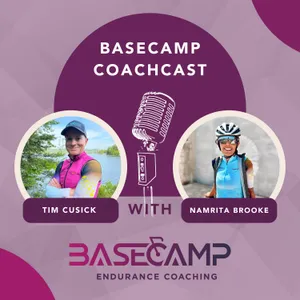
Welcome to the BaseCamp Community endurance coaching podcast! Each episode will feature timely topics related to training and nutrition strategies that you can apply to get the most out of your season. Check out BaseCamp’s coaching, community training programs and camps over at joinbasecamp.com.
Latest Episodes
The most recent episodes — sign up to get AI-powered summaries of each one.
- 1 weeks ago1h 5m
Transition for the Ages: Why Restoration Should Change as Cyclists Get Older
The cycling season may be over, but that does not mean training should stop completely; especially as we get older.In this episode, Head Coaches Tim Cusick and Dr. Namrita Brooke explore how the transition period should evolve with age. They explain why younger cyclists may benefit from a longer break, while mature athletes often need a more deliberate shift toward recovery, strength, mobility, and aerobic maintenance.You’ll learn how to reduce fatigue without unnecessary detraining, which physical qualities become more expensive to rebuild with age, and how to use a simple three-phase approach. Unload, Restore, and Rebuild Readiness to arrive at your next training cycle recovered, motivated, and ready to perform.
- 3 weeks ago58 min
Stop Chasing Recovery, Build a Bigger Adaptive Reserve
Athletes are constantly told to recover better. Sleep more. Monitor HRV. Take more rest. Avoid carrying too much fatigue.But what if the real goal is not simply to recover from training? What if it is to build a body capable of absorbing more productive training?Join BaseCamp Head Coaches Tim Cusick and Dr. Namrita Brooke as they introduce the concept of adaptive reserve: the physical, nutritional, and psychological capacity you bring into training that determines how much stress you can tolerate, how effectively you adapt, and how quickly you can train productively again.They explore why recovery and readiness tell only part of the story, how aerobic fitness and consistent fueling can accelerate adaptation, and how to recognize whether your reserve is growing—or quietly being depleted.It is time to stop chasing perfect recovery and start building a bigger adaptive reserve.
- Aug 14, 20261h 9m
Race the Moment: The Art and Science of Dynamic Gravel Pacing
Gravel racing cannot be reduced to one power target or a perfectly paced plan. Success requires a dynamic, multifaceted approach, continually balancing effort, terrain, wind, group position, fueling, durability, and how your body is responding.In this episode, BaseCamp Head Coaches Tim Cusick and Dr. Namrita Brooke explore how to race the field without abandoning your plan. They explain when it makes sense to spend energy to stay with a group, when discipline matters more than tactics, and how to recognize the early signals that it is time to adjust.Whatever grave race you are preparing for, you will learn why the best gravel racers do not simply follow a number, they read the race, manage the moment, and make better decisions before fatigue makes those decisions for them.
- Aug 3, 20261h 11m
Rethinking Masters Training: Age, History, and Untapped Potential
Training after 50 is often defined by the bell curve.We look at what normally happens to athletes as they age, identify the average decline, and begin building expectations around it. Lower aerobic capacity. Slower recovery. Reduced strength. Less performance.Those changes are real, but the average is a poor way to understand the individual athlete standing in front of us.Athletes over 50 may actually be harder to profile than younger athletes because aging magnifies their history. It reveals the accumulated impact of decades of training, inactivity, strength work, injuries, fueling, recovery, stress, and lifestyle choices.We often think age makes athletes more alike because they are all experiencing the effects of aging. What is really happening is that age makes their accumulated differences more visible.Two athletes can both be 55, but one may have 25 years of consistent aerobic development, while the other has only recently begun structured training. One may have protected muscle and strength for decades. The other may never have lifted. One may be carrying old injuries and years of accumulated fatigue, while the other still has a large amount of untapped potential.That is why this episode takes a different look at training after 50.Hosted by BaseCamp Head Coaches Dr. Namrita Brooke and Tim Cusick, we explore why chronological age should not define the program, why training history may tell us more than the birth certificate, and how to identify the runway an athlete still has ahead of them.The goal is not to ignore aging. It is to stop treating the average aging curve as an individual athlete’s destiny.
- Jul 17, 202654 min
Rethinking AI Coaching: Smarter Systems, Missing Context, and the Human Edge
Hosted by Dr. Namrita Brooke and Tim Cusick, this episode explores how artificial intelligence is changing endurance coaching. We look at what AI and AI coaching software already do well, including analyzing data, identifying patterns, evaluating training, and helping design or adjust plans. We also examine the limitations—especially what happens when information is incomplete, context is missing, or AI fills in the gaps with assumptions. Most importantly, we discuss why the future of coaching is not simply human versus artificial intelligence, but expert human coaching made stronger by better tools.Listen to the episode, then leave us a review below and let us know where you think AI fits into the future of endurance coaching.
- Jul 3, 202658 min
When to Let Go of FTP and CTL: Why Fitness Metrics Can Limit Your Performance
FTP and CTL are powerful tools for building fitness; but they are not performance. In this episode, we explore when athletes need to stop chasing bigger numbers and shift their focus toward what actually produces results: fitness, durability, repeatability, and performance skills. Learn why holding on to training-phase metrics for too long can limit your ability to perform when it matters most.
- Jun 19, 202648 min
Why Aren’t You Getting Faster? Tim and Namrita Can Only Pick One Reason
It is one of the questions we hear more than almost any other: “Why am I not getting faster?”In this episode, Head Coaches Tim Cusick and Namrita Brooke take on that question with one simple rule: they can each choose only one reason—and one fix.The result is a fun, honest conversation about training, nutrition and getting fast. They may not completely agree, but they will help you think differently about what is really holding you back—and what you can do about it.
- Jun 5, 20261h 17m
Connected Fitness: Why Better Fitness Comes From Better Integration
Better performance is not built from bike training, nutrition, or strength work in isolation. It comes from how well those pieces work together.In this episode, hosts Dr. Namrita Brooke and Tim Cusick are joined by BaseCamp strength trainer Menachem Brodie to explore durability: the ability to keep producing power, holding form, fueling well, and making good decisions as fatigue builds.Together, they discuss how integrated training helps cyclists become fitter, stronger, and more resilient when it matters most.
About The BaseCamp Community Podcast
Welcome to the BaseCamp Community endurance coaching podcast! Each episode will feature timely topics related to training and nutrition strategies that you can apply to get the most out of your season. Check out BaseCamp’s coaching, community training programs and camps over at joinbasecamp.com.
Customized Recaps
AI-powered recaps with compact key takeaways, quotes, and insights.
Straight to Your Inbox
Get key takeaways from The BaseCamp Community Podcast in a 5-minute read.
Save Hours Every Week
Stay current on your favorite podcasts without falling behind.
Frequently Asked Questions
What is Podzilla's The BaseCamp Community Podcast daily summary?
It's a free AI-powered email that summarizes new episodes of The BaseCamp Community Podcast as soon as they're published. You get the key takeaways, notable quotes, and links & mentions — all in a quick read.
How does the The BaseCamp Community Podcast podcast summary work?
When a new episode drops, our AI transcribes and analyzes it, then generates a personalized summary tailored to your interests and profession. It's delivered to your inbox every morning.
Is this an official The BaseCamp Community Podcast product?
No. Podzilla is an independent service that summarizes publicly available podcast content. We're not affiliated with or endorsed by BaseCamp Endurance Coaching.
Can I get summaries of other podcasts too?
Absolutely! The free plan covers up to 3 podcasts. Upgrade to Pro for 15, or Premium for 50. Browse our full catalog at /podcasts.
How often does The BaseCamp Community Podcast release new episodes?
The BaseCamp Community Podcast publishes monthly. Our AI generates a summary within hours of each new episode.
What topics does The BaseCamp Community Podcast cover?
The BaseCamp Community Podcast covers topics including Sports. Our AI identifies the specific themes in each episode and highlights what matters most to you.
Start getting The BaseCamp Community Podcast summaries tomorrow morning.
Free forever for up to 3 podcasts. No credit card required.
Free forever for up to 3 podcasts. No credit card required.