Free Daily Podcast Summary
The Art of Adventure: Daily Summaries Delivered
by Arthur Beale
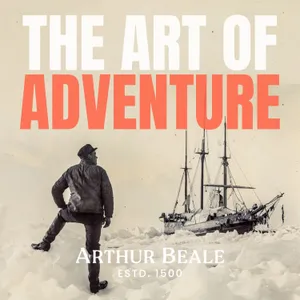
The Art of Adventure is a weekly podcast from Arthur Beale hosted by Hugh Taylor. Each episode dives into one extraordinary journey, from history’s most famous names to overlooked pioneers and modern trailblazers. Along the way, we ask what these stories reveal about the real art of adventure: the preparation, the doubt, the grit, the judgement - and the tiny choices that change everything. New episodes every Wednesday.
Latest Episodes
The most recent episodes — sign up to get AI-powered summaries of each one.
- 5 days ago36 min
The Race for Timbuktu: The Hunt for Africa's City of Gold
For centuries, Timbuktu was Europe's idea of the unreachable place - an African El Dorado where the roofs were said to be made of gold. The myth had roots in something real: in 1325 the Malian emperor Mansa Musa travelled to Mecca with so much gold that his spending in Cairo devalued the Egyptian currency for years afterwards. By the time European explorers went looking, the city had been in decline for two centuries. Nobody in Europe knew that, because nobody had been there and come back.In the 1820s, the French put up a prize: a small fortune for the first person to reach Timbuktu and return alive to describe it.Two men went after it, and they could not have been less alike. Alexander Gordon Laing was a Scottish army officer who crossed the Sahara openly. René Caillié was the son of a convict, orphaned at eleven, self-taught and self-funded. He spent months learning Arabic, travelled alone and in disguise. One man never returned, and the other discovered something he could have never predicted. Charlie English joins Hugh to tell the story of both men. A writer and journalist, and formerly head of international news at the Guardian, Charlie left the paper to write The Book Smugglers of Timbuktu, which braids this nineteenth-century race together with a modern one - the librarians who smuggled the city's ancient manuscripts to safety during the jihadist occupation of 2012.The Book Smugglers of Timbuktu by Charlie English is out now, published in the US as The Storied City.Charlie and a group of academics are raising funds to support the Mohammed Tahar Library in Timbuktu. Search for the Mohammed Tahar Library Project on Patreon.The Art of Adventure is brought to you by Arthur Beale, outfitters to sailors, adventurers, vagabonds and explorers for over 500 years. Find out more at arthurbeale.co.uk. Listeners get 15% off with the code PODCAST at checkout.
- 1 weeks ago39 min
Denali 1967: The Worst Climbing Disaster in North American History (Part 2)
Seven men were somewhere on the upper slopes of Denali and nobody had heard from them since a single radio call from the summit. Five survivors were pinned in their tents three thousand feet below, so battered by the wind that four hours of climbing gained them only a few hundred yards. In 1967 there was no rescue service on the mountain, no aircraft that could fly in those conditions, and no way for anyone to go up and look.Which is how a group of climbers with no connection to the expedition became the only people who could find out what had happened. A Mountaineering Club of Alaska team, a bush pilot circling in a Super Cub, and a note wrapped around a rock and dropped onto the ice.What they found at high camp was a collapsed tent and a body still gripping the tent pole. Below Archdeacon's Tower they found two more men, one sitting upright with a calm look on his face. Weeks later, when a return party climbed to look again, all of it was gone. The only trace ever recovered from the seven was the top few inches of a flagstaff and a scrap of nylon.In the second of this two-part series, Andy Hall takes Hugh through the search, the fifty-year argument over who was to blame, and the night his father spent at park headquarters with Joe Wilcox, telephoning seven sets of parents. George Hall called it the longest night of his life. What Andy only worked out decades later was what his father did next — refusing a direct order to close the mountain to climbing, and paying for it with his career.None of the seven men has ever been found. They are all still up there.Denali's Howl: The Deadliest Climbing Disaster on America's Wildest Peak by Andy Hall is out now.The Art of Adventure is brought to you by Arthur Beale, outfitters to sailors, adventurers, vagabonds and explorers for over 500 years. Find out more at arthurbeale.co.uk. Listeners get 15% off with the code PODCAST at checkout.
- 2 weeks ago40 min
Denali 1967: The Worst Climbing Disaster in North American History (Part 1)
In the summer of 1967, twelve men set out to climb Denali - then officially Mount McKinley - the highest mountain in North America. Nine of them had been recruited by a 24-year-old graduate student named Joe Wilcox, and most had never met before they arrived in Alaska. The other three were a Colorado team who had lost their fourth man in a car accident weeks earlier, and who were forced to merge with Wilcox's group days before the climb because park rules required a minimum of four. Twelve strangers, one leader, and a mountain that none of them had any real experience of.Denali in 1967 was a different proposition to Denali today. There was no rescue service. Weather forecasts came from a radio DJ reading out the temperature in Anchorage. Radios were so poor that a message from the mountain had to be relayed through Fairbanks and back again. From base to summit it is a bigger climb than Everest, and its position close to the Arctic means the death zone starts lower down.On 15 July, four men reached the summit in near-perfect weather. Three days later, the remaining seven made their own attempt - and radioed from the top as the cloud closed in around them. It was the last anyone ever heard from them. What was building over the mountain would be described as the worst storm ever to hit Denali with climbers on it.Andy Hall joins Hugh for the first of a two-part series. An Alaskan journalist and former editor of Alaska magazine, Andy has a personal connection to this story: in 1967 his father, George Hall, was superintendent of the park, and Andy was five years old and living inside the crisis as it unfolded. His book Denali's Howl draws on five years of research - tracking down the survivors and rescuers, and unearthing the lost tapes and documents of that summer, including recorded interviews with his late father.In Part 1: the mountain, the men, the merger that shouldn't have happened, and the decision to split the team that has been argued over ever since.Denali's Howl: The Deadliest Climbing Disaster on America's Wildest Peak is out now.The Art of Adventure is brought to you by Arthur Beale, outfitters to sailors, adventurers, vagabonds and explorers for over 500 years. Find out more at arthurbeale.co.uk. Listeners get 15% off with the code PODCAST at checkout.
- 3 weeks ago44 min
The Last Tourist in Russia
In February 2022, Charlie Walker flew to Russia to travel 600 miles alone across Arctic Siberia. Five days later, Russia invaded Ukraine. He had a narrow window to get out - and chose to stay and finish the trip, becoming very possibly the last Western tourist in Russia.Walker set off on foot from the coldest inhabited place on earth, hiking frozen rivers and ice roads in temperatures down to minus 50. The expedition itself mostly went to plan. The problem was everything around it. With independent media silenced and a new law threatening 15 years in prison for "fake news" about the war, his presence was logged village by village and reported. By the time he reached the coast, he was expected. What followed was an interrogation, a fabricated case, and four weeks in a Russian prison - with the real risk of becoming a bargaining chip - before he was finally deported.Charlie Walker - adventurer, author and Fellow of the Royal Geographical Society - joins Hugh to tell the full story: why he carried on after the invasion, how he talked about the war without being drawn on it, the memory cards he had to keep hidden, and what it's like to be locked up abroad with no idea when, or whether, you'll get out.Charlie's book, On Thin Ice: An Explorer's Memoir of Siberia, Surveillance, and Survival, is out now from Duckworth.The Art of Adventure is brought to you by Arthur Beale, outfitters to sailors, adventurers, vagabonds and explorers for over 500 years. Find out more at arthurbeale.co.uk. Listeners get 15% off with the code PODCAST at checkout.
- Aug 19, 202644 min
Theodore Roosevelt's Last Great Adventure: The River of Doubt
In 1914, former US President Theodore Roosevelt nearly died in the Amazon. Feverish and delirious from an infected wound, he asked his son to leave him behind — and carried a lethal dose of morphine in case the end came.Roosevelt had gone to Brazil after losing the 1912 election, the strongest third-party run in American history. A planned speaking tour turned into an expedition to chart the River of Doubt, an uncharted Amazon tributary, alongside the Brazilian explorer Cândido Rondon. It went badly wrong: wrong boats, a drowned crew member, a murder among the men, malaria, starvation, and the leg injury that nearly killed Roosevelt before they reached safety.Dr Michael Cullinane, Walton Chair of Theodore Roosevelt Studies, joins Hugh to tell the full story — what happened on the river, how Roosevelt survived it, and why a man who had already been almost everything kept throwing himself at the unknown.For Roosevelt's own account, the Theodore Roosevelt Center holds a free digital archive of his letters home at theodorerooseveltcenter.org. Further reading: Candice Millard's The River of Doubt is the definitive account of the expedition, and Darrin Lunde's The Naturalist traces where Roosevelt's love of the wild began.The Art of Adventure is brought to you by Arthur Beale, outfitters to sailors, adventurers, vagabonds and explorers for over 500 years. Find out more at arthurbeale.co.uk. Listeners get 15% off with the code PODCAST at checkout.
- Aug 12, 202649 min
Dismasted in the Southern Ocean: Lisa Blair's Solo Record Around Antarctica
Seventy-two days into her attempt to sail solo around Antarctica, more than 1,000 miles from the nearest land, Lisa Blair's mast came down in a storm. She was alone, outside rescue range, in the most hostile stretch of water on the planet. She fought through the night to save the boat and her life - and then, having lost the record she had spent years chasing, she had to decide what to do next.Lisa joins Hugh to tell the full story - and why she has learned to celebrate the small wins rather than the finish line. And she explains why the records were never really the point. In July 2027 she sets out on the Arctic Impact Project, an attempt to be the first person to sail solo, non-stop and unassisted around the Arctic Circle in a single season. It is a voyage that has only become possible because the ice is disappearing.Lisa Blair's book Facing Fear is out now: lisablairsailstheworld.com.Follow her on Instagram: https://www.instagram.com/lisablairsailstheworld/?hl=en The Art of Adventure is brought to you by Arthur Beale, outfitters to sailors, adventurers and explorers for nearly 500 years. Find out more at arthurbeale.co.uk.Listeners get 15% off with the code PODCAST at checkout.
- Aug 5, 202635 min
Scott vs. Amundsen: Triumph and Tragedy (Part 2)
March 1912. Roald Amundsen has beaten Scott to the South Pole, outrun the winter ice, and telegraphed his triumph around the world. But back on the ice, Captain Scott and his men are still fighting for their lives — and no one yet knows their fate.In the conclusion of this two-part series, host Hugh Taylor is joined once more by historian Dr Max Jones - author of The Last Great Quest - to tell the other side of the story. Who was Amundsen, the meticulous Norwegian who made winning look almost easy? Why did Scott's tragic failure eclipse Amundsen's success in the public imagination? And how did a dying man's final journal turn defeat into one of the most enduring legends in British history?From the freak weather that sealed Scott's fate, to Oates walking out into the blizzard, the discovery of the tent, and a century of fierce debate over Scott's reputation — this is the story of how the race to the South Pole ended, and why we're still arguing about it today.The Art of Adventure is brought to you by Arthur Beale, outfitters to sailors, adventurers and explorers for nearly 500 years. Find out more at arthurbeale.co.uk.
- Jul 29, 202648 min
Scott vs. Amundsen: The Race to The South Pole Begins (Part 1)
June 1910. Captain Robert Falcon Scott sets sail from Cardiff aboard the Terra Nova, convinced he has a clear run at the South Pole. Then a telegram arrives: "Beg leave to inform you Fram proceeding south. Amundsen." The race is on.In Part 1 of this two-part series, host Hugh Taylor is joined by historian Dr Max Jones - author of The Last Great Quest - to unpick the real story behind the Scott vs Amundsen rivalry. Who was Scott, really? Why was Britain so fixated on the Pole? And how did a bitter falling-out with Shackleton, a secret change of plan by Amundsen, and a fateful decision to take five men instead of four set the stage for one of history's most enduring tragedies?From naval ambition to the brutal reality of manhauling across the ice, this is the story of how the race to the South Pole began - and how Scott's party finally reached the Pole, and what they found when they arrived. The Art of Adventure is brought to you by Arthur Beale, outfitters to sailors, adventurers and explorers for nearly 500 years. Find out more at arthurbeale.co.uk.Listeners get 15% off with the code PODCAST at checkout.
About The Art of Adventure
The Art of Adventure is a weekly podcast from Arthur Beale hosted by Hugh Taylor. Each episode dives into one extraordinary journey, from history’s most famous names to overlooked pioneers and modern trailblazers. Along the way, we ask what these stories reveal about the real art of adventure: the preparation, the doubt, the grit, the judgement - and the tiny choices that change everything. New episodes every Wednesday.
Customized Recaps
AI-powered recaps with compact key takeaways, quotes, and insights.
Straight to Your Inbox
Get key takeaways from The Art of Adventure in a 5-minute read.
Save Hours Every Week
Stay current on your favorite podcasts without falling behind.
Frequently Asked Questions
What is Podzilla's The Art of Adventure daily summary?
It's a free AI-powered email that summarizes new episodes of The Art of Adventure as soon as they're published. You get the key takeaways, notable quotes, and links & mentions — all in a quick read.
How does the The Art of Adventure podcast summary work?
When a new episode drops, our AI transcribes and analyzes it, then generates a personalized summary tailored to your interests and profession. It's delivered to your inbox every morning.
Is this an official The Art of Adventure product?
No. Podzilla is an independent service that summarizes publicly available podcast content. We're not affiliated with or endorsed by Arthur Beale.
Can I get summaries of other podcasts too?
Absolutely! The free plan covers up to 3 podcasts. Upgrade to Pro for 15, or Premium for 50. Browse our full catalog at /podcasts.
How often does The Art of Adventure release new episodes?
The Art of Adventure publishes weekly. Our AI generates a summary within hours of each new episode.
What topics does The Art of Adventure cover?
The Art of Adventure covers topics including History, Culture, Society & Culture, Travel, Places & Travel. Our AI identifies the specific themes in each episode and highlights what matters most to you.
Start getting The Art of Adventure summaries tomorrow morning.
Free forever for up to 3 podcasts. No credit card required.
Free forever for up to 3 podcasts. No credit card required.