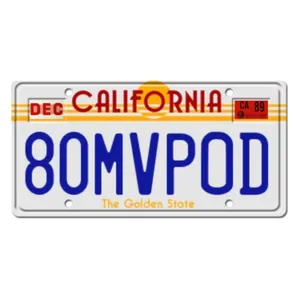
Free Daily Podcast Summary
The 80s Movie Podcast: Daily Summaries Delivered
by Edward Havens
Not just the movies Hollywood remembers but also the ones it forgot, and why every movie still matters. The 80s Movie Podcast is your ultimate throwback ride through the most iconic decade in film. From explosive blockbusters and cult classics to hidden gems you forgot you loved, each episode dives deep into the stories, stars, soundtracks, and behind-the-scenes magic that defined the era. Expect bold opinions, nostalgic deep dives, and plenty of laughs as we revisit the movies that shaped a generation, whether it’s high school hijinks, sci-fi adventures, action-packed showdowns, or unforgettable coming-of-age moments. If it had big hair, bigger explosions, and a killer synth score, it’s fair game. Whether you lived the 80s or just wish you had, The 80s Movie Podcast brings the decade back to life, one reel at a time. Press play and let’s rewind.
Latest Episodes
The most recent episodes — sign up to get AI-powered summaries of each one.
- 6 days ago16 min
Red Headed Stranger (1986): Willie Nelson’s Fight to Make His Film His Way
This week on The 80s Movie Podcast, host Edward Havens traces the nearly decade-long journey from Willie Nelson’s 1975 album to the start of filming. Nelson believed Red Headed Stranger’s spare songs and unnamed preacher could live as a movie. He sought out Texas writer Bill Wittliff to develop the screenplay. Universal imagined a $14 million production and wanted Robert Redford in the lead. Nelson insisted on playing the preacher himself. When Redford declined and Universal lost interest, Nelson and Wittliff returned their advances to reclaim the script. They took the project to HBO, with Sam Peckinpah attached to direct. HBO set a $5 million budget, while Peckinpah wanted at least twice that. He left, and the project collapsed again. Nelson and Wittliff rebuilt the film as a $1.8 million independent production. Nelson mortgaged property, while Don Tyson, Darrell Royal, and Bud Shrake invested. A cash shortage during filming threatened the production until Carolyn Mugar provided the money to finish. The budget shaped the production from the start. Nelson’s Spicewood ranch became Driscoll, Montana, a frontier town built with donated materials and local labor. Wittliff made his directing debut during a 39-day shoot that began in April 1985. Morgan Fairchild and Katharine Ross joined Nelson, along with local performers and his family. Cast and crew often took on several jobs to keep the low-budget production moving. Nelson built the soundtrack around acoustic music, including new guitar arrangements recorded on his ranch. After the film was complete, he and Wittliff faced another challenge: finding a distributor. Edward follows Alive Films’ regional rollout, the film’s mixed critical response, and the set’s later life as Luck, Texas. Hear how years of setbacks, financial risks, and practical compromises carried Red Headed Stranger from a cherished album to an independently made Western.
- 3 weeks ago25 min
Eating Raoul (1982): Paul Bartel’s Cult Film
This week on The 80s Movie Podcast, host Edward Havens explores Paul Bartel’s 1982 cult film Eating Raoul. Paul and Mary Bland dream of opening a restaurant. But their plan to pay for it turns to murder. First, we trace Bartel’s early fascination with movies and animation, from his time at UPA through UCLA and low-budget filmmaking. Then we follow Bartel and writer Richard Blackburn as they develop the story. They make the film on a small budget with borrowed equipment and help from friends and family. Meanwhile, we look at performances by Mary Woronov, Robert Beltran, Ed Begley Jr., Buck Henry, Edie McClurg, and Susan Saiger. Next, we track the movie from its Park City premiere through theatrical expansion, critical reception, and home video. Finally, we explore Bartel’s later career and the making and release history that shaped this distinctive 1980s independent film.
- Sep 14, 202618 min
Losin' It (1983): Tom Cruise and the Lost History of Tijuana
Some movies teach their stars lessons that stay with them for the rest of their careers. This week on The 80s Movie Podcast, host Edward Havens looks at Losin' It, the 1983 teen comedy that began as Tijuanaand starred a young Tom Cruise alongside Jackie Earle Haley and Shelley Long. Four teenagers head across the border in 1965, expecting an unforgettable adventure. Instead, they stumble into a chaotic night of bad decisions, romance, and trouble. But the real story begins with the movie audiences first saw during its 1982 test engagements. Originally titled Tijuana, the film later changed distributors, changed titles, and was re-edited before its wider 1983 release as Losin' It. For Tom Cruise, the experience offered an early lesson about how much a filmmaker can lose control of a movie after production ends. We explore how watching Tijuana become Losin' It gave Cruise an early glimpse into the realities of Hollywood filmmaking. Years before he became one of Hollywood’s most powerful stars, the experience helped shape his understanding of creative control, filmmaking, and the importance of protecting the quality of a movie. Along the way, we revisit the film’s unusual history, its brief 1982 theatrical test, and the version audiences eventually received in 1983. Losin' It may be a forgotten early Tom Cruise comedy, but its troubled journey offers a fascinating glimpse at the lessons that helped shape one of Hollywood’s biggest careers.
- Aug 20, 202617 min
Rude Boy (1980): The Clash, British Punk, and a Changing Britain
This week on The 80s Movie Podcast, host Edward Havens travels across the Atlantic to revisit a forgotten British film that captured The Clash at a pivotal moment. Rude Boy arrived in 1980 as punk was colliding with a changing Britain. However, the film is more than a document of one of the era’s greatest bands. We follow Ray Gange, a young Londoner who drifts into the band’s orbit and becomes their roadie. Along the way, filmmakers David Mingay and Jack Hazan capture a world shaped by music, politics, unemployment, racism, and rising social unrest. Meanwhile, The Clash are trying to navigate their growing fame without losing the anger that made them matter. The film’s strange blend of documentary and fiction gives Rude Boy its uneasy power. At first, Ray seems like a witness to history. Instead, his behavior becomes part of the story, while Joe Strummer, Mick Jones, Paul Simonon, and Topper Headon reveal different sides of life inside the band. In addition, the movie places their music against the political tensions of late-1970s Britain. We explore the National Front, the anti-fascist movement, the Lewisham clashes, and the atmosphere surrounding Rock Against Racism. As a result, Rude Boy becomes a snapshot of a country approaching the Thatcher era. We also look at the film’s complicated reception. Critics and audiences struggled with its unusual structure, while The Clash themselves later distanced themselves from the finished movie. Nevertheless, Rude Boy remains a fascinating time capsule. Its performances, street footage, backstage moments, and political context preserve a world that was already changing when the cameras arrived. Ultimately, this episode is about more than The Clash or punk rock. It is about what happens when filmmakers try to capture a cultural movement while that movement is still happening. We revisit Rude Boy as a piece of British film history, punk history, and political history, and we consider why its rough edges may be exactly what make it worth remembering.
- Jun 4, 202613 min
Hearts and Armour (1984): Love, Magic, and Medieval Mayhem in a Lost Tanya Roberts Cult Fantasy
In this episode of The 80s Movie Podcast, host Edward Havens explores Hearts and Armour (1983), an Italian fantasy adventure inspired by Orlando Furioso. The film follows star-crossed lovers caught between Christian and Saracen armies during a sprawling medieval conflict. However, prophecy, magic, and divided loyalties threaten every chance at happiness. Along the way, we examine the film's production design, elaborate costumes, and ambitious fantasy world. In addition, we discuss performances from Tanya Roberts, Ronn Moss, Barbara De Rossi, and the rest of the international cast. Director Giacomo Battiato aimed for epic storytelling, while drawing on classic European literature and fantasy traditions. The result remains one of the most visually distinctive genre films of the decade. At the same time, we consider why Hearts and Armour remains a cult curiosity among fantasy fans. Furthermore, we look at its reputation as a beautiful but divisive film. Many viewers praise its costumes, armor, and action sequences despite its unconventional storytelling. Whether you discovered it on cable, VHS, or streaming, this episode revisits a forgotten fantasy epic that still sparks debate among genre enthusiasts.
- May 13, 202612 min
Oliver Reed & Cannon Films’ Forgotten Shelved Horror Comedy: Dr. Heckyl and Mr. Hype (1980)
This week on The 80s Movie Podcast, host Edward Havens launches a new semi-regular series, Produced and Abandoned, spotlighting films that were completed but largely discarded by their distributors. First up: the bizarre and nearly forgotten 1980 horror-comedy Dr. Heckyl and Mr. Hype, a very loose retelling of "Dr. Jekyll and Mr. Hyde," starring Oliver Reed in a dual role, and written and directed by Charles B. Griffith, the legendary screenwriter behind The Little Shop of Horrors. Produced by Cannon Films, the movie was rushed from concept to completion in just a few months, only to practically vanish from theaters. Edward explores the film’s wild production history, from Griffith’s original comedy concept and failed attempt to cast Dick Van Dyke to Oliver Reed’s last-minute involvement and the movie’s mysterious disappearance after only a handful of theatrical screenings. Plus: the connections to cult favorites like Condorman and The Apple, the strange international afterlife of the film on VHS, and why forgotten studio castoffs like Dr. Heckyl and Mr. Hype still deserve rediscovery decades later. ----more---- Transcript From Los Angeles, California, the entertainment capital of the world. It's The 80s Movie Podcast. I'm your host, Edward Havens. Thank you for listening today. Today, on this 137th episode of the show, I'm going to be starting a new semi-regular series called Produced and Abandoned, that brings movies that were made and barely exhibited back to the spotlight, if even only for a moment. One of the many advantages of having a non-linear podcast like this one is that I, as the host and the researcher and the writer, can zag unexpectedly at a moment's notice when I feel compelled to. And that happened to me this week. For a film historian like myself who focuses on movies from a specific discipline like, say, from the 1980s, the internet is a veritable cornucopia of people who share in some way many of your same passions, and you will find them doing a lot of the legwork unintentionally for you, or pointing you in a direction you didn't know you needed to go. In 2026, I. Edward Havens, still have an active Facebook account, which I mainly use to keep in touch with my friends and family who are scattered throughout the globe. I have curated my feed so that the non-relative crazy uncles and aunts of the world, with their tinfoil hats and indecipherable conspiracy theories about the strangest subjects, do not reach me. So it's not as toxic a space as many people know it to be. Some time last week, thanks to filmmaker Adam Rifkin, I learned about a private Facebook group called Old Movie Newspaper and Print Ads from Around the World. Nearly a century of digital newspaper clippings, mostly from the United States and mostly from the 1970s and 1980s. If, for example, if you wanted to know how many theaters the god awful 1988 Joe Piscopo horror/action/comedy film Dead Heat opened at in Detroit in May of 1988, I can tell you that now. It was twenty one theaters, by the way. Including four drive ins. And while perusing this private Facebook group of insane movie nerds, my kind of people, I saw an ad for an Oliver Reed movie I had never heard of before, Dr. Jekyll and Mr. Hype. Well, the episode that I had been working on, that I've been tinkering with for damn more than two years now, was moved to the backburner once again, for the time being. I had to learn more about this movie, and I had to learn about it right then and there, because that's who I am. At one thirty in the morning, with a toddler ready to wake up in five and a half hours. I was exhausted, but at least I was going to get the ball rolling. And what I discovered is just how amazingly quick this film went from concept to writing, to production to completion. In an interview published in the 1997 book "BackStory 3: Interviews with Screenwriters of the 1960s," the film's writer and director, Charles B. Griffith, described how the film came together. The title, originally "Doctor Feelgood and Mr. Hype," was one of several joke titles and ideas that Griffith had come up with for an expected meeting with Francis Ford Coppola about getting a movie made in the late 1970s. Griffith's own pitch for the film was that a hippie invents a new drug that turns its users into advertising executives. It was more meant to be an opening icebreaker joke than a real movie. After filming the movie Up From the Depths in the Philippines in 1978, Griffith would find himself talking to Cannon Films co-president Menahem Golan, who wanted Griffith to write a screenplay for The Happy Hooker Goes to Hollywood. While that film would get made, it would get made without Griffith ever signing on to it. But the two men would continue to talk regularly, as Griffith had been a roommate of Golan's when the Israeli filmmaker first arrived in A
- May 1, 20262 min
Host Update — Why The 80s Movie Podcast Was Paused 8 Months (Apology & Thanks)
Edward Havens, host of The 80s Movie Podcast, issues a brief apology and explains why the show paused for the past eight months. This 2m52s host update thanks listeners and provides a candid explanation of the hiatus. Thank you for sticking with the neon-lit rewind. Your support matters.
- Aug 17, 202513 min
Keanu Reeves TV Movie "The Brotherhood of Justice" (1986), Host's 40th High School Reunion, and Personal Tribute
The first ever remote episode of The 80s Movie Podcast, we remember an old friend, and recount how a long-forgotten 1986 Keanu Reeves TV movie, The Brotherhood of Justice, which was filmed at the host's high school weeks after his graduation and moving to Los Angeles to break into the film industry. Expect production anecdotes, personal memories, and a fresh look at a little-known early Keanu role.
Get The 80s Movie Podcast summaries in your inbox
Free AI-powered daily recaps. Key takeaways, quotes, and mentions — in a 5-minute read.
Get Free Summaries →Free forever for up to 3 podcasts. No credit card required.
You Might Also Like
Listeners also like.

Vintage Video
Re-watching 1980s videos to save listeners the trouble.
HOLLYWOODLAND
Examines crimes connected to Hollywood figures and film history, from murders to conspiracies and scandals.
Talk ’90s to me
Podmasters

Professor of Rock
Music historian Adam Reader examines the origins and stories of classic rock songs through interviews and detailed episode explorations.

For the Nostalgia
Brittanny
We Hate Movies
Comedians critique and mock poorly received movies from the 1980s to today, focusing on bad action films, rom-coms, and CGI-heavy blockbusters.

Moving Pictures Film Club
Tim Coleman

Now Playing - The Movie Review Podcast
Reviews major film franchises with in-depth analysis, behind-the-scenes details, and humorous critiques.

90210MG
A nostalgic rewatch of every episode of Beverly Hills, 90210 from the beginning, with behind-the-scenes insights and fan commentary.

You Must Remember This
Explores hidden and forgotten stories from Hollywood’s first century, uncovering the truth behind myths, scandals, and iconic figures.
You Had 2 Be There
Revisits 90s and 2000s pop culture, fashion, and internet nostalgia with humor and guest stories.
The Rewatchables
Film enthusiasts analyze classic movies that remain popular through repeated viewings.
About The 80s Movie Podcast
Not just the movies Hollywood remembers but also the ones it forgot, and why every movie still matters. The 80s Movie Podcast is your ultimate throwback ride through the most iconic decade in film. From explosive blockbusters and cult classics to hidden gems you forgot you loved, each episode dives deep into the stories, stars, soundtracks, and behind-the-scenes magic that defined the era. Expect bold opinions, nostalgic deep dives, and plenty of laughs as we revisit the movies that shaped a generation, whether it’s high school hijinks, sci-fi adventures, action-packed showdowns, or unforgettable coming-of-age moments. If it had big hair, bigger explosions, and a killer synth score, it’s fair game. Whether you lived the 80s or just wish you had, The 80s Movie Podcast brings the decade back to life, one reel at a time. Press play and let’s rewind.
Customized Recaps
AI-powered recaps with compact key takeaways, quotes, and insights.
Straight to Your Inbox
Get key takeaways from The 80s Movie Podcast in a 5-minute read.
Save Hours Every Week
Stay current on your favorite podcasts without falling behind.
Frequently Asked Questions
What is Podzilla's The 80s Movie Podcast daily summary?
It's a free AI-powered email that summarizes new episodes of The 80s Movie Podcast as soon as they're published. You get the key takeaways, notable quotes, and links & mentions — all in a quick read.
How does the The 80s Movie Podcast podcast summary work?
When a new episode drops, our AI transcribes and analyzes it, then generates a personalized summary tailored to your interests and profession. It's delivered to your inbox every morning.
Is this an official The 80s Movie Podcast product?
No. Podzilla is an independent service that summarizes publicly available podcast content. We're not affiliated with or endorsed by Edward Havens.
Can I get summaries of other podcasts too?
Absolutely! The free plan covers up to 3 podcasts, any in the catalog. Basic raises that to 15, Pro to 40 and Max to 100. Browse our full catalog at /podcasts.
How often does The 80s Movie Podcast release new episodes?
The 80s Movie Podcast publishes monthly. Our AI generates a summary within hours of each new episode.
What topics does The 80s Movie Podcast cover?
The 80s Movie Podcast covers topics including History, Arts, Film, TV & Film, Visual Arts. Our AI identifies the specific themes in each episode and highlights what matters most to you.
Start getting The 80s Movie Podcast summaries tomorrow morning.
Free forever for up to 3 podcasts. No credit card required.
Free forever for up to 3 podcasts. No credit card required.