Free Daily Podcast Summary
Terrible Lizards: Daily Summaries Delivered
by Iszi Lawrence and David Hone
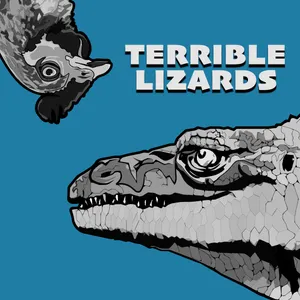
Terrible Lizards is a podcast about Dinosaurs with Dr David Hone and Iszi Lawrence.
Latest Episodes
The most recent episodes — sign up to get AI-powered summaries of each one.
- Yesterday10 min
S12DB23 Were Dinosaurs Venomous
Were any dinosaurs venomous? The idea has made headlines, but the evidence for the best-known candidate, Sinornithosaurus, doesn't hold up. In this Dinosaur Bite, Iszi Lawrence and Dr Dave Hone look at the claim that this small dinosaur had venom-delivering teeth. Dave explains why the supposed venom groove is better understood as part of the process of tooth replacement, and why the apparent space for a venom gland in its skull is far from convincing. The discussion also gets into the difference between venomous and poisonous animals, and why it can be difficult to tell what a fossil's anatomy really means. The answer is less sensational than a venomous dinosaur, but it's a useful example of how a striking idea can catch on even after the evidence has been challenged. Support Terrible Lizards and get access to bonus episodes and other extra content on Patreon: https://patreon.com/terriblelizards RAWR!
- 1 weeks ago1h 9m
TLS12E10 The Unfeathered Bird: How Anatomy Reveals Evolution
What can the anatomy of modern birds tell us about dinosaurs? And why do so many artists, even professionals, get bird anatomy wrong? In this episode of Terrible Lizards, Iszi Lawrence and Dr Dave Hone are joined by Katrina van Grouw, author, illustrator and avian biologist, to explore the connections between bird anatomy, dinosaur evolution and the mechanics of flight. Katrina's new book, A New Unfeathered Bird, is an extensively expanded version of her acclaimed The Unfeathered Bird. It combines detailed anatomical illustrations with a deep dive into how birds are built, how they move and how they evolved. The book also reaches back into the dinosaur family tree, with illustrations of non-avian dinosaurs in action. We talk about why artists often put a bird's knees in the wrong place, what skeletons reveal about how animals move, and how different birds have evolved different ways of flying. Katrina explains the difference between thermal soaring and dynamic soaring, why albatrosses have such distinctive wings, and how birds use their tails and individual feathers to manoeuvre in the air. The conversation also explores how birds diversified after the extinction of the non-avian dinosaurs, what we can learn by comparing animals with similar adaptations, and why understanding anatomy means looking beyond appearances to consider how an animal actually works. Katrina also tells us how A New Unfeathered Bird grew out of a project first conceived decades ago, why she wanted to revisit the science of bird evolution, and how the palaeontology community helped shape the new edition. It's a fascinating look at the meeting point between art and science, and at what careful observation can reveal about the animals around us. A New Unfeathered Bird by Katrina van Grouw is available to pre-order ahead of publication on 12 January 2027. Find the book at NHBS: https://www.nhbs.com/a-new-unfeathered-bird-book Follow Katrina on Instagram: https://www.instagram.com/katrina_van_grouw/ Support Terrible Lizards and get access to bonus episodes and other extra content on Patreon: https://patreon.com/terriblelizards Terrible Lizards is a dinosaur podcast hosted by Iszi Lawrence and palaeontologist Dr Dave Hone.
- 2 weeks ago15 min
S12DB22 Was T. rex Feathered? What the Fossils Really Tell Us
Were pachycephalosaurs really headbutting each other? Could they have been covered in fuzzy filaments? And does the evidence for scaly skin mean that T. rex was definitely not feathered? Youtube link: https://youtu.be/Km8CWetEnxI In this Dinosaur Bite, Iszi Lawrence and Dr Dave Hone get into the details of dinosaur skin, from the healed injuries on thick-skulled pachycephalosaurs to the mysterious patterns preserved in tyrannosaur fossils. Dave explains why what looks like a scale is not necessarily a scale, and why we still have a lot to learn about the coverings of many dinosaurs. We also hear about the challenges of preserving delicate fossil evidence. Sometimes palaeontologists have to make difficult decisions about what to save, and occasionally that means deliberately breaking bones to get a fossil out of the ground in one piece. It's a reminder that the fossil record is shaped not only by what nature preserves, but also by what researchers can recover. Support Terrible Lizards and get access to bonus episodes and other extra content on Patreon: https://patreon.com/terriblelizards RAWR!
- 4 weeks ago10 min
S12DB21 Was Torosaurus REALLY a Male Triceratops?
Was Torosaurus REALLY a Male Triceratops? | Dinosaur Bites Terrible Lizards Dinosaur Bites – bite-sized extracts from old episodes and live streams to keep you going. Was Torosaurus actually just a male Triceratops? Can we tell whether pterosaurs had emotions? And could the surprisingly dexterous feet of modern birds give us clues about dinosaur behaviour? In this Dinosaur Bite, Iszi Lawrence and Dr Dave Hone tackle some wonderfully difficult questions about what we can and can't know about dinosaur behaviour and biology. They discuss whether pterosaurs and dinosaurs had emotions. We can see emotional responses in living reptiles and birds, but how far can we push that comparison when the animals in question have been extinct for millions of years? Is the long-running Triceratops vs Torosaurus debate. Could the two dinosaurs actually be different sexes of the same species? Dave explains why the idea is tempting, but why the fossil record makes him very sceptical — including the strange distribution of Triceratops and Torosaurus fossils and the mysterious specimen nicknamed "Tiny". And finally, a question about foot dexterity in birds: some modern birds can use their feet almost like hands to pick up and manipulate food. Could that tell us anything about the motor skills of their dinosaur ancestors? Plus: a five-year-old's interpretation of "Pterosaurs in Motion", some extremely determined pterosaur squawking, and Dave's hopes of one day writing a new book about pterosaurs. Watch the video on YouTube: Watch Terrible Lizards on YouTube https://youtu.be/2MTGkSdqSJw Support Terrible Lizards and get bonus episodes and other extra content: Patreon – Terrible Lizards https://patreon.com/terriblelizards Terrible Lizards is a dinosaur podcast hosted by Iszi Lawrence and palaeontologist Dr Dave Hone. RAWR!
- Sep 30, 202612 min
TLS12DB20 Forked Tongues
Could a pair of Quetzalcoatlus really harass a T. rex away from a carcass? And did dinosaurs have forked tongues like snakes and Komodo dragons? In this Dinosaur Bite, Iszi Lawrence and Dr Dave Hone tackle both questions - starting with the Prehistoric Planet scene in which two enormous azhdarchid pterosaurs hassle a T. rex over a carcass. Dave explains why the basic idea is perfectly plausible, drawing comparisons with modern animals such as hyenas, lions and vultures. But there's one part of the scene he isn't convinced by: with a huge carcass available, would the T. rex really bother wasting energy chasing the pterosaurs away? They then turn to the surprisingly complicated question of forked tongues. What does the fossil record tell us about dinosaur tongues? Why do snakes and some lizards have them? Could pterosaurs or marine reptiles have had them? And what can evolutionary relationships tell us when the soft tissue itself has completely disappeared? Along the way, we get into how animals use smell, how sharks detect things in water, electroreception, and one of the fundamental problems of biology: where exactly do we draw the boundaries between species when evolution is a continuum? Watch the video on YouTube: Watch Terrible Lizards on YouTube https://youtu.be/56vlTGVTCOY Support Terrible Lizards and get bonus episodes and other extra content: https://patreon.com/terriblelizards Terrible Lizards is a dinosaur podcast hosted by Iszi Lawrence and palaeontologist Dr Dave Hone. RAWR!
- Sep 23, 202658 min
TLS12E09 Dinosaur Tracks and photogrammetry
What can dinosaur footprints tell us that bones can't? n this episode of Terrible Lizards, Iszi Lawrence and Dr Dave Hone talk to palaeontologist Brent Breithaupt about the science of trace fossils: the footprints, trackways, nests, bite marks and other evidence left behind by animals millions of years ago. You can watch the episode on youtube here: https://youtu.be/puS0gkuTCHY Brent has spent decades studying dinosaur and pterosaur footprints, particularly in Wyoming, and was at the forefront of using photogrammetry to turn enormous fossil trackways into detailed 3D digital records. He explains how scientists can use footprints to investigate how dinosaurs moved, how fast they travelled, how large they were and even how they may have interacted with one another. We also discuss: 🦖 Dinosaur footprints: what they can tell us about individual animals and whole populations. 🦶 Trace fossils vs body fossils: why something an animal did can sometimes tell us more about its behaviour than its bones. 📸 Photogrammetry: how researchers went from stepladders, tripods and remote-control aircraft to modern drones and smartphones. 🎈 The Great Dinosaur Footprint Blimp: what happens when you try to photograph a tracksite from the air and the Wyoming wind picks up. 🦅 Pterosaur footprints: why they are relatively rare and why Wyoming has some particularly important tracksites. 💃 Dinosaur courtship: the evidence for theropods making display scrapes, and what modern birds can tell us about interpreting these mysterious traces. 🔬 Being sceptical about fossil behaviour: why good palaeontology means considering alternative explanations rather than simply finding evidence that supports your favourite idea. 🦴 Brent also talks about his work on Big Al, Walking with Dinosaurs, modern emus and rheas, and his attempts to track down historic dinosaur quarries from the 19th century. And, naturally, Iszi gets Brent, Dave and herself to make their best guesses at what a dinosaur might sound like while displaying at a lek. Brent Breithaupt is a palaeontologist and ichnologist whose research has included dinosaur and pterosaur trace fossils, fossil trackways, photogrammetry and the history of dinosaur discoveries in Wyoming. Support Terrible Lizards and get bonus episodes and other extra content: https://patreon.com/terriblelizards If you enjoy the podcast, please subscribe on YouTube, follow the podcast in your favourite podcast app, leave a review and share it with another dinosaur fan. Terrible Lizards is a dinosaur podcast hosted by Iszi Lawrence and palaeontologist Dr Dave Hone.
- Sep 16, 202613 min
S12DB19 Where Did Pterosaurs Lay Their Eggs?
How did pterosaurs actually nest? Did they build colonies like seabirds, bury their soft-shelled eggs like crocodiles and turtles, or something stranger? In this archive extract, Iszi Lawrence and Dr Dave Hone discuss pterosaur nesting behaviour, what we know about predators that might have eaten pterosaurs and their eggs, and why the fossil evidence is frustratingly limited. They also tackle what might have survived the Cretaceous-Paleogene extinction, why some small feathered dinosaurs might have been better placed to survive than larger species, and some of the most mysterious dinosaur fossils still waiting for more attention. Plus: why Amargasaurus is such a strange sauropod, what "taphonomy" actually means, and whether the fossil record is missing tiny dinosaurs — including dinosaurs as small as hummingbirds. If you'd like to support the podcast and get bonus episodes every month, join us on Patreon: www.patreon.com/terriblelizards Watch this episode on youtube: https://youtu.be/elbP8SlWJbk
- Sep 2, 202610 min
S12DB18 How Did Dinosaur Heads Attach?
Link to youtube video: https://youtu.be/VVFicHNMxys What happens when a palaeontologist goes back to his office and comes home with five boxes of dinosaur casts and fossils? In this archive extract from one of our earliest live shows, we look at the contents of Dr Dave Hone's fossil collection including a real ceratopsian skull bone, casts of tiny dinosaurs and Iszi's Lego dinosaur that turns out to be surprisingly anatomically accurate. In this Dinosaur Bite, Dave explains how a ceratopsian's skull connects to its neck, why some fossils are particularly good for museums and outreach, and why palaeontologists have far more tiny dinosaurs than the public might expect. And just how small could an adult ceratopsian get? If you'd like to support the podcast and get bonus episodes every month, join us on Patreon: https://patreon.com/terriblelizards If you enjoy Terrible Lizards, please like, subscribe, leave a review, and share the podcast with a fellow dinosaur fan. It really helps us keep making new episodes.
Get Terrible Lizards summaries in your inbox
Free AI-powered daily recaps. Key takeaways, quotes, and mentions — in a 5-minute read.
Get Free Summaries →Free forever for up to 3 podcasts. No credit card required.
You Might Also Like
Listeners also like.
Reptile Talk
A podcast exploring the lives and experiences of reptile enthusiasts worldwide.

Tooth & Claw: True Stories of Animal Attacks
A wildlife biologist and guests analyze documented animal attacks to explain animal behavior and how to stay safe in the wild.
Terrestrials
Nature stories that reveal surprising animal and plant behaviors through immersive, family-friendly audio adventures.
Tumble Science Podcast for Kids
Stories of scientific discovery told for kids and families, featuring interviews with scientists and researchers.
The Zooquarium Podcast
A biologist and an artist answer listener questions about animals and ecosystems, blending science and creativity for all ages.

Wild Times: Wildlife Education
Wildlife biologist Forrest Galante and co-hosts share expert insights and adventurous stories about wildlife, conservation, and expeditions.

5 Live Science Podcast
Dr Chris and the Naked Scientists present the latest science news and analysis.
Just the Zoo of Us
Two hosts rate animal species on effectiveness, ingenuity, and aesthetics.
Monstro Bizarro
Explores real-life cases of cryptids, paranormal phenomena, and monster mysteries.
Skeptoid
Examines urban legends, paranormal claims, and science myths with critical analysis and evidence-based research.

Science Friday
Explores diverse science and technology topics, from space to microscopic life, with engaging educational stories.

Here Be Monsters
Here Be Monsters
About Terrible Lizards
Terrible Lizards is a podcast about Dinosaurs with Dr David Hone and Iszi Lawrence.
Customized Recaps
AI-powered recaps with compact key takeaways, quotes, and insights.
Straight to Your Inbox
Get key takeaways from Terrible Lizards in a 5-minute read.
Save Hours Every Week
Stay current on your favorite podcasts without falling behind.
Frequently Asked Questions
What is Podzilla's Terrible Lizards daily summary?
It's a free AI-powered email that summarizes new episodes of Terrible Lizards as soon as they're published. You get the key takeaways, notable quotes, and links & mentions — all in a quick read.
How does the Terrible Lizards podcast summary work?
When a new episode drops, our AI transcribes and analyzes it, then generates a personalized summary tailored to your interests and profession. It's delivered to your inbox every morning.
Is this an official Terrible Lizards product?
No. Podzilla is an independent service that summarizes publicly available podcast content. We're not affiliated with or endorsed by Iszi Lawrence and David Hone.
Can I get summaries of other podcasts too?
Absolutely! The free plan covers up to 3 podcasts, any in the catalog. Basic raises that to 15, Pro to 40 and Max to 100. Browse our full catalog at /podcasts.
How often does Terrible Lizards release new episodes?
Terrible Lizards publishes weekly. Our AI generates a summary within hours of each new episode.
What topics does Terrible Lizards cover?
Terrible Lizards covers topics including Science, Nature, Natural Sciences. Our AI identifies the specific themes in each episode and highlights what matters most to you.
Start getting Terrible Lizards summaries tomorrow morning.
Free forever for up to 3 podcasts. No credit card required.
Free forever for up to 3 podcasts. No credit card required.