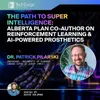
The Path to Superintelligence: Alberta Plan Co-Author On Reinforcement Learning & AI-Powered Prosthetics
In this episode, Dr. Patrick Pilarski, co-author of the Alberta Plan alongside Richard Sutton and Michael Bowling, makes the case for a radically different kind of AI: one that never stops learning, builds its own understanding from raw experience, and gets more out of limited compute rather than more data centers. A Canada CIFAR AI Chair (Amii) and professor at the University of Alberta, Pilarski also leads a lab that builds robotic prosthetic limbs that learn to anticipate what their users intend to do before they do it.In this conversation, Pilarski joins TechSurge to unpack why his co-author Rich Sutton has publicly called LLMs a dead end, how the Alberta Plan’s “temporal uniformity” differs from how today’s AI labs bolt reinforcement learning onto pre-trained models, and why he believes AI safety problems in today’s LLM agents are really reinforcement learning problems the field has studied for decades.The conversation covers:✅ Why Richard Sutton argues large language models are a dead end✅ The four core commitments of the Alberta Plan for AI research✅ Why “temporal uniformity” rejects the idea of separate training and deployment phases✅ Patrick’s upcoming move to ExperienceFlow.AI as Head of Edge Superintelligence✅ Why he doesn’t believe the AI data center build-out locks the industry into one path✅ How reinforcement learning’s lessons on exploration and reward specification apply to AI agent safety✅ Inside his lab’s work on AI-powered prosthetic limbs that predict user intent✅ Supernumerary limbs and the future of human augmentationGuest Links:Patrick Pilarski: Canada CIFAR AI Chair and Fellow at Amii, Professor in the Department of Medicine at the University of Alberta, co-author of the Alberta Plan, and co-lead of the BLINC Lab. Incoming Head of Edge Superintelligence at ExperienceFlow.AI.University of Alberta faculty page: https://sites.ualberta.ca/~pilarski/#teachingBLINC Lab: https://blinclab.caFurther Reading and ResourcesThe Alberta Plan – Pilarski’s contrarian roadmap for AI, co-authored with Richard Sutton and Michael Bowling, built around continual learning, temporal uniformity, computational efficiency, and multi-agent interaction.arXiv paper: https://arxiv.org/abs/2208.11173The Bitter Lesson – Richard Sutton’s influential essay, referenced in the conversation, arguing that scaling compute consistently beats hand-crafted human knowledge in AI research.http://www.incompleteideas.net/IncIdeas/BitterLesson.htmlReward Is Enough – The paper discussed in the episode, arguing that sufficiently rich reward signals alone can give rise to the full range of abilities associated with intelligence.ScienceDirect: https://www.sciencedirect.com/science/article/pii/S0004370221000862AI Agent Safety is a Reinforcement Learning Problem – A paper co-authored by Pilarski, mapping AI agent safety failures onto established reinforcement learning challenges like safe exploration and reward misspecification.OpenReview: https://openreview.net/forum?id=wvga9chmb6ExperienceFlow.AI – The company Pilarski is joining as Head of Edge Superintelligence, whose Superintelligence Research Laboratory focuses on continual learning and is led scientifically by Richard Sutton.Press release: https://www.businesswire.com/news/home/20251105563930/en/ExperienceFlow.AI-Announces-the-Launch-of-Its-Research-Laboratory-to-Advance-Experience-powered-Decentralized-SuperintelligenceAMD’s Acquisition of World Labs – Referenced in the episode’s discussion of “world models,” AMD’s $8.2 billion deal to acquire Fei-Fei Li’s company.CNBC: https://www.cnbc.com/2026/09/28/amd-fei-fei-li-world-labs.htmlChapters:00:00 – Welcome to Edmonton: AI, Free Will, and the Rodeo00:57 – Why AI Researchers Name Papers Better Than Other Scientists02:37 – Should We Anthropomorphize AI?08:03 – The Alberta Plan, Explained11:25 – “LLMs
Podzilla Summary coming soon
Sign up to get notified when the full AI-powered summary is ready.
Free forever for up to 3 podcasts. No credit card required.
Listen to This Episode
More from TechSurge: Deep Tech Podcast

From Chips to Agents: Rebuilding the AI Stack

FedEx CEO on Physical AI, the Big Bet on Data, and the Two Trillion-Dollar Supply Chain Problem

Gaming Chip Pioneer Raja Koduri on China's AI Cost Advantage and Moving Beyond the GPU

The Race to Build the Next Trillion-Dollar AI Chip Company
Get summaries like this every morning.
Free AI-powered recaps of TechSurge: Deep Tech Podcast and your other favorite podcasts, delivered to your inbox.
Free forever for up to 3 podcasts. No credit card required.