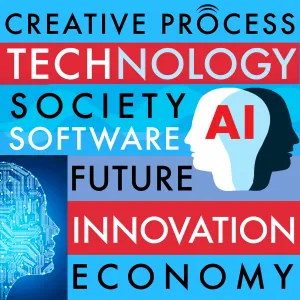
Free Daily Podcast Summary
Tech, Innovation & Society - The Creative Process: Technology, AI, Software, Future, Economy, Science, Engineering & Robotics Interviews: Daily Summaries Delivered
by Technology, AI, Software, Future, Economy, Science, Engineering & Robotics Interviews - Creative Process Original Series
Rethinking tomorrow. We focus on technology, innovation, society, AI, science, engineering, the economy & issues facing people & the planet. Leading thinkers, organizations & environmentalists discuss technology, creativity & pathways for a more sustainable future. Exploring the fascinating minds of creative people. Conversations with writers, artists & creative thinkers across the Arts & STEM. We discuss their life, work & artistic practice. Winners of Oscar, Emmy, Tony, Pulitzer, leaders & public figures share real experiences & offer valuable insights. Notable guests and participating museums and organizations include: Academy of Motion Picture Arts & Sciences, Neil Patrick Harris, Smithsonian, Roxane Gay, Musée Picasso, Neil Gaiman, UNESCO, Joyce Carol Oates, Mark Seliger, Acropolis Museum, Hilary Mantel, Songwriters Hall of Fame, George Saunders, The New Museum, Lemony Snicket, Pritzker Architecture Prize, Hans-Ulrich Obrist, Serpentine Galleries, Joe Mante
Latest Episodes
The most recent episodes — sign up to get AI-powered summaries of each one.
- 6 days ago39 min
Humanity, Tech, and the Future of Authentic Connection w/ EMMY VAN DEURZEN
Emmy van Deurzen is a philosopher, a therapist and a pioneer who has spent five decades mapping the architecture of human existence. Born in the Netherlands and trained in the radical psychiatric wards of France, she came to London in 1977 to work alongside R.D. Laing, only to realize the anti-psychiatry movement had kind of lost its way. She decided to build something new. Today, she's the founder of the New School of Psychotherapy and Counselling and the leading voice of existential therapy in the United Kingdom and founded the Existential Movement.Her work challenges the medical model of mental illness, suggesting instead that our crises are not diseases to be cured but philosophical crossroads to be understood. Her latest book is a distillation of that life's work. Beginning To Live: The Art of Existential Freedom is her first book written for a general audience, offering a guide on how to reclaim our freedom and find meaning in the face of suffering. Emmy van Deurzen, welcome to The Creative Process. The Paths to Freedom Emmy Van Deurzen, Philosopher, Existential Therapist, Author AI and Artificial Wisdom Practicing Freedom Finding Inner Peace Amidst the Ruins The Yellow Balloon Multilingual Roots, Language and Translation The End of One Love, The Beginning of a Love of the Arts The Art of Loving The Canvas of Life The Purified Essence The AI Dependency Radical Psychiatry, R.D. Laing and The Divided Self Awakening to Beauty The Art of Living and Existential FreedomEpisode Websitewww.creativeprocess.info/podInstagram:@creativeprocesspodcast
- 6 days ago54 min
The Fight for the Future: AI, Privacy & Power with CARISSA VÉLIZ
“Algorithms are deciding whether you are eligible for a loan, a job, an apartment or insurance. They determine what you see online, who reads your social media posts and who connects with you on dating apps. They may even decide whether you get arrested or go to jail. Your very life hangs in the balance of prophecies.”In this episode of the Speaking Out of Place podcast, Professor David Palumbo-Liu talks with Carissa Véliz, an associate professor at the University of Oxford, about her new book, Prophecy: Prediction, Power, and the Fight for the Future—from Ancient Oracles to AI. Linking this work to her previous book, Privacy is Power: Why and How You Should Take Back Control of Your Data, Véliz writes: “ surveillance and prediction are digital technology’s original sins.”In our wide-ranging discussion, we talk about how both massive and intrusive invasions of privacy at all levels of society and false claims to be able to predict the future erode democracy, are corrosive to ethics, and undermine people’s ability to think for themselves. Instead, we are conditioned to trust an unregulated band of “effective altruists” who claim to know better than we what kinds of lives we should prefer and the choices we should make. Véliz argues instead that we should embrace the uncertain to build resilience, to prepare for contingency but not be determined by what we cannot see, and to foster curiosity and imagination. Digital Technology's Original Sins How Books and Prophecies Choose Their Readers The Link Between AI, Mass Surveillance, and Profit Why Ethics Is the Hidden Foundation of Democracy The Future Tense as a Tech Executive Power Play Predictions as Speech Acts and Self-Fulfilling Prophecies Artificial Intelligence as the Ultimate Bullshitter Effective Altruism, Utilitarianism, and the Dangers of InfinityEpisode Websitewww.palumbo-liu.comhttps://speakingoutofplace.comBluesky @palumboliu.bsky.socialInstagram @speaking_out_of_place
- Aug 19, 202618 min
AI, Robotics, VR, Bio-plastics: LINCOLN CENTER’S Shanta Thake on the Power of Performing Arts in the Age of AI - Highlights
"I really do believe that the arts are critical to how we move forward together, and live performance in particular, I think, is a way of us practicing how to move across our ideological boundaries and find one another and imagine these new worlds together and create together."Shanta Thake is the Chief Artistic Officer at Lincoln Center for the Performing Arts—the nation's largest performing arts complex. Before stepping into this role, she spent sixteen years at The Public Theater, shaping the city's cultural landscape through Joe's Pub and expansive community initiatives. Today, she is tearing down walls—both the literal barriers separating Lincoln Center from its neighbors, and the figurative ones that dictate who belongs in our cultural spaces. She views the arts not as a luxury, but as essential civic infrastructure. We are pleased to have Shanta Thake to discuss her journey, the power of radical curation, and the future of public performance. Art as the Oldest Technology The Gift of Pause Reimagining Lincoln Center A Collective Caretaking The Curiosity of Childhood San Juan Hill and The Wall globalFEST: Music and ConnectionEpisode Websitewww.creativeprocess.info/podInstagram:@creativeprocesspodcast
- Aug 7, 202626 min
Fake Corridors: Surviving the Labyrinth of Social Media & Disinformation - Highlights
Today, we have a conversation about time, memory, and the bittersweet geography of human sorrow. Georgi Gospodinovis widely considered one of the most daring voices in contemporary European literature. His acclaimed novel, The Physics of Sorrow, won the prestigious Jan Michalski Prize in 2016, blending ancient myth and quantum physics to chronicle the delicate realities of post-socialist Eastern Europe. Joining him is Angela Rodel, a brilliant linguist, musician, and translator whose profound artistic empathy carries the flowing cadences of the Bulgarian language into vivid English. Together, this extraordinary creative duo made history by winning the 2023 International Booker Prizefor Time Shelter—the first book written in Bulgarian to ever receive the honor.Time Shelter is a masterfully dark, funny, and prescient novel. It begins with an enigmatic psychiatrist opening a clinic that treats Alzheimer’s patients by meticulously recreating past decades to match their internal clocks. But the experiment quickly escapes the clinic walls, triggering a pan-European crisis where entire nations hold democratic referendums to choose which era of the past they will retreat into. It is a book that holds up a mirror to our own world, exploring what happens when a civilization faces a deficit of meaning and tries to weaponize nostalgia. The Trap of Nostalgia The Nonlinear Approach to Storytelling Translating the Atmosphere The Pandemic of the Past Death and the Gardener The Translators Calling Slowing Down Time Storytelling vs Propaganda Translating the Atmosphere What makes a good life? What has given your life meaning? Reflections on God and the Stories His Grandmother Told Him The Importance of Hugging, Empathy and StorytellingEpisode Websitewww.creativeprocess.info/podInstagram:@creativeprocesspodcast
- Aug 3, 202657 min
Reclaiming the Human Circuit: Bio-Tech, Interactive Art, and Society w/ LINCOLN CENTER’S SHANTA THAKE
“Lincoln Center is multiple stages. I think probably over three dozen stages across 16 acres. It is a vast canvas in and of itself. And then we have this beautiful plaza that leads to this beautiful campus, and that’s the visual I think that most people have when they think of Lincoln Center is this beautiful fountain in the center and these three gorgeous buildings.It’s New York’s biggest plaza, and it feels very vibrant and beautiful. In the summer, we really take that plaza and we transform it into a dance floor. So this idea of also interrupting what people’s notion of Lincoln Center is because it’s a space that is very aspirational, which is a great thing.”Shanta Thake is the Chief Artistic Officer at Lincoln Center for the Performing Arts—the nation's largest performing arts complex. Before stepping into this role, she spent sixteen years at The Public Theater, shaping the city's cultural landscape through Joe's Pub and expansive community initiatives. Today, she is tearing down walls—both the literal barriers separating Lincoln Center from its neighbors, and the figurative ones that dictate who belongs in our cultural spaces. She views the arts not as a luxury, but as essential civic infrastructure. We are pleased to have Shanta Thake to discuss her journey, the power of radical curation, and the future of public performance. Reimagining Lincoln Center Art and the Human Experience The Curiosity of Childhood Alvin Ailey and the Pivot The Invisible Arts The Power of Public Theater Curation, Programming and the Art of Listening San Juan Hill and The Wall Art as the Oldest Technology globalFEST: Music and Connection Finding Universal Belonging The Gift of Pause A Collective CaretakingEpisode Websitewww.creativeprocess.info/podInstagram:@creativeprocesspodcast
- Jul 10, 20261h 43m
The $7.5 Trillion Gamble on AI Domination & The Future of Humanity w/ NACHO DE GREGORIO
For over a decade, technology has promised to make life easier. Social media was meant to connect us, we were told smartphones would simplify our lives, and now artificial intelligence promises to lift even more daily burdens. Yet these advances also raise an important question: when do tools enhance human creativity, and when do they replace the very experiences that give life meaning? While AI holds immense promise, many people face challenges coping with current technological advancements that ‘redefine’ human communication, work, education, and democratic values. Today, we examine societal and cultural impacts of AI, identity, inclusion, governance, education, and community well-being. And are speaking with Nacho de Gregorio, author of TheWhiteBox, one of Medium's most-followed AI analysts, for a level-headed conversation about both the remarkable potential and the real limitations of AI. The AI compute gap and national security The hidden risks of the AI debt bubble Separating AI hype from job displacements Shadow borrowing and the data center boom Europe's missing infrastructure and tech sovereignty The Jevons paradox and the demand for compute Regulatory capture and doomerism Why open source AI is the best path forward The chess paradox and the future of human art Unmeasurable domains and future-proofing your career Tutoring and AI in education Navigating the AI slop and information ecosystem Finding beauty in the natural world The pleasure of waiting vs. the hustle Setting healthy boundaries with technologyEpisode Websitewww.creativeprocess.info/podInstagram:@creativeprocesspodcast
- Jul 9, 202617 min
Surviving the AI Hype Cycle Without Losing Your Mind (or Your Job) w/ NACHO DE GREGORIO - Highlights
“ I'm a believer in this technology. I believe that the cheaper it is, the more people will use it. So, even if we assume that models will get smaller for the same level of intelligence, the demand to actually have more compute is going to be enormous. And the reason why you want to have the, the compute close to you is not only in terms of performance. As a national security threat, I'm not saying this will happen, but it could happen that, China or US or whoever decides to stop exporting compute to the rest of the world. If that happens today, Europe has zero AI at the scale of data the data center.”For over a decade, technology has promised to make life easier. Social media was meant to connect us, we were told smartphones would simplify our lives, and now artificial intelligence promises to lift even more daily burdens. Yet these advances also raise an important question: when do tools enhance human creativity, and when do they replace the very experiences that give life meaning? While AI holds immense promise, many people face challenges coping with current technological advancements that ‘redefine’ human communication, work, education, and democratic values. Today, we examine societal and cultural impacts of AI, identity, inclusion, governance, education, and community well-being. And are speaking with Nacho de Gregorio, author of TheWhiteBox, one of Medium's most-followed AI analysts, for a level-headed conversation about both the remarkable potential and the real limitations of AI. The hidden risks of the AI debt bubble Shadow borrowing and the data center boom The AI compute gap and national security Europe's missing infrastructure and tech sovereignty The Jevons paradox and the demand for compute Why open source AI is the best path forward The chess paradox and the future of human art Unmeasurable domains and future-proofing your career Tutoring and AI in education Navigating AI slop and the information ecosystem The Pleasure of Waiting vs. The HustleEpisode Websitewww.creativeprocess.info/podInstagram:@creativeprocesspodcast
- Jun 10, 20261h 18m
Building Bridges Between Technology, Nature & Architecture with SALWA & SELMA MIKOU
“Architecture should bring a true sensation of wellbeing. We were really lucky to experience that as children, and now as architects, we try to bring all that we learned into our practice.”Salwa and Selma Mikou are the founders of Paris-based Mikou Architecture. Born in Fez, Morocco and educated in Paris, they have spent the last two decades reimagining the relationship between the built environment and the cultural landscape.After honing their craft under two of the world’s most iconic architects, Jean Nouvel and Renzo Piano, they founded their own studio. For them, architecture is a living interaction with landscape and what they call the Atlas of Resonance, interpreting the hidden layers of a territory, geology, memory, and craft. It is a philosophy that rejects the generic, seeking instead to weave together technological innovation with local materials. Whether it is a mosque in the north of England or a hybrid innovation hub in a former royal manufactory, their work asks a fundamental question: How does space shape the way we think, learn and remember?They were selected by Rem Koolhaas to represent Morocco at the Venice Biennale. Most recently, they were commissioned by Hermès to create a 17,000-square-meter facility that bridges industrial performance with poetic expression. At the heart of their practice is a belief that architecture is not just about building—it’s about shaping relationships: between people, between past and future, between technology and craft. The Intuitive Knowledge of Living Art The Medina and the Geometry of Childhood The Social Spaces of Rooftops The Intuitive Knowledge of Living Art Contextual Echoes & Traces of the Site The Twin Dynamic and Confrontation with 'l'autre' The Temples of Water The Mosque as Pure Spatiality The Crisis Period and Structural Systems Building Culture with Yves Saint Laurent & Pierre Bergé The Wast ed-dar (وسط الدار) and the Heart of a Building Preserving the Human Core of Expression Urban Acupuncture in the Modern City The Smells and Sounds of Home Balance, Nature, and SisterhoodEpisode Websitewww.creativeprocess.info/podInstagram:@creativeprocesspodcast
Get Tech, Innovation & Society - The Creative Process: Technology, AI, Software, Future, Economy, Science, Engineering & Robotics Interviews summaries in your inbox
Free AI-powered daily recaps. Key takeaways, quotes, and mentions — in a 5-minute read.
Get Free Summaries →Free forever for up to 3 podcasts. No credit card required.
You Might Also Like
Listeners also like.

TED Tech
Experts examine how technology reshapes society, science, design, and business through TED Talks hosted by Sherrell Dorsey.

The AI XR Podcast
Insightful interviews with tech founders and executives on AI, virtual reality, augmented reality, and the future of spatial computing.

Tomorrow, Today
Exploring how emerging technologies like AI, quantum, and space shape human potential and redefine the future of humanity.

Heroes, Action, Adventure, Extreme Sports - Profiles in Courage - The Creative Process
Interviews with adventurers, athletes, and activists exploring courage, resilience, and creativity through extreme sports, exploration, and social change.
Possible with Reid Hoffman
Explores optimistic, realistic futures through in-depth conversations with innovators in AI, science, health, and global affairs.

The Builders
Intimate conversations with leading figures in AI and tech exploring their visions, fears, and motivations shaping the future.

The Interface
Explores how technology shapes human life, culture, and identity through discussions on AI, social media, cybersecurity, and digital trends.
The Most Interesting Thing in AI
Conversations with leading thinkers on the ethical, economic, and social impacts of artificial intelligence.
Uncanny Valley | WIRED
Examines power and influence in Silicon Valley through interviews and reporting on major tech stories.
Your Undivided Attention
Explores how technology reshapes human behavior, society, and thought with insights from experts and innovators.

Artificial Intelligence Masterclass
Examines the philosophical and ethical dimensions of artificial intelligence and its impact on society, meaning, and the future of work.
"The Cognitive Revolution"
Explores the transformative impact of artificial intelligence through interviews with innovators shaping its future.
About Tech, Innovation & Society - The Creative Process: Technology, AI, Software, Future, Economy, Science, Engineering & Robotics Interviews
Rethinking tomorrow. We focus on technology, innovation, society, AI, science, engineering, the economy & issues facing people & the planet. Leading thinkers, organizations & environmentalists discuss technology, creativity & pathways for a more sustainable future. Exploring the fascinating minds of creative people. Conversations with writers, artists & creative thinkers across the Arts & STEM. We discuss their life, work & artistic practice. Winners of Oscar, Emmy, Tony, Pulitzer, leaders & public figures share real experiences & offer valuable insights. Notable guests and participating museums and organizations include: Academy of Motion Picture Arts & Sciences, Neil Patrick Harris, Smithsonian, Roxane Gay, Musée Picasso, Neil Gaiman, UNESCO, Joyce Carol Oates, Mark Seliger, Acropolis Museum, Hilary Mantel, Songwriters Hall of Fame, George Saunders, The New Museum, Lemony Snicket, Pritzker Architecture Prize, Hans-Ulrich Obrist, Serpentine Galleries, Joe Mante
Customized Recaps
AI-powered recaps with compact key takeaways, quotes, and insights.
Straight to Your Inbox
Get key takeaways from Tech, Innovation & Society - The Creative Process: Technology, AI, Software, Future, Economy, Science, Engineering & Robotics Interviews in a 5-minute read.
Save Hours Every Week
Stay current on your favorite podcasts without falling behind.
Frequently Asked Questions
What is Podzilla's Tech, Innovation & Society - The Creative Process: Technology, AI, Software, Future, Economy, Science, Engineering & Robotics Interviews daily summary?
It's a free AI-powered email that summarizes new episodes of Tech, Innovation & Society - The Creative Process: Technology, AI, Software, Future, Economy, Science, Engineering & Robotics Interviews as soon as they're published. You get the key takeaways, notable quotes, and links & mentions — all in a quick read.
How does the Tech, Innovation & Society - The Creative Process: Technology, AI, Software, Future, Economy, Science, Engineering & Robotics Interviews podcast summary work?
When a new episode drops, our AI transcribes and analyzes it, then generates a personalized summary tailored to your interests and profession. It's delivered to your inbox every morning.
Is this an official Tech, Innovation & Society - The Creative Process: Technology, AI, Software, Future, Economy, Science, Engineering & Robotics Interviews product?
No. Podzilla is an independent service that summarizes publicly available podcast content. We're not affiliated with or endorsed by Technology, AI, Software, Future, Economy, Science, Engineering & Robotics Interviews - Creative Process Original Series.
Can I get summaries of other podcasts too?
Absolutely! The free plan covers up to 3 podcasts, any in the catalog. Basic raises that to 15, Pro to 40 and Max to 100. Browse our full catalog at /podcasts.
How often does Tech, Innovation & Society - The Creative Process: Technology, AI, Software, Future, Economy, Science, Engineering & Robotics Interviews release new episodes?
Tech, Innovation & Society - The Creative Process: Technology, AI, Software, Future, Economy, Science, Engineering & Robotics Interviews publishes weekly. Our AI generates a summary within hours of each new episode.
What topics does Tech, Innovation & Society - The Creative Process: Technology, AI, Software, Future, Economy, Science, Engineering & Robotics Interviews cover?
Tech, Innovation & Society - The Creative Process: Technology, AI, Software, Future, Economy, Science, Engineering & Robotics Interviews covers topics including Technology, Education, Documentary, Culture, Society & Culture. Our AI identifies the specific themes in each episode and highlights what matters most to you.
Start getting Tech, Innovation & Society - The Creative Process: Technology, AI, Software, Future, Economy, Science, Engineering & Robotics Interviews summaries tomorrow morning.
Free forever for up to 3 podcasts. No credit card required.
Free forever for up to 3 podcasts. No credit card required.