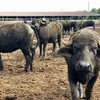
If you enjoyed this essay episode, you can subscribe for more at danielleoteri.com. If you're planning a trip to Italy and would like some expert guidance, book a consultation at danielleoteri-italy.com. And if neither of those is right for you but you'd like to show a little love, you can always buy me a coffee. The most delicious thing you can eat in Southern Italy is buffalo milk mozzarella. Italy has earned such a sterling culinary reputation that most people just open their mouths and say yes to whatever is put in front of them. But every once in a while, someone says buffalo mozzarella, what the hell is that?It is a strange thing to encounter, especially because the languid, enormous, but very sensitive water buffalo are cugini to the ones you’ll find in Vietnam or Cambodia, where buffalo milk mozzarella is not a thing. Buffalo mozzarella is made primarily in the region of Campania. It graces pizzas in Naples and has a different casein than most cow’s milk, so the lactose-intolerant among us can indulge. Buffalo farms abound in Caserta, near the stupendous Palace of Caserta, from where the Bourbon monarchy ruled over “the Kingdom of the Two Sicilies.” Before Italy became the nation we know it as today in 1861, it was a monarchy that pioneered several industries, including a dairy industry based on buffalo milk. But even more exquisite is the stuff made at a handful of farms, a little farther south.If you’re driving there, maybe on a day trip from Naples or the Amalfi Coast, you’ll inevitably get snarled in traffic on what locals call “the mozzarella highway” through Battipaglia. Every sign on the roadside is flashing mozzarella di bufala. The traffic is largely due to hundreds of trucks that pass through daily to pick up mozzarella and transport it to supermarkets across Italy. I’ve heard waiters in Florence extol the virtues of its freshness, boasting that it just arrived in the restaurant that afternoon. I’ve also heard waiters in New York cooing that they just picked it up from JFK that morning. Keep driving; Battipaglia is an industrial farming zone, and everything is pasteurized for export. Better things await in the town called Capaccio-Paestum.Paestum is most famous for three extraordinarily well-preserved Greek temples. They are massive and built of travertine, a volcanic stone, then coated in plaster and painted to mimic marble, which doesn’t exist in Southern Italy. Paestum was colonized by Greeks, conquered by Lucanians, who were the indigenous people of the area, whom the Greeks employed as their security goons, and then became a Roman city. Paestum was considered very old when the Romans conquered it. The oldest of the three temples was 280 years old. The Greeks regarded everything around the temples as sacred ground, but the Romans were insatiable real estate developers. There developed markets, civic buildings, a large Asclepieion, which was the closest thing to a hospital in the classical world, and dozens of smaller temples, all surrounding the big, very old ones.Roman Paestum was bigger and far more important than Pompeii or Herculaneum, and though it’s beyond the reach of Mount Vesuvius’s molten tentacles, it is still affected by earthquakes. The Roman Empire declined, and Paestum sank. Literally. The reason: a phenomenon called bradyseism, which is a Greek word: bradys means slow, and seismos means movement.” It’s an imperceptible but continuous slow rising and falling of the earth - a slow-motion earthquake.When the Greeks built the temples close to the glittering Tyrrhenian sea, things were on the up. But by the third and fourth centuries, Paestum was a swamp, infested with malaria carrying mosquitos. Mal aria means ‘bad air.”The Paestani fled for the hills. Some went to the hills just above Paestum, founding Capaccio, my grandmother’s hometown, while others went higher to the sea-facing cliffs of the Amalfi Coast. The name Positano may be related to the Paestani who settled there.And certainly people also went to Salerno, which was a Roman city, then under Lombard rule, and in 1077 was officially conquered by the Normans, proud descendants of the Vikings, loosely related to the Normans who just 11 years earlier had taken England at the Battle of Hastings. Salerno was a luxurious city, full of international merchants, and home to the world’s first medical school. Meanwhile, once glorious Paestum, not very far away at all, must have looked like the zombie apocalypse.Just to let you know, I haven’t forgotten we were talking about buffalo and delicious cheese; they will soon re-enter our story, but first, we need to make a stop in Salerno.Salerno was where the Norman king built a cathedral dedicated to Saint Matthe
Podzilla Summary coming soon
Sign up to get notified when the full AI-powered summary is ready.
Free forever for up to 3 podcasts. No credit card required.
Listen to This Episode
Get summaries like this every morning.
Free AI-powered recaps of Danielle Oteri's Italy and your other favorite podcasts, delivered to your inbox.
Free forever for up to 3 podcasts. No credit card required.