Free Daily Podcast Summary
Tales of the Sea: Daily Summaries Delivered
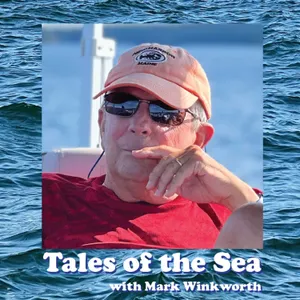
by Mark Winkworth
This podcast is my chance to talk with some of most passionate and knowledgable ocean advocates at work today including; authors, scientists, marine biologists, ocean farmers, and a host of other extraordinary individuals who care deeply about the health and future of the seas around us. In addition, the podcast is also my chance to share some of my favorite stories, poetry, plays, music, and true-life adventures inspired by the sea. This is a podcast for all those who care about the sea... its past, its present and its promise.
Latest Episodes
The most recent episodes — sign up to get AI-powered summaries of each one.
- 2 days ago43 min
A Life Illuminated with Dr. Edie Widder
Today, I want to talk about the deep ocean. And when I say deep, understand that the deepest part of the ocean is over seven miles down. That's 30 Empire state buildings deep. Another way to visualize it, if you dropped Mount Everest into the Western Pacific Ocean's Mariana trench, its peak would still be more than a mile underwater. The pressure at those depths is crushing at eight tons per square inch. The temperature is just above freezing, and it has long been thought to be completely dark. In fact, it is anything but. What we discovered largely in the last few decades is that the deep ocean is anything but empty.In today’s episode I’ll be talking with Dr. Edie Widder – one of the world’s leading oceanographers who has taken us to these depths and taught us a great deal about the creatures of the deep and the mysterious, almost magical ability of many of these deep-sea dwellers to literally make their own light – a phenomenon known as Bioluminescence.
- 2 weeks ago41 min
Unfathomable with author Mary Boone
If we're going to preserve and protect our oceans for generations to come, we need to start with the next generation, with curiosity as the entry point, and storytelling as the key, which brings us to today's guest. Mary Boone is an award-winning author whose new book, Unfathomable: 20 Wild But True Stories About the Ocean is exactly the kind of work the ocean needs right now. The book is funny, it's dramatic, it's occasionally gross in the best possible way, and it's quietly powerfully building a new generation of ocean advocates, one astonished young reader at a time. In one story,
- Aug 5, 202646 min
Oyster Society with author Virginia Shaffer
My guest today has spent over a decade researching oysters, the people, the places, and the stories behind them. She's a food writer, a certified oyster sommelier, the founder of Lady Oyster Tours & Tastings, Maine's first oyster culinary tour company, and the author of a brand new book, Oyster Society: Adventures with the Shellfishly Motivated. The book is a real page turner for anyone who wants to know anything and everything about oysters.
- Jun 14, 202631 min
A Rising Tide Lifts All Boats
The other morning on my walk down Commercial Street here in Portland, I was watching the lobster boats unload at the wharf. Diesels were rumbling and seagulls circling, hoping for a morning snack. A busy working harbor before much of the city is awake.A school bus rolled past me with kids’ faces pressed to the windows. A few of them looked out at the fishing boats like it was a totally new sight – and for some – it was.Some of the kids live no more than a few minutes from the harbor. But odds are that many of them have never been on a boat. Never been on the water. Not because they didn't want to, but because they never had the opportunity. Meanwhile, the fishing industry that built this state is in danger of aging out. Including the lobster industry .Last fall, in 2025, Maine lost Virginia “Ginny” Oliver, better known as the lobster lady. She was 101 years young. Ginny had started hauling traps when she was just eight years old. The New Times even did an article on her long career, along with Public Radio and countless magazines and newspapers. She was still lobstering up until the day she passed.Today's episode is all about an organization here in Portland that is trying to close the gap – between young people who have never considered a career on the water – and those who have spent their whole lives fishing. It’s an innovative initiative called Lift All Boats. I’ll be talking with Ben Coniff and Miranda Shin, two people who are actively introducing high school kids, ages 15-18 into the fishing industry through a lobster fishing mentorship program. The goal is to get more young people started on their way to obtaining a very-hard-to-get lobstering license.
- May 25, 202640 min
Survival at Sea "Rope" with Tim Queeney
Today I want to talk about a discovery humans have taken for granted for thousands of years — something woven into every great voyage in history.Every age of discovery, every battle at sea, every whaling hunt, every shipwreck — held together, quite literally, by miles and miles of it. And yet, almost no one ever thinks about it.My guest today however does. Tim Queeney is the author of Rope: How a Bundle of Twisted Fibers Became the Backbone of Civilization, and he’s joining me to talk about the maritime thread of that story — the ropewalks, the rigging, the disasters, the whalers, and the salty language we still use today without realizing where it came from.
- Apr 12, 202640 min
Shipwrecks with James Delgado
Today we’re going to be talking about what I consider to be one of the most mysterious and fascinating subjects when it comes to the sea. Shipwrecks.What is it about a shipwreck that gets into our blood? Is it the mystery? The tragedy? The loss of life and the grief of those who lost loved ones. Or is it the feeling that somewhere beneath those waves, history is still waiting to be discovered? My guest today has made it his life's work to find out.James Delgado is a maritime archaeologist, National Geographic explorer and host of the television series, The Sea Hunters as well as the author of 33 books including The Great Museum of the Sea. James has dived on the Titanic the USS Arizona and more than 100 other sites.
- Dec 17, 20257 min
Christmas at Sea
Many of you, I’m guessing, are familiar with the novel Treasure Island – the classic adventure of young Jim Hawkins who finds a map to a pirate’s buried treasure and embarks on a perilous voyage with a colorful crew including the infamous Long John Silver.You may also be familiar with another work, The Strange Case of Dr. Jekyll and Mr. Hyde – the story of a respected London doctor who discovers a powerful potion that enables him to separate his good and evil natures. Good ultimately triumphs over evil – but not without some dastardly doings along the way.Both of these classic works are by the same author, the Scottish novelist, poet, essayist and travel writer, Robert Louis Stevenson.An only child, Robert was burdened with a lifetime of chronic illness – primarily respiratory in nature – and only lived to experience his 44th birthday.He is also the author of one of my favorite Holiday Poems. It is titled, Christmas at Sea.The poem describes how a square-rigged sailing ship has become caught between two headlands. The ship unable to make her escape because of the winds, tide and current. You sailors out there will relate to this situation when forces of nature prevent a sailboat from making progress to her desired destination.Enjoy.
- Aug 26, 202547 min
Jellyfish Mysteries
Today I want to take a look at those strange-looking, gelatinous, floating blobs in the sea that often look like deflated balloons with long strings attached. In fact, this summer, beachgoers along the coast of Maine where I live, have observed some of these creatures as large as five feet in diameter, trailing tentacles as long as 100 feet. These sea creatures are collectively known as JELLYFISH (which seems like a cute enough name) but those who are in-the-know AVOID them like the plague - because some varieties can use their tentacles to STING you with needle-sharp, mini-harpoons called nematocysts - capable of injecting a toxic venom – causing pain, often a lot of pain – that can affect your respiratory system which can be extremely dangerous – and in severe cases even cause paralysis and death in as little as 20 minutes.
About Tales of the Sea
This podcast is my chance to talk with some of most passionate and knowledgable ocean advocates at work today including; authors, scientists, marine biologists, ocean farmers, and a host of other extraordinary individuals who care deeply about the health and future of the seas around us. In addition, the podcast is also my chance to share some of my favorite stories, poetry, plays, music, and true-life adventures inspired by the sea. This is a podcast for all those who care about the sea... its past, its present and its promise.
Customized Recaps
AI-powered recaps with compact key takeaways, quotes, and insights.
Straight to Your Inbox
Get key takeaways from Tales of the Sea in a 5-minute read.
Save Hours Every Week
Stay current on your favorite podcasts without falling behind.
Frequently Asked Questions
What is Podzilla's Tales of the Sea daily summary?
It's a free AI-powered email that summarizes new episodes of Tales of the Sea as soon as they're published. You get the key takeaways, notable quotes, and links & mentions — all in a quick read.
How does the Tales of the Sea podcast summary work?
When a new episode drops, our AI transcribes and analyzes it, then generates a personalized summary tailored to your interests and profession. It's delivered to your inbox every morning.
Is this an official Tales of the Sea product?
No. Podzilla is an independent service that summarizes publicly available podcast content. We're not affiliated with or endorsed by Mark Winkworth.
Can I get summaries of other podcasts too?
Absolutely! The free plan covers up to 3 podcasts. Upgrade to Pro for 15, or Premium for 50. Browse our full catalog at /podcasts.
How often does Tales of the Sea release new episodes?
Tales of the Sea publishes monthly. Our AI generates a summary within hours of each new episode.
What topics does Tales of the Sea cover?
Tales of the Sea covers topics including Arts, Culture, Society & Culture, Travel, Performing Arts, Places & Travel. Our AI identifies the specific themes in each episode and highlights what matters most to you.
Start getting Tales of the Sea summaries tomorrow morning.
Free forever for up to 3 podcasts. No credit card required.
Free forever for up to 3 podcasts. No credit card required.