Free Daily Podcast Summary
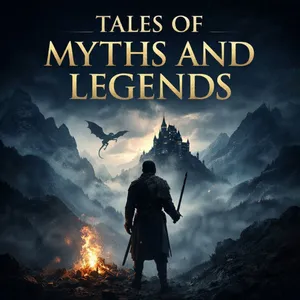
Tales of Myths and Legends: Daily Summaries Delivered
by Forbidden Knowledge Network
Tales of Myths and Legends explores mythology, folklore, legendary heroes, cursed artifacts, lost gods, and mysterious creatures from across cultures. Each episode brings ancient epics, prophecies, and traditional stories to life through immersive narration and a structured, documentary-style approach. Examining origins, symbolism, and cultural impact, the series reveals how these enduring stories have shaped belief, tradition, and the way we understand the world.
Latest Episodes
The most recent episodes — sign up to get AI-powered summaries of each one.
- 2 days ago21 min
Athena: The Goddess Born From the Head of Zeus
Athena’s armed emergence from the head of Zeus is among the most recognizable scenes in Greek myth. Yet the spectacle begins with a prophecy, a pregnant goddess named Metis, and Zeus’s attempt to stop a future son from becoming ruler of gods and mortals.This episode follows the surviving evidence behind Athena’s birth: Hesiod’s account of Metis and the succession prophecy, Pindar’s bronze axe and battle cry, the Homeric Hymn’s cosmic reaction, Apollodorus’s alternative axe-bearers and River Triton setting, archaic vase paintings, Aeschylus’s courtroom Athena, and the lost center of the Parthenon’s east pediment.The story has no conventional mortal hero facing a monster. Its setting is the Greek divine cosmos, and its conflict is a struggle over prophecy, succession, birth, counsel, and divine authority. Why did Greek tradition preserve Athena as the conceived child of Metis while also allowing her to appear as Zeus’s father-born daughter?This podcast uses artificial intelligence in its research, writing, production, and narration. Episodes are editorially reviewed before publication.#TalesOfMythsAndLegends #GreekMythologyOlympianGodsAncientReligion #Athena #Zeus #MetisYES OR NO: Did Zeus prevent the prophesied succession by swallowing Metis??????
- 1 weeks ago21 min
Osiris: The Murdered God Who Became Lord of the Dead
Osiris, the Egyptian god of the dead, sits enthroned at the end of Hunefer’s judgment in a New Kingdom Book of the Dead. Before him, a human heart is weighed. Anubis attends the balance, Thoth records the result, Horus leads the justified dead onward, and Isis and Nephthys stand beside the god who offers a transformed existence after death.Yet Egyptian tradition said that Osiris himself had first been destroyed by his brother Seth. Isis, Osiris’s wife, and Nephthys mourned and protected him. Horus, their son and Osiris’s heir, fought Seth for the kingship of the living. Osiris did not simply resume his old earthly rule. He became sovereign among the dead.This episode follows that transformation through the oldest surviving Pyramid Texts, Middle Kingdom coffins, the sacred landscape of Abydos, the succession struggle in The Contendings of Horus and Seth, and the judgment papyrus of Hunefer. It also confronts a crucial source problem: the famous chest, the search at Byblos, and the fourteen scattered body parts come most fully from Plutarch’s Greek account, written more than two thousand years after the earliest Egyptian evidence.Osiris became a model for royal continuity, bodily restoration, judgment, ritual, and the hope that death need not end a person forever.This podcast uses artificial intelligence in its research, writing, production, and narration. Episodes are editorially reviewed before publication.#TalesOfMythsAndLegends #EgyptianMythologyAndAncientReligiousLegend #Osiris #Isis #SethYES OR NO: Did Horus have the stronger claim to Osiris’s throne than Seth???????
- 2 weeks ago22 min
Orpheus and Eurydice: The Man Who Entered the Underworld for Love
Orpheus, the legendary musician associated with Thrace, enters the field of the dead after the loss of his wife. In the best-known ancient version, his music persuades the rulers below to permit Eurydice’s return—but only if he leads her upward without looking behind him.Near the boundary of the living world, Orpheus turns. Eurydice disappears a second time.But the famous backward glance is not found in the earliest surviving reference to Orpheus’s descent. Euripides, Plato, Diodorus Siculus, Virgil, Ovid, Apollodorus, and Pausanias preserve strikingly different versions of what Orpheus found below, whether Eurydice was truly restored, and why the rescue failed.This episode follows the tragedy from Ovid’s ominous wedding scene to the song that stills the punishments of the dead, then traces the surviving evidence backward toward the oldest written witnesses. Was the backward glance always part of the legend—or did it become central only later?This podcast uses artificial intelligence in its research, writing, production, and narration. Episodes are editorially reviewed before publication.#TalesOfMythsAndLegends #GreekMythologyTragicLoveUnderworldJourneyAncient #Orpheus #Eurydice #GreekMythologyYES OR NO: Was the backward glance part of the earliest Orpheus myth??????
- 3 weeks ago21 min
Lucifer: The Angel Who Fell From Heaven
Lucifer is one of the most famous names in Western religious legend, yet the Bible contains no single chapter called “The Fall of Lucifer.” The familiar story of a radiant angel who becomes proud, rebels against God, leads angels into war, and is cast down by Michael developed over centuries from several different passages.This episode begins with the traditional image of heaven’s great rebellion, then follows the fragments from which that image was built. Isaiah mocks the king of Babylon through the fall of a shining morning star. Ezekiel laments the ruler of Tyre in imagery of Eden, beauty, precious stones, and corruption. Luke records Jesus saying that he saw Satan fall like lightning. Revelation shows Michael and his angels fighting the dragon, identified as the Devil and Satan.Later Christian interpreters connected these texts. A Latin word for Venus at dawn, lucifer, meaning “light-bringer,” became Satan’s supposed name before his fall. The episode separates those ancient texts from later theology, medieval art, Dante’s defeated Devil, and Milton’s eloquent rebel. It asks whether Lucifer was ever a biblical personal name, why pride became the traditional cause of his rebellion, and why a symbol of dawn became linked with darkness.This podcast uses artificial intelligence in its research, writing, production, and narration. Episodes are editorially reviewed before publication.#TalesOfMythsAndLegends #BiblicalMythologyFallenAngelsChristianLegend #Lucifer #FallenAngel #SatanYES OR NO: Was Lucifer originally meant to be Satan’s personal name???????
- Aug 22, 202620 min
Achilles: The Warrior With One Fatal Weakness — Famous Greek Hero, War, Destiny, Tragedy
Achilles, son of the sea-goddess Thetis and the mortal king Peleus, is remembered as the greatest warrior of the Trojan War. Yet his story is not simply about an unbeatable fighter with one weak heel. In Homer’s Iliad, Achilles is mortal, vulnerable, and deeply aware that he must choose between a long forgotten life and a short life of undying fame.This episode follows Achilles from the prophecies surrounding his birth to the crisis that defines the Iliad: Agamemnon takes Briseis, the captive woman awarded to Achilles, and Achilles withdraws from the war. His refusal leaves the Greeks exposed. Then Patroclus, Achilles’ closest companion, enters battle in Achilles’ armor and is killed by Hector. Grief sends Achilles back into the fighting, where he confronts Hector outside Troy and turns vengeance into an act of terrible excess.The story also examines the moment when Priam, Hector’s aged father, comes to Achilles’ camp to beg for his son’s body. Their shared grief briefly breaks the force of Achilles’ rage. Beyond Homer, later traditions add the River Styx, the famous vulnerable heel, Achilles’ concealment on Skyros, and his death through Paris and Apollo. Achilles survives because his myth asks whether glory can ever repay the cost of a human life.This podcast uses artificial intelligence in its research, writing, production, and narration. Episodes are editorially reviewed before publication.#TalesOfMythsAndLegends #GreekMythologyLegendaryHeroesWarFateAndTragedy #Achilles #TrojanWar #GreekMythologyYES OR NO: Did Achilles make the right choice when he returned to battle???????
- Aug 16, 202621 min
Pegasus: The Winged Horse Born From a Monster’s Blood
Pegasus enters Greek mythology at one of its most violent moments. When Perseus kills the mortal Gorgon Medusa, the winged horse and his brother Chrysaor emerge. Hesiod identifies them as the children of Poseidon and Medusa, making Pegasus neither a simple creature of blood nor a generic fantasy horse, but a singular immortal being with an extraordinary genealogy.From that beginning, Pegasus becomes inseparable from Bellerophon. With a golden bridle given by Athena in Pindar’s account, the hero gains the means to ride the impossible horse and confront the fire-breathing Chimera over Lycia. Their victory brings Bellerophon fame, yet later traditions turn their final ascent into a warning about the distance between heroic achievement and divine status.This episode follows the ancient and later classical traditions surrounding Pegasus: Hesiod’s genealogy, Pindar’s bridle and Olympian stables, Homer’s Bellerophon, the sacred landscape of Helicon, Hippocrene and the Muses, Roman retellings by Ovid, and astronomical traditions linking Pegasus to the heavens. The result is a myth of violence, flight, sacred water, ambition, and an animal whose story moves from Medusa’s death to Zeus’s storm clouds.This podcast uses artificial intelligence in its research, writing, production, and narration. Episodes are editorially reviewed before publication.#TalesOfMythsAndLegends #Documentary #Pegasus #GreekMythology #MedusaYES OR NO: Did Bellerophon have the right to seek Olympus??????
- Aug 8, 202627 min
The Chimera: The Fire-Breathing Monster Built From Nightmares
In the mountains of Lycia, Greek myth placed one of antiquity’s strangest monsters: the Chimera, a fire-breathing hybrid commonly imagined through lion, goat, and serpent. This episode follows Bellerophon, a hero sent to kill the creature not as an honor, but as a sentence of death. Entangled in a royal accusation and carried into danger by a sealed message, he reaches Lycia, where King Iobates gives him the task no ordinary warrior can survive. His greatest chance comes through Pegasus, the winged horse who changes the battle from a ground assault into an attack from the air.The story is told first as action: accusation, exile, impossible command, flight, fire, and victory. Then the episode turns to the sources. Homer gives one of the earliest surviving descriptions of the Chimera in the Iliad. Hesiod places it inside the monstrous family of Typhon and Echidna. Later mythographers add details about Bellerophon, Pegasus, and the famous later explanatory tradition that molten lead helped destroy the beast. The episode also considers Lycia’s landscape, the natural gas flames of Yanartaş, ancient art such as the bronze Chimera of Arezzo, and the word’s later life in language and science. The Chimera remains powerful because it joins recognizable fears into one impossible body: predator, serpent, harmless herd animal made grotesque, and fire rising from living flesh.This podcast uses artificial intelligence in its research, writing, production, and narration. Episodes are editorially reviewed before publication.#TalesOfMythsAndLegends #MythologicalMonsterAncientGreekLegendHeroicQuest #Chimera #GreekMythology #BellerophonYES OR NO: Was Pegasus the main reason Bellerophon defeated the Chimera??????
- Aug 2, 202623 min
The Sirens: The Voices No Sailor Could Resist
In Homer’s Odyssey, Odysseus sails toward one of Greek myth’s most dangerous supernatural tests: the Sirens, singers whose voices no sailor can hear and resist. Warned by Circe, he orders his crew to seal their ears with softened beeswax and bind him upright to the mast. The Sirens do not attack with claws, storms, or weapons. They call Odysseus by name, praise his fame, and promise knowledge of Troy and of everything that happens upon the earth. This episode retells the Homeric encounter, then separates it from later tradition. Homer does not describe the Sirens’ bodies, name them, or make them mermaids. Ancient Greek artists commonly showed them as bird-bodied women, often linked with song, death, and mourning. Later writers gave them names such as Parthenope, Ligeia, and Leucosia, connected them with Achelous, the Muses, Persephone, and southern Italy, and sometimes claimed they died after a hero escaped. The Argonauts face them differently, when Orpheus answers their song with his own music. Medieval and modern retellings transformed the Siren into a fish-tailed temptress, a moral symbol, and a figure of fatal desire. Beneath every version remains the central terror: a voice that does not threaten the listener, but tells him exactly what he longs to know.This podcast uses artificial intelligence in its research, writing, production, and narration. Episodes are editorially reviewed before publication.#TalesOfMythsAndLegends #GreekSeaMythologyIrresistibleSupernaturalTemptat #Sirens #GreekMythology #HomerYES OR NO: Was Odysseus brave to hear the Sirens, or reckless???????
About Tales of Myths and Legends
Tales of Myths and Legends explores mythology, folklore, legendary heroes, cursed artifacts, lost gods, and mysterious creatures from across cultures. Each episode brings ancient epics, prophecies, and traditional stories to life through immersive narration and a structured, documentary-style approach. Examining origins, symbolism, and cultural impact, the series reveals how these enduring stories have shaped belief, tradition, and the way we understand the world.
Customized Recaps
AI-powered recaps with compact key takeaways, quotes, and insights.
Straight to Your Inbox
Get key takeaways from Tales of Myths and Legends in a 5-minute read.
Save Hours Every Week
Stay current on your favorite podcasts without falling behind.
Frequently Asked Questions
What is Podzilla's Tales of Myths and Legends daily summary?
It's a free AI-powered email that summarizes new episodes of Tales of Myths and Legends as soon as they're published. You get the key takeaways, notable quotes, and links & mentions — all in a quick read.
How does the Tales of Myths and Legends podcast summary work?
When a new episode drops, our AI transcribes and analyzes it, then generates a personalized summary tailored to your interests and profession. It's delivered to your inbox every morning.
Is this an official Tales of Myths and Legends product?
No. Podzilla is an independent service that summarizes publicly available podcast content. We're not affiliated with or endorsed by Forbidden Knowledge Network.
Can I get summaries of other podcasts too?
Absolutely! The free plan covers up to 3 podcasts. Upgrade to Pro for 15, or Premium for 50. Browse our full catalog at /podcasts.
How often does Tales of Myths and Legends release new episodes?
Tales of Myths and Legends publishes weekly. Our AI generates a summary within hours of each new episode.
What topics does Tales of Myths and Legends cover?
Tales of Myths and Legends covers topics including History, Fiction, Drama. Our AI identifies the specific themes in each episode and highlights what matters most to you.
Start getting Tales of Myths and Legends summaries tomorrow morning.
Free forever for up to 3 podcasts. No credit card required.
Free forever for up to 3 podcasts. No credit card required.