Free Daily Podcast Summary
Supreme Betrayal: How the Supreme Court and Constitutional Law Have Failed America: Daily Summaries Delivered
by Mark Tushnet, Louis Michael Seidman
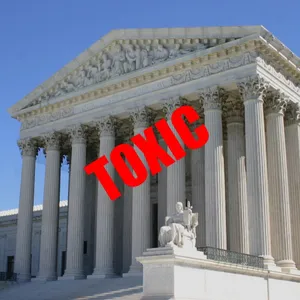
Sitting in their marble palace, dressed in their black robes, Supreme Court Justices would like us to believe that they are wise and disinterested oracles dispensing words of truth and justice. Nothing could be further from the truth. Every episode week, Mark Tushnet and Mike Seidman, two renown constitutional law scholars, lift the curtain and show us how the men and women there who sit on the High Court have been manipulating us.
Latest Episodes
The most recent episodes — sign up to get AI-powered summaries of each one.
- Jul 29, 202645 min
Slaughtering the Administrative State
Using the Court’s decision allowing the President to remove members of independent agencies from their offices we range rather widely—into a discussion of departmentalism, the strategic problems facing democrats after they expel autocrats from office, and the choice between restoring the pre-Trump administrative state and reconstructing a new administrative state with a new balance among expertise, political control, and direct popular participation in decision-making in a response to some sensible impulses underlying contemporary populism.
- Jul 7, 20261h 7m
Religion, Federalism, and the Boundary Problem
We use a recent decision by the Fifth Circuit upholding a Texas statute requiring the display of the Ten Commandments in public school classrooms as a jumping off point to discuss not only the religion clauses but a much more general problem of constitutional theory, which we frame as a problem of federalism but actually ranges much more broadly: What body of people gets to make decisions that govern “themselves”? City councils, state legislatures, Congress? Mark proposes a partial solution in which the courts set a “default rule” identifying the first mover and then that body can choose from the entire range of decision-makers to set policy. Mike finds this interesting but is skeptical and, as Mark works out the account, wonders whether the courts contribute anything to making policy under Mark’s scheme. (Mark thinks they do!)
- Jun 19, 202651 min
The Slush Fund Kerfuffle
We discuss the slush fund kerfuffle with Professor Smauel Bagenstos, who served as general counsel to the Department of Health and Human Services and has written a forthcoming article on slush funds. One theme is that Trump’s lawyers got a decent way toward giving J6 rioters access to federal funds in a way consistent with the formal law but muffed it at the level of detail. Another is that it’s really silly—and says something bad about some kinds of discourse about this sort of thing—to focus on legal formality. And, if you hold out until the end you get one of Mark’s favorite quotations about lawyers, from Carl Sandburg.
- Jun 9, 202641 min
The Callais Decision Part II
In our second episode on the Callais decision we turn to criticism, though only after doing our best to identify some things in the decision that might be correct. Among our concerns are whether the Court was right in saying that things have changed (for the better) since 1965, whether the opinion was a reasonable application of the Court’s prior decision to refrain from federal judicial regulation of partisan gerrymandering, and whether partisan gerrymandering is defensible in places where partisan affiliations are highly correlated with race. And we raise questions about the Court’s apparent commitment to letting district boundary decisions—and more—be made by democratically responsible bodies when those decisions actually constitute the kind of democracy we have.
- Jun 3, 202639 min
The Callais Decision Part I
In the first of two episodes about the Callais decision we speculate about its immediate impact on the 2026 elections, with Mark trying to minimize that impact and Mike arguing that it’s likely to be significant. Then we provide a detailed explanation of the historical background of the 1965 Voting Rights Act, emphasizing the ways in which it was initially interpreted (a combination of generosity and restrictiveness), how Congress responded, and then how the Court began to narrow its effects. The doctrinal details, while intricate, are important for listeners trying to understand exactly why the Callais decision is so threatening to minority representation.
- May 15, 20261h 0m
Constitutional Theory and Constitutional Time
Today we take up a challenge to our views about the tension between democratic self-governance and the contemporary form of judicial that Mark draws from the scholarship of political scientists including Robert Dahl. Dahl’s challenge, in a shorthand, is that American politicians, speaking for we the people, like that form of judicial review—that it has democratic credentials. Other political scientists identify different periods or “regimes” of dominant majorities, and judicial review fits comfortably when there is such a majority. Mike raises questions about the broadbrush nature of Dahl’s account and about the important anti-democratic role judicial review plays when no dominant majority is in place (during interregnums) and in thwarting local majorities not in line with the national majority. Mark counters with the observation that sometimes the local majorities are oppressing people who are in line with the national majority (blue cities in red states or vice versa), and that in any event the fact that one regime eventually replaces another diminishes the degree to which any judicial decision is entrenched and thwarts what Mike calls the ambitions of judicial review. There’s a lot more detail in this rather long episode, and we’ll revisit some of its themes in later episodes.
- May 7, 202649 min
Reasons for Reasons, Constitutional Theory, and Pragmatic Compromises
In this episode we get to the heart of Mike’s book, his argument that judicial review as practiced today can’t be justified because justification requires a foundation in good constitutional theories—and none of the theories on offer are good enough. After a minor skirmish over what’s good enough, we take up a feature of Mike’s account that he finds attractive—that deconstitutionalizing everything would open the way for pragmatic compromises on the deep issues of principle that divide us. Mark responds that, while that might have been true in the past when our parties were coalitions of disparate interests, it’s no longer true today where our parties are ideologically unified and strongly polarized. He argues that in today’s world the result of de-constitutionalization would lead to take-or-leave-it legislation by whoever happens to control the levers of power, not messy compromises. We leave it at that, with further discussion to come in our final episode on Mike’s book.
- Apr 25, 202653 min
Bottom Up Constitutionalism and Some Practical Suggestions
We begin our second episode on Mike's new book Why the Constitution Cannot Save Us by discussing different ideas of popular constitutionalism, with Mike restating his concern that popular constitutionalism can misdirect our attention from what really matters--whether policies are good or bad--to unproductive discussions of what the Constitution "really" means and Mark restating his sense that the language of "the Constitution" does motivate some people to act in ways they wouldn't otherwise. Then we turn to some suggestions Mike makes in his book about compromises that would become available were we to "deconstitutionalize" policy debates. Mark wonders why some of the proposed compromises would be acceptable to people on both sides and observes that the depth of division today makes pragmatic compromises on issues of deep and divisive principle quite difficult to achieve. Mike then offers some ideas about smaller bore reforms that the Court and Congress could adopt to turn doen the heat of constitutional discussion. Mark observes that those reforms don't seem to have much purchase with either the Court or Congress and we end up agreeing that it might make sense for people like us to work toward changing the composition of the Court and Congress so that those reforms would be not just in the Overton window but actually taken seriously.
About Supreme Betrayal: How the Supreme Court and Constitutional Law Have Failed America
Sitting in their marble palace, dressed in their black robes, Supreme Court Justices would like us to believe that they are wise and disinterested oracles dispensing words of truth and justice. Nothing could be further from the truth. Every episode week, Mark Tushnet and Mike Seidman, two renown constitutional law scholars, lift the curtain and show us how the men and women there who sit on the High Court have been manipulating us.
Customized Recaps
AI-powered recaps with compact key takeaways, quotes, and insights.
Straight to Your Inbox
Get key takeaways from Supreme Betrayal: How the Supreme Court and Constitutional Law Have Failed America in a 5-minute read.
Save Hours Every Week
Stay current on your favorite podcasts without falling behind.
Frequently Asked Questions
What is Podzilla's Supreme Betrayal: How the Supreme Court and Constitutional Law Have Failed America daily summary?
It's a free AI-powered email that summarizes new episodes of Supreme Betrayal: How the Supreme Court and Constitutional Law Have Failed America as soon as they're published. You get the key takeaways, notable quotes, and links & mentions — all in a quick read.
How does the Supreme Betrayal: How the Supreme Court and Constitutional Law Have Failed America podcast summary work?
When a new episode drops, our AI transcribes and analyzes it, then generates a personalized summary tailored to your interests and profession. It's delivered to your inbox every morning.
Is this an official Supreme Betrayal: How the Supreme Court and Constitutional Law Have Failed America product?
No. Podzilla is an independent service that summarizes publicly available podcast content. We're not affiliated with or endorsed by Mark Tushnet, Louis Michael Seidman.
Can I get summaries of other podcasts too?
Absolutely! The free plan covers up to 3 podcasts. Upgrade to Pro for 15, or Premium for 50. Browse our full catalog at /podcasts.
How often does Supreme Betrayal: How the Supreme Court and Constitutional Law Have Failed America release new episodes?
Supreme Betrayal: How the Supreme Court and Constitutional Law Have Failed America publishes biweekly. Our AI generates a summary within hours of each new episode.
What topics does Supreme Betrayal: How the Supreme Court and Constitutional Law Have Failed America cover?
Supreme Betrayal: How the Supreme Court and Constitutional Law Have Failed America covers topics including News, History, Government. Our AI identifies the specific themes in each episode and highlights what matters most to you.
Start getting Supreme Betrayal: How the Supreme Court and Constitutional Law Have Failed America summaries tomorrow morning.
Free forever for up to 3 podcasts. No credit card required.
Free forever for up to 3 podcasts. No credit card required.