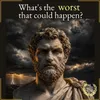
“What’s the worst that could happen?” We’ve all heard this before. Usually it’s tongue in cheek just before something really bad does happen. But counterintuitively, it’s actually one of the most powerful questions that we can ask ourselves when we’re stuck in anxiety. So let’s talk about how imagining the worst can you you be your best. “The mind that is anxious about future events is miserable.” — Seneca The Problem In today’s busy world, we all struggle with anxiety. Most people complain about anxiety hampering their daily happiness. And where does this anxiety come from? It’s from worrying about things that we think are going to happen. This is a natural part of being human. The brain is a prediction machine. Think about when you're walking through a crowd, your brain is constantly reading people's trajectories so you don't collide. It does the same thing with the future — always trying to anticipate what's coming next. That capacity kept us alive. If we couldn't imagine bad outcomes, we'd never prepare for them. But most of us have taken that survival tool and turned it into a source of constant stress. What if instead, you could take that same ability and use it to build resilience rather than anxiety? What if considering the worst could help you become your best? The Philosophy Paradoxes In episode 377, I talked about paradoxes — holding competing ideas without rushing to resolve them. It's one of the most powerful skills we can develop, because the moment we choose a side, we close off other possibilities. Seneca puts it plainly: “Ignorance is the cause of fear.” — Seneca The longer we can withhold judgment and hold each idea and try to understand it, the deeper our understanding of it. This is how we gain wisdom, which is not just about knowledge but about being able to see things clearly. Marcus Aurelius captured this idea in his Meditations: “The first rule is to keep an untroubled spirit. The second is to look things in the face and know them for what they are.” — Marcus Aurelius The more clearly we can define what troubles us, the easier it is to turn it to our benefit. Premeditatio Malorum Stoicism is full of paradoxes, but one of the most useful is premeditatio malorum, the “premeditation of evil”. Rather than ignoring what causes our anxiety, we look it in the face. We stop judging it as good or bad and treat it as something that simply is. This is why the Stoics teach that events are neutral. We're the ones passing verdict on them. “It is not events that disturb people, it is their judgements concerning them.” — Epictetus, When we see things as neutral, some of that anxiety loses its grip. The Present Moment Problem Here's the paradox: the Stoics also teach us to be present. To stop worrying about what might happen, and focus on now. In his Letters to Lucilius, Seneca writes: “There are more things, Lucilius, likely to frighten us than there are to crush us; we suffer more often in imagination than in reality.” The anxiety we feel is a direct result of the story we're telling ourselves about the future. We catastrophize. We treat the worst possible outcome as the only one. And what makes it worse — we're doing it to ourselves. The mind has a hard time distinguishing imagination from reality, so the body responds as if the threat is real. Think about a time you were convinced someone was upset with you. You felt the tension. Maybe in your stomach or shoulders. Then you found out you were wrong, and the relief was immediate. Your body was responding to a story, not a fact. That physical distress creates a spiral: thoughts create story, story creates sensation, sensation triggers the fight-or-flight response, which narrows your thinking to the very thing you're afraid of. That's why getting someone to breathe slows the spiral. Calm the body first, then the mind follows. Avoidance Makes It Worse When we try not to think of something, we give it more power. It’s the pink elephant problem. Try not to think about about a pink elephant and you will think about one. The brain has to imagine a concept before it can dismiss it. It can’t operate in a void, and suppression takes energy. So the fear stalks you. You scroll your phone. You have a drink. You eat things you shouldn't. Anything to avoid sitting with it. But Seneca reminds us: “Everyone faces up more bravely to a thing for which he has long prepared himself, sufferings, even, being withstood if they have been trained for in advance. Those who are unprepared, on the other hand, are panic-stricken by the most insignifican
Podzilla Summary coming soon
Sign up to get notified when the full AI-powered summary is ready.
Free forever for up to 3 podcasts. No credit card required.
More from Stoic Coffee Break
Keystone Habits: How One Good Habit Can Change Everything

The Virtue of Reading | 384
Interview with Jon Brooks: Stoicism and Emotions | 383
What Does It Actually Take to Be Courageous? | 382
Get summaries like this every morning.
Free AI-powered recaps of Stoic Coffee Break and your other favorite podcasts, delivered to your inbox.
Free forever for up to 3 podcasts. No credit card required.